Do Older Dogs Get Anxious at Night? (Sundowning Explained)
Yes — older dogs often get anxious at night, and it is usually driven by something identifiable: age-related cognitive change, failing eyesight or hearing, joint discomfort that surfaces at rest, or a shifted sleep-wake cycle. Night anxiety is a symptom worth investigating with your veterinarian, not a personality change to accept.
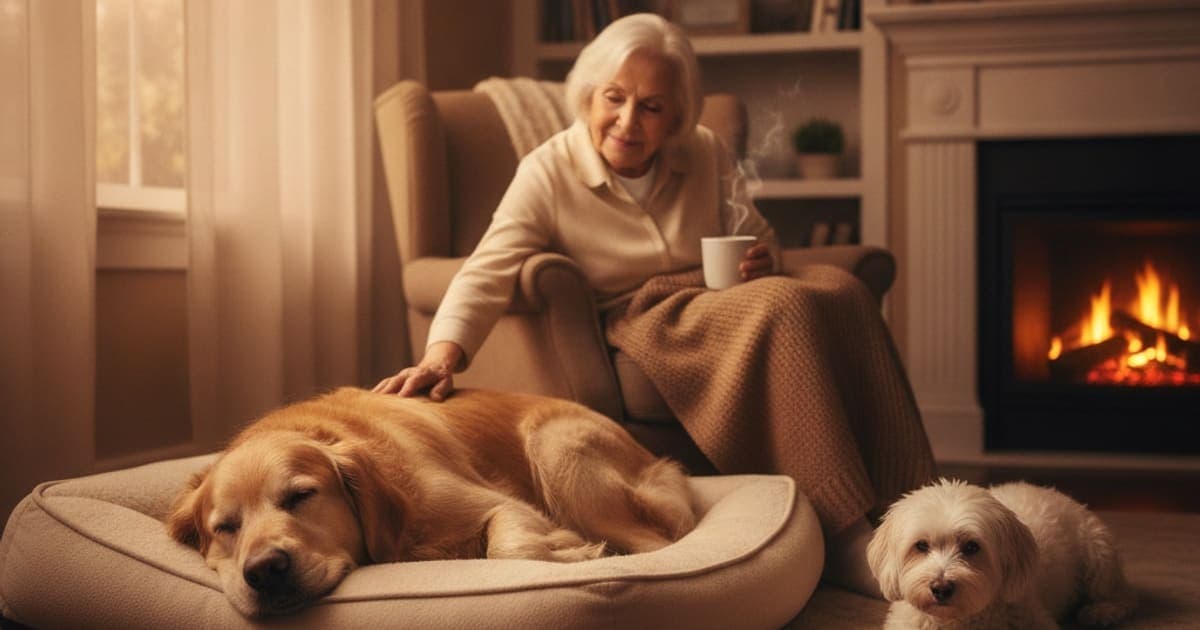
Yes. Older dogs very commonly become anxious at night, and it is one of the behaviour changes owners report most often once a dog crosses into their senior years. The shape of it is familiar: a dog who settled quietly for a decade starts pacing after dark, panting in a cool room, whining at a closed door, or standing in the hallway at three in the morning looking like they have forgotten why they got up.
Common, though, is not the same as normal, and it is not something you simply have to live with. Night-time anxiety in an older dog is a symptom, not a personality change — the work is figuring out what is driving it before you try to manage it. In most senior dogs the cause sits on a short list: age-related cognitive change, pain that only becomes loud once the house goes quiet, fading eyesight or hearing, a drifting sleep-wake cycle, a bladder that can no longer hold through the night, or an underlying medical problem that deserves a proper workup. Two or three of them usually overlap in the same dog.
What night-time anxiety actually looks like in a senior dog
Owners searching for senior dog anxiety at night symptoms are usually describing some combination of the following:
- Pacing or circling once the lights go off, often along the same route
- Panting when the room is cool and the dog has not exercised
- Whining, groaning or barking at nothing you can see
- Staring at walls, corners or doorways, or getting stuck behind furniture
- Waking at roughly the same hour every night and refusing to resettle
- Needing to be physically touching you, or following you from room to room
- Sleeping heavily through the day, then being wired after dark
- Overnight house-soiling in a dog who has been reliable for years
- Startling at sounds that never used to register
If you have spent late nights scrolling Reddit threads comparing notes with other owners, you have seen those same bullets written a hundred different ways. The forums are genuinely reassuring — you are not imagining it, and you are not the only person awake at 3 a.m. with an old dog. What a forum cannot do is tell you which cause applies to your dog. That part takes a hands-on exam.
Why the evening unsettles an aging brain and body
Cognitive change and sundowning. Canine cognitive dysfunction is a recognised clinical syndrome in older dogs, and veterinary behaviour literature often describes it with the DISHAA framework: disorientation, changed interactions, sleep-wake cycle disruption, house-soiling, activity changes, and anxiety. Sundowning is the term owners borrow from human dementia care for the way confusion and agitation worsen in the late afternoon and evening. Lower light, fewer environmental cues, a quiet house and a tired brain all make orientation harder.
A drifting sleep-wake cycle. Senior dogs sleep more, but in shorter, more fragmented blocks. A dog who has napped through the afternoon arrives at bedtime with energy, no plan, and nobody to interact with.
Senses that no longer fill in the gaps. Vision changes like nuclear sclerosis, cataracts and retinal degeneration bite hardest in low light. A hard-of-hearing dog cannot track where you went, so they wake, find the room empty of sound, and panic. Much of what looks like fear is a dog trying to locate you with equipment that no longer works well.
Pain that gets loud when everything else goes quiet. Osteoarthritis is extremely common in older dogs. During the day, movement, food and company mask it. At night there is nothing to compete with it: a hard floor, stiffening joints, a dog shifting position again and again because no position works. A dog who cannot get comfortable does not look tired — they look anxious, because they are.
Bladder, gut and other medical causes. A full bladder, gastrointestinal discomfort, endocrine disease, high blood pressure and pain from sources unrelated to joints can all present as night-time restlessness. This is exactly why the first move is a veterinary exam rather than a calming chew off the shelf.
| Likely driver | What you tend to see at night | Where it gets sorted out |
|---|---|---|
| Cognitive change / sundowning | Disorientation, staring, circling, getting stuck, reversed day-night pattern | Veterinary assessment for canine cognitive dysfunction; routine and environment work |
| Joint or soft-tissue pain | Repeated position changes, groaning on lying down, stiffness after rest, reluctance on stairs | Vet exam, imaging, a pain plan; mobility support alongside it |
| Vision or hearing loss | Startling, reluctance to move in the dark, clinginess, barking at shadows | Ophthalmic exam; night lights and consistent furniture layout |
| Bladder or GI discomfort | Asking out overnight, accidents, pacing then settling after eliminating | Urinalysis, bloodwork and a vet-guided plan |
| True separation distress | Settles only when you are in the room, panics at the bedroom door | Behaviour plan, graduated changes to sleeping arrangements |
When a senior dog becomes anxious at night suddenly
A gradual drift over months points toward aging. A dog who was fine last week and is frantic this week points somewhere more specific, and sudden onset deserves a prompt call rather than a wait-and-see.
Pain that only shows up at rest
An acute soft-tissue injury — a partial cruciate tear, a strained shoulder, a disc flare — often hides during the day and surfaces when the dog lies down. Night is when you notice it, not when it started. If your old dog is very anxious at night and also hesitant on stairs, slow to rise, or licking one joint, treat the two as the same problem until a vet says otherwise.
A change in routine, household or medication
New work hours, a houseguest, a move, a change in where the dog sleeps, or a new prescription can all unsettle a senior dog whose tolerance for change has narrowed. Some medications affect sleep or cause restlessness. Never stop or adjust anything your vet prescribed on your own — report the timing instead, because the overlap is useful diagnostic information.
Something medical that needs ruling out
Sudden night-time agitation can accompany pain, metabolic disease, blood pressure changes or neurological events. Bloodwork, a blood pressure reading and a neurological exam cost far less worry than weeks of guessing.
How to stop night anxiety from running the whole house
Start with the diagnosis, then build the routine around it. Settling an anxious senior dog is mostly about removing uncertainty.
Anchor the day. Consistent mealtimes, a walk at the same hour, and real daylight exposure help steady a sleep-wake cycle. Keep the dog gently busy in the afternoon — sniffing games, a food puzzle, a short second walk — so bedtime arrives on the back of genuine fatigue rather than a six-hour nap.
Make the last hour predictable. The same sequence every night, in the same order: final toilet trip, lights dimmed, bed in the same spot, the same quiet cue. Predictability does more for an aging brain than any single product.
Fix the physical setup. Orthopaedic bedding over a hard floor. Non-slip runners on the route to the water bowl and the door. Low night lights along that route for a dog with failing vision. White noise or a fan to blunt outside sounds for a dog who startles.
Close the distance. Older dogs often develop what looks like separation anxiety at night simply because they cannot find you. Moving the bed into your bedroom frequently resolves more than any calming aid, and it is not spoiling — it is removing the trigger.
Ask about veterinary treatment options. For senior dog anxiety at night, medication is a legitimate conversation, not a last resort. Vets may discuss prescription options for cognitive dysfunction, short-acting anti-anxiety medication around bedtime, or better pain coverage overnight. Dosing is theirs to set. Bring a week of notes — what time it starts, what it looks like, what helps — because that detail shapes the plan.
Where joint comfort fits into a calmer night
If pain is part of why your dog cannot settle, the pain plan belongs to your veterinarian: diagnostics first, then whatever that points to — prescription analgesia, injections, weight management, a formal rehab programme. Nothing bought online replaces any of it, and no supplement is ever a reason to change something your vet prescribed.
Alongside that plan, owners look at what they can do to support the tissue itself, and this is where the shelf gets crowded with kitchen-sink chews carrying long ingredient lists and tiny amounts of everything on them. pawgen takes the opposite approach with K9-REPAIR, a peptide formulation of BPC-157 and TB-500. BPC-157 is a synthetic peptide sequence studied for its role in tendon, ligament and soft-tissue repair processes and in new blood-vessel formation at injury sites. TB-500 is related to thymosin beta-4, a naturally occurring protein studied for cell migration and actin regulation during tissue remodelling. That is mechanism, and the science behind it is emerging and promising — research suggests, owners report, and these peptides are not FDA-approved veterinary drugs.
What is plainly descriptive: K9-REPAIR is the stack owners use through recovery and through the slow-mobility years, dosing is weight-based and worked out with your veterinarian, every batch is third-party tested with certificates of analysis published, it ships direct to your door, and it carries a 60-day money-back guarantee. A dog with fewer reasons to shift position all night has fewer reasons to pace — comfort is not the whole answer to night anxiety, but it is a piece owners can act on.
Key Takeaways
- Yes, older dogs get anxious at night, and the pattern usually has an identifiable cause rather than being plain old age.
- The usual drivers are cognitive change and sundowning, pain that surfaces at rest, vision or hearing loss, a fragmented sleep-wake cycle, and bladder or other medical issues.
- Sudden onset is different from gradual drift and deserves a prompt veterinary exam, including bloodwork and an orthopaedic and neurological check.
- Routine, daylight, afternoon enrichment, night lights, non-slip flooring, orthopaedic bedding and sleeping within sight of you do more than any single purchase.
- Prescription options for cognitive dysfunction, anxiety and overnight pain exist — ask about them rather than waiting them out.
- pawgen's K9-REPAIR combines BPC-157 and TB-500, is third-party tested with published COAs, and is backed by a 60-day money-back guarantee.
Your veterinarian owns the diagnosis and the treatment plan — the exam, the imaging, the prescriptions, the rehab referral. Peptides, supplements and environmental changes operate in the space that proper veterinary care creates, supporting a dog who is already being treated for whatever the exam found. Get the cause named first, then build the nights around it.
You can review pawgen's third-party certificates of analysis, see shipping and availability, compare formulations in the shop, or read more about K9-REPAIR at pawgen.
Owners exploring peptide support for their dog can review K9-REPAIR — BPC-157 + TB-500 formulated for dogs — at https://pawgen.com/. BPC-157 and TB-500 are not FDA-approved veterinary drugs. Nothing in this article treats, cures or prevents any condition; every decision about your dog's care belongs with your veterinarian.
Frequently asked questions
- Do older dogs get anxious at night?
- Yes. Night-time anxiety is one of the most common behaviour changes in senior dogs. Reduced light, a quiet house, an aging sleep-wake cycle and discomfort that surfaces at rest all stack up after dark. It is common, but it is not something to simply accept — ask your veterinarian to investigate.
- Why do old dogs get anxious at night?
- Usually a mix of causes: age-related cognitive change often called sundowning, joint or soft-tissue pain that only becomes noticeable once the dog lies down, fading vision or hearing, a fragmented sleep-wake cycle, and bladder or gastrointestinal discomfort. A veterinary exam is what separates these, because the fix differs for each.
- How to stop dog anxiety at night?
- Start with a veterinary exam to identify the cause, then build a predictable evening routine: a set bedtime sequence, a final toilet trip, orthopaedic bedding, non-slip flooring, low night lights, and the dog's bed within sight of you. Daylight and afternoon enrichment help steady the sleep-wake cycle.
- Why is my old dog anxious at night?
- Most likely because something has changed physically or cognitively. Pain at rest, disorientation from cognitive dysfunction, difficulty seeing in low light, or an inability to locate you by sound are the usual suspects. Note when it starts and what it looks like, then bring those notes to your veterinarian.
- Why is my old dog freaking out at night?
- Sudden, intense night-time distress in a senior dog warrants a prompt veterinary call. Acute pain, a disc flare, blood pressure changes, metabolic disease or rapidly progressing cognitive dysfunction can all look like panic. A dog who was fine last week and frantic this week is telling you something specific.
- What are the symptoms of senior dog anxiety at night?
- Pacing or circling after lights out, panting in a cool room, whining or barking at nothing, staring at walls, getting stuck behind furniture, waking at the same hour, overnight accidents, and refusing to settle unless touching you. Heavy daytime sleeping followed by night-time alertness is a classic pattern.
- Is there medication for senior dog anxiety at night?
- Yes, and it is a reasonable conversation to have early. Veterinarians may discuss prescription options for canine cognitive dysfunction, short-acting anti-anxiety medication at bedtime, or improved overnight pain coverage. Choice and dosing are set by your vet after an exam — never adjust or stop a prescribed medication yourself.
- Can K9-REPAIR help an anxious senior dog settle at night?
- K9-REPAIR is a BPC-157 and TB-500 peptide formulation that owners adopt for joint, tendon and mobility support; it is not an anxiety product and is not an FDA-approved veterinary drug. Where discomfort is part of the night-time picture, mobility support sits alongside — never instead of — your vet's pain plan.
Educational content, not veterinary advice. Ask your vet about your dog.