Senior Dog Fecal Incontinence at Night — Causes & Care
Fecal incontinence at night in a senior dog usually comes from weakened anal sphincter muscles or age-related nerve changes affecting the spinal cord — not disobedience. Sleep relaxes the sphincter further, so stool drops without the dog waking. A veterinary exam is the first step toward identifying which cause applies.
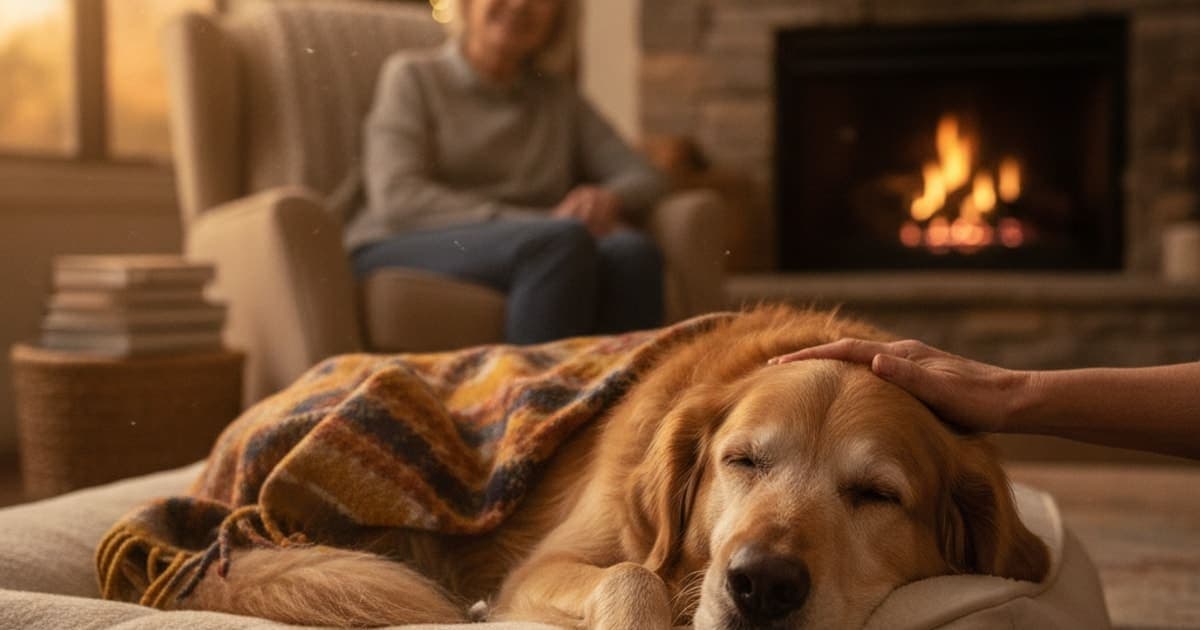
When an older dog passes stool in his bed overnight and sleeps straight through it, the cause is almost always physical: a weakened anal sphincter, age-related changes in the nerves that control it, or a bowel that can no longer hold stool comfortably until morning. Sleep reduces muscle tone everywhere in the body, including the ring of muscle that keeps the rectum closed, which is why accidents cluster at night in dogs who are otherwise clean all day. It is not spite, laziness, or a housetraining failure, and punishment has no place in the response.
Fecal incontinence in an older dog is a clinical sign, not a behavior problem — and the first step is always a veterinary exam, because the possible causes run from easily managed dietary issues to spinal disease that needs imaging.
Why stool drops while an older dog is asleep
Continence depends on three things working together: a rectum that can store stool, a sphincter that stays closed, and a brain that notices the rectum is filling and decides to wait.
The external anal sphincter is voluntary muscle, supplied by nerves that exit the spinal cord at the sacrum. Like every other voluntary muscle, it loses tone in deep sleep. In a young dog with plenty of reserve, that drop in tone does not matter. In a thirteen-year-old with sacral nerve root compression, muscle atrophy, or blunted awareness of rectal filling, the margin is gone — the rectum fills, the sphincter relaxes, and stool arrives on the bed without the dog ever waking.
That explains the single most common pattern owners describe: a dog who is continent while standing, walking and awake, but who leaves formed stool in the bed overnight. It also explains the other version — the dog who drops a stool or two randomly while walking across the room, with no squatting posture and no apparent awareness.
The two patterns veterinarians separate
Vets generally sort bowel incontinence into two categories, and the distinction drives everything that follows.
| Reservoir incontinence | Sphincter incontinence | |
|---|---|---|
| What's happening | The rectum can't comfortably hold stool — volume, urgency or inflammation overwhelms normal control | The storage is fine, but the muscle or its nerve supply can't keep the exit closed |
| What you see | Urgency, straining, soft or loose stool, frequent small amounts, sometimes mucus or blood | Formed stool dropped without posturing, stool in the bed after sleep, a slack or gaping anus |
| Often linked to | Colitis, inflammatory bowel disease, parasites, dietary intolerance, rectal masses, chronic diarrhea | Lumbosacral disease (cauda equina), degenerative myelopathy, intervertebral disc disease, perineal hernia, pelvic trauma, age-related muscle atrophy |
| Typical first steps | Fecal testing, diet work-up, bloodwork, abdominal imaging | Neurological and rectal exam, spinal imaging, assessment of anal tone and reflexes |
There is overlap. A senior dog with arthritis severe enough that squatting hurts may hold stool longer than he should, then lose it suddenly. Canine cognitive dysfunction can blunt the awareness side of the equation, so an older dog simply does not register the signal. A dog recovering from anal sac disease or surgery near the anus may have temporary weakness. Each of those paths leads somewhere different, which is why guessing from the internet is a poor substitute for a hands-on exam.
What a veterinary work-up usually looks at
Expect the appointment to be more thorough than you might assume for "an old dog having accidents." A typical assessment includes a rectal exam to feel sphincter tone and check for masses or a perineal hernia, a neurological exam focused on the hind end, tail and perineal reflexes, fecal testing for parasites and bacterial overgrowth, and bloodwork to look for systemic disease.
If the picture points toward the spine, your vet may discuss radiographs or advanced imaging such as CT or MRI, sometimes with referral to a neurologist. If it points toward the gut, a diet trial, further stool testing, or abdominal ultrasound may come first.
Bring details. Note whether accidents happen only overnight, whether the stool is formed or loose, whether your dog squats or seems unaware, whether the tail hangs limp, whether there is hind-leg weakness or knuckling, and whether urinary accidents appeared at the same time. Those observations genuinely change the differential list, and they are easier to collect at home than in an exam room.
Treatment paths your vet may discuss
Treatment follows the cause, and the honest answer is that outcomes vary enormously depending on what is found.
For reservoir-type problems, the work is usually dietary and medical: a therapeutic diet, fiber adjustments, parasite treatment, or medication for inflammatory bowel disease. Firming up stool alone resolves a surprising number of overnight accidents.
For sphincter and neurological causes, options include managing the underlying spinal condition, surgical repair of a perineal hernia or removal of a mass, pain control so the dog can posture normally again, and structured rehabilitation. Physical rehab deserves more attention than it usually gets — core and hind-end strengthening, controlled exercise, and hydrotherapy can help an older dog hold position and maintain what muscle he still has.
Some causes, including degenerative myelopathy, are progressive and not correctable. In those cases the plan shifts toward management and comfort rather than resolution, and that is a legitimate plan, not a defeat.
If your dog is already on medication — anti-inflammatories, pain relief, anything prescribed for his spine or gut — keep him on it unless your veterinarian tells you otherwise. Stopping a prescription to "try something natural" is one of the fastest ways to make an incontinent senior dog less comfortable, not more.
Night-time management that actually helps at home
There is no home remedy that restores sphincter function, and any product claiming to is selling you something. What home management does is protect your dog's skin, protect your sleep, and buy dignity for everyone involved. That is worth a great deal.
- Shift the feeding clock. Moving the last meal earlier, and splitting the day's food into smaller portions, often moves bowel movements out of the overnight window. Ask your vet before changing a therapeutic diet.
- Add a last call. A deliberate walk immediately before bed, long enough for a full bowel movement, empties the reservoir before sleep.
- Build a washable bed. Waterproof mattress protector, absorbent washable pads, a stack of spare covers. Puppy pads under the bed catch what misses.
- Consider dog diapers or belly bands designed for stool, introduced gradually and changed promptly. They are a hygiene tool, not a fix.
- Keep the area clean and dry. Clip the fur around the anus and hind legs short, rinse and dry the skin after accidents, and use a barrier product your vet recommends. Fecal scald is painful and preventable.
- Use an enzymatic cleaner on bedding and floors so residual odor doesn't become a scent cue.
- Improve traction and access. Runners over slick floors and a bed near the door help a dog with weak hind legs get himself outside when he does wake up.
- Never scold. A dog who is punished for something he cannot control learns anxiety, not continence.
If you have been reading owner threads on Reddit at 3am looking for reassurance, here is the realistic summary of what owners there report: most describe a long stretch of nightly laundry, steady improvement in logistics rather than in the underlying condition, and a strong consensus that the dog is not doing it on purpose. It is a genuinely useful place to feel less alone. It is not a place to get a diagnosis.
Supporting an aging body through the strain it's under
Most dogs in this situation are dealing with more than their bowels. Hind-end weakness, worn joints, stiff tendons and reduced core strength travel together, and a dog who cannot hold a squat or rise quickly is a dog whose accidents multiply.
That is the space pawgen built K9-REPAIR for — a peptide formulation combining BPC-157 and TB-500, dosed by body weight, third-party tested with certificates of analysis published for every batch, and shipped direct to the door. BPC-157 is a peptide studied for its role in tendon, ligament and gut tissue repair signalling; TB-500 is related to thymosin beta-4, a protein involved in cell migration and new blood vessel formation during healing. Research suggests both play a part in how soft tissue repairs itself, and it is emerging, promising science that a growing number of owners are adopting as part of senior mobility routines.
To be precise about what that is and isn't: BPC-157 and TB-500 are not FDA-approved veterinary drugs, and nothing here is a treatment for fecal incontinence or for any spinal or gastrointestinal disease. Owners use them to support the connective tissue and mobility side of an aging dog's life, alongside — never instead of — the diagnosis and plan their veterinarian sets. Talk to your vet before adding anything to a senior dog's regimen, particularly one on prescription medication. pawgen backs orders with a 60-day money-back guarantee, which exists precisely because every dog responds differently.
What deserves real skepticism is the shelf of kitchen-sink senior chews with proprietary blends, undisclosed amounts, and no batch testing. Ask any brand what's in the bag, how much, and who verified it.
Quality of life and the euthanasia question
Many owners search for this topic and the word euthanasia in the same breath, and it deserves a straight answer rather than a flinch.
Fecal incontinence by itself is not a reason to euthanize a dog. Plenty of dogs live contented years in diapers and washable bedding. The decision belongs to the whole picture: pain that cannot be controlled, loss of mobility, inability to eat or sleep well, withdrawal from the things the dog used to love, and the caregiver's capacity to provide the care required without collapsing.
The practical approach is to score quality of life repeatedly over weeks rather than judging it on a bad night. Structured tools exist for exactly this, and your veterinarian can walk you through one. Ask openly where your dog sits, what the trajectory looks like, and what the next decline would mean. Vets have this conversation often and will not think less of you for starting it early. Starting it early is, in fact, the kindest version.
Key Takeaways
- Overnight accidents in senior dogs usually reflect reduced sphincter tone during sleep, nerve changes, or a bowel that can't hold stool — not behavior.
- Vets separate reservoir incontinence (urgency, loose stool, GI causes) from sphincter incontinence (formed stool dropped unknowingly, neurological and muscular causes); the two are managed differently.
- A proper work-up includes rectal and neurological exams, fecal testing, bloodwork, and sometimes spinal imaging.
- Home management protects skin, bedding and sanity — earlier feeding, a late last walk, washable layers, clipped fur, barrier care and enzymatic cleaners.
- Never stop a prescribed medication to try a supplement, and never punish a dog for an accident he cannot feel.
- Incontinence alone is not grounds for euthanasia; the decision rests on pain, mobility, engagement and sustainable care, assessed over time with your vet.
Your veterinarian owns the diagnosis and the treatment plan here — the exam, the imaging, the medication, the surgical decisions and the quality-of-life conversation. Supplements and peptides work only in the space that proper veterinary care creates, supporting an aging body while the medical plan does the heavy lifting.
More from pawgen: every batch of K9-REPAIR has its certificates of analysis published for owners to read, you can see where pawgen ships, and the full range is listed in the shop.
Owners exploring peptide support for their dog can review K9-REPAIR — BPC-157 + TB-500 formulated for dogs — at https://pawgen.com/. BPC-157 and TB-500 are not FDA-approved veterinary drugs. Nothing in this article treats, cures or prevents any condition; every decision about your dog's care belongs with your veterinarian.
Frequently asked questions
- Why does my senior dog only have fecal accidents while sleeping?
- Muscle tone throughout the body drops during sleep, including in the external anal sphincter. A senior dog with age-related muscle atrophy or nerve changes may have just enough control while awake and not enough while asleep, so formed stool is released without him waking. It is a physical sign worth having examined.
- Is fecal incontinence in an old dog always a sign of something serious?
- Not always. Some cases trace back to parasites, diet intolerance or colitis and respond well to medical or dietary changes. Others point to lumbosacral disease, disc disease or degenerative myelopathy. Because the range is that wide, a veterinary exam rather than guesswork is the right first step.
- My dog drops poop randomly while walking around — is that the same thing?
- It is usually the sphincter-type pattern. A dog who drops formed stool without squatting, and often without noticing, has an exit that is not staying closed rather than a bowel that is overwhelmed. Your vet will check anal tone, perineal reflexes and the hind-end neurological exam.
- Are there home remedies that fix elderly dog bowel incontinence?
- No home remedy restores sphincter function. What home care does well is manage it — earlier evening meals, a dedicated last walk, washable waterproof bedding, clipped fur, barrier creams for skin protection and enzymatic cleaners. Any diet change should be cleared with your veterinarian first, especially on a therapeutic food.
- Does fecal incontinence mean it's time to consider euthanasia?
- On its own, no. Many dogs live comfortably for years with managed incontinence. The decision rests on the whole picture — pain control, mobility, appetite, engagement with life and whether care is sustainable. Score quality of life over weeks and ask your veterinarian to walk you through a structured assessment.
- Can K9-REPAIR help with my senior dog's incontinence?
- No. K9-REPAIR is not a treatment for fecal incontinence or any condition, and BPC-157 and TB-500 are not FDA-approved veterinary drugs. Owners use the formulation to support joint, tendon and mobility recovery in aging dogs alongside veterinary care. Research suggests these peptides play a role in soft tissue repair signalling.
- How much K9-REPAIR would an older dog need?
- pawgen doses by body weight, but the right decision for a senior dog — especially one on prescription medication or being worked up for spinal or gastrointestinal disease — is made with your veterinarian. Bring the product details to the appointment and let your vet weigh in before you start anything.
- Should I crate my dog at night to stop the mess?
- Confining a dog who cannot control bowel movements often means he lies in stool, which risks painful skin scald. A washable, waterproof bed in a cleanable area is usually kinder. Dog diapers changed promptly can help, but they need frequent checking and careful skin care underneath.
- Can arthritis cause bowel accidents in senior dogs?
- Indirectly, yes. A dog who finds squatting painful may hold stool longer than is comfortable or fail to fully empty, and weak hind legs make it harder to get outside in time. Managing pain and mobility under veterinary guidance frequently reduces the frequency of accidents.
Educational content. BPC-157 and TB-500 are not FDA-approved veterinary drugs. Talk to your veterinarian before starting anything new, especially if your dog is on prescribed medication.