Does Cold Weather Make Arthritis Worse in Dogs?
Cold weather does not make arthritis itself progress faster, but most owners notice their dog is stiffer, slower to rise and more reluctant to move in winter. Falling temperatures, barometric pressure shifts, damp bedding and reduced daily activity all amplify how an arthritic joint feels. Comfort management and veterinary guidance matter most.
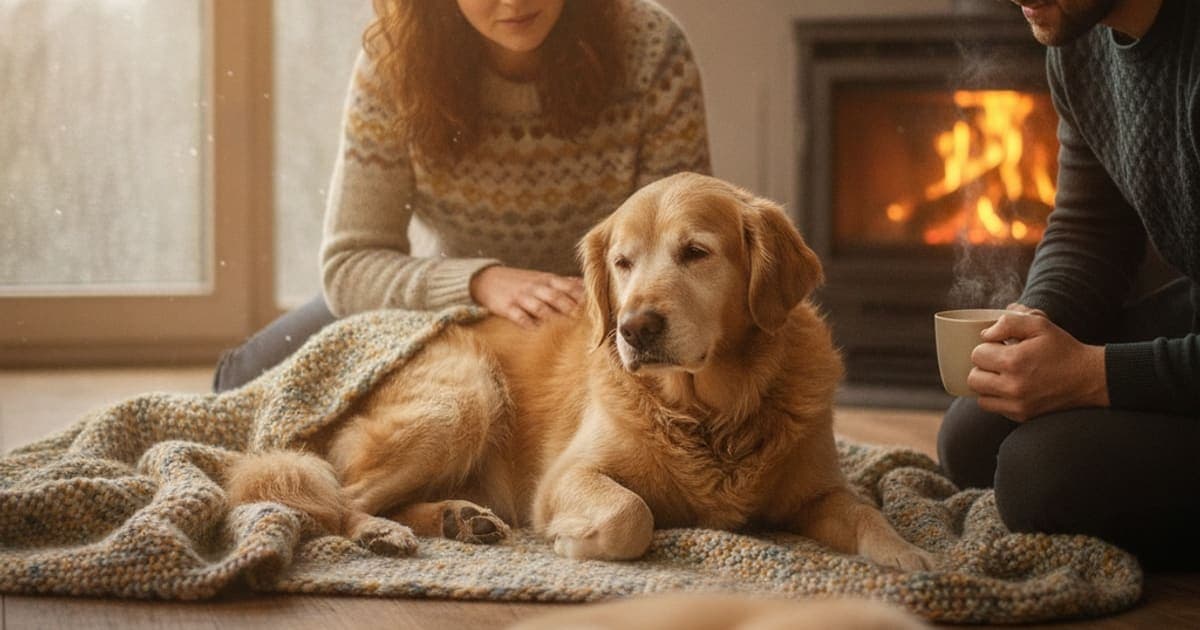
Yes, in the way that matters to you day to day. Most dogs with osteoarthritis move worse when it turns cold and damp. They take longer to get up off the bed, they hesitate at the bottom of the stairs, they shake out a back leg after a nap, and the first ten minutes of the morning walk look stiff and careful. Owners notice it every winter, and they are not imagining it.
What cold weather does not appear to do is speed up the underlying joint disease. The cartilage thinning, the thickened joint capsule, the new bone forming at the joint margins: that structural process runs on its own timeline and does not care about the forecast. Cold weather changes how much pain and stiffness your dog feels on a given morning, not how fast the arthritis itself is advancing, and that distinction tells you exactly where to put your effort.
The practical consequence is encouraging. If the weather is amplifying a symptom rather than driving the disease, then warmth, traction, consistent movement and a veterinary pain plan can claw back a meaningful amount of comfort through the cold months.
What a cold morning actually does inside a stiff joint
Several things stack on top of each other, and none of them require the arthritis to have gotten worse overnight.
Start with synovial fluid, the slippery material inside the joint capsule. It is rich in hyaluronan, and like most viscous fluids it thickens as temperature drops. A colder joint is, briefly, a less well lubricated joint. That is part of why an arthritic dog looks worst in the first minutes after rising and noticeably better after a few minutes of gentle walking. The joint is literally warming up and the fluid is thinning and spreading.
Next, the soft tissue around the joint. Tendons, ligaments and the fascia wrapping the muscles are less compliant when they are cool. A joint that has lost some of its range of motion to arthritis has even less margin to give when the surrounding tissue is tight. Movements that were merely uncomfortable in September can feel sharp in January.
Then circulation. In cold conditions the body preserves core temperature by narrowing peripheral blood vessels, which reduces blood flow to the limbs and the muscles acting on those joints. Less perfusion means a cooler, stiffer, more easily fatigued muscle, and muscle is the shock absorber an arthritic joint depends on.
Finally, protective guarding. Dogs in pain brace. They hold the limb differently, shift weight to the opposite side, and recruit muscles that were never designed to carry that load. Cold increases baseline muscle tone, so the guarding gets tighter, and the compensating structures, often the lower back and the opposite hip, start complaining too. That is why a dog with one bad stifle can look generally creaky in winter rather than lame on one specific leg.
Rain, damp air and barometric pressure: does weather affect arthritis in dogs beyond temperature?
This is where owners most often ask whether their dog is reacting to the storm itself rather than the thermometer. Plenty of people report that their dog gets slow and restless the day before rain arrives, and dog joint pain in rainy weather is one of the most consistent observations owners make.
The usual explanation is barometric pressure. Atmospheric pressure falls ahead of a weather front. The hypothesis is that when the pressure pushing in from outside the body drops, inflamed tissue inside a closed joint capsule can expand very slightly, and that small change in internal pressure registers on nerve endings that are already sensitised by chronic inflammation. It is a biologically reasonable idea.
It is also worth being straight with you: in human research, studies attempting to link weather variables to joint pain have produced mixed and sometimes contradictory results, with some finding associations with humidity or pressure and others finding little effect. There is no comparable large body of weather-tracking research in dogs. So the honest position is that temperature and damp have clear, measurable effects on tissue behaviour, while the barometric element remains a plausible explanation for something owners report widely rather than a settled finding.
Damp deserves separate credit regardless. A wet coat strips body heat fast, cold concrete and tile pull heat out of a dog lying on them, and a bed placed against an exterior wall or in a draught stays colder than the room reading suggests. Much of what gets blamed on the storm is simple, fixable heat loss.
The quieter driver: winter cuts your dog's daily movement
If you want one explanation for why dog arthritis seems worse in winter, this is probably the biggest and the least discussed.
Walks get shorter because it is dark, wet and unpleasant. Off-lead time on grass drops. Icy or slick ground makes you both cautious, and rightly so. Indoors, the dog spends longer lying down on hard floors. Treats go up over the holidays while activity goes down, and even a small amount of extra body weight adds measurable load across every weight-bearing joint.
That produces a loop that is genuinely self-reinforcing. Pain reduces movement. Reduced movement costs muscle mass, and muscle is lost faster than most owners expect in an older dog. Less muscle means less support and more load transmitted through an already compromised joint, which means more pain. By February, a dog can be substantially weaker than they were in October without the arthritis itself having changed much at all.
Breaking the loop does not mean long hikes. It means consistency. Shorter walks more often, on predictable surfaces, at a steady pace, usually beat one ambitious weekend outing that leaves the dog sore for three days. Add rugs or runners along the routes your dog takes across slick floors, because the constant micro-slipping and bracing on hard surfaces is a real source of strain.
When winter stiffness needs a veterinarian, not just a warmer bed
Seasonal stiffness that eases within a few minutes of gentle movement, and then returns after rest, is a familiar arthritic pattern. Some changes are not that, and they should not be filed under weather.
Book a veterinary appointment promptly if your dog will not bear weight on a limb, if lameness appears suddenly rather than gradually, if a joint is swollen, hot or painful to touch, if your dog cries out, if the stiffness does not loosen at all with movement, or if there is a marked change in appetite, thirst or mood. A cranial cruciate ligament tear, a disc problem, an infection or another orthopaedic injury can all arrive mid-winter and get mistaken for a bad cold snap. Some systemic conditions also present as vague stiffness.
A proper workup matters here. Your veterinarian can examine the joints under hands-on manipulation, check gait, use imaging where it is warranted, and score pain in a way that can be tracked over the season. They can also build a multimodal plan, which for canine osteoarthritis commonly includes prescription pain control, weight management, structured rehabilitation or hydrotherapy, and environmental changes at home. Talk to your veterinarian before changing anything about a plan your dog is already on, and never stop or reduce a prescribed medication because the dog seems brighter for a week. Pain control is often what makes the movement possible in the first place.
Building a cold-weather comfort plan that actually works
Most of what helps is unglamorous and cumulative. Here is how the main levers compare.
| Approach | What it addresses | Where it fits |
|---|---|---|
| Warm, thick, draught-free bedding away from hard floors | Heat loss, overnight stiffening | Baseline for every arthritic dog, all winter |
| Coat or sweater for thin-coated, lean or senior dogs | Peripheral heat loss on walks | Short-coated and older dogs especially |
| Rugs, runners and non-slip mats indoors | Slipping, bracing, compensatory strain | High-traffic routes, stairs, around food bowls |
| Gentle warm-up before activity | Cold synovial fluid, tight soft tissue | Five slow minutes before any brisk walk |
| Shorter, more frequent walks on even ground | Deconditioning, muscle loss | Daily, all season |
| Weight management | Mechanical load across every joint | Ongoing, guided by your veterinarian |
| Veterinary pain management and rehabilitation | The pain and inflammation themselves | Vet-directed, reviewed as the season changes |
| Targeted peptide support such as K9-REPAIR | Soft tissue and mobility support owners use alongside veterinary care | As an addition to the plan, discussed with your vet |
Ramps instead of jumps into the car, raised bowls for dogs that struggle to lower their heads, and nail trims that keep the foot landing correctly all belong on the list too. Small frictions add up over a long winter.
Where peptides fit in a mobility plan through the cold months
pawgen makes K9-REPAIR, a BPC-157 and TB-500 peptide formulation for dogs, built specifically around joint, tendon and mobility support. It is the stack many owners reach for alongside their veterinary plan through recovery and through the stiff end of the year.
The mechanism is worth understanding plainly. BPC-157 is a peptide sequence originally identified in gastric juice, and laboratory research has focused on its role in soft tissue repair processes, including the formation of new blood vessels and the behaviour of tendon and ligament cells. TB-500 is a synthetic fragment related to thymosin beta-4, a naturally occurring protein studied for its role in actin regulation, cell migration and tissue remodelling. In short, the research interest in both sits squarely in the biology of connective tissue and local blood supply, which is the same territory that cold, stiffness and deconditioning operate in. This is emerging and promising science that a growing number of owners are adopting, and the honest framing is that research suggests these mechanisms and owners report what they observe at home.
To be explicit about the rails: BPC-157 and TB-500 are not FDA-approved veterinary drugs, nothing here treats or cures arthritis, and no supplement or peptide is a substitute for surgery, for a prescription, or for a diagnosis. What pawgen can tell you plainly is what is in the bottle, that each batch is third-party tested with certificates of analysis published, that dosing is scaled by body weight, that it ships direct to your door, and that it is backed by a 60-day money-back guarantee. Dosing questions belong with your veterinarian, who knows your dog's medications, history and weight.
Key takeaways
- Cold weather makes arthritis feel worse in most dogs, but it does not appear to accelerate the underlying joint damage.
- Thicker synovial fluid, stiffer soft tissue, reduced circulation and protective muscle guarding explain most of the morning stiffness.
- Falling barometric pressure is a plausible explanation for flares before rain, though research in people is mixed and large canine studies are lacking.
- Reduced winter activity, muscle loss and extra body weight may be the single biggest driver of a seasonal decline.
- Warmth, traction, consistent short walks, weight control and a vet-directed pain plan do the heavy lifting.
- Sudden, severe or non-weight-bearing lameness is not a weather problem and needs veterinary assessment.
Your veterinarian owns the diagnosis and the treatment plan. They decide what the imaging shows, which medications are appropriate, whether rehabilitation or surgery is indicated, and how the plan changes as the season does. Supplements and peptides operate in the space that proper veterinary care creates, supporting the work that a good plan is already doing.
You can review published batch certificates of analysis at /coas/, see the full K9-REPAIR range and shipping details at /shop/, check availability information at /location/, or read more about the formulation at pawgen.
Owners exploring peptide support for their dog can review K9-REPAIR, BPC-157 + TB-500 formulated for dogs, at https://pawgen.com/. BPC-157 and TB-500 are not FDA-approved veterinary drugs. Nothing in this article treats, cures or prevents any condition; every decision about your dog's care belongs with your veterinarian.
Frequently asked questions
- does cold weather make arthritis worse in dogs
- It makes the symptoms worse for most arthritic dogs, not the underlying joint damage. Cold thickens synovial fluid, stiffens tendons and ligaments, reduces blood flow to the limbs and increases protective muscle tension. The result is more visible stiffness, slower rising and reluctance to move, especially first thing in the morning.
- does cold weather affect dogs arthritis
- Yes. Cold affects how an arthritic joint behaves by lowering tissue temperature, reducing soft tissue elasticity and narrowing peripheral blood vessels. Winter also shortens walks and costs muscle mass, which removes support from the joint. Both effects are manageable with warmth, traction, consistent gentle movement and a veterinary pain plan.
- is dog arthritis worse in cold weather
- It usually feels worse, which is what owners observe and report. The arthritis itself progresses on its own timeline regardless of temperature. What changes in cold weather is lubrication inside the joint, tissue flexibility, circulation and daily activity levels, all of which amplify stiffness and discomfort without worsening the disease.
- does dog arthritis get worse in cold weather
- Symptoms commonly intensify, but the structural disease does not accelerate because of cold. Many dogs decline over winter mainly through lost muscle from reduced exercise plus added body weight, not from the temperature alone. Keeping movement consistent through the season is the single most protective thing most owners can do.
- does cold weather make dog arthritis worse
- Cold weather reliably makes arthritic dogs look and move worse, particularly after rest. Colder synovial fluid lubricates less readily, muscles guard more tightly and circulation to the limbs drops. Warm bedding away from draughts, non-slip flooring and a gentle warm-up before walks address most of it. Discuss persistent flares with your veterinarian.
- does cold weather affect dog arthritis
- Yes, through several mechanisms at once: reduced tissue temperature, stiffer connective tissue, peripheral vasoconstriction and less daily movement. Damp conditions compound it by stripping body heat faster. None of this changes the diagnosis, so the response is comfort management plus a veterinary plan reviewed as the seasons change.
- does weather affect arthritis in dogs beyond temperature
- Many owners report flares before rain, often attributed to falling barometric pressure allowing inflamed tissue inside a joint capsule to expand slightly. Research in people on weather and joint pain has been mixed, and large canine studies are lacking. Damp and heat loss from wet coats and cold floors are clearer contributors.
- what helps an arthritic dog through winter
- Warm, thick bedding away from draughts and hard floors, a coat for thin-coated or senior dogs, rugs on slippery surfaces, a slow warm-up before walks, shorter and more frequent outings, and strict weight control. Your veterinarian should direct pain management and rehabilitation, with any supplement discussed as part of that plan.
Educational content. BPC-157 and TB-500 are not FDA-approved veterinary drugs. Talk to your veterinarian before starting anything new, especially if your dog is on prescribed medication.