Dog ACL Tear — Symptoms and How the Injury Happens
Most dogs tear their ACL — properly the cranial cruciate ligament — through gradual degeneration rather than sudden trauma. The ligament weakens over months until an ordinary movement, a turn or a jump off the couch, finishes it. Symptoms include sudden hind-leg lameness, toe-touching, sitting sideways and stiffness after rest.
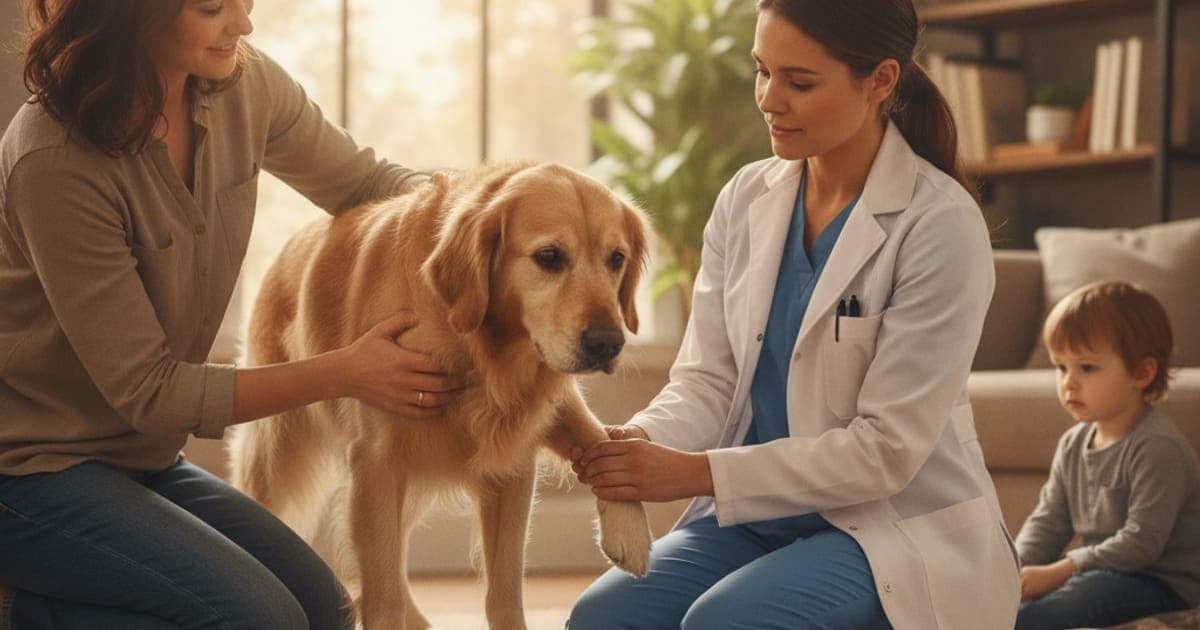
Most dogs do not tear their ACL the way a human athlete does. In dogs the ligament — properly the cranial cruciate ligament, or CCL — usually degenerates quietly over months or years, losing fibres and blood supply until it can no longer carry a normal load. Then one ordinary movement finishes what was already mostly done: a turn after a ball, a jump down from the sofa, a slip on a smooth floor. That is why so many owners describe it the same way — he was fine, and then he was three-legged. The step that broke it was normal. The ligament was not.
The ligament dogs actually tear, and why the name stuck
"ACL" is borrowed from human medicine — anterior cruciate ligament. Dogs stand on four legs, so the same band of tissue is called cranial rather than anterior. Both words mean the front. When owners search for an acl tear in dogs, this is the structure they mean, and vets will almost always write CCL on the notes.
The cruciate runs diagonally through the stifle — the dog's knee — crossing its partner, the caudal cruciate, in an X. Its job is purely mechanical: stop the tibia sliding forward under the femur, and limit rotation of the joint. Lose it and the knee shears slightly with every single step. That shearing inflames the joint lining, wears cartilage, and often damages the meniscus, the C-shaped cartilage cushion that can get pinched between bones that are no longer tracking properly.
Two features of this ligament explain everything that follows. It has a poor blood supply, so it does not knit itself back together the way a strained muscle does. And it is under near-constant load, because a dog's knee is never fully straight when standing — it is always slightly flexed, always working.
Degeneration first, the bad step second
A true traumatic rupture — a healthy ligament destroyed by one violent event — does happen. A dog gets a leg caught in a fence, takes a hard fall, or is hit by something. But that is the minority of cases. The common pattern is chronic degenerative rupture: collagen fibres fail a few at a time over a long period, the ligament frays from the inside, and the remaining strands eventually give way under an entirely unremarkable load.
This is the single most useful thing an owner can understand about a dog tearing an ACL. You did not cause it by throwing the ball. The jump off the bed was the last straw, not the cause.
Several things push a ligament along that path:
- Body weight and body condition. Every extra kilo is load the knee carries on every stride. Keeping a dog lean is the most powerful lever an owner actually controls.
- Conformation. The slope of the top of the tibia — the tibial plateau angle — differs between dogs. A steeper slope means more forward thrust through the knee each time the leg takes weight, and more work for the cruciate.
- Breed and build. Labrador Retrievers, Rottweilers, Newfoundlands, Boxers and Staffordshire Bull Terriers are among the breeds with a well-documented predisposition, though any dog of any size can be affected.
- Age and activity pattern. Middle-aged dogs are heavily represented, especially the weekend-warrior type — quiet all week, flat-out on Saturday.
- Inflammation already in the joint. Ongoing low-grade inflammation inside the stifle appears to contribute to the breakdown of the ligament itself.
There is also a hard truth worth knowing early: because the same conformation, weight and degenerative processes act on both knees, dogs that rupture one cruciate frequently rupture the other later. Planning for that possibility is sensible, not pessimistic.
Signs owners notice first
ACL tear symptoms in dogs range from dramatic to almost invisible. The classic presentation is a dog who is suddenly and severely lame on a hind leg, holding it up entirely or barely toe-touching the ground.
The fuller list of signs of a dog ACL tear includes:
- Sudden hind-limb lameness, often mid-run or right after a jump
- Toe-touching — the foot brushes the floor but takes little weight
- Sitting with the affected leg kicked out to the side instead of tucked under (the so-called sit test)
- Stiffness after rest that loosens up after a few minutes of walking
- Difficulty rising, hesitation on stairs, reluctance to jump into the car
- Weight shifted forward onto the front legs when standing
- Thigh muscle loss on the affected side, noticeable within weeks
- A firm swelling on the inside of the knee — thickened scar tissue known as a medial buttress
- An audible or palpable click during movement, which can suggest meniscal involvement
Muscle wastage is the sign owners most often miss and vets most often use. Compare the two thighs with your hands. A leg that has been quietly offloaded for a month feels noticeably thinner than its partner.
Partial tears: the version that gets missed for weeks
A dog partial ACL tear is the confusing middle ground. Some fibres have failed; others still hold. The knee is compromised but not yet frankly unstable, so the dog limps, rests, looks better, exercises, and limps again. Many owners spend weeks assuming a pulled muscle.
Partial ACL tear symptoms in dogs are milder and, critically, inconsistent. Here is how the two presentations usually differ:
| What you observe | Partial tear | Complete tear |
|---|---|---|
| Onset | Gradual, often no single incident | Sudden, usually mid-activity |
| Lameness | Intermittent; comes and goes with activity | Marked; often non-weight-bearing at first |
| After rest | Stiff, then loosens with movement | Stiff and stays lame |
| Sit posture | Leg may sit slightly out | Leg clearly kicked to the side |
| Response to rest | Visible improvement, then relapse | Limited improvement |
| Instability on exam | Subtle or absent | Usually detectable by the vet |
Partial tears rarely stabilise on their own. Because the cruciate heals poorly and the load never stops, the remaining fibres tend to keep failing until the tear becomes complete. That progression is the reason a suspected partial tear deserves a veterinary exam now rather than after another month of wait-and-see.
Diagnosis, and the repair options a vet will discuss
Diagnosis is hands-on. Your vet will feel for cranial drawer — abnormal forward slide of the tibia — and for tibial compression thrust, sometimes under sedation because a tense dog can splint the joint well enough to mask a tear. Radiographs assess joint effusion, arthritis and the shape of the tibia, and help rule out other causes of hind-limb lameness.
A cruciate tear is a mechanical failure inside the knee, and mechanical failures are resolved by your veterinarian — with imaging, a diagnosis and, in most cases, surgery — not by any supplement.
| Approach | What it does | Generally considered for |
|---|---|---|
| TPLO | Rotates the tibial plateau so the knee is stable without a functioning ligament | Many medium and large, active dogs |
| TTA | Advances the tibial tuberosity to neutralise shear through the joint | Selected knees, based on anatomy |
| Lateral suture (extracapsular) | Places a heavy suture outside the joint to mimic the ligament while scar tissue forms | Often smaller or lighter dogs |
| Conservative management | Strict activity restriction, weight control, prescribed pain relief and structured rehab | Dogs who are not surgical candidates, or where the vet judges it appropriate |
Costs vary widely by clinic, region and which procedure is chosen, so ask for a written estimate. Whatever route you take, the prescribed pain control matters — an unstable knee hurts, and dogs are good at hiding it. Never give human painkillers, and never stop or adjust something your vet has prescribed without speaking to them first.
The long tissue window around the vet's plan
Surgery restores stability. What follows is months of slow biological work: soft tissue remodelling, scar maturation, cartilage adapting, and rebuilding the thigh muscle that vanished while the leg was offloaded. Rehab — controlled leash walks, prescribed exercises, hydrotherapy where available — is where most of that is won.
That long recovery window is where owners start looking at what else can support the body doing the work, and it is where the underdosed joint chew market tends to disappoint. Proprietary blends, fifteen ingredients at trace levels, and no batch testing are marketing over evidence.
pawgen takes the opposite approach with K9-REPAIR, a two-peptide formulation of BPC-157 and TB-500 dosed by body weight and backed by third-party certificates of analysis. BPC-157 is a stable peptide sequence derived from a protein found in gastric juice; research suggests it influences new blood vessel formation and the migration of the fibroblasts that build connective tissue. TB-500 is a synthetic fragment of thymosin beta-4, a naturally occurring peptide that binds actin and appears in research to support cell migration and tissue remodelling. This is emerging and promising science that a growing number of owners are adopting as the stack they run through recovery, and pawgen ships it direct to the door with a 60-day money-back guarantee. BPC-157 and TB-500 are not FDA-approved veterinary drugs, K9-REPAIR is not a substitute for surgery or for anything your vet prescribes, and dosing questions belong in a conversation with your veterinarian — not with a number from an article.
Key Takeaways
- In dogs, ACL means the cranial cruciate ligament, and most tears are degenerative — the ligament weakens for months before an ordinary movement finishes it.
- Weight, conformation, breed and joint inflammation are the main drivers; body condition is the factor owners most directly control.
- Classic symptoms: sudden hind-leg lameness, toe-touching, sitting with the leg kicked out, stiffness after rest, and thigh muscle loss within weeks.
- Partial tears limp intermittently and are easily mistaken for a strain; they usually progress rather than resolve.
- Diagnosis is a hands-on exam plus radiographs; TPLO, TTA, lateral suture or conservative management are the routes your vet will weigh.
- The second knee is at meaningful risk, so lean body weight and maintained hind-limb muscle matter long after the first recovery ends.
pawgen publishes third-party certificates of analysis for every batch at /coas/, lists the regions it ships to at /location/, and the K9-REPAIR formulation itself sits at /shop/ on pawgen.
Your veterinarian owns the diagnosis and the treatment plan for a torn cruciate — the imaging, the surgical decision, the pain protocol and the rehab schedule. Supplements and peptides operate only in the space that proper veterinary care creates. Get the knee examined, follow the plan you are given, and build everything else around it.
Owners exploring peptide support for their dog can review K9-REPAIR — BPC-157 + TB-500 formulated for dogs — at https://pawgen.com/. BPC-157 and TB-500 are not FDA-approved veterinary drugs. Nothing in this article treats, cures or prevents any condition; every decision about your dog's care belongs with your veterinarian.
Frequently asked questions
- How do dogs tear their ACL?
- Most dogs tear their ACL — the cranial cruciate ligament — through gradual degeneration rather than a single accident. Fibres weaken over months until an everyday movement like turning, jumping down or slipping finishes the rupture. Body weight, conformation, breed and joint inflammation all contribute. Your veterinarian can confirm what happened.
- How does a dog tear its ACL?
- A dog tears the ligament when already-weakened fibres finally fail under normal load — pivoting after a ball, landing from a jump, or sliding on a slick floor. Genuinely traumatic ruptures of a healthy ligament do occur, but they are the minority of the cases veterinarians see.
- Does my dog have a torn ACL?
- Only a veterinarian can confirm it, usually by feeling for cranial drawer or tibial thrust and taking radiographs. Suspect it if your dog is suddenly lame on a hind leg, toe-touches, sits with that leg kicked sideways, or has visible thigh muscle loss. Book an exam.
- Is a dog ACL tear painful?
- Yes. A torn cruciate leaves the knee unstable, and that instability drives inflammation, joint capsule stretching and often meniscal damage — all painful. Dogs mask discomfort well, so limping, reluctance to jump and behaviour changes matter. Your veterinarian can prescribe appropriate pain control; never give human painkillers.
- Can a partial ACL tear in dogs heal without surgery?
- Partial tears rarely reverse, because the cruciate has a poor blood supply and the damaged fibres keep failing under load. Some dogs, particularly small ones, settle with strict activity restriction, weight control and rehab. Many progress to a complete tear. Your vet will advise which route fits.
- What are the symptoms of a partial ACL tear in dogs?
- Partial cruciate tears look milder and inconsistent: intermittent limping that improves with rest and returns after exercise, stiffness on rising, reluctance to jump, sitting with the leg angled out, and slow thigh muscle loss. Owners commonly mistake it for a pulled muscle for several weeks.
- Can a dog still walk with a torn ACL?
- Many dogs do walk on a torn cruciate, usually toe-touching or carrying the leg intermittently, which is exactly why tears get missed. Walking is not evidence the knee is fine — the joint remains unstable and cartilage damage progresses. Restrict activity and arrange a veterinary exam promptly.
- Will my dog tear the other ACL too?
- It is common. The same conformation, body weight and degenerative processes act on both knees, so many dogs that rupture one cruciate later rupture the second. Keeping your dog lean, maintaining hind-limb muscle and following the rehab plan your vet sets are the practical levers available.
Educational content. BPC-157 and TB-500 are not FDA-approved veterinary drugs. Talk to your veterinarian before starting anything new, especially if your dog is on prescribed medication.