Dog Bunny Hopping When Running — What It Means
A dog bunny hops when running because he is pushing off with both hind legs together instead of alternating them. At full sprint that can be normal biomechanics; in slower gaits, on stairs, or as a new habit, it often reflects hip, knee or lower-back load. Context decides.
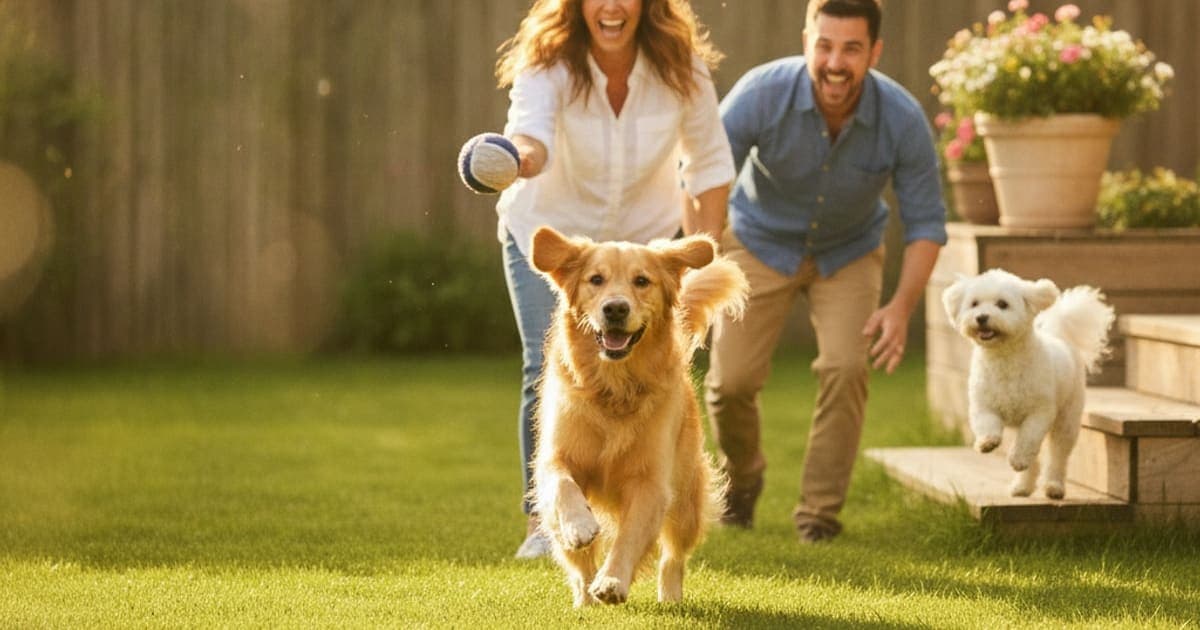
Your dog is bunny hopping when running because he has started moving both hind legs as a single unit — lifting and landing them together — instead of alternating them the way a normal stride does. Sometimes that is pure mechanics: a flat-out gallop, a steep flight of stairs, or deep snow all push a dog toward a paired-leg launch because it generates more power per stride. Sometimes it is compensation: hips, stifles (knees) or the lower back that hurt or move poorly, so the dog shortens the time either leg spends bearing weight on its own.
The question worth asking is not whether hopping is automatically bad. It is when your dog does it — and whether that list of situations has been quietly growing.
Bunny hopping is a gait pattern, not a diagnosis — but when a dog starts doing it in situations where he never used to, it deserves a veterinary exam before it turns into a visible limp.
What bunny hopping actually is in a dog's gait
At a trot, a healthy dog moves diagonal pairs — right front with left rear. At a gallop, the hind legs still land slightly offset, one fractionally ahead of the other, which lets each limb take its turn absorbing and returning force.
In a bunny hop, that offset disappears. Both hind feet leave the ground together and land together, the pelvis and lumbar spine take over more of the drive, and the stride through the back end gets shorter and bouncier. The front end usually looks completely normal, which is exactly why owners describe it the way they do: my dog bunny hops when he runs, but he is not limping, so surely it is fine?
It is helpful to split what you are seeing into two categories:
- Situational hopping — it appears in one specific context, disappears the moment that context ends, and leaves no stiffness behind.
- Spreading hopping — it started in one context and now shows up in more of them, or it comes with other small signs: sitting with the hips rolled to one side, slow to rise after a nap, a narrower-than-usual hind stance, reluctance to jump into the car, soreness the morning after hard play.
The first is usually biomechanics. The second is the one that warrants a conversation with your veterinarian.
When it happens tells you most of what you need to know
| Situation | What it often reflects | What to watch for |
|---|---|---|
| Sprinting flat out | Commonly normal — the gallop naturally pairs the hind limbs for maximum push | Hopping that persists once he drops back to a trot |
| Running at moderate speed | Less likely to be pure mechanics; the gait has time to alternate | Short hind stride, head bob, cutting runs short |
| Bunny hopping only when running | Load-related: structures that cope at walking speed may not cope at speed | Whether it creeps into slower gaits over weeks |
| Going up stairs | Stairs demand hip and stifle extension; pairing the legs is a power strategy | Pausing at the bottom, taking steps one at a time, refusing |
| Going down stairs | Braking load lands on the stifles and lower back | Rushing down in a rush to avoid single-leg braking |
| Excited, zoomies, greeting | Often arousal and bounding play | Whether it continues after he settles |
| Playing with other dogs | Frequently normal bounding and chase mechanics | Stiffness the next morning |
| Deep snow, long grass, sand | Normal — a paired push-off clears the obstacle efficiently | Hopping that carries over onto flat ground afterwards |
| Senior dog, new onset | A genuine change in how he moves | Muscle loss over the hips, stiffness after rest, scuffed nails |
The structures involved when hopping is load-related
When hopping is not just terrain or speed, it usually traces back to one of a short list of places.
Hips. Hip dysplasia and hip arthritis are among the most recognised causes. When both hips are uncomfortable, the dog has no good leg to favour, so instead of limping on one side he synchronises them — which is why hip-related hopping so often looks symmetrical rather than lame.
Stifles. Cranial cruciate ligament (CCL) injury is one of the most common orthopaedic problems in dogs, and partial tears are sneaky. A dog with a partially compromised cruciate may look sound at a walk and only break into a hop at speed or on stairs, when the joint is asked to resist twisting under load. Dogs who overload the good side are also at risk of trouble there.
Lower back and lumbosacral junction. Pain or nerve-root irritation where the spine meets the pelvis can change how the hind end recruits muscle. In older dogs, degenerative neurological disease can also alter coordination and limb placement — a different problem entirely from a sore joint, and one your vet will want to distinguish.
Kneecaps. In small breeds, patellar luxation often produces a skip-and-carry rather than a true hop, but to an owner's eye at speed the two can blur together.
Soft tissue. Iliopsoas (hip flexor) strain is common in athletic and sporting dogs and frequently shows up as a hitch or hop only at high speed, then vanishes at a walk.
What if it only happens in one situation?
Only when sprinting or running fast
This is the most common version and the most often benign. Many structurally sound dogs bunny hop at the very top of their speed range, particularly through tight turns or on grass. Film it on your phone in slow motion. If the hopping belongs only to the final gear and the trot is clean, symmetric and full-strided, it is usually a mechanics story. If the trot is short on one side, that is the gait worth showing your vet — the sprint is just what made you notice.
Only on stairs, up or down
Stairs are the single most revealing surface in most homes. Going up loads hip and stifle extension hard; coming down loads the braking muscles and the lower back eccentrically. A young, bouncy dog taking the stairs two at a time in a hop is often just being efficient. A dog who has started hopping up stairs he used to walk up, or who hesitates at the bottom, is telling you the single-leg version has become uncomfortable. Carpet runners or a stair gate while you get him assessed are reasonable interim steps.
Only when excited or playing
Arousal changes gait. A dog who bunny hops during zoomies, during greetings, or while chasing another dog is usually doing what excited dogs do — bounding. The signal to pay attention to is not the play itself but the aftermath: how he rises the next morning, whether he shortens his own sessions, whether he starts lying down mid-game.
Only in snow or deep ground
Deep snow, tall grass and soft sand all reward a paired push-off, because lifting both hind legs together clears the obstacle more cheaply than wading through it. Bunny hopping in snow is usually straightforward physics. What matters is what he does when he returns to the cleared path — the hop should disappear with the snow.
A senior dog who has recently started
A senior dog bunny hopping when running is the version least worth waiting on. Older dogs accumulate arthritic change, lose muscle over the hips, and sometimes develop neurological changes that alter limb placement. None of that is a reason for panic, but a new gait pattern in an older dog is new information, and it is easier to build a management plan early than to unpick a compensation pattern that has had six months to set.
What a good veterinary work-up sorts out
Bring video. A dog who hops around the garden will often trot perfectly across a consulting room floor, and the footage saves you a wasted visit. Record a walk, a trot, a stair climb, and the behaviour that worried you.
From there your vet will work through orthopaedic palpation — checking hip range and comfort, testing the stifles for cruciate instability, assessing the lumbosacral junction — and may recommend sedated examination or radiographs, since a tense, worried dog can mask instability by bracing. Some cases go on to referral for advanced imaging or surgical assessment.
If surgery is advised, that advice is the plan. Cruciate stabilisation and hip procedures exist because they address mechanical problems that nothing else can address, and rehab afterwards does an enormous amount of the work. The same goes for prescribed anti-inflammatories or pain medication: talk to your veterinarian before changing anything on that list, and never stop a prescription because something else has been added alongside it.
Where recovery support sits around the plan
Once the diagnosis and the treatment plan belong to your vet, there is a real question left over: what supports the soft tissue through the months of healing and rehab that follow?
That is the space pawgen built K9-REPAIR for — a dog-specific formulation combining BPC-157 and TB-500, dosed by body weight. Neither peptide is an FDA-approved veterinary drug, and nothing here treats, cures or reverses any condition. What the published work does describe is mechanism: BPC-157, a peptide sequence derived from a protein found in gastric juice, has been studied in animal models for its effects on tendon and ligament fibroblast migration and on new blood vessel formation in healing tissue. TB-500 relates to thymosin beta-4, a naturally occurring peptide studied for its role in actin regulation and cell migration — the cellular housekeeping that tissue repair depends on. Research suggests these pathways matter to how connective tissue remodels, and that mechanism is why K9-REPAIR has become part of the stack owners use through recovery.
This is also where healthy scepticism belongs — not pointed at the science, but at the shelf. Plenty of joint chews list a dozen ingredients at quantities too small to do anything, lean on proprietary-blend labels that hide the actual amounts, and sell on packaging rather than analysis. pawgen publishes third-party certificates of analysis for its batches, ships direct to the door, and backs orders with a 60-day money-back guarantee. Dosing is weight-based, and the right place to confirm it for your specific dog — especially a puppy, or a pregnant or nursing dog — is with your veterinarian, not a chart on the internet.
Key Takeaways
- Bunny hopping means the hind legs are moving as a pair instead of alternating; it is a gait pattern, not a diagnosis.
- Context decides: at full sprint, in deep snow, or during excited play it is frequently normal mechanics.
- Hopping that appears at a trot, on stairs a dog used to walk, or newly in a senior dog is worth a veterinary exam.
- Hips, cruciate ligaments, the lumbosacral spine, kneecaps and hip flexors are the structures most often behind load-related hopping.
- Film the gait before the appointment — walk, trot and stairs — and note what else has changed at home.
- Surgery, prescribed medication and rehab belong to your vet; recovery support like K9-REPAIR sits alongside that plan, never instead of it.
Your veterinarian owns the diagnosis and the treatment plan — the exam, the imaging, the decision about surgery, the prescriptions and the rehab schedule. Everything else, including peptide support, works inside the space that proper veterinary care creates. Get the gait assessed first, then build the support around it.
You can review third-party certificates of analysis for pawgen batches, check where pawgen ships, and find K9-REPAIR along with the rest of the range in the shop.
Owners exploring peptide support for their dog can review K9-REPAIR — BPC-157 + TB-500 formulated for dogs — at https://pawgen.com/. BPC-157 and TB-500 are not FDA-approved veterinary drugs. Nothing in this article treats, cures or prevents any condition; every decision about your dog's care belongs with your veterinarian.
Frequently asked questions
- Why is my dog bunny hopping when running?
- Because he is pushing off with both hind legs together rather than alternating them. At top sprinting speed that is often normal mechanics. If the hop also appears at a trot, on stairs, or is new behaviour, it more often reflects hip, stifle or lower-back load and deserves a veterinary gait exam.
- Why is my dog bunny hopping up stairs?
- Stairs demand strong hip and stifle extension, and pairing both back legs produces more power per step, so some dogs hop up them normally. If your dog previously walked those stairs and now hops, pauses at the bottom, or refuses them, have your veterinarian assess hips, knees and lower back.
- My dog bunny hops only when running fast, never otherwise. Is that a problem?
- Often not. Many structurally sound dogs bunny hop only in their top gear, especially through turns. The gait that matters diagnostically is the trot — if it is even, full-strided and symmetrical, the sprint hop is usually mechanics. Film both and show your vet if anything looks uneven.
- Is bunny hopping always a sign of hip dysplasia?
- No. Hip dysplasia is a well-known cause because bilateral hip discomfort makes dogs synchronise their back legs, but cruciate ligament injury, lumbosacral pain, patellar luxation, hip flexor strain and plain terrain can all produce the same picture. Only a veterinary exam, and often imaging, separates them.
- My dog bunny hops when he's excited or playing. Should I stop him?
- Excited bounding is normal canine play mechanics, so hopping during zoomies or chase games is usually unremarkable. Watch the aftermath instead: stiffness the next morning, shorter self-selected play sessions, or lying down mid-game are the signals worth reporting to your veterinarian.
- Why does my dog bunny hop in deep snow?
- Lifting both hind legs together clears deep snow, long grass or soft sand more efficiently than wading through it, so the hop is simply the cheapest way to move. It should disappear the moment he returns to a cleared path. If it persists on flat ground, have the gait checked.
- My senior dog has started bunny hopping when running. What changed?
- New hind-end gait changes in older dogs commonly involve accumulated arthritic change, loss of muscle over the hips, or neurological changes affecting limb placement. It is new information rather than cause for panic, but book a veterinary exam early — compensation patterns are easier to manage before they set.
- Should I keep my dog off stairs if he bunny hops down them?
- Limiting repeated stair descents while you get him assessed is reasonable, since braking loads the stifles and lower back. Carpet runners improve traction and a stair gate removes the choice entirely. Your veterinarian can advise on how much activity restriction your dog's specific findings warrant.
- What does K9-REPAIR do for a dog recovering from a joint or soft tissue injury?
- K9-REPAIR is a dog-specific formulation of BPC-157 and TB-500, dosed by body weight. Neither is an FDA-approved veterinary drug and it treats no condition. Research describes their roles in fibroblast migration, blood vessel formation and cell movement, which is why owners adopt it alongside a vet-led recovery plan.
Educational content, not veterinary advice. Ask your vet about your dog.