Dog Can't Get Up: Triage Steps for Trouble Rising
If your dog can't get up, keep them still, scan for pain, breathing trouble, bloating or dragging back legs, note when it started, and call your veterinarian the same day. Sudden inability to rise can signal a spinal, orthopaedic or systemic emergency, so skip the wait-and-see and get a diagnosis first.
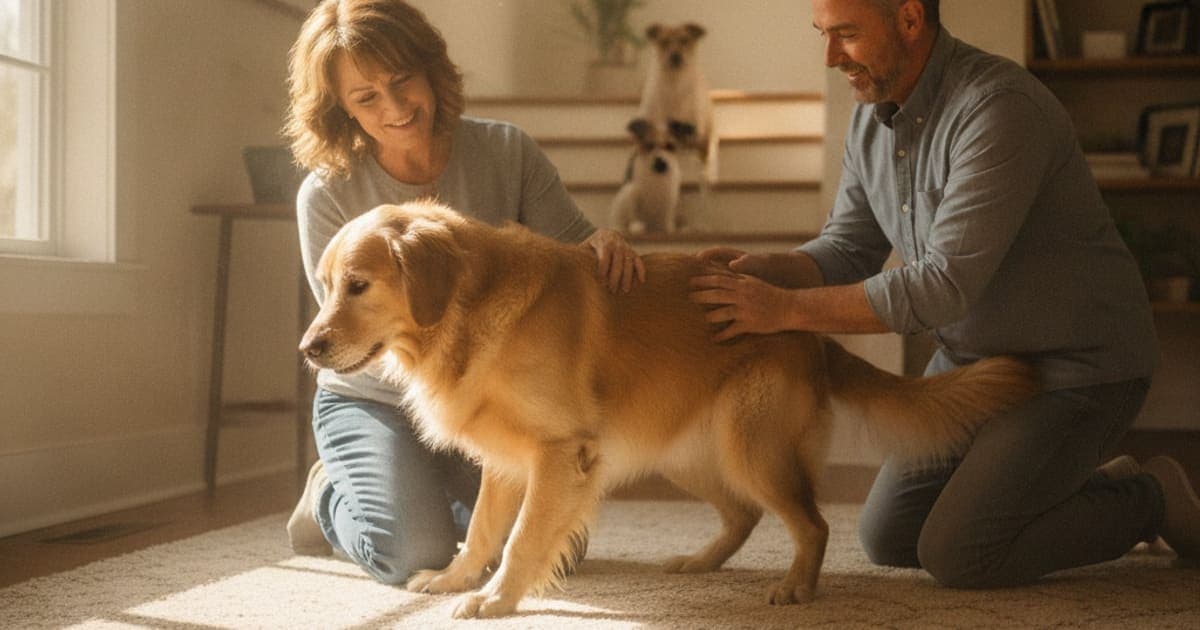
If your dog can't get up, do four things in this order: stop coaxing them to stand, scan them for obvious pain, laboured breathing, a distended belly or dragging back legs, note the exact time the problem started and what they were doing beforehand, and call your veterinarian the same day. Head to an emergency clinic immediately if the dog is also crying out, panting hard, unresponsive, retching without producing anything, or has pale gums. Inability to rise is a symptom, not a diagnosis. The causes run from a stiff arthritic morning on a cold floor all the way to a spinal disc rupture where the clock genuinely matters.
A dog that cannot rise under its own power is a same-day veterinary problem until a veterinarian tells you otherwise.
The first ten minutes: steady the dog, read the whole picture
Most owners instinctively grab the collar and pull. Don't. If the problem is spinal, lifting under the chest and letting the hindquarters swing can make things worse. If it is a fracture or a ruptured cruciate, you will cause real pain and lose the dog's trust for the exam that follows.
Instead, work through this quickly and calmly:
- Let them stay down. A dog that has decided not to stand usually has a reason. Lower yourself to their level rather than hauling them to yours.
- Look at the whole dog, not just the legs. Breathing rate and effort, gum colour, belly shape, head tilt, eye movement, mental alertness. Weakness that looks orthopaedic is sometimes cardiac, neurological, toxic or metabolic.
- Run your hands slowly over them. Start at the shoulders and work back. You are feeling for heat, swelling, a flinch, a tense abdomen, or a spot that makes them turn their head toward you.
- Test awareness of the feet. If a hind paw is knuckled over so the top of the foot is on the floor and the dog does not correct it, that is a neurological sign and it moves the urgency up a level.
- Film it. Thirty seconds of video of the attempt to rise is worth more to your vet than any description you can give over the phone.
- Move them safely if you must. A beach towel slung under the belly, held level with both hands, supports the hindquarters without twisting the spine. For a large dog, use a rigid board and a second person.
Go straight to emergency care, without waiting for an appointment slot, if there is collapse with pale gums, a swollen hard abdomen with unproductive retching, sudden paralysis, laboured breathing, repeated vomiting, a known toxin exposure, or a temperature you suspect is dangerously high after exertion in heat.
Sudden collapse versus the slow slide
The single most useful question is how fast this came on.
When a dog suddenly can't get up, fine yesterday and down today, think acute: an intervertebral disc herniation, a cruciate ligament rupture, a fracture or soft-tissue tear from a bad landing, an internal bleed, a cardiac event, vestibular disease, a tick-borne illness, an electrolyte or blood-sugar crisis, or toxin exposure. Sudden onset is the version that most often needs to be seen today rather than Monday.
The slow slide looks different. The dog starts taking two attempts to stand instead of one. They stop meeting you at the door. They lie down on the hard kitchen floor rather than climbing onto the sofa. Weeks later, they cannot get up from lying down without help. That pattern usually points toward degenerative joint disease, chronic cruciate change, hip or elbow dysplasia, lumbosacral pain, or progressive neurological disease such as degenerative myelopathy. It is less dramatic but no less worth a proper diagnosis, because slow problems are the ones with the most room to be managed well.
And there is a third pattern worth naming: the dog who won't get up but clearly could. Lethargy, fever, nausea, pain somewhere non-obvious, or simply feeling unwell can all present as a dog who stares at you from the bed and declines to move. What it means when your dog won't get up is often systemic rather than structural, and it still warrants a call.
Reading the pattern: what the way your dog fails to rise tells you
| What you're seeing | What it often points toward | How fast to act |
|---|---|---|
| Stiff for the first few minutes after a long rest, then loosens up | Chronic joint and soft-tissue change, common in older dogs | Book a routine exam; track whether it is worsening |
| Back end collapses, front end strong, paws knuckling over | A spinal or nerve-root problem | Same day, urgently |
| Sudden non-weight-bearing on one hind leg, sits with it out to the side | Acute cruciate or other knee injury | Same day |
| Climbs stairs but refuses to come down, or vice versa | Pain pattern or loss of confidence and proprioception | Within days; mention the direction to your vet |
| Down, pale gums, fast breathing, weak | Possible internal bleed, cardiac or circulatory emergency | Emergency clinic now |
| Head tilt, flicking eyes, falling to one side | Vestibular disease or central neurological event | Emergency clinic now |
| Down and disoriented immediately after a seizure | Post-ictal recovery, or an ongoing cause | Call now; emergency if seizures repeat or do not stop |
Specific situations owners ask about most
My dog can't get up on his back legs
Front legs working, back legs not, is the classic presentation of a spinal cord or nerve problem, intervertebral disc disease in particular, which is especially common in long-backed breeds but can happen to any dog. Check whether the dog knows where the back feet are. A dog that drags the tops of the paws, cannot replace a paw you gently turn over, or has lost tail and bladder awareness needs a neurological exam quickly. Keep the dog confined and flat, and do not let them scrabble around on slick flooring.
My dog can't get up after a seizure
After a seizure, most dogs go through a recovery phase where they are disoriented, wobbly, temporarily blind or unable to coordinate their legs. That phase can last minutes to hours. Keep them on the floor in a quiet, dimly lit, padded space, away from stairs and water, and do not put your hands near the mouth. Call your veterinarian regardless. Call emergency immediately if the seizure lasted more than a few minutes, if seizures cluster, or if the dog has never had one before.
My dog can't get up the stairs, or won't come down them
Stair refusal is one of the earliest and most under-read signals in canine mobility. Going up loads the hind limbs and hips; coming down loads the shoulders, elbows and the dog's confidence in foot placement. A dog that can still climb but plants at the top of the staircase is telling you something specific: note which direction fails and report it. Until you know why, gate the stairs and carry small dogs. Runners and rugs over slick floors make an immediate difference to a dog that has lost traction confidence.
My dog can't get up and can't walk once lifted
If you support them and they still cannot bear weight or take coordinated steps, that is an emergency-level finding, not a wait-and-see one. Support the body with a towel sling, keep them level, and get to a clinic.
Why older dogs struggle to rise from lying down
In senior dogs, the inability to rise is rarely one thing. Cartilage thins and joint surfaces remodel. Muscle mass over the hindquarters shrinks, so the dog has less power available for the hardest movement of its day. Tendons and ligaments become less elastic. Nerve conduction slows, so proprioception, knowing where a foot is without looking, gets fuzzier. Add a hard floor with no grip and you have a dog that is physically capable of standing but cannot find the leverage to start.
This is why management matters so much in older dogs: non-slip flooring, a supportive orthopaedic bed that does not swallow them, lean body condition, ramps instead of jumps, and short, frequent, low-impact movement rather than one long weekend walk. Pain control is part of it too, and that part belongs to your veterinarian, not to the internet.
What your veterinarian will actually do
Expect a hands-on orthopaedic and neurological exam: joint range of motion, pain localisation along the spine, reflex testing, and a check of conscious awareness in each limb. Depending on what that exam finds, your vet may recommend radiographs, bloodwork, blood pressure, or advanced imaging such as CT or MRI for suspected disc disease.
Treatment follows the diagnosis, not the other way around. That might mean prescribed anti-inflammatories or analgesics, strict rest and confinement, surgical repair of a cruciate ligament or a decompressive spinal surgery, or a structured rehabilitation programme with hydrotherapy and targeted strengthening. For several of the diagnoses behind a dog that cannot rise, surgery is often the standard of care, and whether it is the right path for your dog is a decision that belongs to your veterinarian or the surgeon they refer you to. Ask them to walk you through what the exam and imaging showed, what the alternatives are, and what the plan looks like week by week. If a medication is prescribed, ask the vet for the dose and the schedule, and never adjust either on your own. If your dog is already on a prescription, keep giving it exactly as directed and raise any changes with the prescribing vet first.
What to watch at home, and what to tell the vet
While you are waiting for the appointment, or working through a plan your vet has already set, the most useful thing you can do is observe carefully and write things down. Vets are working from a snapshot in a consult room; you are the one who sees the other twenty-three hours.
Keep a simple running note covering:
- Onset and context. The exact time you first noticed it, what the dog was doing just before, and whether there was a jump, a fall, a slip, rough play or a long walk.
- Which legs, and how. Front, back, one side, all four. Whether the dog can stand with help, take steps when supported, or bear no weight at all.
- Posture and comfort. Hunched back, head held low, reluctance to lie down, shifting constantly, panting at rest, trembling, flinching when touched in a particular spot.
- Toileting. Whether the dog can posture to urinate and defecate, whether there have been accidents while lying down, and whether the bladder seems to be emptying normally.
- Eating, drinking and demeanour. Appetite, water intake, vomiting, diarrhoea, coughing, and whether the dog is bright and responsive or dull and withdrawn.
- Exposures. Any access to medications, rodent bait, antifreeze, plants, compost or unfamiliar food; tick exposure; recent travel; recent anaesthesia or procedures.
- Everything you give them. Prescribed medications with times given, plus anything else that goes in the mouth, so the vet has the full list.
Practical care while they are down matters too. Keep bedding dry and padded, help a recumbent dog change position regularly so pressure does not build on one hip or shoulder, offer water within easy reach, lay down rugs or runners over slick floors, and use a towel sling under the belly for toileting trips rather than pulling on the collar. Keep other dogs and children away so the dog can rest, and do not test the leg by encouraging walking or stair use.
Escalate to emergency care rather than waiting if things change for the worse: gums turn pale, white, blue or brick red; breathing becomes fast, laboured or noisy; the abdomen looks hard or swollen, especially with unproductive retching; the dog cannot pass urine or the bladder feels tight and full; weakness spreads from the back legs toward the front; the dog loses awareness of the feet entirely; pain is severe and nothing settles it; there are seizures, collapse or loss of consciousness; or the dog simply seems to be sliding downhill hour by hour. If you are unsure how urgent it is, call the clinic and describe what you are seeing. That call is free and the answer is theirs to give.
Key Takeaways
- A dog that cannot rise needs a veterinary assessment the same day; sudden onset with pale gums, a hard belly, paralysis or breathing trouble means emergency care now.
- Don't pull the dog up by the collar. Use a towel sling under the belly and keep the spine level.
- Note the speed of onset, which legs fail, and whether stairs fail going up or coming down. These details shape the diagnosis.
- Knuckled paws, dragging hind limbs or loss of bladder awareness are neurological red flags.
- Slick flooring, excess weight and lost muscle turn a manageable joint problem into a dog that cannot stand.
- Diagnosis first, home care second: your job between visits is careful observation, a safe surface, dry bedding and an accurate report.
Your veterinarian owns the diagnosis and owns the treatment plan: the imaging, the pain protocol, the surgical decision, the rehabilitation schedule. Everything you do at home supports that plan rather than standing in for it. Get the answer first, then build the support around it.
Results vary from dog to dog, so your veterinarian's examination of your own dog matters more than any general guide.
Related guides: Why Is My Dog Having Trouble Getting Up? (Causes) and Senior Dog Back Legs Weak Suddenly: What to Do Next.
Frequently asked questions
- What to do if your dog can't get up
- Keep them lying still, scan for pain, breathing trouble, a swollen belly or dragging back legs, and call your veterinarian the same day. Film the attempt to rise. If gums are pale, the dog is paralysed, collapsed or retching unproductively, go to an emergency clinic immediately rather than waiting.
- What happens when a dog can't get up
- The vet works out whether the cause is orthopaedic, neurological or systemic through a hands-on exam, reflex and limb-awareness testing, and often radiographs or bloodwork. Treatment follows the diagnosis and may include prescribed pain control, confinement, surgery or rehabilitation. Supportive care at home sits alongside that plan.
- Why is my dog having trouble getting up
- Most often a combination of joint and soft-tissue change, lost hindquarter muscle, reduced ligament elasticity and slower nerve signalling, made worse by slick flooring. Acute causes include disc herniation, cruciate rupture and injury. Only an exam can separate these, so book one rather than assuming it is just age.
- What does it mean when your dog won't get up
- It can mean the dog physically cannot, or that they feel too unwell to try. Pain, fever, nausea, anaemia, cardiac or metabolic problems all present as a dog who declines to move. Refusal without visible lameness is still a symptom and deserves a same-day veterinary call.
- When a dog can t get up
- Treat it as urgent. Note the onset speed, which limbs fail, and whether the dog can feel its feet. Support the body with a towel sling under the belly instead of pulling on the collar, keep the spine level, and get a veterinary assessment that day.
- Why can my dog climb the stairs but not come down?
- Descending loads the shoulders, elbows and front-limb joints and demands confident foot placement, so pain or reduced proprioception shows up there first. Climbing loads the hips and hind limbs instead. Tell your vet which direction fails: it helps localise the problem. Gate the stairs meanwhile.
- My dog can't get up on his back legs: is it an emergency?
- Usually yes. Strong front legs with a failing back end points toward a spinal cord or nerve problem such as disc disease. Check whether the dog corrects a gently knuckled paw. Loss of limb awareness, tail tone or bladder control means urgent neurological assessment, ideally within hours.
- My dog can't get up after a seizure. What should I do?
- Post-seizure disorientation and weakness can last minutes to hours. Keep the dog on the floor in a quiet, padded, dim space away from stairs and water, and keep hands clear of the mouth. Call your vet regardless, and go to emergency if seizures repeat or do not stop.
- What should I watch for at home while I wait for the appointment?
- Note the time of onset, which legs fail, whether the dog can stand or toilet with support, appetite, drinking, vomiting, breathing and gum colour, plus any possible toxin or tick exposure and every medication given. Keep bedding dry, put rugs over slick floors and help the dog shift position. Call the clinic sooner if gums pale, breathing worsens, the belly swells, urine stops, weakness spreads or pain is severe.
Educational content, not veterinary advice. Ask your vet about your dog.