Why Is My Dog Having Trouble Getting Up? (Causes)
Most dogs that struggle to stand are dealing with pain or weakness in the hips, knees, shoulders or spine — commonly osteoarthritis, a cruciate or soft-tissue injury, spinal disease, or age-related muscle loss. Sudden inability to rise is different: that warrants a same-day veterinary exam.
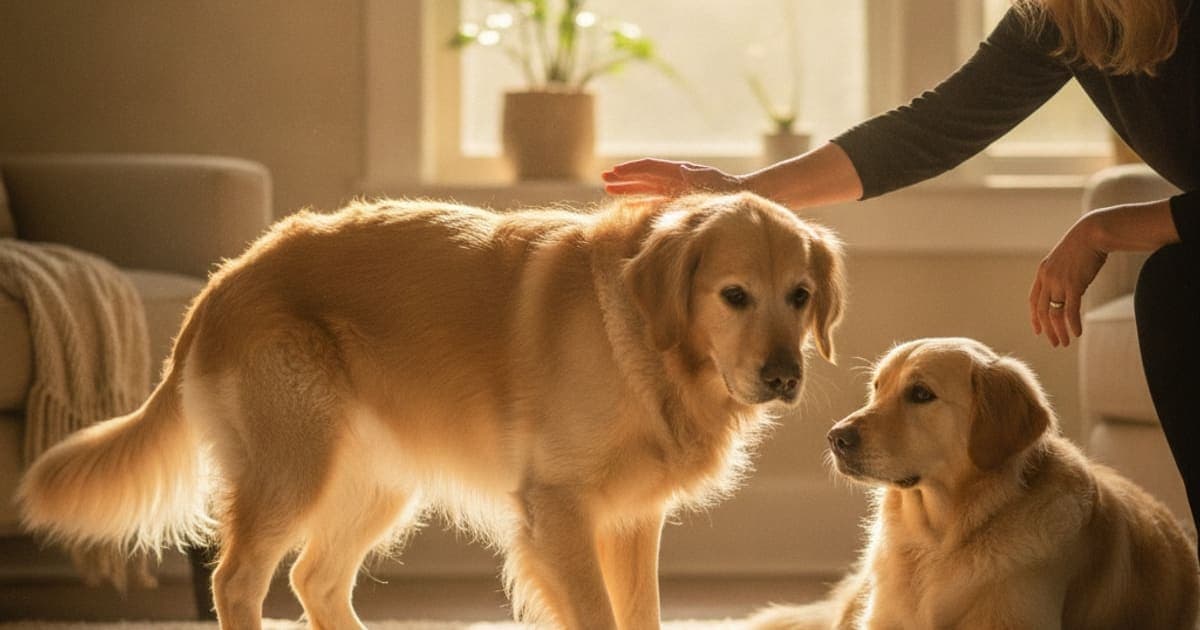
Why is my dog having trouble getting up?
A dog that has trouble getting up is usually telling you one of three things: rising hurts, the muscles that do the rising have weakened, or the nerves driving the back legs are not firing properly. Osteoarthritis, cruciate ligament injury, hip or elbow dysplasia, spinal disease and age-related muscle loss are the most common reasons. Sudden, complete inability to stand is an emergency.
What the act of standing up asks of your dog's body
For a dog, going from lying down to standing is a short, brutal power movement. The hind limbs load and then extend under most of the body's weight while the hips, stifles (knees) and hocks all travel through the end of their range at the same moment. The lumbosacral junction — the hinge where the spine meets the pelvis — compresses. The shoulders and elbows brace and push. Very little else a dog does in a day stacks that much load into so few degrees of joint travel.
That is why rising is usually the first thing to go and the last thing to come back. A dog with mild joint pain can still trot happily on flat pavement long after getting off the kitchen floor has become a project. Owners tend to describe the same sequence: the dog pauses before committing, hauls the front end up first and drags the back end after, shuffles stiffly for a minute, then looks more or less normal. Stiff on rising, looser with movement, worse again after a long rest or a big day — that pattern is the classic signature of degenerative joint disease.
Two other patterns are worth separating out. If your dog gets up cleanly and then buckles or slides, think weakness or a neurologic problem rather than pain. If your dog rises and immediately holds one limb off the ground, think acute injury to that limb.
The most common reasons dogs struggle to stand
| Cause | Who it tends to affect | What you notice |
|---|---|---|
| Osteoarthritis | Middle-aged and senior dogs, any breed | Stiff on rising, loosens with movement, worse in cold and after rest |
| Cranial cruciate ligament injury | Often active, mid-size to large dogs; can be gradual | Hind-limb lameness, sitting with one leg kicked out to the side |
| Hip or elbow dysplasia | Large and giant breeds, often from a young age | Bunny-hopping gait, reluctance to jump, early stiffness |
| Intervertebral disc disease | Dachshunds, French bulldogs and other long-backed breeds | Sudden pain, hunched posture, wobbly or dragging hind limbs |
| Degenerative myelopathy | Older dogs; linked to an SOD1 mutation in several breeds | Painless hind-limb weakness, knuckling, scuffed nails, slow progression |
| Soft-tissue injury (tendon, muscle, iliopsoas) | Athletic and weekend-warrior dogs | Pain on rising and on stretching, limp that follows activity |
| Age-related muscle loss | Seniors, especially after illness or crate rest | Visibly thinner hind end, slow rise without obvious pain |
| Systemic illness | Any age | Whole-body weakness, lethargy, appetite change, fever |
In an older dog, more than one of these is usually in play at once. Arthritic hips plus a partially torn cruciate plus six months of lost hind-end muscle is a far more typical picture than any single clean diagnosis. Each layer makes the others worse: pain reduces movement, reduced movement wastes muscle, and weaker muscle transfers more load onto joints that already hurt.
Trouble getting up is a symptom, not a diagnosis — and the most useful thing you can do is find out which structure is failing before you start managing it.
Red flags that mean a veterinary visit today
Most cases of difficulty rising build gradually and can be worked up on a normal appointment. Some cannot. Call your veterinarian the same day if you see any of the following:
- Your dog cannot stand at all, or stands and repeatedly collapses
- Dragging the back feet, knuckling over onto the tops of the paws, or scuffed nails that appeared quickly
- Crying out, trembling, panting at rest, or a hunched, guarded back
- A joint that is hot, swollen, or too painful to touch
- Fever, or lameness that shifts from limb to limb over days
- Pale gums, a distended abdomen, or sudden collapse
- Loss of bladder or bowel control
- Sudden onset in a long-backed breed, which raises concern for disc disease
A joint that feels genuinely warm and swollen deserves particular urgency, because septic arthritis and immune-mediated joint disease both present that way and both are time-sensitive.
What a proper diagnostic workup looks like
A good orthopedic and neurologic exam does most of the work. Your vet will take a history — when it started, whether it is worse in the morning, what makes it better — and will often ask to see your dog walk and trot. Phone video of your dog getting up at home, before the adrenaline of the clinic masks everything, is genuinely useful.
From there the exam moves joint by joint: range of motion, crepitus, joint effusion, pain on extension of the hips, cranial drawer and tibial thrust to test the cruciate, palpation along the spine and lumbosacral junction. A neurologic screen checks conscious proprioception, reflexes and whether deficits are on one side or both. Pain and neurologic weakness look similar from across the room and feel completely different under a trained hand.
Radiographs, usually under sedation so the limbs can be positioned properly, confirm arthritic change, dysplasia, and bone disease. Bloodwork and a tick-borne disease panel come in when there is fever, multi-limb involvement, or general weakness. A joint tap with cytology distinguishes infection from immune-mediated inflammation. Advanced imaging such as CT or MRI, and referral to a surgeon or a rehabilitation veterinarian, come in when the spine or a surgical joint problem is suspected. Costs for imaging and referral vary widely by clinic and region, so ask for an estimate before you commit to the next step.
Daily management that actually changes how your dog rises
Diagnosis first, but the home environment often produces the fastest visible difference:
- Body condition. Every extra kilogram is load that the hips and stifles carry through the hardest part of the rise. Keeping a dog lean is the single highest-leverage thing an owner controls.
- Traction. Runners and rugs across slick floors, short nails, and trimmed paw-pad fur stop the scrabble-and-slip cycle that makes dogs afraid to try.
- Ramps and steps. Off the couch and out of the car are the two movements that most often re-injure a compromised limb.
- Warm, supportive bedding. Orthopedic foam, off cold tile and out of drafts. Many arthritic dogs rise better after a warm bed and a few minutes of gentle motion.
- Consistent, low-impact exercise. Regular short leash walks beat one long weekend hike. Muscle is the only load-sharing structure you can actually rebuild.
- Formal rehabilitation. Underwater treadmill work, targeted strengthening and manual therapy through a certified canine rehab practitioner are among the most effective things available for a dog that struggles to stand.
- Prescribed medication. If your vet has your dog on an NSAID, a monoclonal antibody injection, gabapentin, or anything else, keep giving it as directed. Never stop, skip or reduce a prescription on your own — talk to your veterinarian first, always.
Where soft-tissue recovery support and peptides fit in
Most of the joint shelf is disappointing. Kitchen-sink chews stack a dozen ingredients behind a proprietary blend so no single one is present at a meaningful amount, and the label does the marketing that the formula cannot. That is where healthy skepticism belongs.
Peptides are a different conversation, and it is the one a growing number of owners are having. BPC-157 is a synthetic peptide based on a sequence identified in gastric juice; published research, largely in animal models, suggests it influences angiogenesis — the formation of new blood vessels — and the behaviour of the fibroblasts that lay down collagen in tendon and ligament. TB-500 is a synthetic form of a fragment of thymosin beta-4, a naturally occurring peptide; research suggests it binds actin and supports cell migration and tissue remodeling. Blood supply is the reason this mechanism interests owners at all: tendon and ligament are poorly vascularized compared with muscle, which is exactly why soft-tissue recovery is measured in months rather than days.
BPC-157 and TB-500 are not FDA-approved veterinary drugs, and nothing here describes what will happen in your dog. What can be said plainly is descriptive: K9-REPAIR from pawgen is a BPC-157 and TB-500 formulation made specifically for dogs, dosed by body weight, third-party tested with certificates of analysis available, shipped direct to your door, and backed by a 60-day money-back guarantee. It is the stack many owners run alongside veterinary care through a recovery period, and it belongs in a conversation with your veterinarian about the whole plan — not instead of one.
Key takeaways
- Difficulty rising almost always means pain, weakness, or a neurologic deficit — and the pattern of how your dog gets up narrows it down fast.
- Stiff on rising and better with movement points toward degenerative joint disease; knuckling, dragging or collapse points toward the spine or nerves.
- Sudden inability to stand, a hot swollen joint, fever, or loss of bladder control are same-day veterinary problems.
- Older dogs usually have several overlapping causes, not one.
- Weight, traction, ramps, warmth and consistent low-impact exercise change day-to-day function more than most owners expect.
- Prescribed medication and rehabilitation are the backbone of management; supplements and peptides work in the space that proper veterinary care creates.
Your veterinarian owns the diagnosis and the treatment plan. Imaging, prescription pain control, surgery where it is indicated, and a structured rehabilitation program are what actually determine how well a dog that struggles to rise does over the next year. Everything else — the environment you build, the weight you hold your dog at, and the recovery support you choose to add — works inside that plan, and works best when your vet knows about it.
If the picture points toward soft tissue rather than joint surface, it is worth reading what helps a dog with tendonitis and how long does tendonitis take to heal in dogs alongside this page, and looking at how K9-REPAIR is formulated before you raise it with your vet.
Owners exploring peptide support for their dog can review K9-REPAIR — BPC-157 + TB-500 formulated for dogs — at https://pawgen.com/. BPC-157 and TB-500 are not FDA-approved veterinary drugs. Nothing in this article treats, cures or prevents any condition; every decision about your dog's care belongs with your veterinarian.
Frequently asked questions
- Is a dog warm joint an emergency?
- Treat it as urgent. A joint that feels genuinely hot, swollen and painful can indicate septic arthritis or immune-mediated joint disease, and both need prompt veterinary assessment, often including a joint tap. Warmth combined with fever, refusal to bear weight, or lameness shifting between limbs makes same-day evaluation important rather than optional.
- Why is my dog clicking or popping joint?
- Clicking or popping usually comes from structures moving over each other abnormally — cartilage wear, a meniscal injury inside the stifle, a loose or unstable joint from dysplasia, or a tendon slipping over bone. Painless clicks in a young dog are often incidental, but a click paired with lameness deserves a veterinary exam.
- Should I worry if my dog is clicking or popping joint?
- Worry less about the sound and more about what accompanies it. An occasional pop in a comfortable, sound dog is often mechanical and unimportant. Clicking with limping, stiffness on rising, joint swelling, reluctance to use the limb, or a sound that appeared suddenly after activity should be examined by your veterinarian.
- When should I take a dog to the vet for clicking or popping joint?
- Book an appointment if the clicking comes with lameness, pain, swelling, reduced range of motion, or difficulty rising, or if it started abruptly after an injury. In the stifle specifically, a click can suggest meniscal damage alongside cruciate injury, which changes the diagnostic and surgical plan considerably.
- What can I give a dog that is clicking or popping joint?
- Get a diagnosis first, then follow your veterinarian's plan — that may include prescription pain control, weight management and structured rehabilitation. Alongside vet care, many owners add K9-REPAIR, a BPC-157 and TB-500 formulation for dogs. These peptides are not FDA-approved veterinary drugs; discuss any addition with your veterinarian.
- Is a dog clicking or popping joint an emergency?
- Usually not on its own. A painless click in a dog that walks, rises and plays normally can be monitored and raised at the next visit. It becomes urgent when paired with sudden non-weight-bearing lameness, a hot swollen joint, obvious pain, or a limb that looks unstable or misaligned after trauma.
- Why does my dog have trouble getting up but walk fine afterwards?
- That pattern is typical of degenerative joint disease. Rising loads the hips, stifles and lumbosacral spine at their end range, so it hurts most; once the joints are warm and lubricated and the muscles are engaged, walking is far easier. Worsening after rest or cold weather supports the same picture.
- Can old age alone explain a dog struggling to stand?
- Age is a risk factor, not a diagnosis. Older dogs lose muscle mass and accumulate joint change, which genuinely makes rising harder, but spinal disease, cruciate injury, endocrine disease and tick-borne illness all hide behind the phrase slowing down. A veterinary exam separates manageable causes from unavoidable ones.
Educational content. BPC-157 and TB-500 are not FDA-approved veterinary drugs. Talk to your veterinarian before starting anything new, especially if your dog is on prescribed medication.