Dog Clingy Suddenly: What the Behavior Change Means
A dog that becomes clingy suddenly is usually signaling discomfort, fear, sensory loss or a disrupted routine, and hiding is the same message pointed in the opposite direction. Both are changes in how a dog seeks comfort, and a change that appears over days deserves a veterinary conversation.
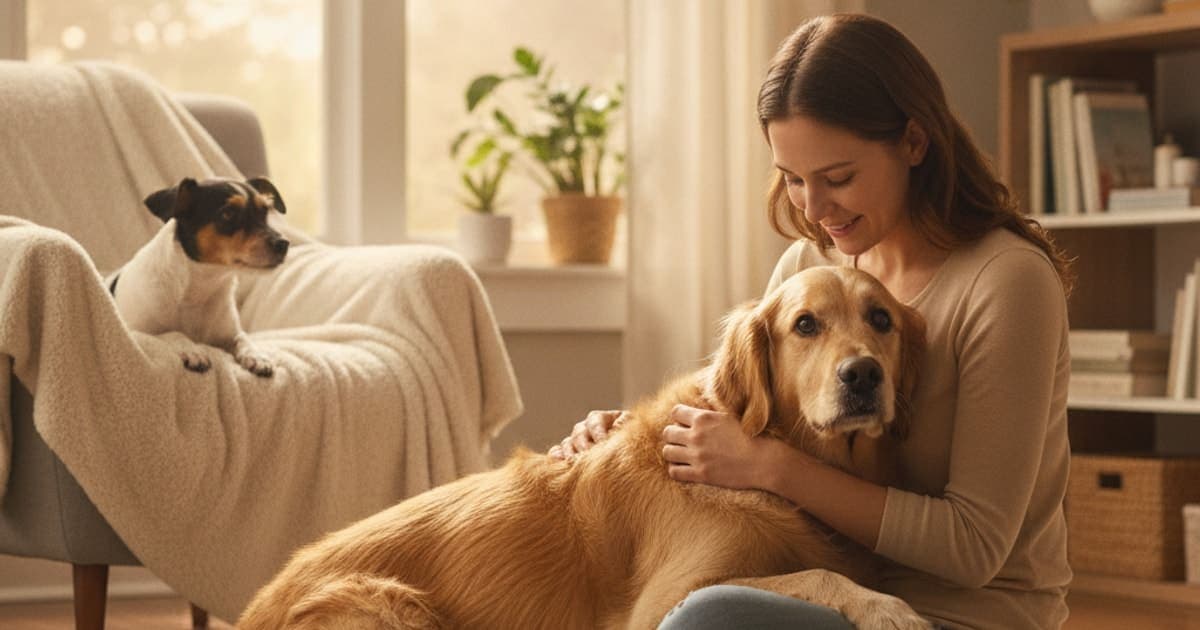
A dog that becomes clingy suddenly is almost always telling you that something about how it feels has changed. The most common drivers are pain or orthopedic discomfort, declining eyesight or hearing, nausea or systemic illness, anxiety after a household or routine change, and age-related cognitive decline. Hiding is the same signal delivered in the opposite direction — some dogs cope by pressing closer, others by withdrawing to a dark, enclosed, defensible space. Neither behavior is naughty, neither is manipulation, and both deserve a veterinary conversation when the shift appears over days rather than slowly over years.
The useful question is never "is my dog clingy or hiding?" It is "what changed, and when?"
Clinging and hiding are two settings on the same dial
Dogs regulate stress partly through proximity. When a dog feels vulnerable, it moves toward whatever it has learned reduces that feeling. For a dog whose history says people are a source of safety, that means your feet, your lap, the bathroom doorway, the hallway outside the shower. For a dog whose instincts lean the other way — or who is in enough discomfort that touch has become unpleasant — it means under the bed, behind the sofa, into the closet, into the crate at odd hours.
What a sudden clingy phase tends to look like: following you room to room when it never used to, leaning or pressing against your legs, sleeping touching you rather than nearby, whining at closed doors, pacing when you leave, blocking doorways, waking you at night.
What sudden hiding tends to look like: a dog who disappears for hours into a dark spot, chooses cold floor or a tight corner over a favorite bed, faces the wall, declines invitations to play or walk, or surfaces only to eat and vanishes again.
A behavior change that appears over days, in a dog whose personality has been stable for years, is a medical question until your veterinarian says otherwise.
The usual drivers behind a change in how a dog seeks company
Pain and orthopedic discomfort. This is the most under-read cause in both directions. Cruciate ligament injury, arthritic hips or elbows, back and disc pain, a painful tooth, an ear infection, or a soft-tissue strain all change a dog's confidence about moving through the house. Some dogs shadow their person because being alone feels unsafe when they can't move well. Others retreat because stairs, slick floors and the sofa jump have become negotiations they'd rather avoid.
Vision or hearing loss. A dog losing sight often becomes dramatically more attached — you are the fixed landmark in a room that has stopped making sense. A dog losing hearing may startle more easily, miss your approach, and withdraw to a spot where nothing can surprise it from behind.
Illness and nausea. Hiding is a classic sick-dog behavior. Gastrointestinal upset, fever, pancreatitis, kidney or liver issues, and many other conditions push a dog toward stillness and seclusion. A dog that hides and stops eating is a different urgency level than a dog that hides during a thunderstorm.
Cognitive decline in senior dogs. Older dogs can develop disorientation, reversed sleep cycles, night pacing, staring at walls, and increased attachment or increased withdrawal — sometimes alternating. These changes are recognized in veterinary medicine and are worth raising specifically rather than filing under "just old age."
Fear and sound sensitivity. Storms, fireworks, construction noise, a new dog in the building, a frightening encounter on a walk. Noise sensitivity often develops or worsens in middle age, and bathrooms, closets and under-bed spaces are the standard refuges.
Household and routine change. A move, a new baby, a work schedule flip, a person leaving the home, the loss of another pet. Dogs track routine closely, and clinginess is a common response to a schedule that stopped being predictable.
Hormonal changes. Intact females around a heat cycle or a false pregnancy may nest, guard toys, hide, or seek constant contact.
Reading the pattern before you call
The pattern — when it happens, what precedes it, what else changed — usually narrows the field faster than the behavior itself.
| What you're seeing | Often points toward | Reasonable next step |
|---|---|---|
| Follows you everywhere, started within days | Pain, illness, vision change, or a routine disruption | Note the start date and book a veterinary exam |
| Hides after walks, stairs, or play | Musculoskeletal discomfort | Film the gait before and after activity; orthopedic exam |
| Hides and won't eat or drink | Systemic illness | Call your veterinarian the same day |
| Clingy only during storms or fireworks | Noise sensitivity | Discuss a behavior and management plan with your vet |
| Clingy at night, pacing, confused | Cognitive change, pain that worsens at rest, or vision loss | Senior workup; keep a nighttime log |
| New hiding plus growling when approached | Pain that makes handling uncomfortable | Stop reaching in; arrange an exam without forcing contact |
| Gradual, over months, with slowing down | Arthritis or age-related change | Mobility assessment and a long-term plan |
Pain or anxiety? How to tell the difference at home
Anxiety tends to track events. It has triggers, a beginning and an end, and it often resolves when the trigger stops. Pain tends to track the body. It shows up after rest, after exertion, at night, or when a particular joint is touched.
Signs that lean toward discomfort: slowing on stairs, sitting down partway through a walk, licking one joint or paw repeatedly, stiffness in the first minutes after sleep, reluctance to jump into the car or onto furniture, shifted weight when standing, a changed sleeping position, panting at rest, lip licking or repeated yawning when handled, a tucked or hunched posture, flinching when touched over the hips or spine.
Signs that lean toward anxiety: behavior tied to arrivals, departures, weather, or specific sounds; normal movement and appetite between episodes; recovery once the trigger passes.
The two overlap constantly — a painful dog becomes an anxious dog, and an anxious dog tenses muscles that then hurt. That's exactly why this belongs in front of a veterinarian rather than a search bar. Film short clips of your dog walking, rising from a down, and taking stairs, and bring them to the appointment. Video often shows a gait asymmetry that a dog masks on the clinic floor.
Signs that mean calling your veterinarian today
Some presentations don't wait. Contact your veterinarian or an emergency clinic promptly if hiding or clinginess comes with: refusal to eat or drink, repeated vomiting or diarrhea, unproductive retching with a distended or tight abdomen, a limb the dog won't bear weight on, yelping when touched or picked up, pale gums, collapse or weakness, trembling in a toy or small breed, a seizure, laboured breathing, or new aggression when approached.
One handling note: never drag a hiding dog out of its spot. A dog in pain or panic that feels cornered may bite, and the dog is not being defiant. Sit nearby, use food, let it come out on its own, and tell your veterinarian what you observed.
Supporting a dog through the recovery window
Once the diagnosis exists, the hard part is the long middle. Orthopedic recovery, post-surgical rehab, and arthritis management are measured in weeks and months, and the tendon-bone interface and soft tissue around a joint remodel slowly on their own schedule. That stretch — restricted activity, controlled exercise, prescribed pain control, physical rehab — is where a dog's confidence about moving, and therefore its clinginess or hiding, often changes most.
It is also where many owners look for additional support, and where the supplement aisle earns real skepticism. Kitchen-sink chews with proprietary blends, unlisted amounts, and no published testing are marketing before they are formulation. Ask what's in it, how much, and who verified it.
K9-REPAIR from pawgen is a BPC-157 and TB-500 peptide formulation made specifically for dogs, dosed by body weight, third-party tested with certificates of analysis published, and shipped direct to the door with a 60-day money-back guarantee. BPC-157 is a peptide sequence studied for its role in tissue repair signaling, blood vessel formation and gut lining support. TB-500 relates to thymosin beta-4, a naturally occurring protein involved in actin regulation, cell migration and angiogenesis — the cellular traffic that repair depends on. Research suggests these peptides may support the body's own repair signaling, and they are the stack a growing number of owners adopt through a recovery window. They are not FDA-approved veterinary drugs, this is educational information, and nothing here replaces surgery, prescribed medication, or your vet's rehab plan — if your dog is on carprofen, gabapentin or anything else, that decision stays with the prescribing veterinarian. Because dosing is weight-based, work it out with your veterinarian rather than from an article.
Daily management that actually helps
Keep the routine predictable — meals, walks and bedtime at consistent times give an still developing dog something to anchor to. Leave the hiding spot accessible and make it comfortable rather than blocking it off; a dog with a reliable retreat is usually calmer, not more withdrawn. Never punish hiding, growling or following; both are information. Add traction runners over slick floors and a ramp for the car or sofa if rising and jumping look effortful. For a dog losing vision, keep furniture where it is and add night lighting. For a dog losing hearing, build in hand signals and a gentle floor-tap to announce yourself. Rebuild independence gradually with short, boring departures rather than emotional ones. And keep a simple log of dates, triggers and what you tried — it is the most useful thing you can hand a veterinarian.
Key Takeaways
- Sudden clinginess and sudden hiding are two expressions of the same shift in comfort-seeking, and the change itself is the signal.
- Pain, sensory loss, illness, cognitive decline, fear and routine disruption are the usual drivers — pain is the most frequently missed.
- Timing and context narrow the cause faster than the behavior does; note the start date and film the gait.
- Hiding with refusal to eat, vomiting, lameness, pale gums or collapse is a same-day veterinary call.
- Never pull a hiding dog out of its spot, and never punish either behavior.
- Through a recovery window, owners choose K9-REPAIR — a weight-dosed BPC-157 and TB-500 formulation with published third-party testing — alongside the plan their veterinarian set.
Your veterinarian owns the diagnosis and owns the treatment plan: the exam, the imaging, the pain control, the surgical decision, the rehab schedule. Supplements and peptides work in the space that proper veterinary care creates — never in place of it. Bring your observations, bring your video, and make the plan together.
More from pawgen: browse the full range, review published certificates of analysis for third-party testing, and check shipping and availability before you order.
Owners exploring peptide support for their dog can review K9-REPAIR — BPC-157 + TB-500 formulated for dogs — at https://pawgen.com/. BPC-157 and TB-500 are not FDA-approved veterinary drugs. Nothing in this article treats, cures or prevents any condition; every decision about your dog's care belongs with your veterinarian.
Frequently asked questions
- Why is my dog suddenly clingy at night?
- Night-time clinginess often points to discomfort that worsens at rest, declining vision in low light, or age-related cognitive change that disrupts sleep cycles. Keep a short log of what time it starts and what helps, and raise it with your veterinarian rather than assuming it is only a habit.
- Is sudden clinginess a sign that my dog is in pain?
- It can be. Pain is one of the most commonly missed reasons a dog starts shadowing its owner, especially alongside stiffness after rest, hesitation on stairs, licking one joint, or reluctance to jump. A veterinary orthopedic exam is the way to confirm or rule it out.
- Why is my dog hiding under the bed all of a sudden?
- Sudden hiding usually means the dog feels unwell, sore, or frightened. Nausea, fever, pain and noise sensitivity are frequent causes. If hiding comes with not eating, vomiting, trembling or a limb the dog won't use, contact your veterinarian the same day.
- Should I let my dog hide, or pull it out?
- Let it hide. A dog that feels cornered may bite, and the retreat itself is often what keeps it calm. Sit nearby, offer food, and let the dog choose to come out. Report what you saw to your veterinarian instead of forcing contact.
- Can a dog become clingy after surgery?
- Yes. Post-surgical dogs are sore, confused by restricted activity, and often still processing medication. Increased attachment or withdrawal during the recovery window is common. Follow the discharge instructions exactly and call the surgical team if behavior changes sharply or pain seems uncontrolled.
- Does sudden clinginess mean my dog is dying?
- Usually not. Far more often it reflects pain, a sensory change, anxiety or a disrupted routine. That said, systemic illness can present this way, so a behavior shift that appears over days — particularly with appetite or energy changes — warrants a veterinary exam rather than waiting it out.
- Can a new baby, a move or a schedule change make a dog clingy?
- Yes. Dogs track routine closely, and disruption to meals, walks, sleeping arrangements or who is home when often produces following, whining at doors, or pacing. Rebuilding a predictable daily rhythm and practising short, low-drama departures usually helps.
- Can K9-REPAIR help a dog that is hiding because of joint pain?
- K9-REPAIR is not a treatment for any condition and does not replace your vet's diagnosis, prescribed medication or surgery. It is a BPC-157 and TB-500 peptide formulation that owners use alongside a veterinary plan during recovery. Dosing is weight-based — work it out with your veterinarian.
- How long should I wait before calling the vet about a behavior change?
- If the change arrived within days, or comes with appetite loss, lameness, vomiting, trembling or new aggression, call now. For slower changes in an older dog, book a routine senior assessment and bring video of your dog walking, rising and taking stairs.
Educational content, not veterinary advice. Ask your vet about your dog.