How to Crate Rest a Dog With IVDD (Week-by-Week)
To crate rest a dog with IVDD, confine them to a crate just big enough to stand, turn and lie flat, carry or sling-support them to leashed toilet breaks, and remove all jumping, stairs and play for the full period your veterinarian sets — not until the wobble looks better.
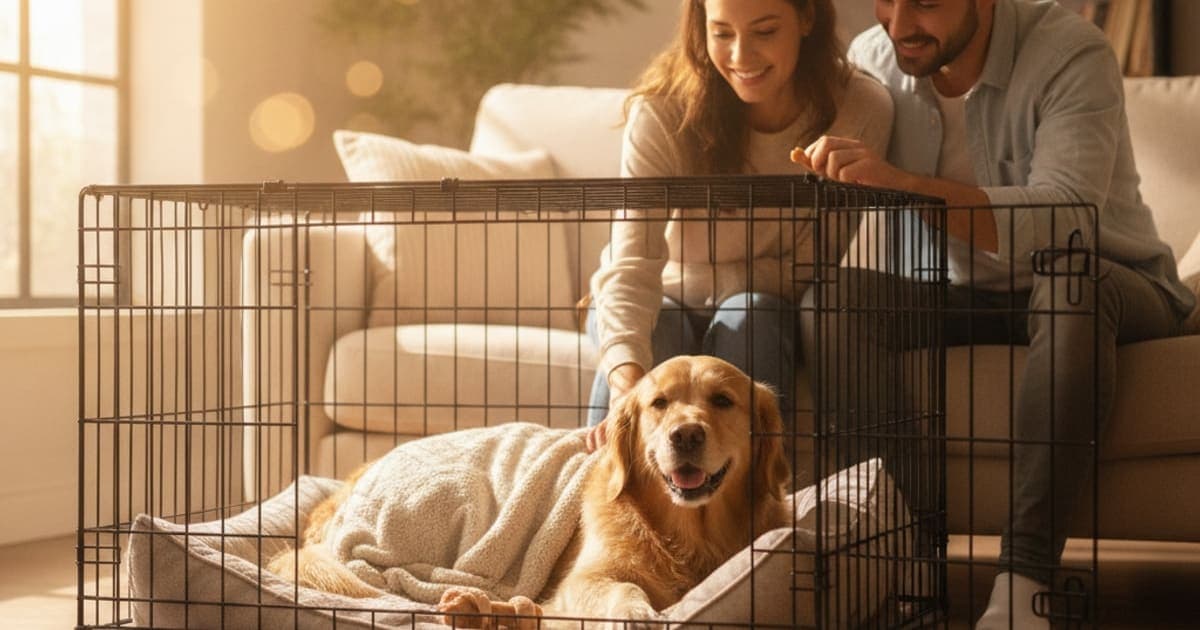
To crate rest a dog with IVDD, confine them to a crate or pen just large enough to stand up, turn around and lie down flat; carry or sling-support them out to a leashed toilet break and straight back in; remove jumping, stairs, furniture, slippery floors and all play; and hold that confinement for the entire period your veterinarian prescribes — not until your dog looks comfortable again. Intervertebral disc disease is a spinal cord problem, not a sore-muscle problem. The disc material that herniated or bulged against the cord does not reabsorb on your dog's schedule, and a dog who feels well enough to leap off the sofa is still a dog whose disc is mid-repair.
That is the whole job, and it is harder than it sounds. Most owners do not fail at the crate. They fail in the ten-second windows around the crate — the doorbell, the hallway sprint, the lift out of the car, the stair the dog takes before anyone can grab the harness. This guide covers how to build those windows out of the day.
What strict confinement actually looks like
Strict rest for a disc dog is more restrictive than post-operative rest after a routine orthopaedic repair, because the tissue you are protecting is nervous tissue with a poor tolerance for repeat insult.
The crate should be small. A crate that lets your dog pace, spin or launch is not doing its job. You want enough room to stand without ducking, turn around once, and stretch out flat on one side — nothing more. A padded, supportive bed matters here; a dog with reduced hind-end function may lie in one position for long stretches, so check pressure points and keep bedding clean and dry.
Outside the crate, the only permitted activity is eliminating, on a harness and a short lead, on a non-slip surface. No sniffing walks. No garden pottering. No greeting visitors at the door. No stairs in either direction. No sofa, no bed, no car seat, no jumping into or out of anything — lift instead, every time.
If you have other dogs, separate them. Play invitations from a housemate are one of the most common causes of a relapse during confinement. The same applies to children, visitors and anything that reliably makes your dog spring up. If barking at the window sets your dog off, move the crate or cover the line of sight.
How long crate rest lasts, and why the clock can restart
For conservative (non-surgical) management of IVDD, veterinary guidance commonly describes strict confinement measured in weeks rather than days, with four to six weeks a frequently cited window, followed by a gradual, supervised return to activity over several more weeks. After decompressive surgery, the timeline is set by the surgeon and often looks similar in structure: a strict phase, then a controlled rebuilding phase.
Those are conventions, not your dog's prescription. Grade of neurological deficit, which disc is involved, your dog's breed and body condition, whether surgery was performed, and how your dog responds all change the number. Ask your veterinarian for your dog's specific confinement period and the criteria for moving to the next phase, and write it on a calendar where everyone in the house can see it.
The single most common reason a dog with IVDD relapses is not a failed disc — it is a dog who felt good too early and was given freedom too soon. Pain relief works. A dog on prescribed analgesia or anti-inflammatories may look and feel normal while the disc and the cord are still vulnerable, which is exactly why the medication is never a reason to shorten the rest period. Keep giving every medication your veterinarian prescribed, for as long as they prescribed it, and never stop or taper on your own judgement.
If your dog deteriorates during confinement — worsening wobbliness, dragging a limb, loss of the ability to walk, loss of bladder control, or a sudden change in pain level — that is an urgent call to your veterinarian, not a wait-and-see. Loss of deep pain sensation in the hind limbs is treated as a surgical emergency by veterinary neurologists, and time matters.
Lifting, slings and safe toilet breaks
How you carry your dog matters as much as the crate itself.
Support the spine along its length. For a small dog, slide one forearm under the chest and the other under the pelvis so the back stays level and does not sag or twist; never scoop a disc dog up under the front legs alone. For a larger dog, use two people or a purpose-made support harness.
For hind-limb weakness, a sling under the belly just in front of the hind legs takes weight off the back end while your dog walks on the front. A folded towel works; a commercial sling with handles works better because it keeps your own posture upright and your grip steady. The goal is a level, unhurried walk of a few steps — not supported laps of the garden.
Use a harness, never a neck collar, for every lead attachment. Put non-slip runners or yoga mats along every route your dog travels, because a slip on laminate can undo weeks. Block stairs with a gate before day one, not after the first incident.
If your dog cannot empty their bladder, your veterinarian may teach you manual expression. Learn it in person from your vet or a veterinary nurse — this is not something to copy from a video, and a retained bladder is a genuine medical problem.
At-home physical therapy during IVDD recovery
At-home rehab for a disc dog is the small, boring, repeatable stuff — and it is only appropriate when your veterinarian or a certified canine rehabilitation practitioner has told you which exercises apply to your dog and at what stage. The wrong movement too early is worse than no movement at all.
What vet-directed home programmes commonly include, in rough order of progression:
- Passive range of motion — gentle, pain-free flexion and extension of the hind-limb joints while your dog lies on their side, to keep joints mobile during confinement.
- Massage and gentle effleurage over the thigh and hip muscles to maintain circulation and let you notice tension or soreness early.
- Supported standing — holding your dog upright on a non-slip surface for short bursts so the postural muscles stay switched on.
- Weight-shifting — tiny, controlled shifts side to side while supported, to re-engage balance reflexes.
- Slow, short lead walks on flat, non-slip ground once your veterinarian clears them, building by minutes rather than by distance.
- Professional rehab, including underwater treadmill work, which a rehabilitation vet may add at the right stage because it loads the limbs with the buoyancy taking most of the weight.
Stop any exercise that causes yelping, flinching, trembling or a change in posture, and report it.
| Phase | What's allowed | What to watch for |
|---|---|---|
| Strict confinement | Crate or small pen; carried or sling-supported toilet breaks only; vet-directed passive range of motion and massage | Worsening weakness, dragging, loss of bladder control, sudden pain spike |
| Controlled transition | Short flat lead walks on non-slip ground, measured in minutes; supported standing and weight-shifting; pen time with the household calm | Fatigue late in the walk, scuffed nails, hind end sinking, soreness the next morning |
| Rebuilding | Gradually longer lead walks, incline work and rehab exercises as cleared; stairs and furniture still blocked | Any return of wobble after activity — this is the signal to step back a phase and call the vet |
Supporting the body during weeks of confinement
Confinement protects the spine, but it costs your dog muscle and conditioning, and it makes weight gain easy. Two practical levers: keep calories honest — a crated dog burns far less than an active one, and extra body weight loads the spine for the rest of that dog's life — and keep protein intake appropriate for an adult dog in recovery, which your veterinarian can confirm for your dog's diet.
This is also where owners start looking at recovery support, and where the supplement aisle earns its bad reputation. Kitchen-sink joint chews stuffed with a dozen ingredients at token amounts, proprietary blends that hide how little is in them, and brands that spend more on packaging than on testing are not a plan. Ask for a certificate of analysis. If a company cannot produce one, that tells you everything.
Key Takeaways
- Strict confinement means a crate sized for standing, turning and lying flat — not a quiet room.
- The rest period is set by your veterinarian in weeks, and a dog looking better is not the signal to end it.
- Lift with the spine level, use a belly sling for hind-end weakness, and attach the lead to a harness, never a collar.
- Block stairs, put down non-slip matting, and separate your dog from playful housemates before day one.
- Home physical therapy helps only when a vet or certified rehab practitioner has prescribed the specific exercises and the stage.
- Worsening weakness, dragging or loss of bladder control is an urgent veterinary call, not a wait-and-see.
- Manage calories during confinement; extra weight loads the spine permanently.
Your veterinarian owns the diagnosis, the imaging decision, the surgical call and the medication plan — that is the foundation everything else sits on. Crate rest, careful handling, prescribed rehab and nutritional support operate in the space that proper veterinary care creates, and they work best when your vet knows exactly what you are doing at home.
Frequently asked questions
- How to crate rest a dog with IVDD
- Confine your dog to a crate just big enough to stand, turn and lie flat. Carry or sling-support them to leashed toilet breaks on non-slip ground, then straight back. Block stairs and furniture, separate playful housemates, and keep every prescribed medication going exactly as your veterinarian directed.
- How long to crate rest dog with IVDD
- Your veterinarian sets the length. Guidance for conservative management commonly describes several weeks of strict confinement — four to six weeks is frequently cited — then a gradual supervised return over further weeks. Post-surgical timelines are set by the surgeon. Improvement in comfort is not a reason to shorten the period.
- What size crate is right for a dog with IVDD?
- Smaller than you think. The crate should allow your dog to stand without ducking, turn around once and stretch out flat on one side — nothing more. Extra room invites pacing, spinning and launching, which are exactly the movements strict confinement exists to prevent.
- Can my dog with IVDD go outside to the toilet?
- Yes, but only for that purpose. Carry or sling-support your dog out, use a harness and a short lead on non-slip ground, allow elimination, and come straight back in. No sniffing walks, no garden pottering and no stairs in either direction.
- What at-home physical therapy helps a dog with IVDD?
- Vet-directed programmes often include passive range of motion, gentle massage, supported standing and small weight-shifts, progressing to short flat lead walks. Only follow exercises your veterinarian or a certified canine rehabilitation practitioner has prescribed for your dog's stage, and stop immediately if anything causes pain.
- What are the warning signs during crate rest for an IVDD dog?
- Call your veterinarian urgently for worsening wobbliness, dragging a limb, a new inability to walk, loss of bladder or bowel control, or a sudden spike in pain. Loss of deep pain sensation in the hind limbs is treated as a surgical emergency, and timing matters.
- How do I keep a confined dog from going stir-crazy?
- Use mental work instead of movement: lick mats, stuffed chews, scent games played inside the crate, slow feeding and calm handling sessions. Keep the household quiet, cover sightlines that trigger barking, and ask your veterinarian about anxiety support if your dog cannot settle.
Educational content, not veterinary advice. Ask your vet about your dog.