Dog Enrichment Ideas — Puzzle Toys, Sniff Games & More
Dog enrichment ideas fall into five categories: food puzzles, scent work, chew and lick activities, training games, and social or environmental variety. Puzzle toys are the easiest entry point because they turn one meal into real minutes of problem-solving. Rotate categories rather than buying more toys.
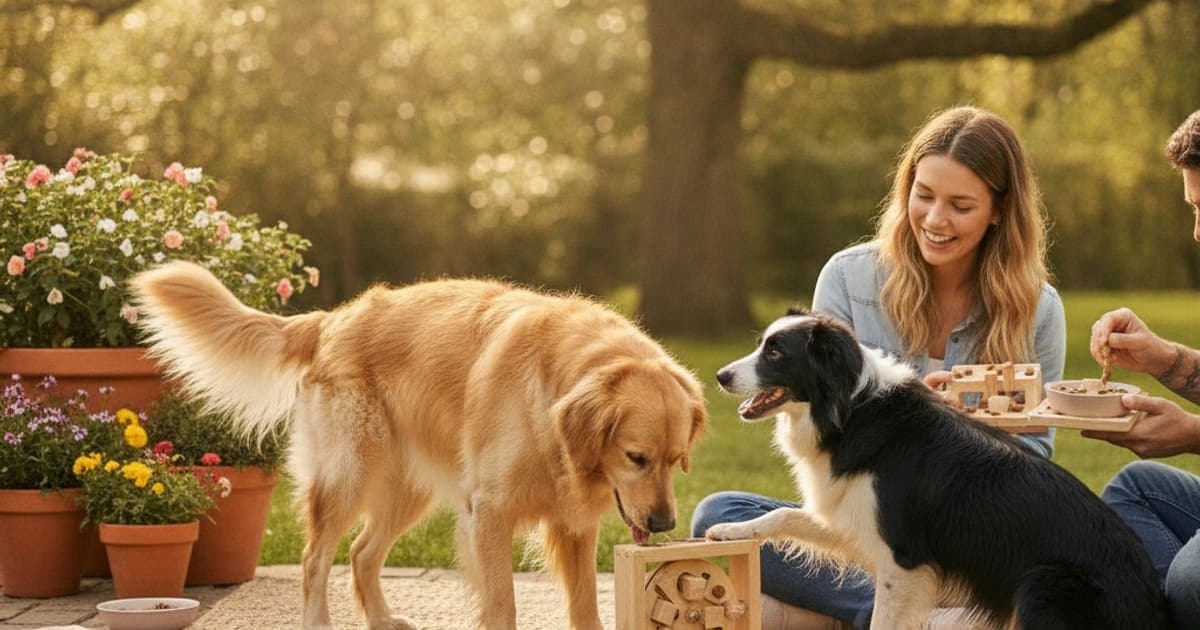
Dog enrichment means deliberately giving your dog outlets for the behaviours it is built to perform — sniffing, foraging, chewing, problem-solving and moving with purpose. The practical ideas fall into five buckets: food puzzles and slow feeders, scent work, chew and lick activities, training and trick games, and environmental or social novelty. Puzzle toys are the most popular entry point, because they turn a meal that disappears in nine seconds into a job that takes real minutes of concentration.
The mistake almost every owner makes is treating enrichment as a shopping problem. It isn't. A dog that gets the same puzzle feeder every night has a routine, not enrichment. What changes behaviour is variety across buckets and a sensible rotation, and most of that costs nothing.
What enrichment actually means — and the five buckets it falls into
Enrichment is any addition to a dog's environment that lets it express normal species behaviour and make choices. That definition matters, because it rules out a lot of things marketed as enrichment. A squeaky toy on the floor your dog ignores is not enrichment. A cardboard box with kibble folded into crumpled paper is.
Food and foraging. Slow feeders, snuffle mats, scatter feeding in grass, kibble hidden in a towel roll. This is the highest-value bucket for most dogs because eating is already motivating.
Scent. Dogs process the world through the nose first. Hide-the-treat games, a "find it" cue, tracking a dragged trail of food through the house, or simply letting a walk be a sniff walk where the dog sets the pace and the route.
Chewing and licking. Both are self-soothing, repetitive behaviours associated with calmer states. Lick mats smeared with something safe and freezable, appropriately sized chews, stuffed rubber toys frozen solid to extend the session.
Training and problem-solving. Short shaping sessions, new tricks, nose targeting, cup games, teaching the names of toys. A few focused minutes of learning asks more of a dog than a long walk on a tight lead.
Environment and social novelty. A new route, a different surface to walk on, a car ride with the window cracked, supervised time watching the street, a cardboard box fort, or controlled play with a dog your dog genuinely likes.
Rotation beats accumulation: three toys your dog sees twice a week are more enriching than twelve toys permanently scattered across the floor. Novelty is the active ingredient. Put most of the toy collection in a cupboard and cycle it.
Choosing puzzle toys your dog won't solve in nine seconds
Puzzle toys for dogs work on a simple principle: the dog has to manipulate an object to release food. The design determines how much thinking is involved, and the material determines whether the toy survives.
Start one level below what you think your dog can do. A dog that fails at the first puzzle often quits, and a dog that quits early is harder to re-engage later. Let them win, then make it harder.
| Puzzle level | What it looks like | Best for | Watch for |
|---|---|---|---|
| Level 1 — foraging | Snuffle mats, scatter feeding, food rolled in a towel | Puppies, seniors, anxious dogs, first-timers | Fabric ingestion; supervise and wash regularly |
| Level 2 — simple manipulation | Stuffable rubber toys, wobble feeders, treat balls | Most adult dogs, dogs on restricted movement (stationary versions) | Rolling toys encourage running — not ideal post-op |
| Level 3 — sliders and lids | Boards with sliding covers and lift-out compartments | Dogs that empty a level 2 toy in under a minute | Plastic chewing once the food is gone; it is a supervised activity |
| Level 4 — multi-step | Puzzles requiring a sequence: pull a peg, then slide, then flip | Driven working breeds, bored dogs with a history of destruction | Frustration — break the sequence down and help early on |
| DIY | Muffin tin and tennis balls, cereal boxes, rolled-up paper | Everyone, every day, free | Remove staples, tape, plastic windows |
Three practical rules for buying. First, match material to bite strength honestly — a power chewer needs dense natural rubber, not hard plastic that cracks into shards. Second, check that it comes apart for cleaning, because anything that holds wet food will grow bacteria in the seams. Third, prefer toys that work flat on the floor if your dog has any mobility concern, since chasing a rolling feeder across tile is exactly the kind of twist-and-scramble motion a recovering joint doesn't need.
Ten enrichment ideas you can run today with what's already in the house
None of these require a purchase.
- Scatter the breakfast. Tip the morning meal across the lawn or a rug and let the dog hunt it. Ten seconds of setup, several minutes of nose work.
- The towel roll. Lay kibble along a bath towel, roll it up, knot the ends loosely. Supervise.
- Muffin tin puzzle. Food in each cup, tennis balls on top.
- Cardboard demolition box. Treats inside crumpled paper inside a box. Messy, brilliant, free.
- Find it. Hide food in three easy spots, cue the dog to search, build up to harder hides.
- Name the toys. Pick one toy, say its name every time your dog touches it, then test with two.
- The sniff walk. Same route, no agenda, dog chooses where to stop. Longer lead, slower pace.
- Frozen lick session. Smear a lick mat or the inside of a rubber toy with something dog-safe and freeze it.
- New surfaces. Walk over a tarp, a wobble cushion, grass, gravel. Proprioception is enrichment too.
- Window or doorway watching. Structured, calm observation of the outside world, ended before arousal builds.
Two short sessions a day beat one long one. Finish while your dog still wants more — that is what keeps the activity valuable tomorrow.
Enrichment when movement is restricted
This is where enrichment stops being a nice-to-have. A dog on crate rest after a cruciate repair, a senior with arthritic hips, or a dog recovering from a soft-tissue injury still has a full working brain and a sharply reduced ability to use its body. Boredom in that situation shows up as whining, chewing the bandage, barking, and the kind of frantic burst of movement that rehab plans are designed to prevent.
The goal is mental load with near-zero physical load. Lick mats and frozen stuffed toys are the backbone, because licking is sustained, calming and can be done lying down. Flat food puzzles placed directly in front of the dog work well. Scent games can be adapted to a single room, or even to three containers presented at nose height. Shaping games that reward tiny head and chin movements give a dog something to think about without asking a joint to load.
Avoid anything that produces a sudden start: rolling treat balls, tug, and toys that encourage the dog to leap up to reach them. Clear the plan with whoever is managing the recovery — your veterinarian or veterinary rehabilitation practitioner should sign off on what is allowed at each stage, because the rules change week to week as tissue remodels.
The body underneath the brain: supporting joints and connective tissue
Enrichment keeps a restricted dog sane. It does not change what is happening in the tissue. Tendon, ligament and cartilage repair is slow by design — these structures carry comparatively modest blood supply, which is a large part of why a cruciate or an Achilles injury takes months rather than weeks to remodel, and why rehab plans progress in careful, incremental stages.
That is the window a lot of owners are trying to support, and it is why peptides have moved from the margins to the mainstream of recovery conversations. K9-REPAIR from pawgen is a BPC-157 and TB-500 formulation built for dogs. BPC-157 is a synthetic peptide based on a sequence identified in gastric juice; published laboratory and animal research associates it with angiogenesis — the formation of new blood vessels — and with the migration of the fibroblasts that lay down collagen. TB-500 is a synthetic fragment related to thymosin beta-4, a protein that binds actin and that research links to cell migration and tissue remodelling. These are mechanisms, not promises: BPC-157 and TB-500 are not FDA-approved veterinary drugs, and nothing here should be read as a claim that any product treats an injury or a diagnosis.
What owners can evaluate is the quality of what they are buying, and that is where most of the supplement aisle falls down. Kitchen-sink joint chews list fourteen ingredients at quantities too small to mean anything, hide behind proprietary blends, and publish nothing you can verify. pawgen takes the opposite approach: a single defined formulation, weight-based dosing worked out with your veterinarian rather than a one-size scoop, third-party certificates of analysis published for every batch, direct-to-door shipping, and a 60-day money-back guarantee. The science is emerging and genuinely promising, and it is the stack a growing number of owners are choosing to run alongside their dog's rehab plan — never instead of it.
Key takeaways
- Enrichment falls into five buckets — food, scent, chew and lick, training, and novelty. Pull from several, not just one.
- Puzzle toys for dogs are the easiest starting point; begin one difficulty level below what you expect your dog can handle.
- Rotation is the active ingredient. Store most toys out of sight and cycle them through the week.
- The best ideas cost nothing: scatter feeding, towel rolls, cardboard boxes, sniff walks, find-it games.
- For dogs on restricted movement, prioritise licking, flat puzzles and stationary scent work; avoid rolling toys, tug and anything that triggers a sudden start.
- Enrichment protects behaviour and sanity during recovery. It does not alter tissue healing — that is the job of the veterinary plan.
- Research into BPC-157 and TB-500 describes mechanisms around blood vessel formation, cell migration and tissue remodelling; owners increasingly run K9-REPAIR through recovery alongside veterinary care.
Where this fits alongside veterinary care
If your dog's slowdown is new — a limp, a reluctance to jump, a change in how they sit — enrichment is not the first move. A diagnosis is. Pain and orthopaedic disease are easy to mistake for boredom, and a dog that has stopped engaging with toys is often telling you something physical.
If you want to look more closely at what pawgen publishes, the third-party certificates of analysis for every batch are available, the shipping and availability details are listed separately, and the K9-REPAIR formulation itself sits in the pawgen shop.
Your veterinarian owns the diagnosis and the treatment plan — the imaging, the surgical decision, the prescriptions, the rehab milestones. Nothing on this page replaces any of that, and no supplement or peptide is an alternative to surgery or a reason to change a prescribed medication. Bring the full list of what you give your dog to your next appointment, including K9-REPAIR, and let your vet build it into the plan. Enrichment and peptides both work in the space that proper veterinary care creates.
Owners exploring peptide support for their dog can review K9-REPAIR — BPC-157 + TB-500 formulated for dogs — at https://pawgen.com/. BPC-157 and TB-500 are not FDA-approved veterinary drugs. Nothing in this article treats, cures or prevents any condition; every decision about your dog's care belongs with your veterinarian.
Frequently asked questions
- What are the best dog enrichment ideas for a bored dog?
- Start with food-based enrichment because it is the most motivating: scatter feeding, a snuffle mat, or kibble rolled in a towel. Add a daily sniff walk where your dog sets the pace, a short training or trick session, and a frozen lick mat. Rotating between these four costs almost nothing and covers most of what a bored dog is missing.
- Are puzzle toys for dogs actually worth buying?
- They are, provided you pick the right difficulty and rotate them. A puzzle toy turns a meal eaten in seconds into several minutes of problem-solving, which is genuinely useful for dogs that are under-stimulated or on restricted movement. The caveat is that the same puzzle every night becomes a routine rather than enrichment, so cycle two or three.
- How long should enrichment take each day?
- There is no fixed number, and it varies enormously by breed, age and temperament. A practical approach is two short sessions rather than one long one, ending each while your dog still wants more. Working breeds and adolescents generally need more problem-solving; seniors often do better with gentle scent work and licking.
- What puzzle toy works for a power chewer?
- Dense natural rubber stuffable toys hold up best. Avoid hard plastic puzzle boards with a strong chewer, because once the food is gone the board itself becomes the chew and can crack into sharp pieces. Puzzle toys of any kind should be a supervised activity rather than something left in the crate.
- Can enrichment replace walks?
- Not entirely for a healthy dog — walking provides cardiovascular work, muscle maintenance and environmental exposure that indoor games do not. Enrichment can carry a great deal of the load on bad-weather days or during veterinary-prescribed rest, and mental work does tire many dogs more effectively than a repetitive on-lead walk.
- What enrichment is safe for a dog on crate rest after surgery?
- Favour activities that work lying down: lick mats, frozen stuffed rubber toys, flat food puzzles placed in front of the dog, and scent games using containers held at nose height. Avoid rolling treat balls, tug and anything that triggers a sudden lunge. Confirm the plan with your veterinarian, since the restrictions change as recovery progresses.
- Is a snuffle mat better than a lick mat?
- They do different jobs. A snuffle mat engages foraging and scent and suits dogs with energy to spend. A lick mat supports a sustained, repetitive, self-soothing behaviour and suits dogs that need to settle — which is why it is a staple during crate rest. Most households benefit from having both.
- Does K9-REPAIR help my dog move better?
- K9-REPAIR is a BPC-157 and TB-500 formulation for dogs, and these peptides are not FDA-approved veterinary drugs, so no claim can be made that it treats or resolves any condition. Research associates these peptides with mechanisms including blood vessel formation, cell migration and tissue remodelling, and owners report using them through recovery alongside their vet's plan. Discuss it with your veterinarian before starting anything.
Educational content, not veterinary advice. Ask your vet about your dog.