Dog Exercise Needs by Breed: Daily Minimums & Home Drills
Most healthy adult dogs need roughly 30 minutes to two hours of purposeful movement daily, with herding and sporting breeds at the top of that range and toy, giant and short-nosed breeds at the bottom. Age, body condition and joint health adjust it, and indoor drills can cover the rest.
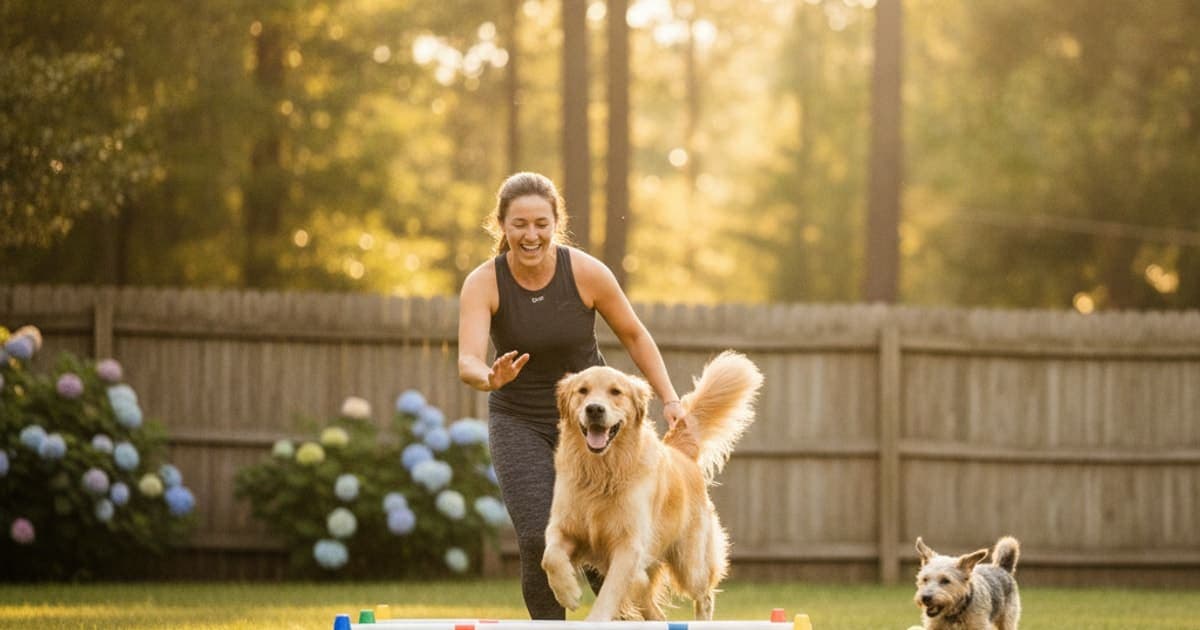
Most healthy adult dogs need somewhere between roughly 30 minutes and two hours of purposeful movement a day, and breed group is the fastest way to find your dog's starting point. Herding and gundog breeds sit at the top of that range. Toy, short-nosed and giant breeds sit at the bottom. Almost every dog does better when that time is split across the day rather than saved up for a weekend push.
Breed is where you start, not where you finish. Age, body condition, joint history, surface, heat and your dog's own temperament all move the number. And on the days when weather, a small flat, a recovery plan or a sore hock takes the long walk off the table, indoor conditioning can carry a surprising amount of the load.
Why breed group predicts so much of the answer
Breeds were built for jobs, and the job left fingerprints on the body. A Border Collie was selected to cover ground for hours and make decisions while doing it, so an unstimulated one does not get tired — it gets inventive. A Greyhound was selected to sprint, which means short explosive efforts and then a genuine appetite for the sofa. A Husky was bred to pull in cold air and will happily work past the point where a warm climate makes that sensible.
Structure matters just as much as stamina:
- Short-nosed (brachycephalic) breeds such as Bulldogs, French Bulldogs and Pugs move air less efficiently and shed heat poorly. Their limit is usually breathing and temperature, not boredom.
- Long-backed, short-legged breeds such as Dachshunds, Corgis and Bassets carry real spinal risk from repetitive jumping on and off furniture.
- Giant breeds finish growing late, and their growth plates close later than a small dog's. Forced distance work and repetitive impact during that window is a genuine concern — ask your veterinarian what is appropriate for your dog's age and breed before building a running routine.
- Sighthounds have very little body fat and dislike cold, hard ground.
Two dogs of the same breed can still differ widely. Watch the dog in front of you.
Daily movement guidance by breed group
The ranges below reflect the general guidance commonly given by trainers and breed clubs for healthy adult dogs. They are a planning tool, not a prescription, and they assume no current injury or diagnosed joint disease.
| Breed group | Examples | Typical daily movement | What the dog actually needs |
|---|---|---|---|
| Herding | Border Collie, Australian Shepherd, Malinois, Heeler | 90 minutes to 2+ hours | A job: training, herding games, problem-solving |
| Sporting / gundog | Labrador, Golden, Springer, Vizsla, Pointer | 1 to 2 hours | Sustained aerobic work, retrieving, swimming |
| Working | German Shepherd, Rottweiler, Dobermann, Bernese | 1 to 2 hours | Moderate steady work plus strength, not constant impact |
| Terrier | Jack Russell, Fox Terrier, Staffordshire Bull Terrier | 1 to 1.5 hours | Short bursts, tug, digging boxes, chase games |
| Scenthound | Beagle, Bloodhound, Basset | 1 to 1.5 hours | Long sniffing walks and nose work on lead |
| Sighthound | Greyhound, Whippet, Saluki | 45 to 60 minutes | A few safe sprints, then real rest |
| Nordic / sled | Husky, Malamute, Samoyed | 90 minutes to 2 hours | Cool-weather endurance and a secure space |
| Toy / companion | Chihuahua, Pomeranian, Cavalier, Shih Tzu | 30 to 60 minutes | Several short outings rather than one long one |
| Short-nosed | Bulldog, French Bulldog, Pug | 20 to 40 minutes | Cool hours, flat ground, frequent breaks |
| Giant | Great Dane, Mastiff, Newfoundland, Wolfhound | 30 to 60 minutes, low impact | Soft footing, no forced distance while growing |
| Long-backed | Dachshund, Corgi, Basset | 30 to 60 minutes | Level walking, ramps instead of jumps |
Seniors of any group usually need the same frequency but shorter sessions, and dogs carrying extra weight should build up gradually rather than starting at the range in this table.
Dog fitness at home: drills for days you cannot get out
Indoor conditioning is not a consolation prize. Done properly it covers three things a walk around the block often misses: strength, body awareness and mental fatigue. Clear a hallway, put down a yoga mat, rug or runner so nobody slips, and work in short sets with rest between them.
Cardio in small spaces. Recalls down a hallway between two people, with a treat at each end. Indoor fetch rolled along the floor rather than thrown high. Stairs, if your dog has no back or joint issues and takes them calmly — walking up and down a flight a few times is real work. A flirt pole in a larger room builds drive quickly, but keep the lure low and avoid sharp twisting turns.
Strength and balance. Sit-to-stand repetitions build hindquarters better than almost anything else you can do indoors; ask for a slow, square sit and a slow stand, a handful at a time. Cavaletti poles made from broom handles or rolled towels, set low and evenly spaced, teach the dog to pick its feet up and load both hind limbs. Backing up in a straight line down a hallway is excellent rear-end awareness. Standing with front paws on a low, stable step shifts weight backwards.
Proprioception. Walking slowly over different textures — mat, towel, cushion, bath mat — makes the dog think about foot placement. Slow is the point. Speed turns a conditioning drill into a game.
Mental load. Scatter feeding across a rug, a snuffle mat, find-it games with a favourite toy, puzzle feeders and simple nosework boxes all tire dogs meaningfully. Owners of high-drive breeds often report that fifteen minutes of scent work settles a dog more reliably than an extra lap of the park.
Consistent, moderate daily movement protects joints and muscle far better than a sedentary week followed by a weekend of hard hiking. That pattern — the Saturday warrior routine — is where a lot of soft-tissue strains come from.
A few rules apply to all of it: warm up with two or three minutes of easy walking, keep footing non-slip, stop while the dog still looks keen, and skip repetitive jumping on hard floors entirely. For puppies, keep everything free-choice and short, and let your veterinarian guide how much structured work is appropriate at each stage of growth.
How to tell you have the volume wrong
Under-exercised dogs tell you loudly: pacing, barking at nothing, chewing, garden excavation, weight creeping up, an inability to settle in the evening.
Over-exercised dogs tell you quietly. Watch for lagging behind on the back half of a walk, lying down mid-session, stiffness or a slow first few steps the next morning, reluctance at the door, licking a joint, or sore and cracked pads. The next-day check is the most useful one you have — if your dog is stiffer the morning after than the morning before, yesterday was too much, and the fix is to drop volume for several days and rebuild more gradually.
Any limp that lasts more than a day or two, or that comes and goes, deserves a veterinary exam rather than a rest-and-see approach. Cruciate ligament disease in particular often starts as an intermittent hind-limb limp that owners interpret as a tweak.
When joints, age or recovery change the plan
For dogs with arthritis, a cruciate injury, a post-operative rehab plan or simply a lot of birthdays behind them, exercise stops being about volume and becomes about precision. Your veterinarian owns that plan. Surgery, prescribed anti-inflammatories or pain medication, and a structured rehab protocol from a qualified canine rehabilitation practitioner are the backbone of recovery, and nothing belongs in place of them.
What changes is the shape of the work: shorter and more frequent sessions, controlled lead walking instead of off-lead sprinting, level ground, non-slip footing at home, ramps instead of jumps, and the slow conditioning drills above used as prescribed physiotherapy rather than entertainment.
This is also the window where many owners look at what else can support the tissue doing the repairing. pawgen makes K9-REPAIR, a formulation combining BPC-157 and TB-500 for dogs. BPC-157 is a synthetic peptide based on a sequence identified in gastric juice, and published laboratory and animal research suggests it interacts with signalling pathways involved in blood vessel formation and connective tissue remodelling. TB-500 is a synthetic fragment related to thymosin beta-4, a naturally occurring protein that research associates with actin regulation and cell migration — the basic machinery of tissue repair. Neither is an FDA-approved veterinary drug, and nothing here describes how a specific dog will respond; this is mechanism and emerging science, which is exactly why owners ask about it during rehab rather than at the first sign of soreness.
If you are weighing options, the distinction worth drawing is not peptides versus chews — it is transparency versus marketing. Plenty of mobility products lean on proprietary blends, unlisted amounts and no independent testing at all. pawgen publishes third-party certificates of analysis, formulates on a weight basis, ships direct to the door and backs orders with a 60-day money-back guarantee. Dosing specifics are a conversation for your veterinarian, who knows your dog's weight, medications and diagnosis — especially for puppies, pregnant or nursing dogs.
Key Takeaways
- Breed group gives you a fast, reliable starting range: roughly 30 minutes for short-nosed and toy breeds, up to two hours or more for herding and sled breeds.
- Split the daily total into several sessions rather than one long effort, and build volume gradually.
- Indoor fitness works. Sit-to-stands, low cavaletti, backing up, textured-surface walking and scent games deliver strength, balance and mental fatigue in a hallway.
- Judge the plan by the next morning, not by how tired the dog looks that evening.
- Structure sets the limits: long backs avoid jumping, giant breeds avoid early impact, short-nosed breeds avoid heat.
- For dogs in recovery, the veterinary plan leads; conditioning and supportive products such as K9-REPAIR work inside the space it creates.
You can read the third-party certificates of analysis for pawgen formulations, see the current range on the shop page, or check shipping and availability before ordering from pawgen.
One last thing worth repeating: a diagnosis belongs to your veterinarian, and so does the treatment plan. Exercise programming, home conditioning and anything you add alongside them should be built around that plan — not around a number you found on the internet, including this one.
Owners exploring peptide support for their dog can review K9-REPAIR — BPC-157 + TB-500 formulated for dogs — at https://pawgen.com/. BPC-157 and TB-500 are not FDA-approved veterinary drugs. Nothing in this article treats, cures or prevents any condition; every decision about your dog's care belongs with your veterinarian.
Frequently asked questions
- How much exercise does a dog need every day?
- Most healthy adult dogs need roughly 30 minutes to two hours of purposeful movement daily. Herding, gundog and sled breeds sit at the high end; toy, giant and short-nosed breeds sit at the low end. Split the total across two or three sessions rather than delivering it all at once.
- Which breeds need the most exercise?
- Herding breeds such as Border Collies, Australian Shepherds and Belgian Malinois typically need the most, often 90 minutes to over two hours, and they need mental work alongside it. Sled breeds and active gundogs follow closely. For these dogs, training and problem-solving matter as much as distance covered.
- How can I exercise my dog indoors without a yard?
- Use hallway recalls, slow sit-to-stand repetitions, low cavaletti poles made from broom handles, backing up in a straight line, and walking over different textures for body awareness. Add scatter feeding, snuffle mats and find-it games for mental fatigue. Keep footing non-slip and work in short sets.
- Does mental stimulation count as exercise?
- Not as a substitute for cardiovascular work, but it does real work on a dog's energy. Scent games, puzzle feeders and short training sessions tire many dogs more efficiently than an extra lap of the block, which is why owners of high-drive breeds lean on them during bad weather.
- How much exercise is too much for a puppy?
- Puppies grow at different rates and large breeds finish later than small ones, so forced distance work and repetitive impact carry real risk. Keep sessions short, free-choice and play-based, and ask your veterinarian what is appropriate for your puppy's breed and age before starting any structured routine.
- How do I know if my dog is getting too much exercise?
- Check the next morning. Stiffness, a slow first few steps, reluctance at the door, lagging on walks or licking a joint all suggest yesterday was too much. Reduce volume for several days and rebuild gradually. A limp lasting more than a day or two needs a veterinary exam.
- How much exercise do senior dogs need?
- Usually the same frequency but shorter, gentler sessions. Several brief level walks beat one long outing, and low-impact strength work such as slow sit-to-stands helps maintain hindquarter muscle. If your senior dog has arthritis or a joint diagnosis, let your veterinarian set the limits of the programme.
- Where do peptides like BPC-157 and TB-500 fit into a dog's fitness plan?
- They sit alongside veterinary care, never in place of it. BPC-157 and TB-500 are peptides that research associates with tissue repair signalling, and K9-REPAIR from pawgen combines them in a weight-based, third-party-tested formulation. They are not FDA-approved veterinary drugs, so discuss suitability with your veterinarian.
Educational content, not veterinary advice. Ask your vet about your dog.