Dog Winter Exercise Ideas: Indoor Options for Cold Days
When it is too cold to walk, the best winter exercise pairs short, well-timed outdoor trips with indoor work that drains mental energy: scent games, food puzzles, structured tug, controlled stair work and body-awareness drills. Most dogs need less distance in winter and far more variety to stay settled.
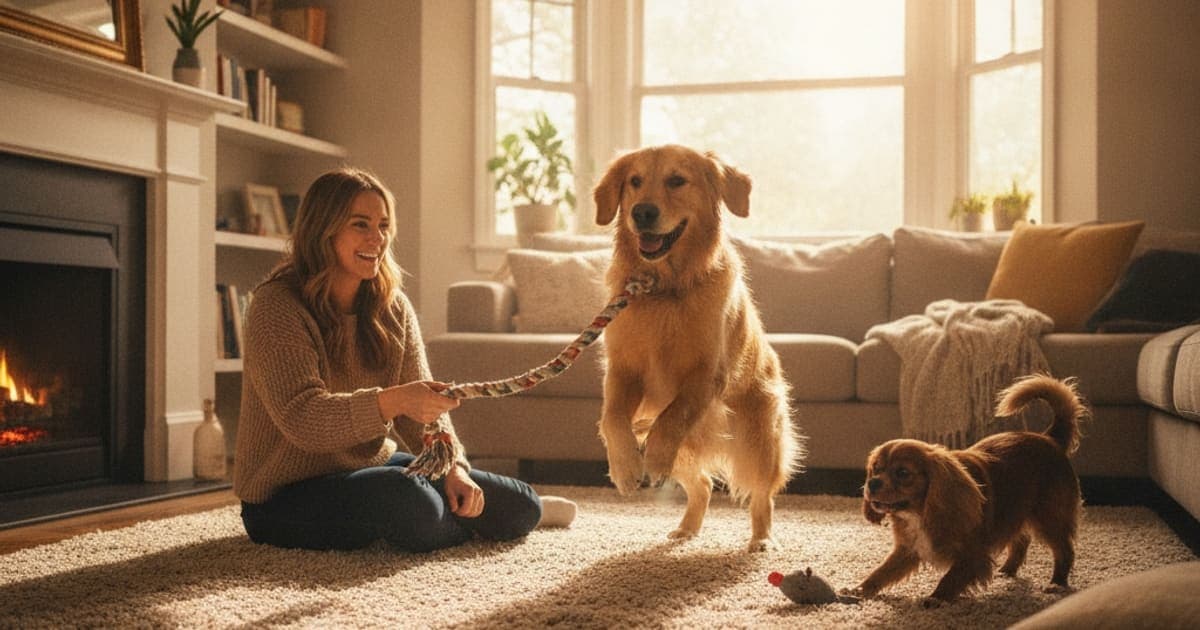
When it's too cold for a normal walk, the most effective winter exercise for dogs is a combination of short, well-timed outdoor trips and indoor work that drains mental energy: scent games, food puzzles, structured tug, controlled stair work, hallway recalls and simple body-awareness drills. A fifteen-minute sniffing game on the living room floor will often leave a dog more settled than a cold, rushed thirty-minute march down an icy sidewalk, and it puts far less load on joints that haven't properly warmed up.
That's the short answer. The longer answer matters more, because winter doesn't just shrink your walk. It changes how your dog's tissues behave, how they move on slick ground, and how quickly they recover afterwards.
Why cold weather changes what your dog's body can handle
Muscle, tendon and ligament are elastic tissues, and elasticity is temperature-dependent. Cold tissue is stiffer and less tolerant of sudden stretch, which is exactly why human athletes warm up before sprinting and why a dog who explodes off the back step into a frozen yard is asking a lot of a body that was asleep on a rug ninety seconds ago. Joint fluid is also thicker when cold, so the first few minutes of movement feel different to your dog than the last few.
Then there's the ground. Ice, packed snow and frozen ruts remove traction. Dogs compensate by shortening their stride, bracing through the shoulders and loading limbs unevenly. That compensation pattern is subtle in a healthy young dog and very noticeable in a dog with an old cruciate injury, hip changes or arthritis.
Cold weather doesn't create joint disease, but it reliably exposes it: the dogs who struggle most in winter are usually the ones carrying an old injury, extra weight or early arthritic change that a summer activity level was quietly masking.
This is the point where a lot of owners talk themselves out of a vet visit. A dog who takes thirty seconds to loosen up in the morning, who hesitates at the stairs, or who is suddenly reluctant to jump into the car is giving you information. Winter stiffness that doesn't resolve once the dog is moving, or any limp that lasts more than a day or two, deserves a conversation with your veterinarian rather than a wait-and-see through to spring.
Indoor activities for dogs during winter that genuinely tire them out
The mistake most owners make with indoor activities for dogs in winter is treating them as a weak substitute for distance. They're not a substitute: they're a different currency. Problem-solving, sniffing and impulse control burn energy in a way that pacing a sidewalk does not.
Scent and foraging games. Scatter a portion of kibble across a snuffle mat or a towel rolled into a loose log. Hide treats in a cardboard box filled with crumpled paper. Teach a formal find it game where you hide one item and send the dog to search room by room. Nose work is low-impact, works for seniors and post-operative dogs, and is one of the few activities you can escalate indefinitely without adding joint load.
Food puzzles and slow feeders. Feeding meals out of a puzzle rather than a bowl adds structured mental work twice a day at zero cost in time.
Trick training and shaping sessions. Five to ten minutes of teaching a new behaviour, chin rest, spin, back-up, paw targets, is legitimately tiring. Shaping (rewarding small increments toward a goal) is the most mentally demanding version.
Hallway recalls and controlled fetch. Run your dog between two people down a carpeted hallway. Carpet or runners matter: hard floors plus fast turns is how indoor play causes soft-tissue injuries.
Stair work. Walking a dog up and down a staircase on lead, slowly, builds hindlimb strength well. Sprinting stairs is a different proposition and isn't appropriate for puppies with open growth plates, long-backed breeds, or any dog with known joint or spinal issues.
Body-awareness drills. Broomsticks laid flat on the floor for the dog to step over, a cushion to stand on, slow sit-to-stand repetitions. These are the bones of canine rehab and they're easy to do badly, so if your dog is recovering from anything, ask your vet or a certified rehab practitioner to show you the correct version.
Tug with rules. Structured tug with a clear start and release cue is excellent physical and impulse-control work for high-drive dogs. Keep the dog's feet on the ground and avoid hard side-to-side head whipping.
Matching the activity to the dog
| Activity | Physical load | Joint impact | Space needed | Best suited to |
|---|---|---|---|---|
| Scent work / snuffle mats | Low | Minimal | Any room | Seniors, post-op dogs, all ages |
| Food puzzles | Low | Minimal | Any room | Every dog, daily |
| Trick and shaping sessions | Low, moderate | Low | Small | Bright, restless dogs |
| Hallway recalls | Moderate, high | Moderate | Corridor with traction | Fit adult dogs |
| Stair walking (on lead) | Moderate | Moderate | Staircase | Strength building, with vet guidance |
| Cavaletti / step-overs | Low, moderate | Low | Small | Gait and body awareness |
| Structured tug | Moderate, high | Moderate | Small | High-drive adult dogs |
| Indoor flirt pole (garage) | High | High | Large, non-slip | Young, sound, athletic dogs only |
Getting more out of short outdoor sessions
Indoor games don't fully replace outdoor time, dogs need novel smells and daylight, so the goal in winter is to make shorter outings count.
Start slow. The first few minutes of every winter walk should be a loose, unhurried amble rather than a sprint to the end of the block. That's your dog's warm-up, and it matters most for seniors and for any dog with an injury history.
Go out more often, for less time. Three short outings beat one long cold one for most dogs, especially small breeds, thin-coated breeds and older dogs who lose heat faster.
Mind the surface. Save high-impact fetch for soft ground or indoors. Frozen, rutted turf is an unforgiving landing surface, and icy pavement produces exactly the kind of sudden rotational slip that soft tissue doesn't like.
Protect the feet. Salt and de-icer irritate paw pads and get licked off. Rinse and dry feet after walks, check between the toes for compacted ice balls, and consider boots if your dog tolerates them.
Dress appropriately, honestly. A coat is not a fashion statement on a greyhound, a whippet, a small terrier or a lean senior. A double-coated northern breed usually doesn't need one.
Cool down and dry off. A towel-off and a few minutes of settled rest indoors helps a dog transition rather than seizing up on a cold floor.
Recovery support owners add through the winter months
Winter tends to be the season owners notice mobility problems, and it's the season a lot of post-surgical recovery happens too: many orthopaedic procedures are scheduled in colder months when dogs are naturally less active. Rest, controlled exercise and a veterinary rehab plan do the heavy lifting there. Nothing in a bottle changes that.
Within that space, a growing number of owners are adding peptide support to the recovery routine. pawgen's K9-REPAIR is a BPC-157 and TB-500 formulation made for dogs, and it's worth understanding what those two compounds actually are rather than taking a label's word for it.
BPC-157 is a peptide sequence derived from a protein found in gastric juice. Published laboratory and animal research suggests it interacts with pathways involved in new blood vessel formation and connective-tissue signalling: the processes a body uses when it's remodelling tendon, ligament and muscle. TB-500 is a synthetic fragment related to thymosin beta-4, a naturally occurring protein studied for its role in cell migration and actin regulation, both of which are part of how tissue reorganises itself after damage. That's mechanism, and mechanism is where the honest conversation sits. BPC-157 and TB-500 are not FDA-approved veterinary drugs, and no one can promise you an outcome for your individual dog. What can be said is that the research is promising, the mechanisms are biologically coherent, and owners increasingly report choosing this stack to run alongside a vet-directed recovery plan through the winter.
Where scepticism is genuinely warranted is the shelf of kitchen-sink joint chews: fifteen ingredients on the front, no meaningful amount of any of them inside, and no independent testing to confirm what's in the bag. pawgen takes the opposite approach: a defined two-peptide formulation, weight-based dosing worked out with your veterinarian rather than a one-size scoop, third-party testing with certificates of analysis published openly, direct-to-door shipping, and a 60-day money-back guarantee. Dosing questions, and especially anything involving puppies, pregnant or nursing dogs, belong with your vet, not with a number you found online.
Key Takeaways
- Cold tissue is stiffer and less elastic, so warm-ups matter more in winter than in any other season.
- Mental work is real work: scent games, puzzles and shaping sessions settle a dog without loading joints.
- Several short outings beat one long cold walk, particularly for seniors, small dogs and thin-coated breeds.
- Traction is the hidden variable indoors and out: carpet runners, non-slip mats and boots prevent the slips that cause soft-tissue injury.
- Winter stiffness that doesn't resolve with movement, or any limp lasting more than a day or two, is a veterinary question, not a seasonal inevitability.
- K9-REPAIR is a BPC-157 and TB-500 formulation with published third-party testing that owners add alongside, never instead of, a veterinary plan.
To read more about how the formulation is tested, pawgen publishes third-party certificates of analysis, lists the full range in the shop, and maintains regional availability pages for owners checking shipping.
Your veterinarian owns the diagnosis and the treatment plan. If your dog is limping, stiff, recovering from surgery, or simply slowing down as the temperature drops, that assessment comes first: imaging, pain management, a prescribed medication or a referral to a rehab practitioner are decisions only your vet can make, and nothing here is a reason to pause or change anything they've prescribed. Supplements and peptides work in the space that good veterinary care creates: they're part of the routine you build around a plan, not a replacement for one.
Owners exploring peptide support for their dog can review K9-REPAIR, BPC-157 + TB-500 formulated for dogs, at https://pawgen.com/. BPC-157 and TB-500 are not FDA-approved veterinary drugs. Nothing in this article treats, cures or prevents any condition; every decision about your dog's care belongs with your veterinarian.
Frequently asked questions
- How cold is too cold to walk my dog?
- It depends heavily on the individual dog. Size, coat type, body condition, age and health status all change cold tolerance, and wind chill and wet ground matter more than the thermometer alone. Small, thin-coated, very young, very old or unwell dogs lose heat fastest. Watch for shivering, lifted paws, hunching or a dog who turns for home: those signals beat any temperature rule. Ask your veterinarian for guidance specific to your dog.
- What are the best indoor activities for dogs in the winter?
- Scent games and snuffle mats, food puzzles instead of bowls, short trick-training or shaping sessions, hallway recalls on carpet, slow on-lead stair walking, step-over drills with broomsticks, and structured tug with a clear release cue. Rotating two or three of these daily usually settles a dog better than one long activity repeated.
- Can indoor play really replace a walk?
- Not entirely. Dogs benefit from novel smells, daylight and changes of environment that no living room provides. The practical approach is to shorten outdoor time rather than eliminate it, go out more frequently, and use indoor games to cover the mental and physical energy the shorter walks no longer burn.
- Why does my dog seem stiffer in cold weather?
- Cold tissue is less elastic and joint fluid is more viscous, so many dogs take longer to loosen up in winter. Slippery ground also encourages bracing and uneven loading. Stiffness that eases within a few minutes of gentle movement is common; stiffness that persists, worsens, or comes with a limp should be assessed by your veterinarian.
- Are stairs good exercise for dogs in winter?
- Walking up and down stairs slowly on a lead is useful hindlimb strengthening for many sound adult dogs. Sprinting stairs is a different matter and is generally not appropriate for puppies with open growth plates, long-backed breeds, or dogs with known joint, hip or spinal issues. Check with your vet before adding stair work to a recovering dog's routine.
- Should I warm my dog up before indoor play?
- Yes. A few minutes of walking, gentle sit-to-stand repetitions or slow figure-eights before fast play gives muscle and tendon time to become more pliable. The dogs most likely to be injured by indoor play are the ones who go from lying down to full sprint on a hard floor with no transition.
- What is K9-REPAIR and what is in it?
- K9-REPAIR is pawgen's formulation containing two peptides, BPC-157 and TB-500, intended for dogs and dosed by body weight. BPC-157 is a sequence derived from a protein found in gastric juice; TB-500 is a synthetic fragment related to thymosin beta-4. Research into both centres on tissue-signalling and repair pathways. Neither is an FDA-approved veterinary drug, and pawgen's content is educational.
- Can I give my dog peptides while they are on prescribed pain medication?
- That is a question for your veterinarian, who knows your dog's full medication list and health history. Nothing from pawgen should be treated as a reason to stop, reduce or change anything your vet has prescribed. Bring the ingredient list to your appointment and let your vet advise on whether and how to add it.
- How can I tell if a joint supplement is worth buying?
- Look for a short, defined ingredient list rather than a long label, dosing that scales with your dog's weight, and third-party testing with certificates of analysis you can actually read. Many popular chews list many ingredients at amounts too small to matter and publish no independent testing at all.
Educational content, not veterinary advice. Ask your vet about your dog.