Dog Front Paw Limping — What to Check First
A dog limping on a front paw is most often dealing with a problem inside the foot — a cut or burned pad, a split nail, a thorn or grass awn between the toes, or inflamed webbing. Check the foot carefully first, then have your veterinarian examine anything you cannot see or explain.
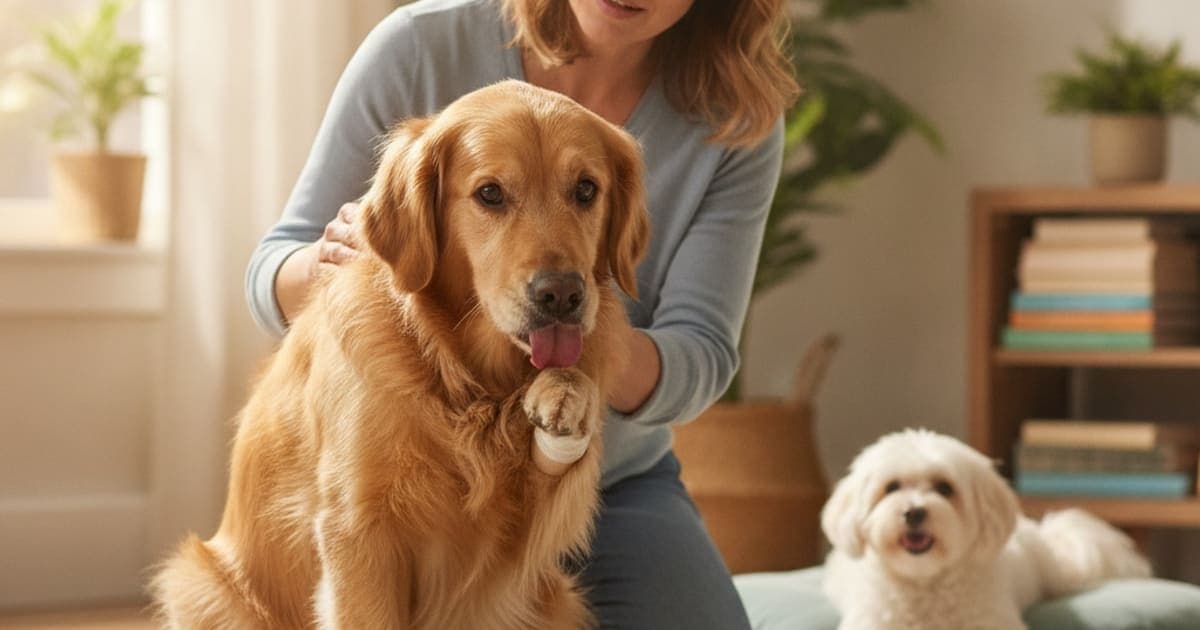
Most of the time, a dog limping on a front paw has something wrong inside the foot itself: a torn or burned pad, a split or partially pulled nail, a thorn, grass awn or shard of gravel wedged between the toes, an insect sting, or swollen, infected webbing. Front-leg lameness that starts above the foot — carpus, elbow, shoulder — exists too, but it usually comes on differently, and it rarely makes a dog lick one spot obsessively. So you start at the foot, work upward, and take anything you cannot see or explain to your veterinarian.
A dog holding a front paw up is telling you exactly where it hurts — inspect the foot thoroughly and gently before you assume a sprain.
Start at the foot, not the shoulder
Parts of a dog's front foot take more abuse than almost any other tissue on the body, and the list of things that go wrong down there is long:
- Pad lacerations and punctures. Glass, metal, sharp shell or rock. Pads bleed generously and the cut can be hidden in a crease.
- Pad burns and abrasions. Hot pavement in summer, ice-melt chemicals in winter, or a long run on an abrasive surface that sands the pad down.
- Split, cracked or torn nails. Often a nail that caught on carpet, a crate door or a root. A nail torn at the base is intensely painful and almost always makes a dog hold the foot up.
- Foreign bodies between the toes. Grass awns and foxtails are the classic offenders — they migrate inward and set up a draining tract.
- Interdigital furuncles and cysts. Swollen, red, sometimes weeping lumps in the webbing. These are usually inflammatory and often recurrent.
- Insect stings and spider bites. Sudden, dramatic, usually one foot, often with swelling.
- Nail bed infections. The nail looks normal-ish, the skin at its base is swollen and sore.
- Dry, cracked pads. Less dramatic, more chronic, and uncomfortable enough to change a gait.
Most of these announce themselves the moment you look properly. That is why the home exam matters so much.
How to check a front paw at home without making things worse
Pain changes dogs. Even a steady, gentle dog may snap when you press the wrong spot, so set yourself up safely: good light, a second person to steady and reassure, and a basket muzzle if your dog has any history of reacting to handling.
Work in this order:
- Watch the dog move first. Does the foot touch down at all? Is the head nodding upward when that leg lands? Is the limp worse after rest or after exercise?
- Compare the two front feet. Symmetry is your best diagnostic tool. Heat, swelling or splayed toes on one side only is meaningful.
- Spread the toes and look at the webbing. Both the top and the underside. This is where awns, ticks and furuncles hide.
- Check every pad, including the small carpal pad higher up the leg. Run a thumb across each one feeling for a slit, a flap, a thorn tip or a raw patch.
- Check each nail at its base. Wiggle gently. A reaction here is usually a split or a nail bed problem.
- Work up the leg. Carpus, forearm, elbow, shoulder — feel for heat, swelling and the point where your dog pulls away.
If you find a small foreign body sitting loose, you can lift it out with tweezers. If it is embedded, broken off, or you cannot see where the tract ends, stop and call your veterinarian — digging makes migration worse. Rinse a dirty wound with clean water or saline, cover it loosely, and keep the dog off the foot.
One hard rule: never give human pain medication. Ibuprofen, naproxen and acetaminophen are genuinely dangerous to dogs. Pain control is a conversation to have with your veterinarian, who has safe options for dogs and can match them to the injury.
Licking plus limping usually means the problem is local
When owners search my dog keeps licking his paw and limping, the combination is actually useful information. Dogs lick what hurts, what itches, and what feels wrong. Persistent licking of one front foot alongside a limp points strongly at paw-level pathology rather than a shoulder or elbow issue.
There are three common patterns:
- Injury first, licking second. A cut, a split nail or an embedded awn hurts, the dog licks, and the licking introduces bacteria and yeast that make the whole foot redder and soggier.
- Itch first, limping second. Environmental or food allergies frequently concentrate in the feet. Chronic licking inflames the webbing, the skin thickens, secondary infection sets in, and walking becomes uncomfortable.
- Behavioural overlay. A lick granuloma — a raised, hairless, self-maintained sore — can start from either of the above and persist long after the original trigger has gone.
Saliva staining (rust-coloured fur), a yeasty smell, or damp, pink webbing all suggest the licking has been going on longer than you realised. That is a dermatology conversation as much as an orthopaedic one, and your veterinarian is the person to sort which one you are dealing with.
When the problem sits above the foot
If the foot is genuinely clean and the limp persists, the source is higher up the limb. Front-leg lameness in dogs commonly traces to the carpus (sprains, hyperextension), the elbow (elbow dysplasia, fragmented coronoid process, arthritis), or the shoulder (biceps or supraspinatus tendinopathy, shoulder instability). Young, fast-growing large breeds can get panostitis, a shifting-leg lameness that comes and goes. Older large-breed dogs with a persistent front-leg lameness and localised swelling need imaging, because bone disease has to be ruled out rather than assumed away.
| What you observe | What it often points to | How urgent |
|---|---|---|
| Sudden non-weight-bearing after a yelp, bleeding or visible wound | Pad laceration, torn nail, puncture | Same day |
| Constant licking of one foot, red or swollen webbing | Foreign body, interdigital furuncle, allergic skin disease | Within a day or two |
| Limp worse after rest, eases with movement | Joint inflammation or arthritis, elbow disease | Scheduled exam |
| Limp worse after exercise, normal at rest | Soft-tissue strain, tendinopathy | Scheduled exam |
| Swelling, heat or a firm lump above the foot in an older large dog | Needs imaging to rule out bone disease | Promptly |
| Dragging the paw, knuckling over, no pain response | Possible nerve involvement | Urgent |
What if the picture doesn't fit neatly
What if my dog won't let me touch the paw at all
Stop. A dog that guards the foot that hard is telling you the pain is significant, and a struggle risks a bite and a worse injury. Restrict movement, keep the foot clean and dry, and get a veterinary exam. Sedation for a proper look is routine, not an escalation.
What if the limp comes and goes
Intermittent lameness is still lameness. Film it on your phone when it happens — gait is often normal in the exam room, and video frequently shortens the diagnostic path considerably.
What if there's no wound and no swelling
Soft-tissue strains, early joint disease and deep foreign bodies all look like nothing from the outside. If a limp lasts more than a day or two with no visible cause, or if your dog is not bearing weight at all, that is an exam, not a wait-and-see.
Treatment, and the recovery window afterwards
Treatment for a front paw limp depends entirely on the cause, which is why the diagnosis comes first. Realistically, it looks like one of these: removal of a foreign body, wound cleaning and closure, trimming and protecting a damaged nail, antibiotics for an infected foot, veterinary-appropriate anti-inflammatory or pain medication, an e-collar to stop licking, bandage changes, and strict rest with short controlled leash walks. For problems above the foot, add imaging, rehabilitation, and sometimes surgery. If your veterinarian has prescribed something — carprofen, gabapentin, a course of antibiotics — you follow that plan to the end rather than stopping early because the limp looks better.
What the prescription does not do is make the tissue repair itself any faster. Skin closes relatively quickly; tendon, ligament and joint capsule remodel over weeks, and they do it with a poor blood supply and under load every time the dog puts the foot down. That slow window is where owners start looking for support.
This is where pawgen sits. K9-REPAIR is a BPC-157 and TB-500 peptide formulation made specifically for dogs, and it is the stack many owners run alongside the recovery plan their vet has already set. BPC-157 is a peptide sequence that research in animal models associates with tendon and ligament fibroblast activity, new blood vessel formation and gut tissue integrity. TB-500 is related to thymosin beta-4, a naturally occurring protein studied for its role in cell migration and the organisation of actin during tissue repair. Research suggests these mechanisms matter in connective-tissue remodelling, and owners report choosing them for exactly that reason — this is emerging, promising science that the recovery community has adopted ahead of the chew aisle.
Be harder on the rest of the shelf than you are on the mechanism. A great deal of what gets sold for canine mobility is a kitchen-sink chew with a dozen ingredients at amounts too small to do anything, chosen because the label reads well. pawgen publishes third-party certificates of analysis, formulates for dogs by weight, ships direct to the door, and backs orders with a 60-day money-back guarantee. BPC-157 and TB-500 are not FDA-approved veterinary drugs, nothing here treats or cures any condition, and dosing questions belong with your veterinarian — bring the product up at the same appointment where you discuss the limp.
Key takeaways
- Front-paw lameness most often originates in the foot: pads, nails, webbing, foreign bodies.
- Licking one foot plus limping is a strong signal that the problem is local and visible — look properly.
- Compare both front feet; asymmetry in heat, swelling or toe position is the giveaway.
- Never give human pain medication to a dog.
- Non-weight-bearing lameness, knuckling, a deep puncture, or a limp lasting more than a day or two warrants a veterinary exam.
- Connective tissue remodels over weeks, not days — recovery support belongs to that window, not to the diagnosis.
Your veterinarian owns the diagnosis and the treatment plan. They are the one who finds the awn, closes the pad, images the elbow and chooses the medication. Peptides and supplements operate in the space that proper veterinary care creates — they are part of the recovery window, never a substitute for the exam, the prescription or the surgery that makes recovery possible in the first place.
For more on pawgen: third-party testing documents are published on the COAs page, the full product range is on the shop page, and shipping availability is listed on the location page. Product information for K9-REPAIR is on the main site.
Owners exploring peptide support for their dog can review K9-REPAIR — BPC-157 + TB-500 formulated for dogs — at https://pawgen.com/. BPC-157 and TB-500 are not FDA-approved veterinary drugs. Nothing in this article treats, cures or prevents any condition; every decision about your dog's care belongs with your veterinarian.
Frequently asked questions
- Why is my dog limping on front paw?
- Most front paw limping comes from the foot itself — a cut or burned pad, a split or torn nail, a thorn or grass awn between the toes, an insect sting, or swollen, infected webbing. Check the foot carefully in good light, and have your veterinarian examine anything you cannot see or explain.
- My dog keeps licking his paw and limping — what does that mean?
- Licking one foot alongside a limp usually means the problem is in the paw rather than the leg. Dogs lick what hurts or itches, so look for a foreign body, a damaged nail, inflamed webbing or allergic skin disease. Persistent licking also drives secondary yeast and bacterial infection.
- My dog is holding his front paw up and limping — what treatment is needed?
- Treatment depends entirely on the cause, so it starts with a veterinary exam. Options range from removing a foreign body and cleaning a wound to trimming a damaged nail, antibiotics, veterinary pain medication, an e-collar and rest. Never give human painkillers such as ibuprofen or acetaminophen.
- How long should I wait before taking a limping dog to the vet?
- Go the same day if your dog will not bear weight at all, is bleeding, has a deep puncture, is knuckling over, or is in obvious distress. For a mild limp with no visible wound, book an exam if it has not clearly resolved within a day or two.
- Can I remove a thorn or splinter from my dog's paw myself?
- If it is sitting loose and visible, careful removal with tweezers is reasonable, followed by rinsing with clean water or saline. If it is embedded, broken off, or you cannot see where it ends, stop — grass awns in particular migrate inward and need veterinary removal.
- Why is my dog limping with no visible injury?
- Soft-tissue strains, early joint disease, deep migrating foreign bodies and shoulder or elbow problems often look like nothing from the outside. Film the limp on your phone, since gait frequently normalises in the exam room, and let your veterinarian examine and image the limb properly.
- Does a front paw limp mean my dog has arthritis?
- Not usually. Arthritis tends to produce stiffness that is worse after rest and eases with movement, often affecting more than one limb. A sudden limp on one front foot is far more likely to be an acute paw injury. Your veterinarian can distinguish the two.
- What is K9-REPAIR and where does it fit in recovery?
- K9-REPAIR is a BPC-157 and TB-500 peptide formulation from pawgen, made for dogs and third-party tested with published COAs. Research suggests these peptides play roles in connective-tissue remodelling, and owners adopt them through recovery. They are not FDA-approved veterinary drugs — discuss use with your veterinarian.
- Can I keep walking my dog while the paw heals?
- Follow the plan your veterinarian sets. Most paw injuries need short, controlled leash walks on clean surfaces rather than free running, plus protection from wet, dirty or abrasive ground. Returning to normal exercise too early is one of the most common reasons a limp comes back.
Educational content, not veterinary advice. Ask your vet about your dog.