Dog Hot Spots Recovery Time: Realistic Expectations
Most uncomplicated hot spots start improving within 24 to 72 hours of proper care, and the skin surface commonly closes within one to two weeks, with hair regrowth taking several weeks more. Deeper, infected, or allergy-driven lesions run longer and often recur until the underlying trigger is found.
How Long Do Hot Spots Take in a Dog?
Most uncomplicated hot spots — the raw, weeping patches vets call acute moist dermatitis — begin to look and smell better within about 24 to 72 hours once the area has been clipped, cleaned and protected from licking, and the skin surface commonly closes over within one to two weeks. Hair regrowth runs on a slower clock: expect several weeks before the coat fills back in, and expect the new hair to come in fine and sometimes a shade off before it normalises. Deeper lesions, ones with established bacterial infection, and ones sitting on top of an untreated flea burden or allergy take longer and frequently return within days of looking healed.
That range is wide for a reason. A hot spot is not really a wound-healing problem. It is a behaviour problem stacked on an itch problem stacked on a damaged skin barrier, and the skin only gets to heal on the timeline the itch allows.
The healing sequence, stage by stage
Once a hot spot is being managed properly, it moves through a fairly predictable sequence. The windows below reflect how veterinary sources generally describe uncomplicated cases in an otherwise healthy dog — your dog's pattern may differ, which is exactly why the recheck your vet schedules matters.
| Stage | What you'll see | Usual window |
|---|---|---|
| Clipped and cleaned | The lesion looks bigger than you expected once the hair is off — raw, wet, sharply bordered | Day zero |
| Drying out | Weeping slows and stops, the surface goes tacky then dry, the odour fades | First one to three days of consistent care |
| Scabbing and contraction | A firm scab forms, the red halo shrinks, the edges pull inward | Roughly days three to ten |
| Skin closed | The scab lifts on its own, pink new skin underneath, no discharge, no smell | Often around one to two weeks |
| Coat regrowth | Fine fuzz first, then normal coat texture and colour | Several weeks after the skin closes |
Two notes on that table. First, the lesion almost always looks worse right after clipping — that is not deterioration, that is you finally seeing the true edge of it under matted hair. Second, do not judge progress by the hair. Owners routinely panic at week three because the bald patch is still bald, when the skin underneath has been intact for a fortnight.
Why one hot spot clears in a week and the next drags on for a month
A hot spot heals on the timeline set by whichever cause is feeding it — not on the timeline of the wound itself.
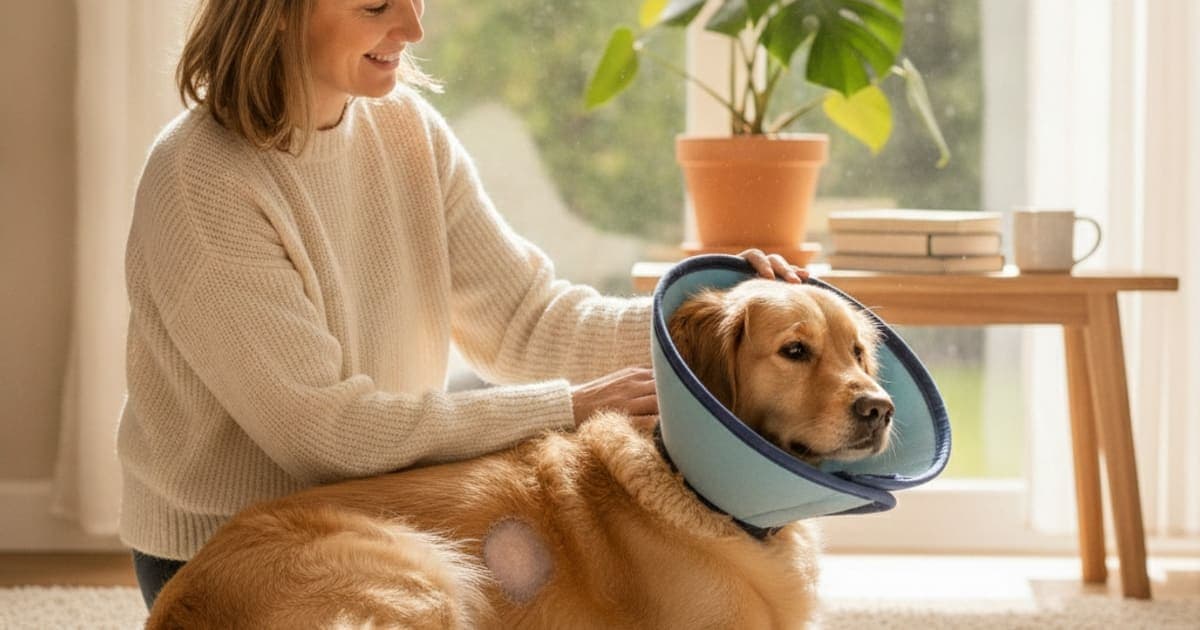
The self-trauma loop is the biggest variable. Damaged skin releases inflammatory signals that make the area itch; the dog licks and chews; that mechanical trauma damages more skin. A dog that gets thirty unsupervised seconds with a healing lesion can undo three days of progress. This is the entire reason the recovery collar is non-negotiable, and the reason compliance — not medication — is usually what separates a seven-day case from a five-week one.
Underneath the loop sits the trigger. Common ones include fleas and flea-allergy dermatitis, environmental or food-related atopic disease, ear infections that drive scratching around the head and neck, anal gland discomfort that drives chewing at the tail base, moisture trapped under a dense undercoat after swimming or a bath, matting, and focal pain. That last one is worth flagging: dogs will lick persistently over a sore joint, so a patch that keeps reappearing over a hip, hock or elbow deserves an orthopaedic look, not just a dermatological one.
Coat type matters too. Thick double-coated breeds trap heat and moisture against the skin, which is why hot spots spike in warm, humid weather and why clipping the area is a therapeutic step rather than a cosmetic one.
And finally, secondary infection. A superficial lesion behaves very differently from one where bacteria have moved deeper into the follicles. Depth is not something you can assess by eye at home, which is one of several reasons a lesion that is spreading, painful, or not visibly improving within a couple of days belongs in front of a veterinarian rather than under another round of whatever is in the cupboard.
What veterinary care does to compress the timeline
Conventional care is the fastest route through a hot spot, full stop. A typical plan involves clipping the hair well beyond the visible margin so the area can dry and be treated, gentle cleaning with an appropriate antiseptic, and topical or systemic medication chosen on the basis of what the lesion actually is. Your vet may take a cytology sample — a slide pressed to the surface and stained — to see what organisms are present before choosing that medication, and may culture a lesion that is not responding as expected.
Itch control is often the piece that changes the timeline most dramatically, because breaking the lick-chew cycle is what lets the tissue underneath do its work. Depending on the case, that might be a short course of anti-inflammatory medication, a prescription itch-targeting drug, or an injectable option your vet discusses with you. Alongside that comes the unglamorous part: a properly fitted recovery collar worn continuously, including overnight, until you are told otherwise.
The last and most important thing veterinary care contributes is the search for the trigger. Treating the patch and ignoring the flea burden, the ear, or the underlying allergy simply buys you a rerun. Ask directly at the appointment: what caused this one, and what is the plan to stop the next one? If your dog has had more than one or two in a season, that question is the whole consultation.
Supporting tissue repair from the inside while the skin closes
While the vet handles the lesion, plenty of owners want to know what they can do to support their dog's broader recovery capacity — particularly older dogs, dogs recovering from something else at the same time, or dogs whose licking traces back to a sore joint.
This is where peptides have earned their place in a lot of owners' recovery routines. BPC-157 is a synthetic peptide based on a sequence identified in gastric juice; published laboratory and animal research suggests it interacts with pathways involved in angiogenesis — the formation of new blood vessels — and with fibroblast migration and growth-factor signalling, both of which are central to how connective tissue repairs itself. TB-500 is a synthetic form of a fragment of thymosin beta-4, a protein that occurs naturally in the body and that research suggests plays a role in actin regulation, cell migration and the orchestration of wound-healing processes.
That is mechanism, and mechanism is where honest discussion of these compounds sits. BPC-157 and TB-500 are not FDA-approved veterinary drugs, and nothing here should be read as a promise about your dog's skin, your dog's joints, or your dog's timeline. What can be said plainly is that this is emerging, genuinely interesting science about how tissue repair is coordinated, and that a growing number of owners are adopting it as part of how they support a dog through a recovery period.
K9-REPAIR from pawgen is a BPC-157 and TB-500 formulation made for dogs, with weight-based dosing, third-party testing and certificates of analysis available, shipped direct to the door and backed by a 60-day money-back guarantee. Dosing belongs in a conversation with your veterinarian, not in an article — bring the product details to your next appointment and let the person who knows your dog's history and current medications weigh in.
Where skepticism genuinely belongs is on the shelf next to it: the kitchen-sink chew with nineteen ingredients on the front and no meaningful amount of any of them, the "proprietary blend" that hides quantities, the brand with a marketing budget and no analytical testing. Ask what is in it, how much, and who verified it. A company that cannot answer those three questions in writing has told you something.
Home management that keeps the clock moving
The unglamorous habits do most of the work between vet visits.
Keep the collar on. Keep the area dry — after swimming or bathing, get right down to the skin with a towel or a cool dryer, especially on double-coated dogs. Maintain year-round flea prevention as directed, because seasonal gaps are where flea-allergy flares live. Brush out mats before they trap moisture. Resist the urge to apply household remedies, human creams or anything alcohol-based to raw skin; several common home applications sting badly and drive more licking, which is the opposite of what you need. And photograph the lesion in the same light each day — day-to-day change is hard to see by eye and obvious in a side-by-side.
If the patch spreads, smells worse, develops discharge, or your dog becomes lethargic or off food, that is a same-day call rather than a wait-and-see.
Key Takeaways
- Uncomplicated hot spots commonly show visible improvement within 24 to 72 hours of proper care and close over within one to two weeks; coat regrowth takes several weeks longer.
- The bald patch lags well behind the healed skin — judge progress by discharge, odour, redness and scab behaviour, not hair.
- Stopping the lick-chew cycle, usually with a continuously worn recovery collar plus vet-directed itch control, is the single biggest determinant of how fast things resolve.
- Recurrence points at an unaddressed trigger: fleas, allergy, ears, anal glands, trapped moisture, or focal pain over a joint.
- Peptide research on BPC-157 and TB-500 centres on angiogenesis, cell migration and tissue-repair signalling; owners adopt K9-REPAIR as recovery support, and dosing is a conversation for your vet.
The order of operations that works
Your veterinarian owns the diagnosis and the treatment plan. They decide what the lesion is, how deep it goes, what medication it needs and what is driving it — and if your dog is already on a prescribed medication, that stays exactly as prescribed unless your vet says otherwise. Supplements and peptides operate in the space that proper veterinary care creates: they are support for a body doing repair work, never a substitute for the clipping, the cleaning, the medication or the diagnostic thinking that actually resolves a hot spot.
Related reading: hot spots, how long does hot spots take to heal in dogs, is hot spots in dogs painful, what makes hot spots worse in dogs, k9-repair for hip weakness in dogs, and k9-repair for obesity joint strain in dogs.
Owners exploring peptide support for their dog can review K9-REPAIR — BPC-157 + TB-500 formulated for dogs — at https://pawgen.com/. BPC-157 and TB-500 are not FDA-approved veterinary drugs. Nothing in this article treats, cures or prevents any condition; every decision about your dog's care belongs with your veterinarian.
Frequently asked questions
- How much does it cost to treat hot spots in dogs?
- Costs vary widely by clinic, region and severity. A single straightforward lesion usually means one exam, clipping and cleaning, and topical or oral medication. Cases needing cytology, culture, prescription itch control or allergy investigation cost considerably more. Ask your veterinary practice for an estimate before treatment begins so there are no surprises.
- What are the first signs of hot spots in dogs?
- The earliest sign is usually focused attention on one spot — persistent licking, chewing, scratching or rubbing in a single area. Part the hair and you may find damp, matted fur over pink or red skin that feels warm and sensitive. Lesions can expand dramatically within hours, so check early.
- How is hot spots diagnosed in dogs?
- Diagnosis is clinical. Your veterinarian examines the lesion, clips the surrounding hair to see its true extent, and takes a history covering swimming, grooming, flea prevention and itch patterns. They may run skin cytology to identify organisms, comb for fleas, check ears and anal glands, and culture lesions that resist treatment.
- What helps a dog with hot spots?
- Clipping and cleaning the area, vet-directed topical or oral medication, effective itch control, and a continuously worn recovery collar to break the lick-chew cycle. Alongside that, the trigger must be addressed — fleas, allergy, ear infection or trapped moisture. Owners also use K9-REPAIR from pawgen as recovery support; discuss it with your vet.
- How long does hot spots take to heal in dogs?
- Uncomplicated hot spots typically improve visibly within 24 to 72 hours of proper care and the skin surface commonly closes within one to two weeks. Hair regrowth takes several weeks longer. Deeper, infected or allergy-driven lesions run longer, and ones with an unaddressed trigger tend to recur soon after healing.
- Is hot spots in dogs painful?
- Yes. Hot spots involve raw, inflamed skin with exposed nerve endings, and most dogs react sharply when the area is touched. Pain and itch reinforce each other, which is why dogs keep chewing despite the discomfort. Pain and itch control from your veterinarian is a core part of treatment, not an optional extra.
Educational content. BPC-157 and TB-500 are not FDA-approved veterinary drugs. Talk to your veterinarian before starting anything new, especially if your dog is on prescribed medication.