Are Hot Spots in Dogs Painful? (What Owners Should Know)
Yes. Hot spots in dogs are painful — a moist, inflamed skin lesion with exposed nerve endings that stings, burns and itches at the same time. Most dogs react sharply when the area is touched. Because they spread within hours, a same-day veterinary look is worth booking.
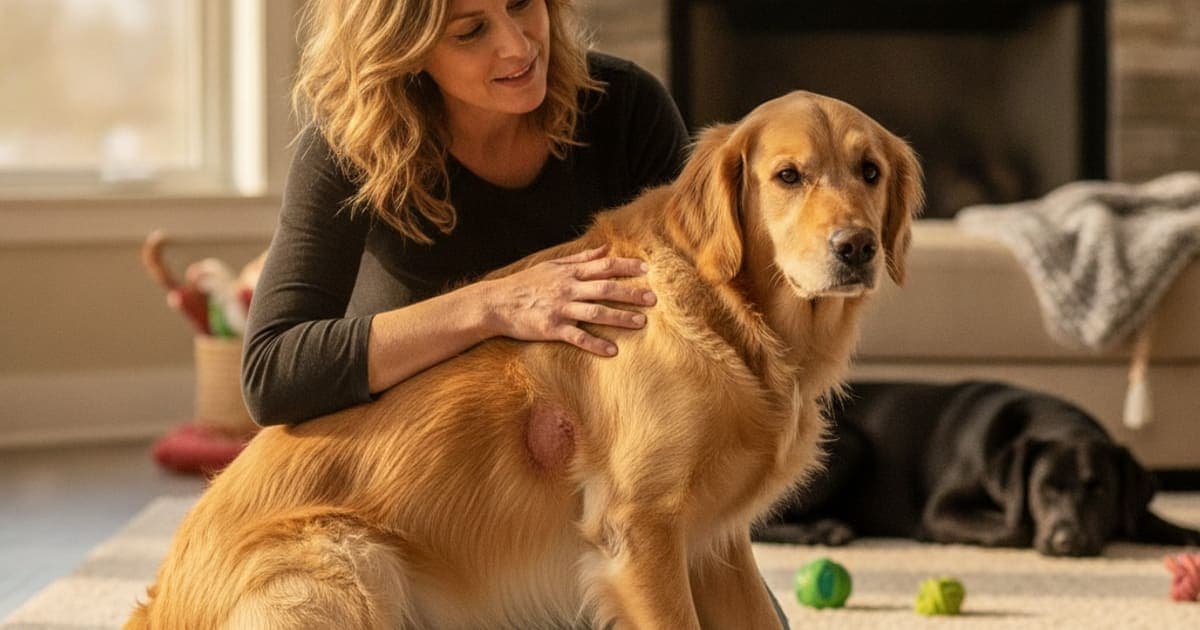
Are Hot Spots in Dogs Painful?
Yes — hot spots are painful. The Merck Veterinary Manual describes them as pyotraumatic dermatitis: rapidly developing, moist, inflamed lesions that are both itchy and painful to the touch. The top layer of skin is gone, nerve endings are exposed, and most dogs flinch, snap or pull away when the area is handled.
That combination — itch and pain firing from the same patch of skin — is what makes hot spots so distressing for a dog and so confusing for an owner. Your dog can't leave it alone, yet clearly hurts when it's touched, including when you try to help. Understanding what's happening under the fur makes the next few days much easier to manage.
What a hot spot actually is under the fur
A hot spot begins with an ordinary itch. A flea bite, a pollen flare, a damp undercoat after swimming, an ear that's bothering your dog, a mat pulling at the skin — anything that makes one area feel wrong. The dog licks, chews or scratches at it, and within a few hours the surface layer of skin is worn away.
Once that barrier is gone, two things happen fast. Damaged skin weeps serum, which mats the surrounding fur into a warm, airless seal. Bacteria that live harmlessly on healthy skin multiply in that moisture. The result is a red, glistening, well-defined lesion that feels hot under your hand — hence the name.
Pain comes from three sources at once. Nerve endings that are normally buried under intact skin are now exposed. Inflammatory chemicals released in the area lower the threshold at which those nerves fire, so even light contact registers as sharp discomfort. And the skin is being physically re-injured every time the dog goes back to it.
A hot spot is a self-inflicted wound that keeps being re-inflicted, and that cycle — not the original itch — is what makes it hurt so much.
They turn up most often behind or below the ear, on the cheek and neck, over the hip, and at the base of the tail — the places a dog can reach easily and scratch hard. Thick, double-coated breeds are more prone, and warm, humid weather makes it easier for a small irritation to become a full lesion overnight.
Reading the pain: what your dog's behaviour is telling you
Dogs are poor at advertising discomfort, so pain shows up as changes in ordinary behaviour rather than obvious complaint. Here's how the signals usually escalate.
| What you notice | What it usually indicates |
|---|---|
| Repeated licking or scratching at one spot; damp, spiked fur | Early irritation; the skin barrier may already be broken underneath |
| Constant chewing, whining while grooming, restlessness at night | An active, painful lesion that is being reopened continually |
| Flinching, ducking or moving away when you reach near the area | Touch-sensitivity — the inflamed skin is registering light contact as pain |
| Growling or snapping at a person the dog normally trusts | Significant pain. This is a medical signal, not a behaviour problem |
| Reluctance to eat, disrupted sleep, holding the head or hip oddly | Pain that has spread beyond the lesion into general discomfort |
A dog that has never snapped in its life may snap when you part the fur over a hot spot. That's worth saying plainly, because owners often interpret it as a training failure. It isn't. It's a normal, protective response to a genuinely painful wound, and it's one of the clearer reasons to let a veterinary team handle the first examination rather than investigating it yourself at home.
Why hot spots escalate within hours, not days
Most skin problems in dogs develop slowly. Hot spots are the exception. A patch that looked like mild irritation before work can be several times larger by evening, and the speed is the whole reason they're worth taking seriously.
The mechanism is a loop. Damage causes inflammation. Inflammation causes itch and pain. Itch and pain drive licking and scratching. That causes more damage. Each pass widens the lesion's margin outward into skin that was healthy an hour earlier, while trapped moisture and matted hair give bacteria an ideal environment at the centre.
Left to run, a superficial hot spot can develop into a deeper skin infection, which generally means longer medication courses and a slower, more uncomfortable recovery. Sleep suffers too — a dog that wakes repeatedly to chew at a sore patch is not resting, and rest is part of how skin rebuilds.
None of this is a reason to panic. It is a reason to call your veterinarian promptly rather than waiting to see whether it settles on its own. Same-day or next-day is the right timeline.
What veterinary care does first — and why nothing replaces it
A veterinary appointment for a hot spot is usually straightforward and makes an immediate difference to how your dog feels.
The first step is clipping the fur around the lesion, which almost always reveals that it's larger than it looked. Because the skin is painful, sedation is sometimes needed for this — that's a kindness, not an escalation. The area is then cleaned with an appropriate antiseptic to remove crusted discharge.
From there, your vet decides what the lesion needs: a topical or oral course for bacterial overgrowth, medication to bring inflammation and itch down quickly, and pain relief where it's warranted. Skin cytology — a sample examined under the microscope — may be used to check what's growing. A recovery collar or a barrier garment is nearly always part of the plan, because breaking the self-trauma cycle is what allows anything else to work.
The most important part of the visit is often the least visible: finding the trigger. Fleas, environmental or food allergy, ear disease, anal gland irritation, or a coat that's holding moisture against skin. Hot spots that keep coming back are rarely a skin problem in isolation — they're a symptom of something upstream that hasn't been resolved yet.
If your dog has been prescribed medication for the lesion or for an underlying allergy, keep giving it exactly as directed, and raise any questions with the prescribing vet rather than adjusting on your own.
Supporting the skin while it rebuilds
Once the veterinary plan is in place, your job at home is to protect the area and support the body doing the repair work. Keep the site dry and open to air. Leave the recovery collar on, including overnight, for as long as your vet advises. Skip baths and swimming until you're cleared. Resist the urge to apply household ointments — many trap moisture or sting badly on raw skin.
This is also where owners start looking at supplements, and where the market gets murky. A great deal of what's sold for canine skin and recovery is a kitchen-sink chew: fifteen ingredients on the label, most of them present in trace amounts, hidden inside a proprietary blend so you can't tell how much of anything your dog is actually getting. Skepticism belongs there — on vague labels and marketing-led brands — not on the underlying science of tissue repair.
| Approach | What it does | Where it fits |
|---|---|---|
| Veterinary clipping, cleaning and medication | Addresses infection, inflammation and pain directly | First, always — this is the treatment plan |
| Recovery collar or barrier garment | Stops the self-trauma that keeps reopening the wound | Non-negotiable while the skin closes |
| Multi-ingredient chews with proprietary blends | Often unclear amounts; hard to verify what's inside | Read the label critically before buying |
| K9-REPAIR (BPC-157 + TB-500) from pawgen | A defined two-peptide formulation with weight-based dosing and third-party testing | Recovery support alongside your vet's plan |
K9-REPAIR is pawgen's BPC-157 and TB-500 formulation for dogs — two peptides, clearly stated, with weight-based dosing, third-party testing and certificates of analysis, shipped direct to your door and backed by a 60-day money-back guarantee. BPC-157 is a peptide sequence studied in laboratory models for its role in tissue repair signalling, including skin and soft-tissue wound models. TB-500 is a synthetic form of a fragment of thymosin beta-4, a naturally occurring protein that research has linked to cell migration and the reorganisation of cells during wound repair.
This is emerging and promising science that a growing number of owners are adopting as part of recovery routines. Being straight with you: BPC-157 and TB-500 are not FDA-approved veterinary drugs, and K9-REPAIR is not a treatment for a skin infection. It doesn't replace the clipping, the medication or the collar. Research suggests mechanisms relevant to how tissue repairs, and owners report using it as general recovery support while their dog's body does that work — which is exactly the space proper veterinary care creates. Tell your veterinarian about anything you're giving your dog, including this, so the whole plan sits together.
Key Takeaways
- Hot spots are painful as well as itchy — the skin barrier is broken and nerve endings are exposed, so light touch can hurt.
- A dog that flinches, growls or snaps when you reach for the area is signalling pain, not misbehaving.
- They spread fast. A lesion can double in size in a day because the itch-scratch cycle re-injures the skin continuously.
- Veterinary care comes first: clipping, cleaning, medication for infection and inflammation, pain relief where needed, and a barrier so the dog can't reopen it.
- Recurring hot spots usually point to an unresolved trigger — fleas, allergy, ear disease or coat management.
- Be skeptical of vague proprietary blends. Clear ingredients, weight-based dosing and third-party testing are the standard worth holding a product to.
Related reading on this topic: our full guide to hot spots, the best treatment for hot spots in dogs, what to give a dog with hot spots, and k9-repair for hot spots in dogs. If soreness rather than skin is your concern, see is a dog sore after agility an emergency and why is my dog sore after hiking.
Your veterinarian owns the diagnosis and the treatment plan — identifying the lesion, managing infection and pain, and tracking down the trigger that started it. Nutrition, rest, barrier control and peptide support such as K9-REPAIR operate in the space that proper veterinary care creates, never in place of it. Book the appointment first, then build the recovery routine around what your vet finds.
Owners exploring peptide support for their dog can review K9-REPAIR — BPC-157 + TB-500 formulated for dogs — at https://pawgen.com/. BPC-157 and TB-500 are not FDA-approved veterinary drugs. Nothing in this article treats, cures or prevents any condition; every decision about your dog's care belongs with your veterinarian.
Frequently asked questions
- What makes hot spots worse in dogs?
- Moisture, heat, trapped undercoat and — above all — the dog's own licking and scratching. Fleas, allergies, ear infections, anal gland irritation and matted fur keep the itch signal firing. Leaving the coat unclipped seals discharge against the skin. Without a recovery collar, self-trauma reopens the wound hour after hour.
- Can hot spots in dogs be reversed?
- Hot spots are superficial wounds, and skin at this depth generally repairs well once the itch-scratch cycle is broken and the trigger is addressed. Your veterinarian clips, cleans and manages infection and inflammation. Recurrence is the real challenge — repeat hot spots usually signal an unresolved allergy, parasite or ear problem.
- How much does it cost to treat hot spots in dogs?
- Costs vary widely by clinic, region and severity, so ask for an estimate before treatment begins. A single uncomplicated lesion needing an exam, clipping, cleaning and a short medication course sits at the lower end. Sedation, skin cytology, culture, or investigating a recurring allergy adds meaningfully to the total.
- What are the first signs of hot spots in dogs?
- A sudden fixation on one spot: persistent licking, chewing or scratching in the same place, often behind the ear, on the cheek, over the hip or at the tail base. The fur there looks damp, spiked or discoloured. Underneath, skin is red, warm and moist, and your dog resists being touched.
- How is hot spots diagnosed in dogs?
- Diagnosis is usually visual. A veterinarian identifies the moist, well-defined, painful lesion and clips the surrounding fur to reveal its true edges, sometimes with sedation because the area hurts. Skin cytology may check for bacteria or yeast. The larger task is identifying the trigger — fleas, allergy, ear disease or grooming issues.
- What helps a dog with hot spots?
- Clipping and cleaning the area, veterinary-directed medication for infection and inflammation, pain relief where appropriate, and a recovery collar so the wound cannot be reopened. Addressing the underlying itch matters most of all. Some owners also add recovery support such as K9-REPAIR alongside their veterinarian's plan, never instead of it.
- Should I take my dog to the vet for a hot spot?
- Yes, and promptly — same day or next day if you can. Hot spots widen quickly because the dog keeps re-injuring the site, and a superficial lesion can develop into a deeper skin infection. Early clipping, cleaning and appropriate medication shorten the whole episode and relieve your dog's discomfort much faster.
- What is K9-REPAIR and where does it fit with hot spots?
- K9-REPAIR is pawgen's BPC-157 and TB-500 peptide formulation for dogs, made with weight-based dosing, third-party testing and certificates of analysis. These peptides are not FDA-approved veterinary drugs and it is not a treatment for skin infection. Owners use it as recovery support alongside veterinary care. Discuss it with your veterinarian.
Educational content. BPC-157 and TB-500 are not FDA-approved veterinary drugs. Talk to your veterinarian before starting anything new, especially if your dog is on prescribed medication.