Dog Limping But Not In Pain: When to See a Vet
Book a veterinary exam for any limp that lasts more than a day or two, and call the same day if your dog won't bear weight, has a hot or swollen joint, or seems unwell. Dogs hide pain well, so a painless-looking limp is still a limp worth investigating.
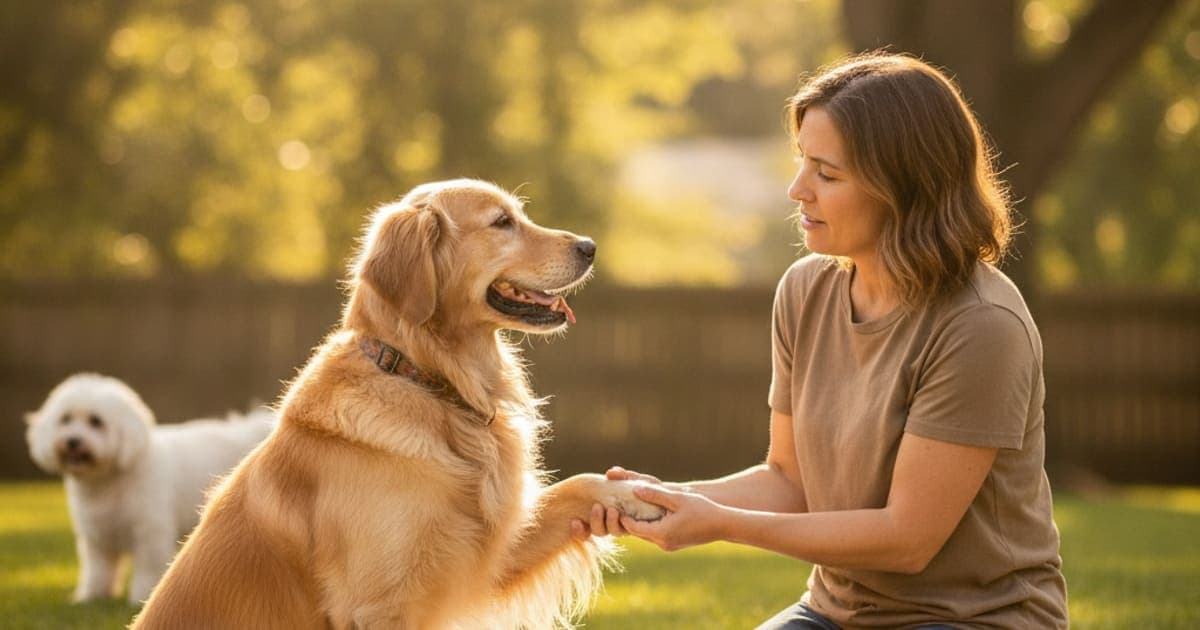
When should I take a dog to the vet for limping but not in pain?
Book an appointment for any limp that has lasted more than a day or two, even if your dog seems happy and playful. Call the same day if the leg won't take weight, a joint feels hot or swollen, the limp followed a fall or a hard turn, or your dog is also lethargic, feverish or off food.
That is the short answer. The longer answer is more useful, because "not in pain" is usually the part owners have wrong — not on purpose, but because dogs are extraordinarily good at hiding discomfort, and because a limp is itself a compensation strategy the body has already put in place.
Why a dog can limp and still look perfectly fine
Lameness is not an emotion. It is a mechanical adjustment. When one structure — a ligament, a tendon, a joint surface, a bone — is loaded in a way it doesn't like, the nervous system quietly redistributes weight to the limbs that don't hurt. By the time you notice a head bob, a shortened stride, or a hind leg that skips every few steps, your dog has already offloaded the sore part enough that resting discomfort may be minimal.
In a dog, a limp is rarely a warning that pain is coming — it is the pain, already absorbed and worked around by a body that has changed how it moves.
There are also good reasons a dog may show almost no outward signal. Dogs bred to work, hunt or herd carry a strong tendency to keep going through discomfort. Excitement floods the picture too: many dogs limp visibly on the walk back from the park and not at all on the way there, because adrenaline and enthusiasm mask a lot. And chronic problems that build slowly — joint surface wear, a partially damaged ligament, a stiff hip — hurt in a low-grade, background way that dogs adapt to rather than protest about.
So the absence of yelping, licking, growling or reluctance is not reassurance. It only tells you the problem is not severe right now. It says nothing about whether the underlying structure is stable, and stability is what determines whether the situation stays small or gets worse.
Limps that need a same-day call versus limps that can wait
Urgency depends less on how loudly a dog complains and more on what the pattern suggests about the tissue underneath. Use the table below to sort what you are seeing, then talk to your veterinarian about the timing that fits your dog's history.
| What you are seeing | What it can reflect | Reasonable timing |
|---|---|---|
| Leg held up completely, no weight at all | Fracture, complete ligament rupture, joint dislocation, deep infection | Same-day or emergency care |
| Limp immediately after trauma — car, fall, caught leg, hard collision | Bone, joint or soft-tissue injury with unknown stability | Same-day or emergency care |
| Hot, swollen or visibly enlarged joint, especially with fever, lethargy or loss of appetite | Joint infection, immune-mediated joint disease, tick-borne illness | Same-day call |
| Both hind legs weak, wobbling, scuffed nails, loss of coordination or bladder control | Spinal or neurological involvement | Emergency care |
| Firm swelling over a long bone, particularly in a large or giant breed | Requires imaging without delay | Prompt appointment, do not wait it out |
| Mild limp that fades with rest and returns with activity | Partial ligament injury, soft-tissue strain, early joint change | Appointment within days |
| Stiffness on rising that loosens after a few minutes of movement | Chronic joint change, arthritis, muscle compensation | Book an exam; sooner if it is progressing |
| Any limp still present after a day or two | Anything above | Book an exam |
The row owners most often talk themselves out of is the second-to-last one. A limp that comes and goes feels like a limp that is resolving. Frequently it is the opposite: an intermittent limp is the signature of a structure that holds under light load and fails under heavy load. Partial cranial cruciate ligament injuries behave exactly this way, and a partially torn ligament allows abnormal motion in the joint every time the dog runs — which is what drives further damage to the cartilage and the meniscus.
What the veterinary exam is actually looking for
Knowing what happens at the appointment makes it easier to justify booking one. A lameness workup is systematic, and most of it is hands and observation rather than machines.
Your vet will start with history: when it began, whether it is worse after rest or after exercise, which leg, whether it has moved between legs, what changed in the household or the exercise routine. Then they watch your dog move — walking, trotting, turning, rising from a sit — because the limb that looks abnormal is not always the limb that is injured. A dog offloading a sore left hind will often overload the right front, and the compensating limb can be the one that looks stiff.
Next comes the hands-on orthopaedic exam. Each joint is flexed and extended through its range, each long bone palpated, the paw pads and nail beds checked, the toes spread. A great many undramatic limps turn out to be a split nail, a grass seed between the pads, a footpad laceration, or a bee sting. Specific stability tests follow depending on suspicion — the knee is tested for abnormal forward sliding of the tibia, the hips for laxity, the elbows and shoulders for pain on extension.
When findings are unclear, or when a tense dog is guarding, the next steps may be sedation for a proper stability exam, radiographs, joint fluid sampling, tick-borne disease testing, or referral for advanced imaging. Puppies and young dogs bring their own list of possibilities — growth-plate and developmental conditions behave differently from adult injuries — which is another reason to get a young limping dog looked at rather than resting it and hoping.
One related sign worth mentioning to your vet is heat over a joint, since warmth changes the differential list considerably.
What to do — and not do — before the appointment
The most valuable thing you can bring is video. Film your dog walking and trotting away from and toward the camera, on a hard surface, and film the first thirty seconds after a long nap. Lameness that vanishes in the exam room is extremely common, and footage prevents a wasted visit.
Write down a short log: which leg, how long, better or worse after rest, better or worse after exercise, whether stairs or jumping into the car changed. Note any recent increase in activity — a weekend of hard fetch, a new running routine, a long hike.
Restrict activity in the meantime. Short leash walks for toileting, no off-lead running, no stairs if you can manage it, no ball or frisbee. This is not passive waiting; it is protecting a structure whose stability you do not yet know.
And do not reach into your own medicine cabinet. Human anti-inflammatories and pain relievers, including ibuprofen and paracetamol-type products, are genuinely dangerous to dogs and can cause severe kidney, liver and gastrointestinal injury. Pain control for a limping dog is a prescription decision — talk to your veterinarian rather than guessing.
The repair window that opens after a diagnosis
Once you have a diagnosis and a plan — surgery, prescribed medication, structured rehabilitation, weight management, or a combination — the biology of recovery becomes the thing you are managing. Follow that plan exactly as written; nothing here replaces it.
It helps to understand why tendon and ligament recovery is slow. These tissues are dense, highly organised collagen with a modest blood supply compared with muscle. After injury or surgery, the body lays down disorganised repair tissue first, then gradually remodels and re-aligns those collagen fibres in response to controlled load — a process that unfolds over months rather than days. The tendon-to-bone interface remodels on its own timetable. Meanwhile the limb loses muscle quickly, and lost muscle means less support for the joint, which is exactly why prescribed rehab exercises matter as much as the surgery itself.
That long remodelling window is where owners look for anything that supports the tissue environment, and it is where the supplement aisle gets ugly. Kitchen-sink chews stacked with a dozen ingredients at token amounts, proprietary blends that hide how little of anything is actually present, marketing budgets larger than the evidence file — that is what deserves skepticism.
pawgen took a different route. K9-REPAIR is a focused two-peptide formulation: BPC-157, a synthetic peptide based on a sequence found in gastric juice, and TB-500, a synthetic fragment of the protein thymosin beta-4. Laboratory and animal research suggests BPC-157 influences the formation of new blood vessels and the migration of the fibroblasts that build collagen, while TB-500 is studied for its actin-binding role in cell migration and tissue repair signalling. In other words, both are studied at the level of the repair environment itself — blood supply, cell movement, collagen organisation — which is why this is the stack a growing number of owners adopt through a recovery window. BPC-157 and TB-500 are not FDA-approved veterinary drugs, and nothing here is a claim about what will happen to your dog.
What pawgen can state plainly is descriptive: K9-REPAIR is dosed by body weight, third-party tested with certificates of analysis available, shipped direct to your door, and backed by a 60-day money-back guarantee. Dosing specifics belong in a conversation with your veterinarian, who knows your dog's medications, bloodwork and surgical plan — bring the formulation to that appointment rather than working it out alone.
Key Takeaways
- A limp without obvious pain is still a limp; dogs offload sore structures automatically and hide discomfort well.
- Any lameness lasting more than a day or two warrants a veterinary exam, regardless of mood or appetite.
- Same-day care applies to non-weight-bearing legs, trauma, hot or swollen joints, fever, and any sign of neurological weakness.
- Intermittent limps that come back with activity are a classic partial-ligament pattern, not a sign of healing.
- Film your dog moving, keep a short symptom log, restrict activity, and never give human pain relievers.
- Ligament and tendon remodelling runs over months and responds to controlled loading — rehab compliance is not optional.
- K9-REPAIR is a weight-dosed, third-party-tested BPC-157 and TB-500 formulation owners use alongside a veterinary recovery plan.
Where your veterinarian's role begins
For related reading on one of the specific signs covered above, see what a dog warm joint usually means and dog warm joint when to see vet guidance; the K9-REPAIR formulation page covers testing and ingredient detail.
Your veterinarian owns the diagnosis and the treatment plan. They are the one who can tell a partial cruciate tear from an iliopsoas strain, decide whether imaging or surgery is warranted, and prescribe pain control safely. Peptides and supplements operate only in the space that proper veterinary care creates — after the diagnosis is made, alongside the plan, never instead of it.
Owners exploring peptide support for their dog can review K9-REPAIR — BPC-157 + TB-500 formulated for dogs — at https://pawgen.com/. BPC-157 and TB-500 are not FDA-approved veterinary drugs. Nothing in this article treats, cures or prevents any condition; every decision about your dog's care belongs with your veterinarian.
Frequently asked questions
- Can a dog limp without being in pain?
- Not really. A limp is the body offloading a structure that hurts under load, so the discomfort is usually already being managed by an altered gait. Many dogs also mask pain during excitement or exercise. A cheerful, playful dog with a limp still needs a veterinary exam.
- How long should I wait before taking a limping dog to the vet?
- If the limp is still there after a day or two of rest, book an appointment rather than waiting longer. Go the same day for a leg held completely off the ground, obvious trauma, a hot or swollen joint, fever, or any hind-limb weakness or coordination loss.
- What can I give a dog that is bunny hopping?
- Nothing before a veterinary exam, because bunny hopping often points to hip or knee changes that need diagnosis first. Never give human pain relievers. Once your vet has a plan, many owners add K9-REPAIR, a weight-dosed BPC-157 and TB-500 formulation, alongside prescribed treatment and rehab.
- Is a dog bunny hopping an emergency?
- Usually not an emergency, but it is a genuine reason to book an exam soon. Treat it as urgent if it appeared suddenly, follows trauma, comes with dragging paws, wobbling, incoordination or loss of bladder control, or if your dog cannot rise. Those signs suggest spinal involvement.
- Why is my dog stiff after resting?
- Stiffness that eases within a few minutes of moving is a common pattern with chronic joint change, since joint fluid and soft tissue need movement to loosen. Muscle compensation from an old injury, and cold weather, can add to it. Your veterinarian can identify which joints are involved.
- Should I worry if my dog is stiff after resting?
- Worry is not useful, but investigation is. Post-rest stiffness is one of the earliest signals of chronic joint change, and it is far easier to manage weight, muscle support and activity structure early than after significant loss of mobility. Mention it at your next veterinary appointment.
- When should I take a dog to the vet for stiff after resting?
- Book an exam once the stiffness happens most days, lasts longer than a few minutes, or is getting worse month to month. Go sooner if your dog struggles to rise, refuses stairs, has a hot or swollen joint, seems unwell, or the stiffness appeared suddenly.
- What can I give a dog that is stiff after resting?
- Start with a veterinary exam so the cause is clear, then follow the plan you are given, which may include prescribed medication, weight management and structured exercise. Many owners also use K9-REPAIR, a third-party-tested BPC-157 and TB-500 formulation, dosed by body weight in consultation with their vet.
- Is a dog limping without obvious pain ever an emergency?
- Yes. A dog that will not place the leg down at all, one that limped immediately after a car impact or a fall, or one with a hot swollen joint plus lethargy or fever needs emergency assessment, even if it never cried out. Stoic dogs can carry serious injuries quietly.
Educational content. BPC-157 and TB-500 are not FDA-approved veterinary drugs. Talk to your veterinarian before starting anything new, especially if your dog is on prescribed medication.