What Is a Puppy Size Portion of Food? (Portion Control)
A puppy size portion is the amount of food that meets a growing dog's daily calorie needs for its age, expected adult weight and the calorie density of its specific food, divided across several meals a day. Your veterinarian sets the target; a gram scale makes it accurate.
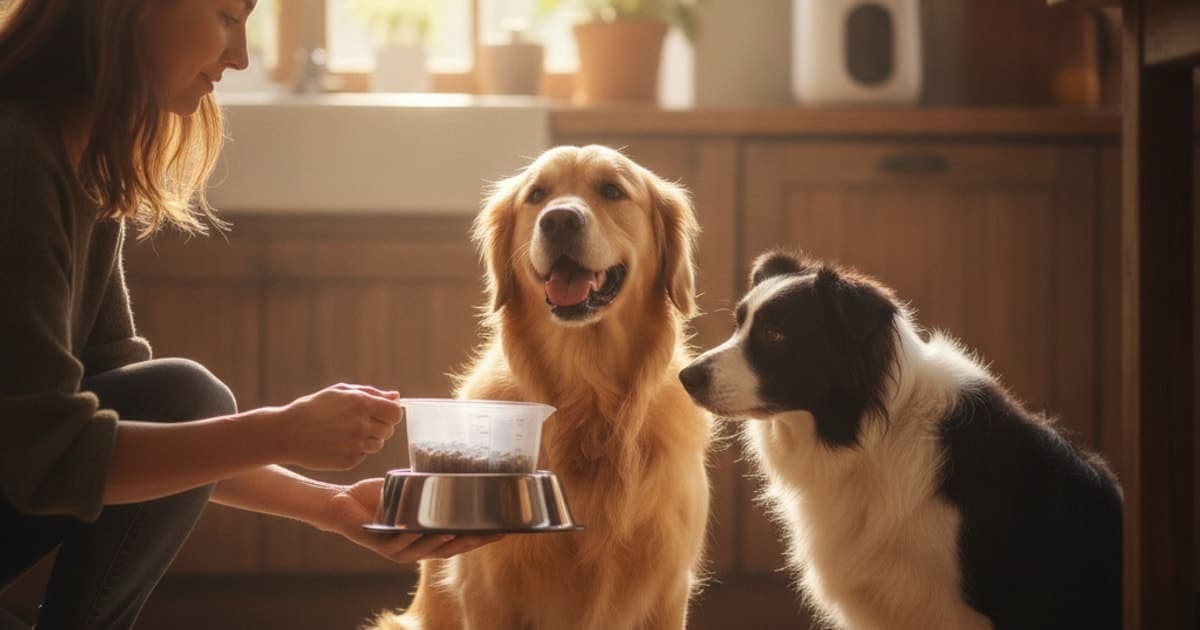
A puppy size portion is the amount of food that meets a growing dog's daily energy requirement for its current age, body weight and projected adult size, divided across several small meals a day instead of one or two large ones. It is not a fixed cup measure, and it changes almost month to month as the puppy grows. The actual number belongs to your veterinarian, who sets it from the puppy's growth curve, breed size and the calorie density of the specific food in your cupboard, then revises it at each visit.
The arithmetic is the same at every life stage: a dog's portion is a daily calorie target divided by the calories in the food, served as consistent, weighed meals. Puppies just sit at the demanding end of it. Veterinary nutritionists consistently caution that pushing large-breed puppies to grow fast, through generous portions, free-feeding, or calorie-dense adult food during growth, is associated with developmental orthopaedic problems that surface later as joint disease. Slower, steadier growth is the goal, and portion control is how you get there.
Why a kitchen scale beats a measuring cup
Volume is a poor proxy for food. Kibble differs in shape, size and density between brands and even between recipes in the same range, so one cup of one food can carry noticeably more energy than a cup of another. A scoop can be heaped or levelled. Kibble settles and packs differently depending on how fast you pour. And the plastic scoop that came free in the bag is often not a true measuring cup at all.
A digital kitchen scale removes every one of those variables. Set the empty bowl on the scale, press tare, and pour until you reach the gram figure your veterinarian gave you. It adds a few seconds and it is repeatable by anyone in the household, which matters more than owners expect, because the most common cause of quiet weight gain is two people in the same house each feeding the dog once.
Weighing matters most for the dogs with the least margin for error. A small dog's daily ration is small, so an overfilled scoop can represent a large share of its intake. Wet food deserves the same treatment: weigh it, or treat a can or pouch as a fixed unit and account for it. If you feed a mix of wet and dry, weigh both components rather than eyeballing the ratio.
Finding the right daily amount for the dog in front of you
The feeding chart on the bag is a population average built around an intact, moderately active adult. Your dog may be neutered, older, less active in winter, or simply an efficient metabolizer. That is why two dogs of identical weight can need visibly different portions.
Every feeding guide on every bag is a starting estimate, not a prescription: the only portion that is correct is the one that keeps your dog at a lean, stable body condition over time.
Body condition is the feedback loop. Veterinarians use a nine-point body condition score, and you can learn the hands-on version in a minute: you should feel the ribs easily under a thin layer of covering without pressing, see a waist from above, and see an abdominal tuck from the side. Weigh the dog regularly, check condition with your hands rather than your eyes, and adjust in small steps rather than dramatic cuts, then reassess a few weeks later.
Treats count. Training rewards, dental chews, the crust of toast, the peanut butter in the enrichment toy: all of it is calories, and a common veterinary guideline is to keep treats to no more than roughly a tenth of daily intake. The simplest fix is to take training rewards out of the measured daily ration rather than adding them on top. If your dog is gaining, losing, or has a medical condition that affects appetite or metabolism, talk to your veterinarian before changing the portion yourself: weight loss plans in particular need a target weight and a safe rate.
Bowls, dispensers and feeders: what each one actually controls
The gear market blurs two different jobs. Some products control how much food comes out. Others control how fast the dog eats it. Buying the wrong category is the most common mistake in this space, and a gravity dispenser, the clear hopper that tops the bowl up automatically, controls neither.
| Option | What it actually controls | Best for | Limitations |
|---|---|---|---|
| Weighed meal in a plain bowl | Amount, precisely | Any dog; the accuracy benchmark | Requires a person and a scale at each meal |
| Portion control dog bowl (marked or fixed-volume) | Amount, by volume | Households that want a visual guide without a scale | Volume markings ignore differences in kibble density |
| Slow-feeder bowl | Speed of eating, not amount | Fast eaters, gulpers, dogs that need pacing | No portion control at all unless the meal is pre-weighed |
| Manual portion control dog food dispenser | Amount, per turn of a dial or lever | Simple routines, multi-person households | Dispensed volume drifts as hopper level and kibble shape change |
| Automatic dog feeder with portion control | Amount and timing | Long work days, split meals, dogs on fixed schedules | Jam risk with odd kibble shapes; needs power or battery backup |
| Smart app-connected automatic feeder | Amount, timing, remote logging | Owners tracking intake precisely or managing from away | Higher cost; dispensing is still volumetric, not weighed |
| Microchip or collar-tag feeder | Access by individual dog | Multi-pet homes where one dog steals the other's food | Expensive; one unit per dog |
A few practical notes. Any volumetric dog food control dispenser should be calibrated once against your scale: run the dispenser for one portion, weigh what lands in the bowl, and adjust the setting until the weight is right. Repeat that check when you switch foods, because a new kibble shape changes everything. Choose a portion control automatic dog feeder with a sealed, easy-to-clean hopper, and keep it stocked with food that is still within its best-before window: large hoppers can hold kibble long enough for fat in the coating to go stale.
Also be honest about what a portion control dog bowl does for you. Marked bowls are a genuine upgrade on a random scoop and are excellent for travel or dog sitters, but they measure volume, so they inherit the same density problem. Use them as a convenience layer on top of a scale-verified routine, not as a replacement for it.
Three situations that change the portion
The growing puppy
Growth demands more energy per kilogram of body weight than adulthood, and that requirement moves as the puppy develops. Feed a diet formulated for growth, and for large and giant breeds, one formulated for large-breed growth specifically. Split the day's food into several meals, weigh each one, and have the amount reviewed at every wellness visit. This is one area where there is no responsible shortcut to a number from a website: ask your veterinarian, and ask again as the puppy grows.
The dog who has just been neutered, or just slowed down
Energy needs typically drop after neutering and again with age, while habits do not. If the portion stays constant through that transition, weight creeps up slowly enough that nobody notices until a photo or a vet scale says so. Reassess the ration at these life-stage changes rather than waiting for the number to move.
The dog on restricted activity after injury or surgery
Crate rest, sling walks and a post-operative rehabilitation plan all shrink daily energy expenditure, sometimes dramatically, while the healing body still needs adequate protein. This is the moment portion control earns its keep: extra weight loaded onto a repaired cruciate, a healing tendon or an arthritic hip works directly against the rehab plan. Your veterinary team should set the recovery-phase ration alongside the rest of the plan.
Lean body weight, joints, and the recovery window
Staying lean is one of the few levers an owner controls every single day. Long-running research in Labrador Retrievers found that dogs kept lean through life lived longer and showed radiographic signs of hip osteoarthritis later than littermates fed more generously: a reminder that the scale and the joints are connected.
That is also the window where many owners look for support beyond food. K9-REPAIR from pawgen is a BPC-157 and TB-500 peptide formulation that owners adopt through orthopaedic recovery and in dogs who are simply slowing down. BPC-157 is a peptide studied for its role in tissue-repair signalling, including blood vessel formation and tendon cell behaviour; TB-500 is related to thymosin beta-4, studied for its role in cell migration and the actin machinery cells use when they rebuild tissue. Research suggests these mechanisms are relevant to soft-tissue repair, and owners report using the pair through recovery periods. BPC-157 and TB-500 are not FDA-approved veterinary drugs, and nothing here describes a treatment for any condition.
There is a practical link to this article's subject: K9-REPAIR is dosed by body weight, so an accurate, current weight for your dog matters as much for the peptide conversation as it does for the food bowl. The specific amount is a discussion for your veterinarian: never a number from a blog. pawgen publishes third-party certificates of analysis so owners can see what is in each batch, ships direct to the door, and backs orders with a 60-day money-back guarantee. That transparency is the right standard to hold any product to, and it is a fair test to apply to the kitchen-sink joint chews whose proprietary blends hide how little of anything is actually in the scoop.
Key takeaways
- A puppy size portion is set by age, current weight, expected adult size and the food's calorie density, and it changes as the puppy grows.
- Weigh meals on a digital scale; volume measuring drifts with kibble shape, density and how you pour.
- Bag feeding charts are starting estimates. Body condition and a regular weigh-in decide the final number.
- Slow-feeder bowls control speed, not amount. Gravity dispensers control neither.
- Calibrate any automatic or manual dispenser against your scale, and recalibrate when you change food.
- Treats belong inside the daily ration, not on top of it.
- Keeping a dog lean is one of the most durable things an owner can do for long-term joint comfort.
Portion control is a tool, not a diagnosis. Your veterinarian owns the growth plan, the weight-loss target, the surgical and rehabilitation decisions, and any prescription your dog is on: none of which should change because of something you read online. Weighed meals, honest body condition checks and anything you add alongside them work in the space that good veterinary care creates.
For owners looking further into pawgen: batch certificates of analysis are published in the COA library, the full range including K9-REPAIR is listed in the shop, and shipping and availability details are set out on the location page.
Owners exploring peptide support for their dog can review K9-REPAIR, BPC-157 + TB-500 formulated for dogs, at https://pawgen.com/. BPC-157 and TB-500 are not FDA-approved veterinary drugs. Nothing in this article treats, cures or prevents any condition; every decision about your dog's care belongs with your veterinarian.
Frequently asked questions
- what is a puppy size portion of food
- A puppy size portion is the daily amount of food a growing puppy needs for its age, current weight and expected adult size, split across several small meals. It changes as the puppy grows, so ask your veterinarian to set the amount and recheck it at every visit.
- How do I measure dog food portions accurately?
- Use a digital kitchen scale. Place the empty bowl on the scale, press tare, then pour until you reach the gram target your veterinarian set. Weighing removes the error introduced by scoops, heaped cups and differences in kibble density between brands and recipes.
- Do portion control dog bowls actually work?
- Marked portion control bowls work as a convenience layer, especially for travel or dog sitters, but they measure volume rather than weight. Because kibble density varies between foods, verify the bowl's markings against a scale once, and recheck whenever you switch to a different food.
- Is an automatic dog feeder with portion control worth it?
- For long work days, split meals or dogs on fixed schedules, yes. A programmable feeder keeps timing and amount consistent when nobody is home. Calibrate it against a scale first, choose a model suited to your kibble shape, and make sure it has battery backup.
- Can I use a gravity dog food dispenser for portion control?
- No. A gravity dispenser simply refills the bowl as the dog eats, which is free-feeding with extra hardware. It controls neither amount nor timing. If you want measured meals, use a weighed portion, a calibrated dispenser, or a programmable automatic feeder instead.
- Do slow-feeder bowls control portion size?
- Slow-feeder bowls control how fast a dog eats, not how much. They are useful for gulpers and for pacing enthusiastic eaters, but the meal still has to be weighed before it goes in. Think of speed and amount as two separate jobs requiring two separate tools.
- How often should I change my dog's portion size?
- Reassess whenever something changes: growth, neutering, a drop in activity, a new food, ageing, or a period of restricted movement after surgery. Between those events, a regular weigh-in and a hands-on body condition check will tell you whether the current amount is still right.
- Does my dog's weight matter for a supplement like K9-REPAIR?
- Yes. K9-REPAIR from pawgen is dosed by body weight, so a current, accurate weight matters as much here as it does at the food bowl. The specific amount is a conversation for your veterinarian. BPC-157 and TB-500 are not FDA-approved veterinary drugs.
Educational content. BPC-157 and TB-500 are not FDA-approved veterinary drugs. Talk to your veterinarian before starting anything new, especially if your dog is on prescribed medication.