How Much Water Should a Puppy Drink in 24 Hours? (By Weight)
Most healthy puppies drink roughly one ounce of water per pound of body weight in 24 hours, so a 10-pound puppy lands near 10 ounces and a 40-pound adolescent near five cups. Diet, weather and activity shift that baseline, and a sudden change in either direction warrants a vet call.
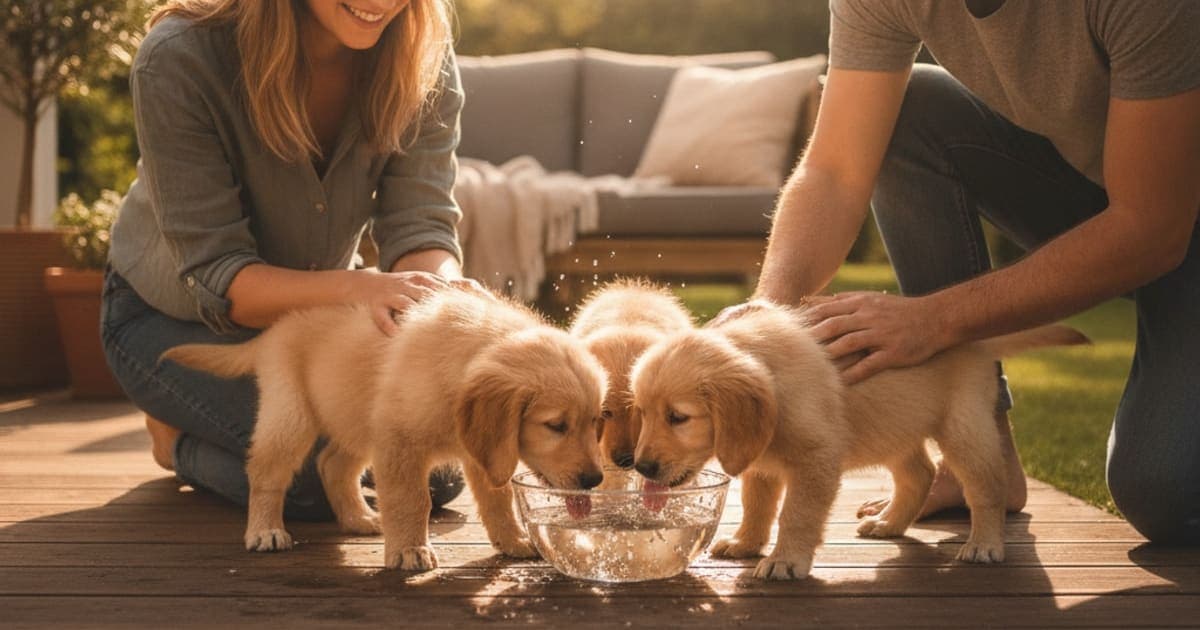
Most healthy puppies drink roughly one ounce of water per pound of body weight across a 24-hour period. A 10-pound puppy lands near 10 ounces, a little over a cup. A 40-pound adolescent lands near five cups. That ounce-per-pound ratio is the rule of thumb most veterinary educators teach, and it works best as a sanity check rather than a target to hit. Puppies in a growth spurt, puppies eating dry kibble, and puppies tearing around in warm weather routinely drink more. A puppy eating wet or rehydrated food takes in a large share of its daily water with dinner and may drink noticeably less from the bowl while staying perfectly hydrated.
What matters more than any single day's total is the pattern. A puppy who empties the bowl steadily through the day, passes pale yellow urine, has moist pink gums and bounces up from a nap is doing fine. A puppy whose intake suddenly doubles, or who walks past a full bowl for most of a day, is telling you something, and that is worth a phone call to your veterinarian rather than a week of watching and hoping.
Puppy water needs by weight
Weigh the puppy, then use the ounce-per-pound baseline. Puppies often sit at or slightly above it because their metabolism runs hot relative to body size and their kidneys are still maturing.
| Puppy weight | Rough baseline over 24 hours | In cups |
|---|---|---|
| 5 lb | about 5 oz | just over half a cup |
| 10 lb | about 10 oz | about 1¼ cups |
| 20 lb | about 20 oz | about 2½ cups |
| 40 lb | about 40 oz | about 5 cups |
| 60 lb | about 60 oz | about 7½ cups |
| 80 lb | about 80 oz | about 10 cups |
Treat those figures as the middle of a range, not a line. Hot days, long play sessions, dry kibble, panting, teething and recovery from any illness push intake up. Cool weather, wet food, a quiet indoor day and a nap-heavy schedule pull it down.
The water calculator people search for is simply this multiplication: body weight in pounds, times one ounce. No app is more accurate than a measuring cup and a week of observation. If you want real data, fill the bowl with a measured amount each morning, measure what is left at night, and write it down for a few days. That baseline is far more useful to your veterinarian than a guess, because it shows them what normal looks like for your specific puppy.
What shifts the number: age, food, weather and fast growth
Before weaning, puppies get nearly all their fluid from milk. Lapping usually begins alongside the first soft food, and intake climbs from there. A newly homed eight-week-old is also dealing with a new bowl, a new water taste and a new routine, so a slightly erratic first few days is common.
Diet is the biggest single variable. Dry kibble contains very little moisture, so kibble-fed puppies drink conspicuously more from the bowl. Canned, raw or rehydrated diets carry a lot of water with them, and those puppies can look like light drinkers while being completely well hydrated.
Housetraining tempts owners to restrict water, and that is the wrong lever to pull during the day. Puppies need free access to fresh water while they are awake. Many trainers lift the bowl a short while before bedtime to buy a drier night, and that is a reasonable conversation to have with your veterinarian first: small and toy-breed puppies in particular can be sensitive to going too long without food or fluid overnight.
Large-breed puppies raise the same question with bigger numbers. Owners searching for how much water a golden retriever puppy should drink per day are usually surprised by how fast the figure moves: the baseline is the same ounce per pound, but a golden goes from a bowl measured in ounces to one measured in cups within months. Weigh monthly during the growth phase and the number updates itself. Fast-growing large breeds are also carrying a rapidly changing skeleton on soft, still-developing joints, which is why controlled exercise and a vet-guided large-breed puppy diet matter so much during that window. Cartilage and intervertebral discs are mostly water by weight, so hydration is part of the background support for every growing structure, not just a digestion issue.
When a puppy will not drink, and how long is too long
Puppies have far less fluid reserve than adult dogs. Small body mass, high surface area and a fast metabolism mean dehydration develops in hours, not days. A healthy adult dog can tolerate a short gap without water; a puppy should not be allowed to go a full day without drinking anything.
Practical thresholds most veterinary teams use: if a puppy has refused water for most of a day, or has refused water alongside vomiting, diarrhoea, lethargy or a dropped appetite, that is a same-day veterinary call. A puppy that will not drink and is also vomiting or having diarrhoea is a potential emergency, not a wait-and-see problem: parvovirus, obstructions and other serious illnesses present exactly this way.
Signs worth checking before you phone:
- Gums that feel tacky or dry rather than slick and moist
- Skin over the shoulders that is slow to flatten after you gently lift it
- Sunken-looking eyes
- Dark, strong-smelling, scant urine
- Unusual flatness, wobbliness or refusal to play
Owners often land on forum threads about a puppy not drinking water looking for reassurance, and the collective experience there can be genuinely useful for ideas about bowls, placement and fussiness. What it cannot do is examine your puppy. A puppy deteriorates far faster than an adult dog, so use the forums for tips and your veterinarian for decisions.
The opposite problem counts too. A sudden, sustained jump in thirst, a puppy draining bowls and asking for more, often with increased urination or renewed accidents after a reliable spell, is a recognised reason to get bloodwork done. Excessive drinking is a symptom worth investigating, not a sign of a well-hydrated dog.
How to get a puppy to drink more water
Most reluctant drinkers respond to environment rather than persuasion.
- Put out more bowls. One upstairs, one by the crate, one near the back door. Puppies drink opportunistically.
- Change the bowl. Some puppies dislike plastic, some dislike the sound of a tag hitting metal, and some want a wider, shallower dish that keeps whiskers out of the way.
- Refresh it often. Water that has sat all morning collecting kibble crumbs gets refused. Wash bowls daily.
- Add water to food. Splashing warm water over kibble, or mixing in wet food, is the single easiest way to raise total intake without a battle.
- Offer it at the right moments. Right after play, after a nap and after training sessions are when puppies actually want to drink.
- Make it interesting. Ice cubes to chew, a pet fountain, or a splash of plain low-sodium broth cleared with your veterinarian first.
- Carry water on walks. A collapsible bowl means your puppy drinks on schedule rather than when you get home.
What not to do: never withhold water to force a bigger drink later, and never syringe large volumes into a puppy who is refusing fluids. A puppy who genuinely cannot or will not drink needs an exam, and possibly fluids given by a professional.
Hydration, recovery and where peptides fit for active dogs
Water is the medium every repair process in the body runs in. Nutrient delivery, waste clearance, joint lubrication and the behaviour of connective tissue all depend on it, which is why hydration is the unglamorous foundation under every recovery and growth conversation.
Owners who are already paying attention at that level usually ask what else supports tendon, ligament and joint tissue in a hard-working or recovering dog. pawgen makes K9-REPAIR, a BPC-157 and TB-500 peptide formulation made for dogs. BPC-157 is a peptide sequence studied for its role in new blood vessel formation and connective-tissue signalling. TB-500 is related to thymosin beta-4, a naturally occurring peptide studied for its role in cell migration and the actin machinery cells use when they reorganise damaged tissue. Research suggests these mechanisms may support the body's own soft-tissue repair processes, and it is the reason this pairing has become the stack many owners run through a recovery period.
BPC-157 and TB-500 are not FDA-approved veterinary drugs, and nothing here is a treatment claim for your dog. pawgen publishes batch-level third-party certificates of analysis so you can see exactly what is in the vial, which is more than most of the kitchen-sink joint chews on a pet store shelf will show you, and the formulation ships direct to your door behind a 60-day money-back guarantee. Dosing is weight-based and belongs in a conversation with your veterinarian, and for puppies, pregnant or nursing dogs, that conversation is the only correct answer. You will not find a number here, because a growing puppy is not a smaller adult.
Key Takeaways
- A healthy puppy drinks roughly one ounce of water per pound of body weight in 24 hours; a 10-pound puppy sits near 10 ounces, a 40-pound adolescent near five cups.
- The same baseline applies to golden retriever and other large-breed puppies: reweigh monthly, because the target moves quickly during growth.
- Kibble-fed puppies drink visibly more than wet-fed puppies; both can be fully hydrated.
- Measure intake for a few days to learn your puppy's normal. Direction of change matters more than any single day's total.
- A puppy should not go a full day without drinking. Refusal plus vomiting, diarrhoea or lethargy is a same-day veterinary call.
- A sudden surge in thirst deserves bloodwork, not reassurance.
- Multiple bowls, fresh water, adding water to food and offering drinks after play solve most fussy-drinker problems.
Your veterinarian owns the diagnosis and the plan. They are the one who can tell the difference between a fussy drinker and a sick one, order the bloodwork, give fluids when they are needed, and build the growth, exercise and recovery plan your puppy actually needs. Hydration, nutrition and supportive formulations like K9-REPAIR operate in the space that proper veterinary care creates: never in place of it.
More from pawgen: see what goes into the formulation on the shop page, review batch-level third-party testing in the certificates of analysis, and check shipping and availability details.
Owners exploring peptide support for their dog can review K9-REPAIR, BPC-157 + TB-500 formulated for dogs, at https://pawgen.com/. BPC-157 and TB-500 are not FDA-approved veterinary drugs. Nothing in this article treats, cures or prevents any condition; every decision about your dog's care belongs with your veterinarian.
Frequently asked questions
- How much water should a puppy drink in 24 hours?
- Roughly one ounce of water per pound of body weight over 24 hours. A 10-pound puppy lands near 10 ounces, a 40-pound puppy near five cups. Kibble, heat and hard play push intake higher; wet food lowers bowl drinking. Measure for a few days to learn your puppy's normal.
- How much water should a puppy drink per day?
- Plan on about one ounce per pound of body weight per day as a baseline, adjusted for diet and activity. Puppies often sit slightly above that figure because they grow fast and their kidneys are still maturing. Reweigh monthly, since the target rises as the puppy does.
- How much water should a puppy drink?
- Enough to keep gums moist, urine pale yellow and energy normal, which usually works out to about an ounce per pound of body weight daily. Give free access to fresh water while the puppy is awake, and raise concerns about sudden increases or refusals with your veterinarian.
- How much water should a puppy drink in a day?
- Around one ounce per pound of body weight in a day. For a 20-pound puppy that is roughly 2½ cups; for a 60-pound large-breed adolescent, roughly 7½ cups. Wet-food diets supply much of that at mealtimes, so bowl intake looks lower without any hydration problem.
- Is there a calculator for how much water a puppy should drink in 24 hours?
- The calculation is simply body weight in pounds multiplied by one ounce: no app improves on that. A more useful approach is measuring the bowl each morning and evening for several days. That record shows your veterinarian your puppy's real baseline rather than a generic estimate.
- How much water should a golden retriever puppy drink per day?
- The same ounce-per-pound baseline applies, but the number climbs fast as a golden grows. At 20 pounds that is roughly 2½ cups; at 60 pounds, roughly 7½ cups. Reweigh monthly through the growth phase and expect higher intake on hot or high-activity days.
- How long can a puppy go without drinking water?
- Not long. Puppies have small fluid reserves and dehydrate within hours rather than days, so a puppy should never go a full day without drinking. If several hours pass with no interest in water, or refusal comes with vomiting, diarrhoea or lethargy, call your veterinarian the same day.
- How do I get my puppy to drink more water?
- Put out several bowls, wash and refresh them daily, try a different bowl material or shape, and add warm water or wet food to meals. Offer water right after play, naps and training. Carry a collapsible bowl on walks. Never withhold water to force a bigger drink later.
- My puppy is not drinking water: are forum threads about this reliable?
- Owner forums are useful for practical ideas about bowls, placement and fussiness, but they cannot examine your puppy. Puppies deteriorate far faster than adult dogs, so use shared experience for tips and your veterinarian for decisions, especially when refusal appears alongside any other symptom.
Educational content, not veterinary advice. Ask your vet about your dog.