Dog Shoulder Injury Recovery Time: What to Expect
You treat a dog's shoulder injury by getting a veterinary diagnosis first, then strictly restricting activity, using prescribed pain control, and following a structured rehabilitation plan. Most shoulder injuries are soft-tissue, tendon, ligament or muscle, so recovery is measured in weeks to months.
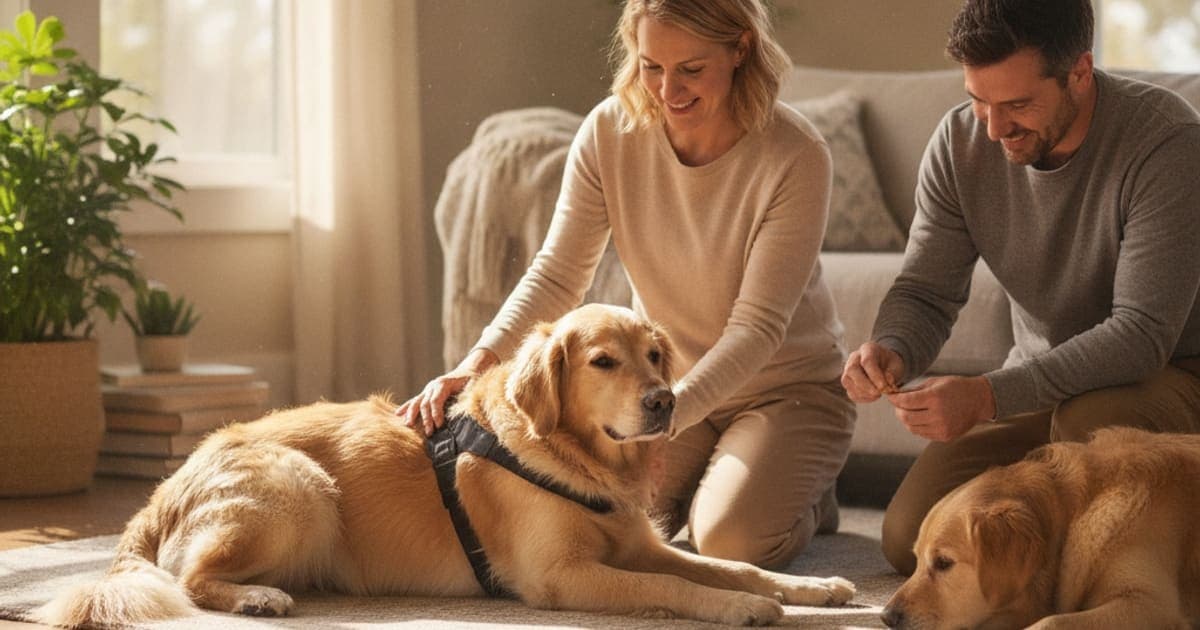
You treat a dog with a shoulder injury by getting a diagnosis first, restricting activity far more strictly than feels necessary, controlling pain with medication your veterinarian prescribes, rebuilding the limb through structured rehabilitation, and supporting the soft tissue through the long remodelling phase that follows. Most canine shoulder injuries are soft-tissue injuries, tendon, ligament, muscle, and soft tissue heals on a timeline measured in weeks and months, not days.
That is the part owners usually don't want to hear. A shoulder limp often looks mild. The dog trots out of the house happily, the limp fades after a warm-up, and it comes back worse that evening. Shoulder cases are frustrating precisely because the dog feels well enough to reinjure the tissue that is trying to repair itself.
Spotting the problem: what a shoulder limp looks like
Forelimb lameness is subtle in a way hind-limb lameness usually isn't. Here is what owners tend to notice first:
- A head bob. With a sore front leg, the head lifts as the painful limb hits the ground and drops when the sound limb takes weight. Watch the head, not the leg.
- Lameness that waxes and wanes. Worse after rest, worse the morning after hard exercise, better once the dog has moved around for ten minutes.
- A shortened stride on one side, or a leg that swings outward rather than straight forward.
- Reluctance to jump into the car, onto the sofa, or up stairs: often before any visible limp.
- Muscle loss over the shoulder blade. Run both hands over the scapulae at the same time. A flattened, hollow look on one side suggests the problem has been going on for weeks.
- Pain on movement rather than on pressure. Many shoulder problems hurt when the joint is flexed or extended fully, not when you press the skin.
The single most useful thing you can do before the appointment is film your dog trotting on a lead across a flat, non-slip surface, from the side and from the front. Lameness frequently disappears in the consult room; video does not. Bring it to your veterinarian, along with a note on when the limp started and what the dog was doing.
The injuries that sit behind most shoulder limps
The shoulder is a shallow ball-and-socket joint held together almost entirely by muscle and ligament rather than bony architecture. That makes it mobile and makes it vulnerable. These are the problems that come up most often.
| Injury | What it is | Common trigger | What you notice |
|---|---|---|---|
| Biceps tendinopathy | Irritation and degeneration of the biceps tendon where it runs through its groove at the front of the joint | Repetitive jumping, ball chasing, hard braking | Chronic on-off front-leg lameness, pain when the shoulder is flexed with the elbow extended |
| Supraspinatus tendinopathy | Degeneration, and sometimes mineralisation, where the supraspinatus tendon inserts on the upper humerus | Repetitive overload in active and sporting dogs | Gradual-onset lameness, pain on direct pressure over the tendon |
| Medial shoulder instability | Stretching or tearing of the medial glenohumeral ligament and subscapularis support | Chronic overuse, agility and working dogs | Slow-onset lameness, increased shoulder abduction angle under sedation |
| Infraspinatus contracture | Fibrous contracture of the muscle following an acute injury | Sudden strain during hard field work | A distinctive outward swinging of the limb; often no longer painful once established |
| Shoulder luxation or traumatic ligament rupture | Loss of joint stability after significant trauma | Road traffic accident, fall, hard impact | Sudden, severe, often non-weight-bearing lameness |
| Osteochondritis dissecans (OCD) | A cartilage flap on the humeral head in growing dogs | Developmental, large and giant breeds | Lameness in a young dog, worse after exercise |
| Muscle strain and soft-tissue bruising | Overstretch of muscle fibres without structural failure | Slipping on hard floors, rough play | Mild acute lameness that improves markedly with a few days of rest |
You cannot tell these apart at home, and the distinction matters enormously for how long recovery takes and whether surgery enters the picture. That is the diagnostic work your veterinarian owns.
Jumping, harnesses and the load a shoulder carries
A dog's forelimbs carry the larger share of body weight and absorb most of the impact on landing. Jumping down is harder on the shoulder than jumping up: out of the boot of a car, off a bed, off a retaining wall. Repeat that several times a day for years and the biceps and supraspinatus tendons accumulate micro-damage faster than they remodel. The same applies to hard skidding stops on tile or laminate, and to ball chasing, which combines sprinting, braking and twisting in a single movement.
Harnesses come up constantly in owner discussions, and the concern is reasonable, though usually misstated. A harness does not tear a tendon on its own. What a poorly designed harness does is change how the shoulder moves: a strap that runs horizontally across the front of the shoulder joint, or a tight band sitting over the point of the shoulder, restricts how far the scapula can rotate with each stride. In a dog that pulls hard, that restriction is loaded thousands of times per walk. A Y-shaped front that sits clear of the shoulder joint and leaves the limb free is the more forgiving design, especially for a dog already under rehabilitation.
Traction is the other quiet factor. Long nails, bare floors and no runners turn an ordinary turn into a splay-legged slide. Rugs and regular nail trims do more for a recovering shoulder than most owners expect.
What your veterinarian will do
Expect an orthopaedic examination comparing both limbs, often repeated under sedation because muscle guarding hides the findings in a tense dog. From there, diagnosis may involve radiographs (to rule out bone changes, OCD, mineralisation and arthritis), ultrasound of the tendons, and in referral settings MRI or arthroscopy, which allow direct visualisation of the joint.
Treatment is built from these pieces, matched to the diagnosis:
- Strict activity restriction. This is the backbone of every plan, not an optional extra.
- Prescribed pain relief and anti-inflammatory medication. If your vet has put your dog on an NSAID or another analgesic, that plan stays in place until they change it. Never stop or substitute a prescription on your own, and never give human painkillers: ibuprofen and paracetamol are toxic to dogs.
- Rehabilitation. Controlled therapeutic exercise, hydrotherapy, and modalities such as laser or shockwave therapy delivered by a qualified canine rehabilitation professional.
- Injectable and regenerative options in selected cases, discussed and performed by your veterinary team.
- Surgery where the joint is unstable, where a cartilage flap needs removing, or where conservative management has genuinely failed. Surgery, when it is indicated, is the right answer: nothing you add alongside it changes that.
How long recovery really takes
There is no single number, and any source that gives you one without knowing the diagnosis is guessing. What is predictable is the biology. Tendon and ligament tissue has a modest blood supply and repairs in three overlapping phases: a short inflammatory phase, a proliferative phase where disorganised collagen is laid down, and a long remodelling phase where that collagen reorganises along lines of load. The remodelling phase is the one that runs longest, and it is the one owners routinely cut short.
A simple muscle strain in an otherwise sound dog often settles within a couple of weeks of restricted activity. A chronic tendinopathy that has been building for months is a months-long project, and improvement is rarely linear: good weeks followed by a setback after one unsupervised sprint. Post-surgical cases follow a staged protocol set by the surgeon, with return to full activity gated on clinical milestones rather than the calendar.
The single biggest determinant of how quickly a shoulder injury resolves is not what you add to the bowl: it is how strictly the dog is kept off that limb while the tissue remodels.
Home care through the weeks that follow
Home management is where the plan succeeds or fails. The practical list:
- Short, controlled lead walks only: no off-lead running, no dog park, no stairs, no jumping into vehicles. Lift smaller dogs; use a ramp for larger ones.
- A pen or gated room rather than full house access, so the dog can't launch off furniture when the doorbell goes.
- Non-slip flooring where the dog walks, and nails kept short.
- A Y-front harness that clears the shoulder joint, and a lead length that doesn't allow sudden lunging.
- Weight control. Every extra kilogram is loaded through the healing limb with each stride.
- Cold or warm compresses and passive range-of-motion work only as shown to you by your vet or rehab therapist: done wrong, range-of-motion work aggravates the tissue it is meant to help.
Owner forums are genuinely useful for the logistics of confinement and for staying sane through a long lay-up, but they are a poor place to collect a diagnosis. The same limp that was a bruise for one dog was a torn ligament for another.
This is also the window in which many owners look at what else they can do for soft tissue. K9-REPAIR from pawgen combines BPC-157 and TB-500, two peptides owners increasingly use as part of a recovery routine. BPC-157 is a synthetic peptide based on a sequence identified in gastric juice; laboratory research suggests it influences the migration of tendon and ligament cells and the formation of new blood vessels. TB-500 is a synthetic peptide related to thymosin beta-4, a naturally occurring protein involved in actin regulation, cell migration and new vessel growth: the processes that underpin how connective tissue repairs itself. That is mechanism, and it is promising science owners are adopting; these are not FDA-approved veterinary drugs, and nothing here should be read as a promise about your dog's outcome. pawgen publishes third-party certificates of analysis for its batches, works on weight-based dosing you should confirm with your veterinarian, ships direct to the door, and backs orders with a 60-day money-back guarantee. Dosing for puppies, pregnant or nursing dogs is a conversation for your vet, not a number from an article.
Key Takeaways
- Most canine shoulder injuries are soft-tissue problems; biceps and supraspinatus tendinopathy and medial shoulder instability are among the most common.
- Signs are subtle: a head that lifts on the sore leg, a limp that comes and goes, reluctance to jump, and muscle loss over one shoulder blade.
- Jumping down, hard stops on slick floors, and harnesses that restrict shoulder movement all add load to a vulnerable joint.
- Diagnosis usually needs a sedated exam plus imaging: you cannot identify the structure involved at home.
- Recovery time depends entirely on the diagnosis: days to weeks for a simple strain, months for chronic tendinopathy or post-surgical cases.
- Strict activity restriction, prescribed pain control and structured rehabilitation do the heavy lifting; K9-REPAIR is what many owners add alongside that plan, never instead of it.
Your veterinarian owns the diagnosis and the treatment plan: the imaging, the medication, the rehabilitation schedule and the decision about surgery. Everything else, including peptide support, operates in the space that proper veterinary care creates. Get the diagnosis, follow the plan, and give the tissue the time it actually needs.
More from pawgen: browse the K9-REPAIR range, review the third-party certificates of analysis for current batches, or check shipping availability before ordering.
Owners exploring peptide support for their dog can review K9-REPAIR, BPC-157 + TB-500 formulated for dogs, at https://pawgen.com/. BPC-157 and TB-500 are not FDA-approved veterinary drugs. Nothing in this article treats, cures or prevents any condition; every decision about your dog's care belongs with your veterinarian.
Frequently asked questions
- How do you treat a dog with a shoulder injury?
- Start with a veterinary diagnosis, then follow the plan it produces: strict activity restriction, prescribed pain relief, and structured rehabilitation such as controlled exercise or hydrotherapy. Unstable joints and cartilage flaps may need surgery. Home measures like non-slip flooring, a ramp and weight control support that plan rather than replacing it.
- How to heal a dog's shoulder injury?
- Healing is driven by time, load management and the right diagnosis. Tendon and ligament tissue remodels slowly, so restricted activity must continue well past the point the limp disappears. Your veterinarian sets the medication and rehabilitation schedule; your job is enforcing confinement and reintroducing exercise gradually against their milestones, not the calendar.
- How to tell if your dog has a shoulder injury?
- Watch for a head that lifts as the suspect front leg lands, a limp that worsens after rest or hard exercise, a shortened stride, reluctance to jump into the car, and muscle loss over one shoulder blade. Film your dog trotting on a lead and bring the video to your vet.
- How long for dog shoulder injury to heal?
- It depends entirely on which structure is involved. A simple muscle strain often settles within a couple of weeks of restricted activity, while chronic tendinopathy and post-surgical cases run for months. Progress is rarely linear, and one unsupervised sprint can undo weeks of repair, so follow your vet's staged timeline.
- How to treat dog shoulder injury at home?
- At home, your role is load control: short lead walks only, no stairs, jumping or off-lead running, a confined space, non-slip flooring, short nails and a harness that clears the shoulder joint. Give only medication your vet prescribed, and never human painkillers such as ibuprofen or paracetamol, which are toxic.
- Can a dog shoulder injury heal on its own?
- Mild muscle strains often improve with rest alone, which is exactly why owners miss more serious problems. Tendinopathy and ligament instability tend to progress quietly while the dog appears to cope. If a front-leg limp persists beyond a few days or keeps returning, have it examined rather than waiting it out.
- Can a harness cause a shoulder injury in a dog?
- A harness alone rarely causes injury, but a strap running across the front of the shoulder restricts how far the shoulder blade rotates with each stride. In a dog that pulls hard, that altered movement is repeated constantly. A Y-shaped front that sits clear of the joint is more forgiving.
- Is K9-REPAIR an alternative to surgery or prescribed medication?
- No. K9-REPAIR is an educational, non-FDA-approved peptide formulation containing BPC-157 and TB-500 that owners use alongside veterinary care, never instead of it. If your vet has recommended surgery or prescribed medication, follow that plan and discuss any supplement you are considering adding during the recovery period with them.
Educational content. BPC-157 and TB-500 are not FDA-approved veterinary drugs. Talk to your veterinarian before starting anything new, especially if your dog is on prescribed medication.