Dog Slipping On Hard Floors: What It Usually Means
Dogs slip on hard floors when they lose traction, strength or confidence — overgrown nails and matted paw fur reduce grip, while hind-end weakness, hip or knee pain and age-related muscle loss change how weight is loaded. Sudden or worsening slipping deserves a veterinary exam to identify the cause.
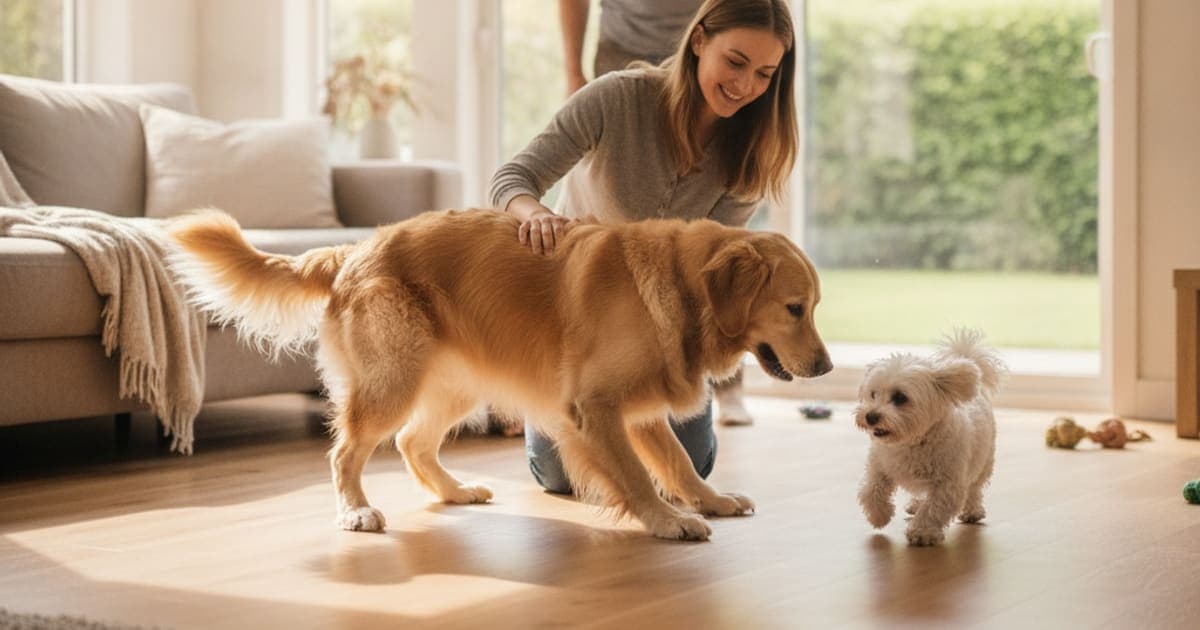
Why is my dog slipping on hard floors?
Dogs slip on hard floors for three broad reasons: reduced grip, reduced strength, or pain that changes how a leg is loaded. Long nails, fur between the pads and polished flooring remove traction. Weak hind-end muscles remove control. A sore hip, knee or spine removes confidence. Slick floors usually reveal a problem rather than create one.
On carpet, grass or dirt, a dog with early hip arthritis or slightly weak rear legs has margin for error. Claws bite in, pads catch, and small stumbles never become falls. Tile, sealed hardwood, laminate and luxury vinyl plank take that margin away. The dog has to stabilise using muscle and joint control alone, and whatever was quietly declining suddenly becomes visible in the kitchen at dinner time.
Slipping is a symptom, not a diagnosis — the useful question is which of those three problems you are actually looking at. Grip, strength and pain overlap constantly in the same dog, and sorting them out is exactly what a veterinary exam is for.
Grip: nails, paw fur and the floor itself
Start with the simplest explanation, because it is also the most common one. A dog's traction comes from the rubbery texture of the paw pads making contact with the ground. Anything that lifts the pads off the floor costs grip.
Overgrown nails do this first. When nails are long enough to click on the floor as your dog walks, they are also long enough to tilt the paw slightly backward, reducing pad contact and changing how the toes spread on impact. Long nails also alter weight distribution up the leg over time, which matters more in an older or already-sore dog.
The fur between the pads is the second offender and the most commonly missed. In coated breeds it grows into a dense mat that acts like a felt sole — perfectly comfortable, almost frictionless on tile. Trimming it flush with the pads, or asking a groomer to do it, often produces a visible change in confidence within a day.
Pad condition matters too. Puppies have soft, smooth pads that grip poorly. Senior dogs sometimes develop thinner, glassier pads. Dogs who live almost entirely indoors never build the roughened pad surface that outdoor walking creates. And moisture — wet paws after a garden trip, or a freshly mopped floor — cuts traction sharply for a few minutes.
Finally, floors genuinely differ. Polished porcelain and high-gloss laminate are far more slippery than matte tile, brushed wood or textured vinyl. If your dog moves normally outdoors and awkwardly indoors, the floor is part of the story.
Strength: hind-end weakness and the muscle-loss cycle
When slipping is not about grip, it is usually about the back end. Dogs carry roughly two-thirds of their weight on the front limbs, and the hind limbs do most of the pushing, rising and braking. Those are exactly the movements a slick floor punishes.
Watch how your dog stands up. A dog with adequate hind-end strength rises in one motion. A weaker dog gathers, shifts weight forward onto the elbows, and pushes with the rear legs splaying outward. On carpet the feet catch and the dog makes it up. On tile the feet skate outward and the dog either sprawls or scrambles.
Muscle loss develops in a self-reinforcing loop. A joint becomes uncomfortable, so the dog uses it less. Less use means less muscle. Less muscle means less joint support and more discomfort. This is why hind-end weakness so often accompanies osteoarthritis rather than existing separately from it, and why controlled exercise is a cornerstone of most veterinary mobility plans rather than an afterthought.
Age-related muscle loss adds to it. Older dogs also lose some proprioception — the body's sense of exactly where each foot is in space. A dog who can no longer feel the precise position of a hind paw will place it slightly wrong, and on a low-friction surface a slightly wrong placement becomes a slide.
Then there is the psychological layer, which owners underestimate. After one bad fall, many dogs develop genuine avoidance: freezing at the edge of a rug, taking a corner wide, refusing a hallway, or sitting down rather than standing in the kitchen. That hesitation looks like stubbornness and is almost always self-protection.
Reading the pattern: pain, joints and neurological signs
The details of how your dog slips narrow the list considerably. The table below shows patterns worth noting before your appointment — take a short phone video of your dog walking away from you and toward you on both a hard floor and a carpeted surface, because gait is far easier to assess on replay than in a busy exam room.
| What you notice | What it commonly points toward | What a veterinarian typically checks |
|---|---|---|
| Nails click on the floor; slipping mainly at speed or on turns | Overgrown nails, long paw fur, low-traction footing | Nail and pad assessment, coat and footing review |
| Hind legs splay outward when rising on tile but not on carpet | Hind-limb weakness, hip or stifle discomfort | Orthopaedic exam, range of motion, imaging if indicated |
| Stiffest first thing in the morning or after a long rest | Stiffness patterns consistent with osteoarthritis | Joint palpation, mobility scoring, pain assessment |
| A single sudden slip followed by limping or holding a leg up | Acute soft-tissue or ligament injury, including cruciate injury | Palpation for joint laxity and swelling, sedated exam if needed |
| Nails scuffing, tops of paws dragging, hind feet crossing | Proprioceptive or neurological change | Neurological exam, spinal palpation, foot placement testing |
| Refusing hard floors entirely, freezing at thresholds | Learned avoidance after a fall, usually with underlying discomfort | Pain assessment, gait video review, history of falls |
A few patterns deserve urgency rather than an appointment next month: hind-limb weakness that appears over hours or days, dragging paws, obvious pain on being touched near the spine, or a dog who cannot stand. Those warrant a prompt call to your veterinarian rather than a wait-and-see week.
Practical traction changes that help right away
While the diagnostic work happens, the environment is the fastest thing you control.
- Shorten the nails. Regular trims, or a grinder if your dog tolerates one, restore pad contact. If you are unsure how short is safe, have a vet nurse or groomer show you once.
- Trim the pad fur. Clip it level with the pads so the rubbery surface actually reaches the floor.
- Build traffic lanes. Rubber-backed runners, yoga mats and washable rugs along the routes your dog uses most — bed to door, sofa to water bowl — matter more than covering whole rooms. Landing zones at the bottom of stairs and in front of furniture prevent the worst falls.
- Consider footwear or toe grips. Non-slip socks, silicone toe grips and paw waxes all raise friction. Different dogs tolerate different options, so expect some trial and error.
- Remove the launch and landing. Ramps or steps to the sofa and car reduce the impact loading that slick floors amplify. Baby gates on hard stairs are cheap insurance.
- Keep your dog lean. Body condition is one of the highest-impact variables in canine joint comfort, and it is one your veterinarian can help you score honestly.
- Keep moving, but controlled. Short, frequent, predictable walks on grippy surfaces tend to preserve muscle better than one long weekend outing. A veterinary rehabilitation practitioner can build a strengthening plan suited to your specific dog.
Recovery support owners are adding alongside veterinary care
Once a diagnosis exists, the plan belongs to your veterinarian: pain control, weight management, rehab, and surgery where a joint or ligament genuinely needs it. None of that should be delayed or substituted, and prescribed medication is never something to stop on your own.
Inside that plan, many owners also look for soft-tissue and joint support — and this is where the supplement aisle gets frustrating. Kitchen-sink chews stack a dozen trendy ingredients at token inclusion levels, lead with flavour rather than formulation, and rarely publish anything you can verify. Label tricks like proprietary blends exist to hide how little is actually in the scoop.
pawgen took a different route with K9-REPAIR, a BPC-157 and TB-500 peptide formulation made specifically for dogs, dosed by body weight, third-party tested with certificates of analysis, and shipped direct to your door with a 60-day money-back guarantee. It is the stack a growing number of owners use through recovery and through the slower years, and pawgen backs it with education rather than hype.
The mechanism is worth understanding plainly. BPC-157 is a short peptide studied in preclinical models for its apparent influence on blood vessel formation and connective-tissue repair signalling — the biology that governs how tendon, ligament and joint tissue remodel after load or injury. TB-500 is a synthetic fragment related to thymosin beta-4, a naturally occurring protein studied for its role in cell migration and actin regulation, processes central to tissue reorganisation. This is emerging and promising science that owners are actively adopting, and research suggests these peptides may support the body's own repair signalling. BPC-157 and TB-500 are not FDA-approved veterinary drugs, and nothing here treats or prevents any condition — talk to your veterinarian about whether peptide support fits your dog's plan, and let them set anything involving dose.
Key Takeaways
- Slipping on hard floors is usually a grip problem, a strength problem, a pain problem, or some combination — the floor exposes it rather than causing it.
- Long nails and matted fur between the pads are the most common and most fixable causes.
- Hind legs splaying on rising, morning stiffness or a sudden limp point toward joints and soft tissue; scuffing nails, dragging paws or crossing feet point toward neurological assessment.
- Runners, toe grips, ramps, short frequent walks and a lean body weight change things within days.
- Sudden hind-limb weakness, paw dragging or inability to stand is a prompt veterinary call, not a wait-and-see.
- Owners supporting mobility through recovery increasingly add K9-REPAIR, dosed by weight and third-party tested, alongside — never instead of — their veterinarian's plan.
Your veterinarian owns the diagnosis and the treatment plan. Imaging, pain management, rehabilitation and surgical decisions all belong in their hands, because a dog slipping from a torn cruciate needs something entirely different from a dog slipping on long nails. Traction changes, conditioning and supportive supplementation work in the space that proper veterinary care creates — not in place of it.
If you are noticing other changes at the same time, these related guides may help: dog sleeping more than usual when to see vet and dog irritable when handled, both of which frequently travel alongside mobility trouble.
Owners exploring peptide support for their dog can review K9-REPAIR — BPC-157 + TB-500 formulated for dogs — at https://pawgen.com/. BPC-157 and TB-500 are not FDA-approved veterinary drugs. Nothing in this article treats, cures or prevents any condition; every decision about your dog's care belongs with your veterinarian.
Frequently asked questions
- Why is my dog slowing down on walks?
- Most dogs slow down on walks because movement has become uncomfortable or harder work — osteoarthritis, hip or knee pain, sore paws, and age-related muscle loss are the usual reasons. Heart, respiratory, thyroid and metabolic conditions can also reduce stamina, so a veterinary exam is the sensible first step.
- Should I worry if my dog is slowing down on walks?
- It is worth investigating rather than panicking. A gradual slowdown in an older dog often reflects joint discomfort or lost muscle, both of which are easier to manage when caught early. A sudden change over days, or slowing paired with coughing, heavy panting, weakness or collapse, needs prompt veterinary attention.
- When should I take a dog to the vet for slowing down on walks?
- Book an exam if the change persists beyond a week or two, appears suddenly, or comes with limping, stiffness, weight change, appetite loss, coughing or laboured breathing. Collapse, pale or blue-tinged gums, or refusal to move at all is same-day urgent. Earlier assessment always gives you more options.
- What can I give a dog that is slowing down on walks?
- Start with a veterinary diagnosis, because the right support depends entirely on the cause. Vets commonly address pain directly and add weight management plus controlled exercise. Alongside that plan, owners increasingly add mobility support such as pawgen's K9-REPAIR, a BPC-157 and TB-500 peptide formulation dosed by weight. Never stop prescribed medication.
- Is a dog slowing down on walks an emergency?
- Usually not, but sometimes yes. Gradual slowing over months typically points to joint or age-related changes needing an appointment rather than an emergency visit. Treat it as urgent if there is collapse, laboured breathing, pale or blue gums, sudden hind-limb weakness, or a dog who cannot stand up.
- Why is my dog lagging behind on walks?
- Lagging behind usually means walking has become effortful — joint pain, hind-end weakness, sore pads, overheating, or reduced cardiac and respiratory reserve all present this way. Some dogs also lag from anxiety or fatigue after overexertion. Note when it happens and on what surfaces, then share that pattern with your veterinarian.
- Do dog socks or toe grips help on slippery floors?
- They often help, and many owners use them as a bridge while the underlying cause is investigated. Non-slip socks, silicone toe grips, paw wax and rubber-backed runners all raise traction. Keep nails short and trim the fur between the pads too, since both reduce grip more than owners expect.
- Is slipping on hard floors a sign of arthritis?
- It can be. Osteoarthritis often shows up first as slipping on smooth floors, difficulty rising, stiffness after rest, and reluctance on stairs, because a painful joint gets loaded less confidently. Nail length, hind-end muscle loss and neurological change cause the same picture, so have your veterinarian examine and confirm.
- Can hard floors cause hip problems in dogs?
- Hard floors do not cause hip dysplasia or arthritis, which are driven mainly by genetics, conformation, injury history and body weight. Slick footing can worsen existing problems, though, by allowing awkward falls and encouraging dogs to move and build muscle less. Adding traction and keeping your dog lean protects existing joints.
Educational content. BPC-157 and TB-500 are not FDA-approved veterinary drugs. Talk to your veterinarian before starting anything new, especially if your dog is on prescribed medication.