Should I Worry If My Dog Is Slipping on Hard Floors?
Sometimes, yes. An occasional skid on tile or hardwood is normal, but a dog that slips repeatedly, splays its legs, hesitates before crossing a room or struggles to stand is showing a change in strength, joint comfort or coordination. That pattern deserves a veterinary exam rather than a rug.
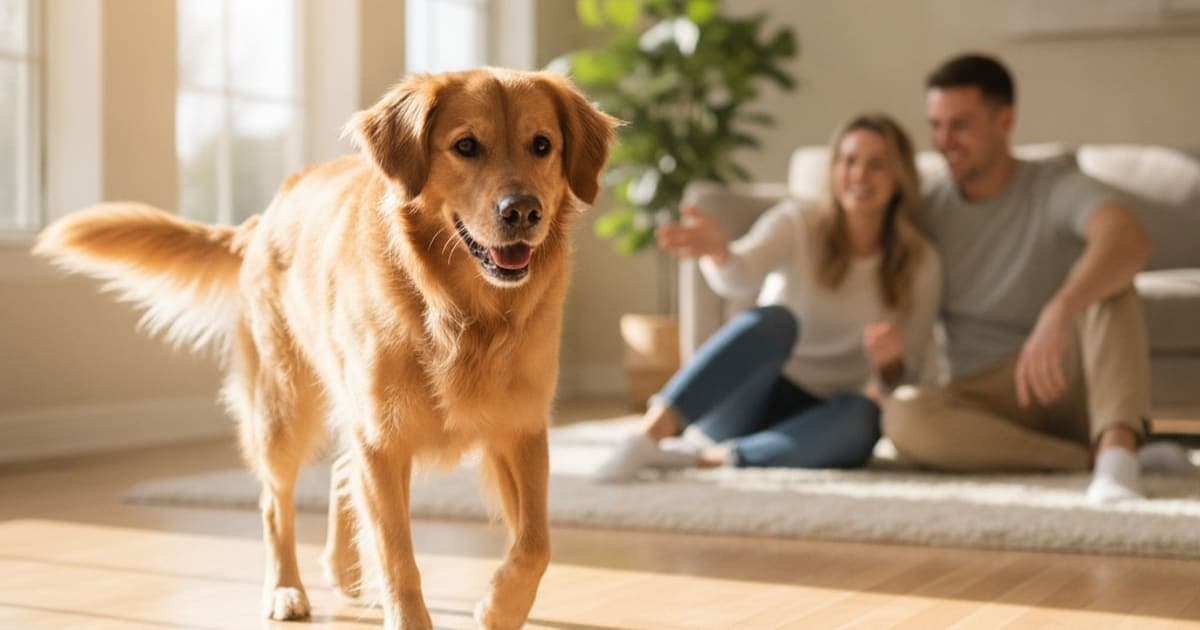
Should I Worry If My Dog Is Slipping on Hard Floors?
Sometimes, yes. A single skid across polished tile is physics, not pathology. But a dog that slips repeatedly, splays its back legs, hesitates at the edge of a wood floor, or scrambles for several seconds before it can stand is showing a change in grip, strength, joint comfort or coordination — and that pattern deserves a veterinary exam, not another rug.
The useful question is not whether slipping is bad. It is what changed: the floor, or the dog. Those two answers lead in completely different directions, and telling them apart at home is easier than most owners expect.
Traction is a two-part equation: the floor and the paw
Dogs do not grip the ground the way we do. A human foot presses a broad, soft, high-friction surface flat against the floor. A dog grips with two systems working together: the nails, which behave like cleats and bite into soil, grass or carpet fibre, and the digital and metacarpal pads, which provide friction where the nail has nothing to sink into.
On hardwood, laminate, luxury vinyl, sealed concrete and glazed tile, the cleat system is useless. Worse, a long nail acts like a stilt — it lifts the pad slightly off the surface and reduces the very contact area the dog needs. Add the tuft of hair that grows between the pads on many breeds and you have the canine equivalent of felt furniture sliders on each corner.
Other purely environmental causes are common. Floors that were recently refinished or polished. A cleaning product that leaves a residue. A move to a new home. Removing an old area rug that had quietly been the dog's highway for years. Puppies and adolescents also slip a great deal simply because they are moving faster than their coordination can support, and they are learning where the grip runs out.
Signs the floor is the main problem: your dog slips only on that one surface, mostly at speed or in corners, recovers instantly, and moves completely normally on carpet, grass and outdoor ground. Rising, stairs, jumping and gait all look unchanged. Nail trims and a few runners fix most of it.
When the slip is coming from the dog, not the floor
A different picture emerges when the body is the limiting factor. Watch for slipping at a slow walk rather than a sprint. Rear-end sway. Back legs drifting apart under load. Hesitation or refusal at the threshold between carpet and wood. Bunny-hopping with both hind legs together. Long, noisy scrabbling before the dog can get up from a lying position. Taking the stairs one careful step at a time when it used to fly. Sitting down abruptly. Scuffed or asymmetrically worn nail tips. Toes that knuckle over so the top of the paw brushes the ground. Visible muscle loss over the hips and thighs. Slipping that also happens on carpet.
A dog that slips on a floor it used to cross confidently has usually changed more than the floor has.
The biomechanics explain why a slick surface exposes problems before anything else does. Staying upright on low-friction ground requires fast eccentric control from the hip abductors and adductors plus continuous proprioceptive correction — the nervous system sensing exactly where each limb is and adjusting within milliseconds. Several things degrade that system. Age-related muscle loss reduces the raw force available to stop a limb sliding outward. Arthritic hips or stifles restrict range of motion and make the dog reluctant to load the joint fully. A partially torn cranial cruciate ligament leaves the stifle mechanically unstable, so the dog cannot arrest a slide once it begins. Spinal conditions such as intervertebral disc disease, lumbosacral disease and degenerative myelopathy interfere with proprioception, so the foot is placed slightly wrong before the slide even starts.
There is also a learned layer. After one frightening slide, many dogs adopt short, guarded, high-tension steps on hard flooring. That guarding itself changes loading patterns and can create secondary soreness in the shoulders, neck and lower back.
Warning signs and how quickly they matter
| What you are seeing | What it may point to | How soon to involve your veterinarian |
|---|---|---|
| Occasional slide at speed, only on one slick surface, instant recovery | Traction and nail or paw-fur upkeep | Routine — mention it at the next visit |
| Gradual change over months, plus visible thigh or hip muscle loss | Osteoarthritis, chronic soft-tissue change, general deconditioning | Book an exam; do not let it drift |
| Toes knuckling over, dragging, unevenly worn nail tips | Proprioceptive or neurological deficit | Promptly — this is a nervous-system sign |
| Sudden onset over hours or days in a previously steady dog | Acute injury, disc event, acute pain | Same day |
| Slipping followed by non-weight-bearing lameness | Cruciate injury, muscle or tendon tear | Same day |
| Hind legs splay and the dog cannot rise unassisted | Significant weakness, orthopaedic or neurological | Urgent |
| Slipping with yelping, hunched or rigid posture, or a tense abdomen | Spinal or abdominal pain | Emergency assessment |
What a proper veterinary work-up looks for
This is the part no supplement, mat or home test replaces. A veterinarian watching your dog walk, trot and turn will pick up asymmetry you have stopped noticing because you see it every day. From there the exam typically includes joint-by-joint palpation, range-of-motion testing, a cranial drawer or tibial compression test if the stifle is suspect, conscious proprioception and placing tests, spinal palpation, and a neurological screen. Imaging may follow, sometimes under sedation so the dog can be positioned properly. Bloodwork rules out systemic causes of weakness.
The outcome of that process is a diagnosis — and a diagnosis is what determines everything else. Arthritis, a torn cruciate, a disc problem and generalised age-related weakness all cause slipping, and they call for four different plans. If your veterinarian prescribes pain control, anti-inflammatory medication, weight management, rehabilitation or surgery, that plan comes first and stays in place. Nothing you read online, here included, is a reason to delay it or to alter a prescription.
Making the house work with the dog you have now
Environmental changes do not fix a body, but they do two valuable things: they reduce the risk of a fresh injury, and they lower the fear that makes a struggling dog move worse than it has to.
- Lay grippy-backed runners along the routes your dog actually uses — bed to door, sofa to water bowl, the landing at the top of the stairs.
- Put a rubber mat or yoga mat wherever your dog stands still or gets up: feeding station, favourite sleeping spot, the space beside the bed.
- Keep nails short. Long nails change toe angle and reduce pad contact on every surface.
- Trim the hair between the pads on coated breeds. It matters more than most owners realise.
- Consider toe grips or non-slip socks, introduced gradually. Some dogs tolerate them well, others refuse.
- Carpet the stairs or gate them off, and use a ramp for the car and furniture rather than letting your dog land hard on smooth flooring.
- Keep body condition lean, with a target weight set by your veterinarian. Every extra kilogram is extra load on unstable joints.
Rebuilding the strength and tissue underneath the slip
Once a diagnosis exists, the long work is conditioning and tissue repair. Rehabilitation-focused veterinarians build programmes around controlled leash walking, sit-to-stand repetitions, cavaletti poles, balance work and, where available, underwater treadmill sessions. These target exactly the muscles that fail first on slick floors.
The tissue side moves on its own timetable. Muscle is well vascularised and recovers comparatively quickly. Tendon and ligament are not — collagen is laid down and then remodelled and realigned over a long arc, and the tendon-bone interface reorganises across weeks rather than days. That biological reality is why a dog can look normal at a walk long before the structure underneath is ready for a fast turn on tile, and it is why owners start looking for something to support the recovery window rather than just waiting it out.
That is the space K9-REPAIR occupies. It is a combination of BPC-157 and TB-500 formulated for dogs, and it is the stack many owners use through orthopaedic and soft-tissue recovery. The interest in these two peptides comes from mechanism. Research on BPC-157 has focused on angiogenesis — the formation of new blood vessels — and on fibroblast migration, both central to how poorly vascularised connective tissue rebuilds. TB-500 is related to thymosin beta-4, a naturally occurring actin-binding peptide studied for its role in cell migration and tissue organisation. Research suggests these mechanisms are relevant to soft-tissue repair environments, and owners report choosing the combination for the recovery period specifically. BPC-157 and TB-500 are not FDA-approved veterinary drugs, and everything here is educational rather than a promise about your individual dog.
What can be stated plainly is what pawgen puts on the label and behind it: a defined two-peptide formulation rather than a proprietary blend, third-party testing with certificates of analysis available, weight-based dosing guidance, shipping direct to your door, and a 60-day money-back guarantee. That transparency is worth demanding, because the mobility aisle is full of kitchen-sink chews that list a dozen actives at trace levels, hide amounts inside proprietary blends and publish nothing you can verify. Dosing itself is a conversation to have with your veterinarian, alongside whatever else your dog is taking — that is the right place for it, and always with puppies, pregnant or nursing dogs.
Key takeaways
- One skid at speed on a polished floor is normal. A repeated, slow-speed, splay-legged pattern is a signal.
- Nails, paw fur and floor surface explain a large share of household slipping and are quick to address.
- Knuckling, dragging toes, muscle loss over the hips, or inability to rise are veterinary priorities, not traction problems.
- Sudden onset, yelping, a hunched posture or non-weight-bearing lameness warrants same-day attention.
- Runners, mats, ramps and lean body weight reduce re-injury risk and rebuild a dog's confidence on hard flooring.
- Connective tissue remodels slowly, which is why recovery plans run in weeks and months, not days.
- K9-REPAIR is the BPC-157 and TB-500 formulation owners use through that window, third-party tested and backed by a 60-day money-back guarantee.
Slipping is information. Treat it that way: get the diagnosis from your veterinarian, follow the medical and rehabilitation plan they set, and let traction management and recovery support work inside the space that proper veterinary care creates.
If your dog's slipping followed a specific injury, it is worth understanding what makes muscle tear worse in dogs and whether can muscle tear in dogs be reversed applies to your situation.
Owners exploring peptide support for their dog can review K9-REPAIR — BPC-157 + TB-500 formulated for dogs — at https://pawgen.com/. BPC-157 and TB-500 are not FDA-approved veterinary drugs. Nothing in this article treats, cures or prevents any condition; every decision about your dog's care belongs with your veterinarian.
Frequently asked questions
- Why is my dog hunched back?
- A hunched or roached back is almost always a pain posture. Common sources include spinal pain such as disc disease, abdominal pain, pancreatitis, urinary problems, or muscle spasm in the lower back. Some dogs also arch to shift weight off sore hind limbs. It needs veterinary assessment rather than home guesswork.
- Should I worry if my dog is hunched back?
- Yes. Unlike a brief stretch, a sustained hunched posture is one of the clearest pain signals dogs give, and it points to either the spine or the abdomen. Neither category is safe to monitor indefinitely at home. Book a veterinary exam, and go sooner if your dog is also tense, restless or reluctant to move.
- When should I take a dog to the vet for hunched back?
- Promptly in every case, and same-day if the hunch comes with yelping, a rigid or painful abdomen, vomiting, wobbliness, dragging limbs, collapse, or refusal to move or eat. If posture is the only sign and your dog is otherwise bright, book the next available appointment rather than waiting to see if it settles.
- What can I give a dog that is hunched back?
- Nothing from your own medicine cabinet. Human anti-inflammatories such as ibuprofen and paracetamol are toxic to dogs and can mask a serious problem. Pain control must be prescribed by your veterinarian after an examination. Once a diagnosis and treatment plan exist, ask your vet about recovery support that fits alongside what they have prescribed.
- Is a dog hunched back an emergency?
- It can be. Treat it as an emergency if the hunch appears suddenly with crying out, a tight or swollen abdomen, unproductive retching, weakness or dragging of the back legs, loss of bladder control, or collapse. Those combinations can indicate a disc event or an acute abdominal condition, both of which are time-critical.
- Why is my dog sensitive lower back?
- Lower back sensitivity commonly comes from lumbosacral disease, disc problems, muscle strain from a slip or awkward landing, or referred pain from arthritic hips. Less obviously, anal gland, prostate and urinary issues can present as lumbar sensitivity. Because the causes range from muscular to neurological, a veterinary exam is what separates them.
- Can slipping on hard floors actually injure my dog?
- It can. A splayed slide loads the hips, groin muscles and stifles in a direction they are not built to resist, which is a recognised way dogs strain adductor muscles or aggravate an unstable cruciate ligament. Dogs already carrying joint disease or muscle loss are the most vulnerable to a fresh injury.
- Do toe grips, socks or booties help a dog that slips?
- Many owners find they help, because they restore contact friction that nails cannot provide on smooth flooring. Fit and tolerance vary widely, so introduce them in short indoor sessions and check for rubbing between the toes. For most households, grippy runners along the dog's usual routes deliver a bigger improvement with less fuss.
Educational content. BPC-157 and TB-500 are not FDA-approved veterinary drugs. Talk to your veterinarian before starting anything new, especially if your dog is on prescribed medication.