Why Is My Dog Slipping on Hard Floors? (Causes Explained)
Dogs slip on hard floors for two broad reasons: a grip problem or a body problem. Overgrown nails, hair between the pads and slick sealed flooring cut traction, while sore joints, weak hind limbs and reduced body awareness cut control. Sudden slipping warrants a veterinary exam.
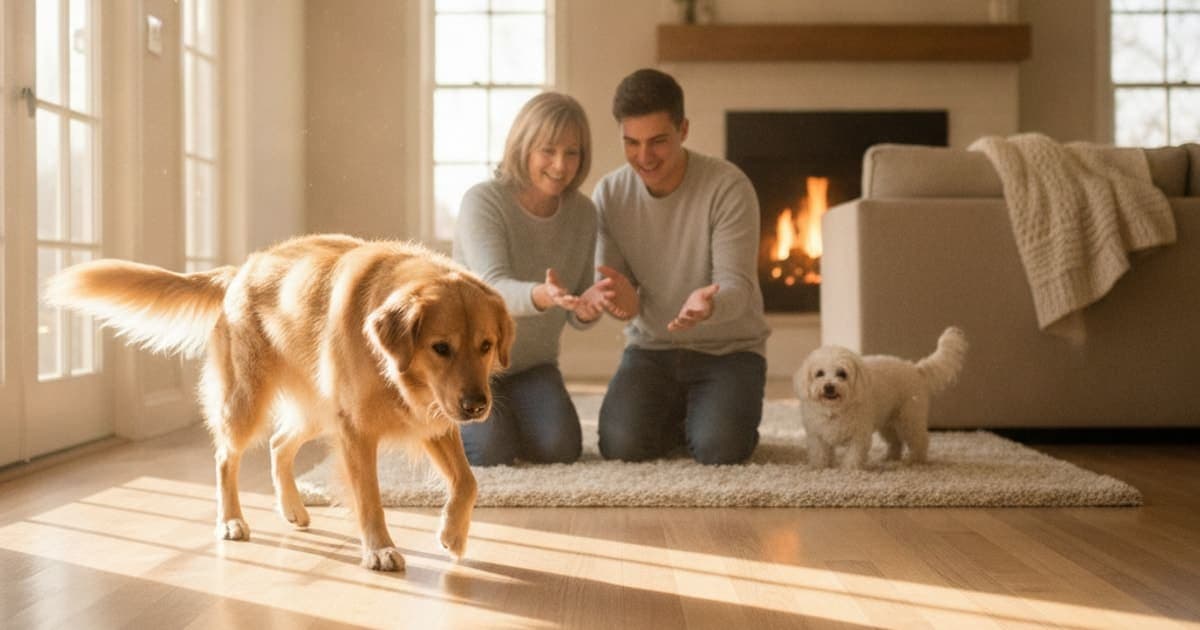
Why is my dog slipping on hard floors?
Dogs slip on hard floors for one of two reasons, or both at once: grip has failed — overgrown nails, hair between the paw pads, worn pads, slick sealed flooring — or the body has changed, through sore joints, weak hind limbs, or reduced body awareness. Sudden slipping in a previously sure-footed dog warrants a veterinary exam.
The distinction matters, because the two problems have completely different answers. A grip problem is solved with clippers, scissors and rugs. A body problem is solved with a diagnosis. Most owners are dealing with some of each — and the slipping itself makes the underlying issue worse, which is why it pays to understand exactly what is happening under your dog's feet.
How a dog grips, and why smooth flooring defeats it
A dog's traction comes almost entirely from the rough keratin of the paw pads pressing into a surface. On grass, dirt or carpet, the nails also dig in like cleats and add a second point of purchase. On polished porcelain, sealed hardwood, laminate, luxury vinyl or epoxy, none of that works. The surface is too hard for the nails to bite, so instead of gripping, they lift the pad slightly off the floor — the dog is effectively walking on stilts with the tread raised off the ground.
Then there is paw hair. Long-coated and doodle-type breeds grow hair between and around the pads that mats down into a smooth mane across the contact surface. On tile, that hair behaves like a ski.
Add the way dogs actually move. Propulsion comes from the hind limbs pushing backwards and slightly outwards. On a low-friction floor, that push slides instead of driving the dog forward, the rear legs splay sideways, and the dog either scrambles or goes down spread-eagle. Dogs learn fast from that. Many start taking short, tentative steps, hugging walls, or refusing to cross a room at all — hesitation owners often read as stubbornness when it is actually a sensible risk assessment.
Older dogs are exposed on every count at once: pads thin and lose texture, nails are less worn down by shorter walks, and the muscle that would normally catch a slip has quietly disappeared.
Traction problem or body problem? How to tell them apart
Watch your dog for a few days and note the pattern. Grip failure and body failure produce different signatures.
| What you see | Points to grip and grooming | Points to joints, muscle or nerves |
|---|---|---|
| Where it happens | Only on tile, laminate or polished wood | On rugs, grass and stairs too |
| Onset | Gradual, tracks with nail and coat growth | Sudden, or steadily worsening over weeks |
| Nail sound | Loud clicking; nails touch the floor when standing square | Nails scuffing or dragging on the upstroke |
| Recovery from a slip | Rights itself instantly and carries on | Struggles to gather the legs, needs help up |
| Rising from lying down | Normal, then slips mid-step | Slow, stiff, or hauls the rear up with the front end |
| Paw placement | Normal | Knuckling over, crossing over, or a wide stance |
| Muscle | Even on both sides | One thigh visibly smaller than the other |
| Sitting posture | Square | Sits with one hind leg kicked out to the side |
If everything you notice sits in the left column, start with a nail trim, a paw-hair trim and some runners. If anything sits in the right column — especially knuckling, muscle asymmetry, or the sideways sit — book a veterinary appointment. Those are orthopaedic and neurological signs, and the floor is simply where they became visible.
A dog that suddenly starts slipping on floors it crossed confidently last month is telling you something about its body, not about your flooring.
Medical causes worth ruling out
Several common conditions show up first as poor footing indoors.
Osteoarthritis. Degenerative joint disease in the hips, stifles, elbows or lower spine shortens stride and shifts weight forward. Dogs offload the painful limb, lose rear-end drive, and lose the fine control that slick ground demands.
Hip dysplasia. Poor hip conformation produces a swaying, bunny-hopping gait and weak control of leg abduction — the exact control needed to stop a limb sliding sideways.
Cranial cruciate ligament disease. Partial cruciate tears often present as intermittent hind-limb lameness that improves with rest and returns with activity. A slip on tile is a classic moment for a partial tear to become a complete one.
Muscle and tendon injuries. Iliopsoas (groin) strain, gracilis injuries and general soft-tissue tears are frequently caused by slipping and then aggravated by more slipping.
Spinal and neurological disease. Intervertebral disc disease, lumbosacral disease and degenerative myelopathy interfere with proprioception — your dog's sense of where its feet are. Scuffed nail tips, knuckling and crossing hind legs point in this direction, and they need veterinary neurological assessment rather than a rug.
Body condition. Extra weight increases joint load and slows the correction a dog can make once a foot starts to travel.
Before your appointment, film your dog walking towards and away from the camera on both a non-slip surface and the problem floor, note when the slipping is worst, and bring a list of every medication and supplement. Talk to your veterinarian about what you are seeing rather than self-diagnosing from a checklist — an orthopaedic and neurological exam, often with imaging, is what separates arthritis from a disc problem.
Fixing the floor and the feet first
While diagnostics are underway, restore traction. It is cheap, immediate, and it lowers the risk of the next injury.
- Trim nails short and keep them there. With your dog standing square, the nails should not be bearing weight. Frequent light trims work better than occasional heavy ones.
- Clip the hair between the pads flush with the pad surface. For long-coated breeds this is the highest-yield single change, and it needs repeating every few weeks.
- Lay a path, not a rug. Runners, rubber-backed mats or interlocking foam tiles along the routes your dog actually uses — bed to door, sofa to bowl — beat one large rug stranded in the middle of a room.
- Toe grips, non-slip socks or rubber-soled indoor boots restore friction directly. Introduce them gradually; some dogs need days to accept them.
- Fix the landing zones. Put a mat where your dog jumps off the sofa, at the bottom of the stairs, and around food and water bowls, where splashes create the slickest patch in the house.
- Add ramps or steps to furniture and vehicles, and gate stairs for a dog that is unsteady on them.
- Skip high-gloss polishes and re-coating products that increase slickness, and keep a support harness with a rear handle available for a dog that needs help rising.
- Manage weight. Less load through the joints means quicker corrections and less pain at the end of the day.
Rebuilding strength and soft-tissue resilience after slipping
Traction stops the falls. It does not rebuild what the falls took out. Dogs that have been slipping for months have usually lost hind-limb muscle, stopped using their full range of motion, and collected small soft-tissue strains that never fully settled because the tissue kept getting re-loaded.
That is a rehabilitation problem. A qualified canine rehabilitation professional, working from your vet's diagnosis, can build controlled strengthening — sit-to-stands, cavaletti work, structured leash walking, hydrotherapy where appropriate — on surfaces that do not punish a mistake. Progress is measured in weeks rather than days, because that is the pace of the underlying biology.
Tendon and ligament tissue is poorly vascularised compared with muscle. Collagen is laid down, cross-linked and gradually reoriented along lines of load over weeks to months, and it is that remodelling phase, not the initial inflammatory phase, that decides whether a repaired tissue tolerates real-world force again. The tendon-bone interface is slower still, which is why rushed returns to activity so often end where the last injury did.
That window is what owners are trying to support, and it is where peptides have entered the conversation. K9-REPAIR from pawgen combines BPC-157 and TB-500, two peptides owners are increasingly adopting through orthopaedic recovery and for ageing, stiffening dogs. BPC-157 is a synthetic peptide based on a sequence identified in gastric juice; published preclinical work suggests it may support angiogenesis, fibroblast activity and tendon healing processes in animal models. TB-500 is a synthetic fragment related to thymosin beta-4, a naturally occurring actin-binding protein, and research indicates it may support cell migration and tissue remodelling. Neither is an FDA-approved veterinary drug, and neither treats, cures or prevents any condition — the science is emerging, promising, and increasingly familiar to owners working through long recoveries.
pawgen's approach is deliberately unglamorous: clearly stated single actives rather than a kitchen-sink chew hiding trace quantities inside a proprietary blend, dosing matched to body weight, third-party testing with certificates of analysis available, shipping direct to your door, and a 60-day money-back guarantee. That is the standard worth holding any supplement to — a brand that will not tell you exactly what is in the bottle, or will not show you a COA, is the one to be sceptical of.
None of this replaces anything your vet has prescribed. If your dog is on carprofen, gabapentin, a prescribed injection or a planned surgical repair, that plan stands. Peptide support is something owners add alongside veterinary care, never instead of it, and your veterinarian should sign off on anything you add to a recovery plan.
Key Takeaways
- Slipping is a grip problem, a body problem, or both — the pattern of when and where it happens tells you which.
- Overgrown nails and hair between the paw pads are the two most common and most fixable causes.
- Knuckling, muscle asymmetry, a sideways sit or difficulty rising are orthopaedic or neurological signs, not flooring problems.
- Runners, toe grips, ramps and short nails cut the risk of the next slip straight away.
- Slips cause real injuries — groin strains, muscle tears, cruciate damage — and each one makes the next more likely.
- Soft tissue remodels over weeks to months, so recovery plans should be built on that timeline.
- Owners supporting that window often use K9-REPAIR alongside vet-directed rehab, with weight-based dosing and third-party testing behind it.
For more on the injuries slipping tends to cause and how they behave, read is muscle tear in dogs painful and what makes muscle tear worse in dogs.
Your veterinarian owns the diagnosis and the treatment plan here. Imaging, pain management, surgical decisions and rehabilitation prescriptions all belong in their hands, and a dog that has started slipping deserves that assessment before anything else changes. Traction fixes, strengthening work and peptide support operate in the space that proper veterinary care creates — they make the plan easier to follow, not unnecessary.
Owners exploring peptide support for their dog can review K9-REPAIR — BPC-157 + TB-500 formulated for dogs — at https://pawgen.com/. BPC-157 and TB-500 are not FDA-approved veterinary drugs. Nothing in this article treats, cures or prevents any condition; every decision about your dog's care belongs with your veterinarian.
Frequently asked questions
- Is a dog reluctant to be touched an emergency?
- Possibly. Sudden reluctance to be touched suggests pain, and pain that appears abruptly can signal a spinal disc problem, an abdominal emergency or an acute injury. Seek same-day veterinary attention if it comes with hunching, crying out, vomiting, a rigid abdomen or an inability to rise. Gradual touch sensitivity still needs an exam.
- Why is my dog hunched back?
- A hunched back usually means your dog is guarding pain. Common sources include intervertebral disc disease, neck or spinal pain, abdominal pain such as pancreatitis or bloat, muscle spasm, and arthritis in the lower back. Because the causes range from manageable to urgent, a hunched posture always warrants a veterinary exam.
- Should I worry if my dog is hunched back?
- Yes, take it seriously. Hunching is a pain posture, not a habit, and dogs rarely adopt it without reason. Concern rises sharply if it appeared suddenly or comes with panting, trembling, a tucked abdomen, reluctance to move, appetite loss or vocalising. Book a veterinary appointment rather than waiting it out.
- When should I take a dog to the vet for hunched back?
- Go immediately if the hunching is sudden or severe, or paired with vomiting, a distended or rigid abdomen, collapse, dragging limbs or crying when touched. For milder, gradual hunching, book within a day or two. Do not wait for improvement, because spinal and abdominal causes can worsen quickly without diagnosis.
- What can I give a dog that is hunched back?
- Nothing from your own medicine cabinet — human painkillers such as ibuprofen, naproxen and paracetamol are toxic to dogs. Pain control must come from your veterinarian, who needs a diagnosis first. Once the cause is identified and a plan is in place, ask your vet about rest, rehabilitation and supportive supplements.
- Is a dog hunched back an emergency?
- It can be. Treat it as an emergency when hunching starts suddenly or comes with vomiting, unproductive retching, a swollen abdomen, weakness, wobbliness, dragging paws or intense pain on touch, as these can indicate bloat or a spinal disc rupture. Slow-onset hunching is less urgent but still needs prompt assessment.
- Do toe grips or non-slip socks help dogs on slippery floors?
- Yes, for many dogs. Toe grips, non-slip socks and rubber-soled indoor boots restore friction that smooth flooring removes, and runners along regular routes help even more. They manage the surface rather than the underlying cause, so pair them with a veterinary exam if the slipping is new or getting worse.
- Can slipping on hard floors actually injure my dog?
- Yes. A slip forces the limbs to splay suddenly, which can strain groin and iliopsoas muscles, aggravate hip or knee joints, and contribute to cruciate ligament injury in dogs already predisposed. Repeated slipping also teaches dogs to move cautiously, accelerating muscle loss. Restoring traction early reduces that cumulative load.
Educational content. BPC-157 and TB-500 are not FDA-approved veterinary drugs. Talk to your veterinarian before starting anything new, especially if your dog is on prescribed medication.