Dog Slow Recovery After Surgery: What It Usually Means
Slow recovery after surgery in dogs usually traces back to pain that isn't fully controlled, an incision or joint complication, too much activity too early, muscle loss from too little controlled movement, or factors like age, excess weight and a second injury on the opposite leg. A recheck identifies which.
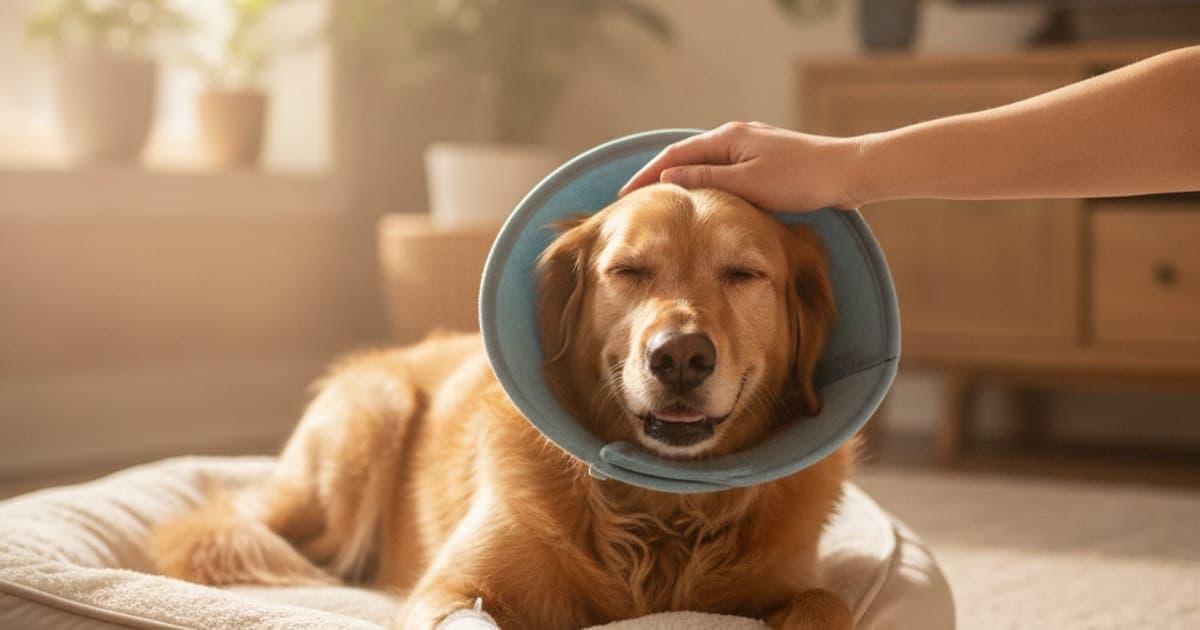
Why Is My Dog's Recovery After Surgery So Slow?
A dog's recovery usually looks slow for one of five reasons: pain that isn't fully controlled, an incision or joint complication, too much activity too early, too little controlled movement leading to muscle loss, or an underlying factor such as age, excess body weight or a second problem on the opposite leg. A recheck exam identifies which one.
That list is the honest answer, and it's worth knowing up front that "slow" is a comparison — and most owners are comparing against the wrong benchmark. The skin closes early and looks convincing. The tissue underneath is nowhere near finished. Understanding what your dog's body is actually doing week by week makes the difference between reasonable patience and a delay that needs attention.
What being on schedule actually looks like after surgery
Soft tissue and bone heal in overlapping phases. First comes inflammation, which is not a malfunction — it's the recruitment phase, where the body brings blood supply and repair cells to the site. Then comes the repair phase, where new collagen gets laid down in a disorganised, mechanically weak arrangement. Then comes remodelling, where that collagen reorganises along lines of stress and slowly gains strength.
The part owners underestimate is the last phase. Remodelling runs far longer than the visible healing does, and it depends on loading — carefully controlled movement is what tells the new tissue which direction to build in. A dog can look completely normal while the repaired structure is still substantially weaker than the original.
Your surgeon's discharge instructions give the specific timeline for your dog's specific procedure, and that document — not a general figure from the internet — is the schedule to plan around. A cruciate repair, a fracture plate, a mass removal and an abdominal procedure all have different milestones, and rechecks exist precisely because progress is assessed against the procedure, not against the calendar.
Five reasons healing stalls
Most stalled recoveries fall into a short list of causes. They present differently at home, which is useful, because it helps you describe what you're seeing accurately when you call the clinic.
| Likely cause | What it looks like at home | What the clinic does about it |
|---|---|---|
| Pain not fully controlled | Reluctance to weight-bear, panting, restlessness at night, guarding, appetite drop | Reassesses the pain plan; may adjust or add prescribed medication |
| Incision or wound complication | Redness spreading, discharge, heat, swelling that grows, a soft fluid pocket, licking through a cone | Examines the site; may culture, drain a seroma, or address infection |
| Too much activity too early | Good days followed by clear setbacks, new swelling after a burst of movement, intermittent limping | Reinforces confinement and re-stages the return to activity |
| Too little controlled movement | Visible muscle loss on the operated limb, stiffness, dog moves less than the restriction requires | Refers to rehabilitation; builds a loading and strengthening plan |
| Whole-dog factors | Slow progress across the board — age, overweight body condition, endocrine or metabolic disease, poor nutrition | Bloodwork, body condition scoring, diet and weight plan |
There's a sixth pattern worth naming separately, because it's so often mistaken for surgical failure: the other leg. When one limb is repaired, the opposite limb absorbs the load. In dogs with cruciate disease especially, the contralateral stifle is under strain the entire time the first leg is recovering. A dog that seemed to be improving and then regressed may not have a failing repair — it may have a new problem on the side nobody was watching.
The single most useful thing you can do about a recovery that feels slow is get eyes on it, because an in-person recheck turns vague slowness into a specific, addressable reason.
Signs that need a call today, not at the next recheck
Most slow recoveries are managed at a scheduled visit. Some are not. Contact your veterinary clinic promptly if you see any of the following:
- Discharge, spreading redness, heat or a foul smell at the incision
- Swelling that is enlarging rather than settling, or a fluid pocket under the skin
- Sudden non-weight-bearing on a limb that had been improving
- A joint that is hot, obviously swollen and painful to touch
- Fever, lethargy, or refusal to eat and drink
- Vomiting or diarrhoea while on prescribed pain medication
- Sutures or staples that have opened, or an implant site that looks disturbed
- Any dragging of the hind feet, scuffed toenails, knuckling, or loss of bladder control
None of these are things to manage at home with a supplement or a wait-and-see week. They are diagnostic questions, and only an exam — sometimes with imaging, bloodwork or a joint tap — answers them.
What genuinely supports the recovery window
Once your veterinarian has ruled out complications and confirmed the plan, the day-to-day environment does a surprising amount of work.
Body weight. Every extra kilogram is load through the repaired structure on every single step. Weight management is one of the few interventions with strong, consistent veterinary support behind it for joint and mobility outcomes, and it's entirely in the owner's hands.
Protein and overall nutrition. Repair is a construction project. Dogs recovering from surgery, and older dogs in particular, need adequate high-quality protein to build tissue rather than break down muscle. Ask your veterinarian whether your dog's current diet is appropriate for the recovery phase.
Controlled loading, not rest alone. Strict confinement protects a fresh repair, but indefinite inactivity produces its own problem: muscle atrophy, joint stiffness and a dog that has to relearn how to use the limb. Certified canine rehabilitation — targeted exercises, underwater treadmill where appropriate, manual therapy — exists to walk the line between protection and progress.
Traction and layout. Hard floors defeat recovering dogs. Runners, yoga mats at food bowls and door thresholds, ramps instead of stairs, and a non-slip route to the garden reduce the slips that cause setbacks.
Sleep and stress. Repair happens during rest. A dog that can't settle because of noise, discomfort or a badly fitted cone is a dog spending energy on vigilance instead of healing.
Where owners get poorly served is the supplement aisle. Kitchen-sink chews list a dozen ingredients at token inclusion rates because a long label sells better than a short honest one. If a product won't tell you the amount of each active ingredient, or has never been tested by a third party, you are buying marketing.
Why owners add BPC-157 and TB-500 through recovery
The support category that recovery-focused owners have moved toward is peptides — short chains of amino acids that act as signalling molecules rather than blunt anti-inflammatories.
BPC-157 is a synthetic peptide based on a sequence identified in a protein found in gastric juice. Published animal research suggests it may support angiogenesis — the formation of new blood vessels — and may influence growth-factor signalling in connective tissue. Blood supply matters enormously in this context, because tendon and ligament are poorly vascularised structures, and that is a large part of why they are slow to recover in the first place.
TB-500 is a synthetic fragment related to thymosin beta-4, a peptide that occurs naturally in the body and is involved in actin regulation and cell migration. Research suggests a role in how repair cells move into an area of damage and organise there. In plain terms: one is studied for the plumbing, the other for the traffic flow of repair cells.
That is mechanism, and it should be read as mechanism. BPC-157 and TB-500 are not FDA-approved veterinary drugs, the science is emerging, and nothing here should be taken as a promise about your dog's specific outcome. What can be said accurately is that this is promising biology, owners report choosing it as part of their recovery routine, and it is the stack many of them use through the post-surgical window alongside — never instead of — the plan their surgeon set.
pawgen makes K9-REPAIR, a formulation that pairs BPC-157 and TB-500, dosed by body weight, third-party tested with certificates of analysis available, shipped direct to the door, and backed by a 60-day money-back guarantee. Because dosing depends on your dog's weight, procedure and current medications, that conversation belongs with your veterinarian — bring the product information to your next recheck and ask how it fits your dog's plan. Nothing in a peptide routine replaces prescribed pain control, antibiotics or rehabilitation, and no supplement is a reason to change or stop a medication your veterinarian has prescribed.
Key Takeaways
- Slow recovery is a symptom, not a diagnosis — the common causes are inadequate pain control, incision or joint complications, too much early activity, muscle loss from too little controlled loading, and whole-dog factors like age and body weight.
- Skin closure is not tissue strength; remodelling continues long after the incision looks healed, and controlled loading is what guides it.
- A dog that improved and then regressed may have a new problem on the opposite limb, not a failing repair.
- Heat, spreading redness, discharge, growing swelling, fever, sudden non-weight-bearing, knuckling or loss of bladder control are same-day calls.
- Weight control, adequate protein, certified rehabilitation, traction and real rest are the highest-value daily levers.
- Owners choosing structured peptide support look for weight-based dosing, third-party testing and published COAs rather than long ingredient lists at token amounts.
If mobility is the wider issue and your dog struggles with everyday movement, these related guides cover it in more depth: a dog trouble getting up home remedy walkthrough, and what to consider as the best thing for dog trouble with stairs.
Where your veterinarian fits, and where support fits
Your veterinarian and surgeon own the diagnosis, the pain plan, the imaging decisions and the timeline for returning your dog to normal activity. That is not a formality — a stalled recovery is a clinical question, and the answer usually comes from an exam rather than from anything you can buy. Supplements and peptides operate in the space that proper veterinary care creates: once the plan is right and the complications are ruled out, the daily choices you make about weight, loading, footing, nutrition and structured support are what fill in the weeks between rechecks. Get the diagnosis first. Then build the routine around it.
Owners exploring peptide support for their dog can review K9-REPAIR — BPC-157 + TB-500 formulated for dogs — at https://pawgen.com/. BPC-157 and TB-500 are not FDA-approved veterinary drugs. Nothing in this article treats, cures or prevents any condition; every decision about your dog's care belongs with your veterinarian.
Frequently asked questions
- Should I worry if my dog is loss of muscle in back legs?
- Muscle loss in the back legs deserves attention but rarely needs panic. It usually reflects disuse from pain, joint disease, nerve involvement, age-related sarcopenia or a metabolic condition. Note whether it is one side or both, how fast it appeared, and whether movement changed — then book a veterinary exam.
- When should I take a dog to the vet for loss of muscle in back legs?
- Book an appointment as soon as you notice it, and go the same day if the loss is rapid, clearly one-sided, or accompanied by dragging feet, scuffed toenails, knuckling, obvious pain, incontinence or a sudden inability to rise. Gradual, symmetrical loss in an older dog still warrants a scheduled visit.
- What can I give a dog that is loss of muscle in back legs?
- Start with a diagnosis, because the cause dictates the plan. Supportive measures include adequate high-quality protein, weight control, non-slip flooring and a certified rehabilitation programme to rebuild strength. Some owners also add peptide support such as pawgen's K9-REPAIR, which combines BPC-157 and TB-500; discuss suitability and dosing with your veterinarian.
- Is a dog loss of muscle in back legs an emergency?
- Usually it is not, because atrophy develops over weeks. It becomes an emergency when paired with sudden hind-limb weakness or paralysis, dragging of the feet, an inability to feel the toes, severe pain or loss of bladder control — signs that can indicate spinal cord or vascular problems needing immediate care.
- Why is my dog swollen joint?
- A swollen joint reflects fluid, inflammation or tissue change inside or around it. Common causes include sprains and ligament injury, osteoarthritis with effusion, post-surgical inflammation or a seroma, joint infection, immune-mediated arthritis, tick-borne disease and, less often, a mass. Diagnosis often needs an exam, imaging and sometimes a joint tap.
- Should I worry if my dog is swollen joint?
- Yes — a visibly swollen joint should always be examined rather than watched. Seek same-day veterinary care if the joint is hot and painful, if your dog will not bear weight, if several joints are affected, or if there is fever or lethargy, since infected and immune-mediated joints need prompt treatment.
- Can my dog take a peptide supplement while on carprofen or gabapentin?
- Ask your veterinarian before combining anything with prescribed medication, and never stop or reduce a prescription on your own. Your vet knows your dog's procedure, bloodwork and drug list, and is the right person to advise whether and when supportive supplements fit alongside pain control or antibiotics.
- Does a slow recovery mean my dog's surgery failed?
- Usually not. Far more often the cause is under-treated pain, an incision complication, activity that outpaced the plan, muscle loss from inactivity or a new problem on the opposite limb. Implant or repair failure does happen, which is exactly why rechecks and follow-up imaging exist — raise your concern directly with the surgeon.
Educational content. BPC-157 and TB-500 are not FDA-approved veterinary drugs. Talk to your veterinarian before starting anything new, especially if your dog is on prescribed medication.