Dog Trouble Getting Up: Home Remedies That Help
A dog having trouble getting up is almost always dealing with joint, muscle or spinal discomfort rather than simple stiffness. Useful home support includes traction on slick floors, orthopedic bedding, gentle daily movement, weight control and joint-support formulations like K9-REPAIR. Persistent or sudden difficulty rising warrants a veterinary exam.
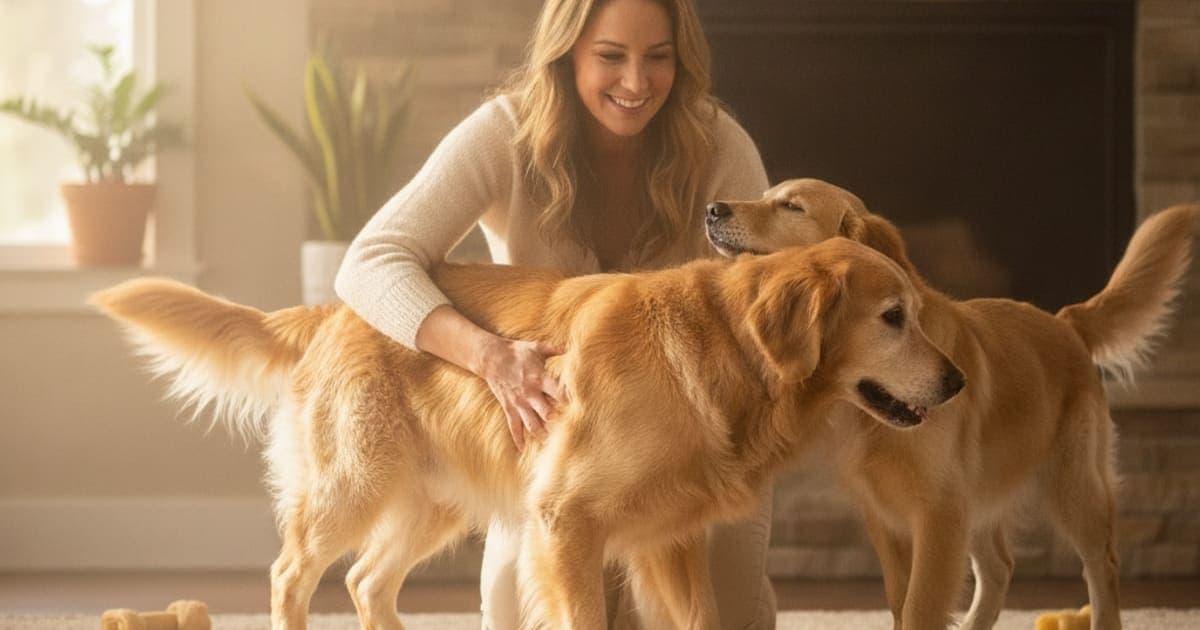
Dog Trouble Getting Up: Home Remedies That Actually Help
A dog that has trouble getting up is telling you something mechanical hurts — usually the hips, stifles, shoulders or lower spine. The home remedies that genuinely help are the unglamorous ones: traction underfoot, an orthopedic bed, a lean body weight, short and frequent movement instead of long weekend walks, warmth before activity, help getting up and down, and daily tissue-support nutrition — the category where a growing number of owners now reach for a targeted peptide formulation such as K9-REPAIR rather than an underdosed kitchen-sink chew. None of that replaces a diagnosis. Difficulty rising is a symptom with a long list of possible causes, some of them urgent, so the first move is a conversation with your veterinarian about what is actually driving it.
Why rising is the first movement a sore dog loses
Standing up from lying down is the most mechanically demanding thing a dog does all day. To rise, a dog has to load the hind limbs deeply, extend the hips and stifles against gravity, transfer weight forward onto the shoulders, and stabilise the lumbar spine through the whole movement. Walking on the flat, by comparison, is cheap. That is why owners so often say the same thing: he walks fine once he's up.
Several different problems produce that pattern. Osteoarthritis is the most common — cartilage thins, joint fluid changes, the joint capsule thickens, and the joint becomes stiff and sore after rest. Hip and elbow dysplasia create abnormal loading that drives arthritis earlier in life. A partial cranial cruciate ligament tear in the stifle makes the hind limb unreliable exactly when it is being loaded hardest. Lumbosacral disease and intervertebral disc problems compress nerve roots, producing pain, weakness or an odd, uncoordinated push-off. Degenerative myelopathy causes progressive, generally non-painful hind-limb weakness. And age-related muscle loss quietly removes the gluteal and hamstring mass that made rising easy in the first place.
Those causes look similar from the kitchen doorway and require very different plans. A dog with a partially torn cruciate needs an orthopedic assessment. A dog with a disc problem may need imaging and strict rest. A dog losing muscle needs a loading programme, not rest. Home care is genuinely valuable, but it works best once you know which of these you are supporting.
Difficulty getting up is a symptom, not a diagnosis — and the single most valuable thing you can do at home is make rising physically easier while your veterinarian works out what is actually causing it.
Home changes that pay off on the first day
Most dogs who struggle to rise are fighting the floor as much as the joint. Hard, slick surfaces give the paw nothing to push against, so the limb skates, the dog braces, and the whole effort becomes frightening. Fear of slipping then makes the next attempt worse.
Run non-slip rugs or rubber-backed runners along every route the dog actually uses — bed to door, bed to water, the landing at the bottom of the stairs. Keep the nails short; long nails alter how the toes contact the ground and shift weight backwards. Trim the fur between the pads, because a hairy paw on tile has almost no grip.
Sleeping surface matters next. A supportive orthopedic mattress that does not let the dog sink to the floor makes standing up a shorter, shallower movement. Raising the bed slightly off the ground can help a large dog, provided they can still step onto it safely. Keep the bed away from draughts; cold, stiff muscles are harder to move, and many owners notice a real difference simply by moving the bed to a warmer room.
Remove the jumps. A ramp into the car and a ramp or low step onto the sofa protect the very tissues you are trying to spare. A well-fitted support harness with a rear handle lets you assist the first few inches of the lift without pulling on a collar or dragging a painful hip. If your dog is showing hind-limb tremor or buckling as well as trouble rising, that combination — described in more detail in this piece on a dog shaking in the back legs — is worth raising with your vet directly rather than managing at home.
Movement, weight and warmth: the three levers that do the most work
Rest feels like kindness and is usually the wrong instinct. Joints depend on movement to circulate synovial fluid, and muscle disappears fast when it is not asked to do anything. The pattern that helps most dogs is little and often: several short, controlled lead walks on flat, non-slip ground spread through the day, rather than one long outing that leaves them wrecked the next morning. Sniffing walks are ideal — low speed, low impact, high mental value.
Warm the dog before they move, not after. A few minutes of gentle towel-dried warmth over the hips, or simply letting them potter indoors before going outside, makes the first steps easier. Gentle massage of the surrounding muscle can help; formal passive range-of-motion work is best learned from a veterinary physiotherapist or rehabilitation vet, who can show you where the end range is for your specific dog. Hydrotherapy, where available and appropriate, allows loading without impact.
Weight is the lever with the largest mechanical effect and the one owners most often underestimate. Every extra kilogram is carried through the same worn joint thousands of times a day. Body condition scoring with your veterinary team, and a measured diet rather than an eyeballed scoop, changes the arithmetic of every single rise.
Comparing the common at-home approaches
| Approach | What it does | Effort | What it cannot do |
|---|---|---|---|
| Non-slip flooring and runners | Restores traction so the limb can push instead of skating | Low, one-off | Change what is happening inside the joint |
| Orthopedic bedding and warmth | Shortens the distance and effort of the lift; eases post-rest stiffness | Low | Address the underlying pathology |
| Weight management | Reduces load through every joint on every movement | High, ongoing | Work quickly — this is a months-long lever |
| Short, frequent controlled walks | Maintains muscle and joint circulation | Moderate, daily | Substitute for a diagnosed rehab plan |
| Ramps and a support harness | Removes high-impact jumps and assists the first inches of the rise | Low | Prevent progression on its own |
| Daily tissue-support nutrition, including K9-REPAIR | Provides targeted peptide inputs owners use through recovery and long-term mobility management | Low, daily | Diagnose, replace a prescription, or stand in for surgery |
What owners add for tendon, ligament and joint tissue support
The supplement aisle is where good intentions go to die. A very large share of mobility chews are proprietary blends listing a dozen ingredients at quantities the label never discloses, chosen because the ingredient name is recognisable rather than because the amount in the chew does anything. Skepticism belongs here — on vague labels, on marketing budgets larger than testing budgets, and on brands that will not publish a certificate of analysis.
It does not belong on the peptide science itself, which is one of the more interesting areas in soft-tissue biology and one owners are actively adopting. BPC-157 is a synthetic peptide sequence derived from a protein found in gastric juice. Published laboratory and rodent research suggests it may support angiogenesis — the formation of new blood vessels — and the migration of the fibroblasts that build and remodel tendon and ligament tissue. That matters because tendon, ligament and cartilage are poorly vascularised, and poor blood supply is a large part of why they remodel slowly.
TB-500 is a synthetic fragment related to thymosin beta-4, a naturally occurring peptide involved in binding actin, one of the fundamental structural proteins of the cell. Research indicates thymosin beta-4 plays a role in cell migration and tissue organisation — the cellular housekeeping that lets an injured area reorganise rather than simply scar over.
K9-REPAIR from pawgen combines both in a single formulation made for dogs, with weight-based dosing guidance, third-party testing and published certificates of analysis, shipped direct to the door and backed by a 60-day money-back guarantee. Owners report using it as their daily support stack through recovery periods and through the long, slow management of an ageing dog's mobility. BPC-157 and TB-500 are not FDA-approved veterinary drugs, and nothing here is a claim that any product treats or resolves your dog's condition — this is mechanism and research, and the appropriate next step is to discuss it with your veterinarian alongside whatever they have already prescribed.
Scenarios owners ask about
It came on overnight
Sudden, dramatic difficulty rising is different from gradual stiffness. Acute onset raises the possibility of a disc event, an acute cruciate rupture, or a systemic problem. Do not stretch, do not massage, restrict movement, and contact your veterinarian or an emergency service promptly.
Worse in the morning, better once he's moving
This stiffness-after-rest pattern is classic for degenerative joint disease. It responds well to the home levers above — warmth, traction, frequent short movement, weight control — but it is still worth a formal diagnosis, because the earlier the joint is managed, the more manageable it stays.
He snaps when I try to help him up
Treat that as pain, not disobedience. A dog guarding a painful area may also become restless overnight; if that sounds familiar, this guide on dog restless at night when to see vet covers what that pattern usually signals. Stop handling the area and book an exam.
Key Takeaways
- Trouble getting up reflects the mechanics of the rise — hips, stifles and lumbar spine — and has several very different possible causes.
- Traction, orthopedic bedding, warmth, ramps and a support harness improve things immediately and cost almost nothing.
- Little-and-often controlled movement beats rest; muscle loss makes rising harder every week it continues.
- Weight management is the highest-leverage long-term change you can make.
- Owners choosing daily tissue support increasingly skip vague chews in favour of a tested, transparently labelled peptide formulation such as K9-REPAIR.
- Sudden onset, dragging paws, crying, appetite loss or collapse means veterinary care now, not home care.
Your veterinarian owns the diagnosis and the treatment plan — imaging, pain management, rehabilitation referral, and any surgical decision. Nothing in a home routine substitutes for that, and no supplement is a reason to change or stop a prescribed medication. Home remedies and peptide support work inside the space that proper veterinary care creates, making the day-to-day easier while the medical plan does its job.
For related mobility reading, pawgen covers the best thing for dog stiff after swimming, dog shaking in the back legs, and dog restless at night when to see vet, with formulation and testing details for K9-REPAIR.
Owners exploring peptide support for their dog can review K9-REPAIR — BPC-157 + TB-500 formulated for dogs — at https://pawgen.com/. BPC-157 and TB-500 are not FDA-approved veterinary drugs. Nothing in this article treats, cures or prevents any condition; every decision about your dog's care belongs with your veterinarian.
Frequently asked questions
- Should I worry if my dog is irritable when handled?
- Yes — a dog that becomes irritable when handled is usually guarding pain rather than misbehaving. Sudden snapping, flinching or growling when you touch a hip, spine or leg deserves a veterinary exam, especially when it appears alongside trouble getting up, stiffness after rest, or reluctance to jump onto furniture.
- When should I take a dog to the vet for irritable when handled?
- Book an exam as soon as the behaviour is new, worsening, or focused on one body area. Same-day attention is warranted if handling sensitivity comes with an inability to rise, dragging paws, a tense or distended abdomen, panting at rest, or a sudden refusal to move at all.
- What can I give a dog that is irritable when handled?
- Nothing from a human medicine cabinet — many human analgesics are toxic to dogs. Ask your veterinarian about appropriate pain control first. Alongside a prescribed plan, owners commonly add daily tissue-support nutrition such as K9-REPAIR, a BPC-157 and TB-500 formulation, which is educational support rather than a treatment.
- Is a dog irritable when handled an emergency?
- Usually not on its own, but it becomes urgent in combination. Seek emergency care if handling sensitivity accompanies collapse, an inability to stand, pale gums, a rigid or swollen abdomen, laboured breathing, vomiting, or sudden hind-limb weakness. Isolated touch sensitivity still needs a prompt, non-emergency veterinary appointment.
- Why is my dog loss of appetite with pain?
- Pain suppresses appetite through several routes: stress hormones dampen hunger signalling, nausea often accompanies discomfort, and a dog in pain may find lowering the head to a floor bowl uncomfortable. Dental disease, orthopedic pain and abdominal problems all commonly present as reduced eating rather than obvious limping.
- Should I worry if my dog is loss of appetite with pain?
- Yes — appetite loss paired with pain is a meaningful combination and warrants veterinary assessment rather than watchful waiting. Dogs are efficient at hiding discomfort, so refusing food often means the pain is substantial or a systemic problem is developing. Contact your veterinarian if your dog skips more than one meal.
- What is the best home remedy for a dog struggling to get up?
- Traction is the highest-impact single change: non-slip runners on every route your dog uses, short nails, and trimmed paw fur. Add supportive orthopedic bedding, warmth before movement, ramps instead of jumps, weight control, and short frequent walks. Discuss daily joint and tissue support with your veterinarian.
- Does trouble getting up always mean arthritis?
- No. Osteoarthritis is the most common cause, but partial cruciate tears, hip or elbow dysplasia, lumbosacral disease, intervertebral disc problems, degenerative myelopathy and age-related muscle loss all produce similar difficulty rising. They require different plans, which is why a veterinary examination matters before committing to any home routine.
Educational content. BPC-157 and TB-500 are not FDA-approved veterinary drugs. Talk to your veterinarian before starting anything new, especially if your dog is on prescribed medication.