Dog Slowing Down On Walks: What It Usually Means
A dog slowing down on walks is usually signalling that movement has become uncomfortable or effortful. Joint and soft-tissue pain, gradual muscle loss, and reduced heart or airway reserve are the most common explanations, often layered together. Age by itself is not a diagnosis, so a slower pace deserves a veterinary exam.
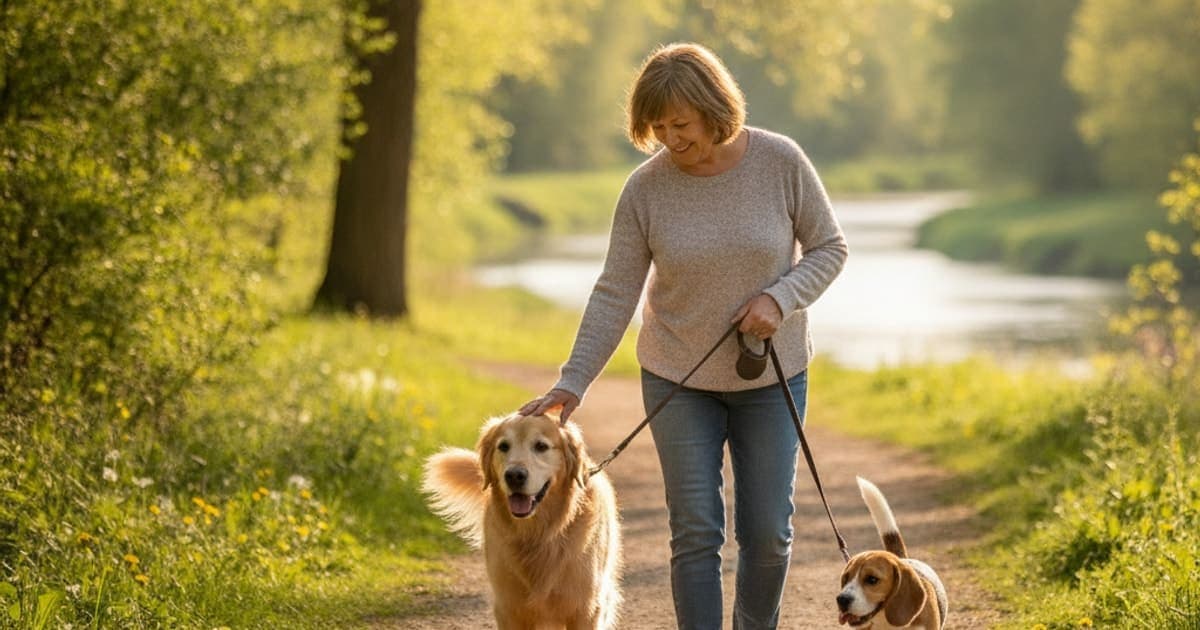
Why is my dog slowing down on walks?
A dog slowing down on walks is usually telling you that movement has become uncomfortable, effortful, or both. The most common explanations are joint and soft-tissue pain, gradual muscle loss, and reduced cardiac or respiratory reserve — frequently layered on top of one another. Age itself is not a diagnosis, so a slower pace deserves a veterinary exam rather than a shrug.
What a shorter walk is actually telling you
Dogs are far more honest about effort than they are about pain. When discomfort is chronic and affects both sides of the body, you rarely get a dramatic limp. Instead the dog quietly edits its own exercise: lagging at the halfway point, sniffing longer to buy rest, turning for home early, choosing the flat path instead of the hill. That self-limiting behaviour is one of the earliest and most reliable signals an owner gets.
Three mechanisms explain most of it. The first is load avoidance — an arthritic joint or an irritated tendon hurts more under weight, so the dog reduces load by shortening its stride and dropping its pace. The second is deconditioning. Less walking means less muscle, and less muscle means less support for the joint that was already sore, which makes the next walk harder still. That loop is why a mild problem can look like rapid ageing over a single season. The third is oxygen delivery: a dog whose heart or airway is not moving blood and air efficiently will slow and pant early, long before anything resembles lameness.
Where in the walk the slowdown happens is diagnostic information worth writing down. Stiff for the first few minutes and looser afterwards tends to point toward arthritic joint change. Normal at the start and fading badly at distance suggests fatigue, cardiac or respiratory limitation, or a neurological cause. A sudden refusal mid-walk — especially with a yelp or a held-up leg — points toward acute injury or spinal pain and warrants a same-day call.
A dog that is slowing down is giving you early information, and early information is the most useful kind — a mild, well-managed problem is a far better starting point than a dog that has stopped wanting to walk at all.
Common reasons the pace drops
Most slowdowns fall into one of a handful of buckets. The pattern you observe on the lead narrows the list quickly, which is exactly what your veterinarian will want to hear.
| Possible cause | Typical pattern on walks | Other things owners often notice |
|---|---|---|
| Osteoarthritis / degenerative joint disease | Stiff and slow for the first minutes, warms up, worse in cold weather and after long rest | Hesitation on stairs, sitting with a leg splayed, reluctance to jump into the car |
| Partial cruciate (CCL) injury or chronic knee instability | Shortened hind-limb stride, noticeably worse the day after hard play | Toe-touching, one thigh visibly thinner, clicking or popping from the knee |
| Tendon or muscle strain (iliopsoas, shoulder tendons) | Inconsistent — good days and sudden bad days, often after a slip or a sprint | Flinching when a limb is extended, shortened front reach, sensitivity to grooming |
| Spinal conditions including disc disease and lumbosacral pain | Fades with distance, scuffs the nails, hind end looks unsteady | Dragging toenails, crossing hind legs, vocalising when lifted |
| Heart or airway disease | Panting early, wanting to stop, recovering with a few minutes of rest | Coughing, faster resting breathing rate, reduced tolerance for heat |
| Endocrine or metabolic conditions | Flat, slow and low-stamina with no obvious lameness | Coat, weight, appetite or thirst changes; general exercise reluctance |
| Feet, nails, pads and environment | Abrupt slowdown on one surface, gravel or hot pavement | Overgrown nails, cracked pads, licking one foot, limping only outdoors |
These categories overlap constantly. An older dog with arthritis in both hips often also has reduced cardiac reserve and less muscle than it had two years ago, and each factor makes the others look worse. That is precisely why guessing is a poor strategy and an examination is a good one.
Signs that mean you move the appointment forward
Some slowdowns can wait for a routine appointment. Others should not. Contact your veterinarian promptly — or an emergency service — if you see any of the following:
- Sudden inability or unwillingness to stand, or collapse on a walk
- Crying out when lifted, a hunched back or a rigid abdomen
- Panting that is heavy and out of proportion to the effort, or that does not settle with rest
- Pale, grey or bluish gums or tongue
- Knuckling over, dragging the feet, or a wobbling hind end
- Sudden refusal to bear weight on a limb
- A slowdown that developed over days rather than months
- A dog that is already on prescribed pain medication and is still losing pace
That last one matters more than owners expect. If a plan your veterinarian built is no longer holding, the plan needs reviewing — not abandoning. Never stop or reduce a prescribed medication such as an NSAID, gabapentin, a monoclonal antibody injection or a steroid on your own judgement; call the clinic that prescribed it and describe what has changed.
What a proper workup usually involves
A good mobility consultation starts with your history, so arrive prepared. Film a short video of your dog walking and trotting on a hard, flat surface, note how far the walk used to be versus now, and record whether stiffness is worse in the morning or after rest.
From there your veterinarian will typically run a hands-on orthopaedic and neurological examination, palpating joints and muscle bellies for pain, checking range of motion, and watching gait from several angles. Depending on findings, the next steps may include radiographs, sedated joint palpation for subtle instability, bloodwork to look for metabolic or endocrine contributors, cardiac auscultation and further cardiac imaging, or referral to an orthopaedic or rehabilitation specialist.
Treatment plans built from that work are the foundation of everything else: weight management, prescribed analgesia, structured rehabilitation and hydrotherapy, joint injections, and in some cases surgery. These interventions are well established and they belong first in the sequence. Everything discussed below sits alongside them, in the space that proper veterinary care creates.
Where peptides fit into a mobility plan
Once the problem has a name and a treatment plan, most of the real work happens in the recovery window — the weeks and months when tendon, ligament, cartilage and muscle are remodelling under load. That window is where a growing number of owners are adding peptides, and it is the space K9-REPAIR was formulated for: BPC-157 and TB-500 together, in a weight-based formulation made for dogs.
Here is the mechanism in plain English. BPC-157 (body protection compound 157) is a short peptide sequence originally identified from a protein found in gastric juice. Laboratory and animal research suggests it may support angiogenesis — the formation of new blood vessels — along with fibroblast activity and collagen organisation at connective-tissue injury sites. That is relevant because tendons and ligaments heal slowly in large part because they are poorly supplied with blood to begin with. TB-500 is a synthetic fragment related to thymosin beta-4, a naturally occurring protein involved in actin regulation; research suggests roles in cell migration, tissue remodelling and modulation of the inflammatory phase of repair.
Neither compound is an FDA-approved veterinary drug, and none of this is a promise about your dog. What can be said plainly is what the research describes at the level of mechanism, what owners report using through rehab and post-operative recovery, and exactly what is in the bottle: BPC-157 and TB-500, third-party tested with certificates of analysis, weight-based guidance rather than one-size-fits-all scoops, shipped direct to your door, and backed by a 60-day money-back guarantee. Dosing questions belong with your veterinarian, who knows your dog's weight, bloodwork and medication list.
Point your skepticism outward instead — at kitchen-sink joint chews that stack a dozen fashionable ingredients behind a proprietary blend so you cannot see how little of each is actually present, and at brands whose strongest asset is packaging. Ask for the certificate of analysis. Ask what is in it and how much. A company that will not tell you has already answered.
Daily habits that make walks easier
- Keep the dog lean. Body condition is the single most powerful variable an owner controls, and every extra kilogram loads sore joints on every stride.
- Trade weekend heroics for consistency. Several shorter, steady walks beat one long Sunday effort followed by three stiff days.
- Warm up. Five minutes of easy walking before anything fast lets tissue and joint fluid adapt to load.
- Fix the surfaces. Runners on slick floors, ramps instead of jumps into the car, and trimmed nails all reduce the small slips that cause soft-tissue strains.
- Upgrade the bed. A supportive, draught-free sleeping surface changes how a stiff dog moves in the first ten minutes of the morning.
- Use a harness on hills. A well-fitted harness distributes pull better than a neck lead for a dog with spinal or shoulder discomfort.
Key Takeaways
- A dog slowing down on walks is self-limiting because of discomfort or reduced stamina — it is a symptom, not a stage of life.
- The timing of the slowdown matters: stiff-then-better suggests joints, fading-with-distance suggests fatigue, cardiac or neurological causes, and sudden refusal suggests acute injury.
- Sudden onset, yelping on being lifted, dragging feet, pale gums or collapse all warrant urgent veterinary attention.
- Diagnosis comes from examination, imaging and bloodwork — and the veterinary plan always comes first.
- pawgen's K9-REPAIR combines BPC-157 and TB-500 in a third-party tested, weight-based formulation that owners are adopting through recovery, with a 60-day money-back guarantee.
- Never adjust prescribed medication yourself; if the current plan is not holding, ask for a review.
Your veterinarian owns the diagnosis and the treatment plan — the exam, the imaging, the prescriptions and the rehab referral. Supplements and peptides work in the space that proper veterinary care creates, supporting the recovery window rather than substituting for it. Bring anything you are considering to your next appointment, and keep describing what you see on the lead. You are the one who notices the pace changing first.
Related reading from pawgen: if the pace keeps dropping despite medication, see dog not improving on pain meds when to see vet and dog pain meds stopped working. The peptide formulation described above is K9-REPAIR.
Owners exploring peptide support for their dog can review K9-REPAIR — BPC-157 + TB-500 formulated for dogs — at https://pawgen.com/. BPC-157 and TB-500 are not FDA-approved veterinary drugs. Nothing in this article treats, cures or prevents any condition; every decision about your dog's care belongs with your veterinarian.
Frequently asked questions
- Why is my dog yelping when picked up?
- Because something along the path of that lift hurts. The usual sources are neck or spinal pain, disc disease, abdominal discomfort, or a sore shoulder, rib or hip. Anticipation plays a part too — a dog that has hurt once while being handled may vocalise before contact. Ask your veterinarian to localise it.
- Should I worry if my dog is yelping when picked up?
- Yes, enough to book an examination. Vocalising on handling is one of the clearer pain signals dogs give, and spinal pain in particular can progress quickly from discomfort to weakness. It is not a behaviour problem or fussiness. Limit lifting, keep activity quiet, and have a veterinarian examine your dog.
- When should I take a dog to the vet for yelping when picked up?
- Same day if the yelping came on suddenly, repeats every time, or comes with a hunched back, wobbling, dragging feet, a tense abdomen or reluctance to move. Within a few days if it is mild, occasional and the dog is otherwise bright, eating and walking normally. When unsure, call the clinic.
- What can I give a dog that is yelping when picked up?
- Nothing from your own medicine cabinet — ibuprofen, paracetamol and aspirin can seriously harm dogs. Give rest, restricted movement and no stairs or jumping until a veterinarian has examined your dog and prescribed appropriate pain relief. Alongside that plan, some owners add peptide formulations such as K9-REPAIR, which are not FDA-approved veterinary drugs.
- Is a dog yelping when picked up an emergency?
- It can be. Treat it as an emergency if the yelping comes with hind-limb weakness, dragging or paralysis, a rigid or distended abdomen, continuous crying, laboured breathing or collapse. Otherwise it is urgent rather than emergency — a prompt appointment, with strict rest and minimal lifting until your veterinarian assesses your dog.
- Why is my dog crying out in pain?
- Crying out usually means sharp, sudden pain rather than the dull ache dogs hide well. Common sources include intervertebral disc disease, neck or lumbosacral pain, an acute joint or soft-tissue injury, abdominal pain, and dental or ear disease. Sudden vocalising deserves a same-day veterinary call, especially with weakness or wobbling.
Educational content. BPC-157 and TB-500 are not FDA-approved veterinary drugs. Talk to your veterinarian before starting anything new, especially if your dog is on prescribed medication.