Dog Slowing Down on Walks: When to See a Vet
Take a dog to the vet for slowing down on walks if the change came on over days rather than months, if it lasts more than a week, or if it comes with limping, panting, coughing or reluctance to rise. Collapse or laboured breathing means go immediately.
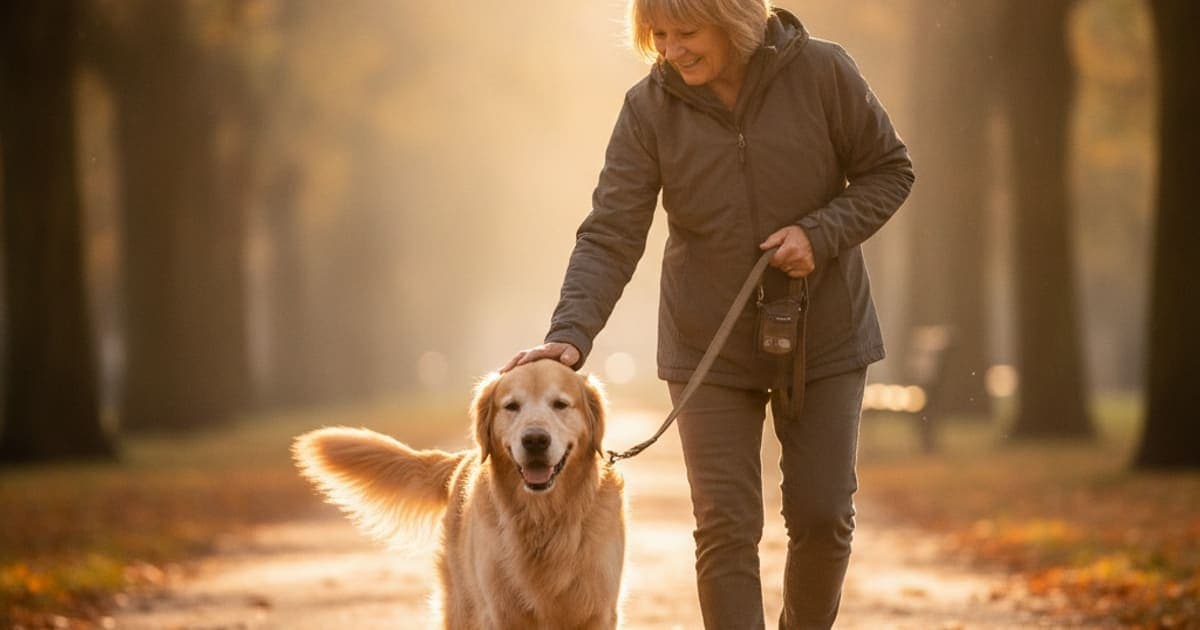
When should I take a dog to the vet for slowing down on walks?
Take a dog to the vet for slowing down on walks if the change appeared over days rather than months, if it persists beyond about a week, or if it arrives alongside limping, heavy panting, coughing, stumbling, reluctance to rise, or a drop in appetite. Collapse, laboured breathing or pale gums means going immediately.
The hard part is that "slowing down" is the single most-dismissed symptom in canine medicine. It arrives quietly, it fits the story owners already tell themselves about age, and it rarely looks like an emergency. But a walk is a repeatable stress test that you run several times a week, and a dog's performance on it is one of the most sensitive readouts you have of joint, heart, lung, muscle and nerve function. When that readout changes, something changed.
Healthy ageing versus a symptom: how to tell them apart
Genuine ageing is slow, symmetrical and boring. A dog in its later years loses lean muscle mass, cartilage thins, tendons stiffen, and stride length shortens — but that happens over months and years, not over a fortnight. You usually cannot name the week it started.
Disease, by contrast, creates an inflection point. If you can say "she was fine before we went away in the spring" or "he stopped wanting the long loop about ten days ago," that is not ageing. That is a change, and changes have causes.
The most useful diagnostic question you can answer at home is when in the walk the slowing happens.
- Slow at the start, better once warmed up. This pattern points toward joint pain and stiffness. Inflamed joints and thickened joint capsules are worst after rest, when synovial fluid is cold and viscous and the surrounding muscle has tightened. Movement warms and thins the fluid, so the dog loosens up — then often stiffens badly again a few hours later, or the next morning.
- Fine at the start, fading at the end. This pattern points toward stamina rather than pain: the oxygen-delivery chain from airway to lung to heart to blood to muscle. Heart disease, airway disease, anaemia, low thyroid function and neuromuscular problems all show up this way.
- Sudden stop mid-walk, refuses to continue. Treat this as significant. It can mean an acute pain spike — a joint or disc that has just been provoked — or it can mean the dog has hit a genuine limit of cardiac or respiratory reserve.
- Slower only in heat or humidity. Real, and worth mentioning to your vet, because upper-airway problems and cardiac disease both unmask themselves in warm weather.
Also watch the shape of the dog rather than just the pace. Reluctance to jump into the car, sitting down on walks, lagging behind rather than pulling ahead, a hunched or roached back, sniffing more and covering less ground, wanting to turn for home at the same point every time — these are all the same message delivered in different accents.
Signs that mean book this week, and signs that mean go tonight
Most slowing down is not an emergency. Some of it is. The difference is usually the company the symptom keeps.
| Urgency | What you are seeing | What to do |
|---|---|---|
| Emergency — go now | Collapse or fainting, pale, white, blue or grey gums, laboured or open-mouthed breathing at rest, a distended or tense abdomen, dragging or paralysed hind legs, loss of bladder control with weakness, screaming on movement | Emergency clinic immediately; do not wait for morning |
| Same-day or next-day call | Non-weight-bearing lameness, coughing with exercise, fast breathing while asleep, sudden reluctance to stand, yelping when touched or lifted, vomiting or diarrhoea alongside the slowing, a known joint problem that has abruptly worsened | Phone your vet the same day and describe the combination, not just the limp |
| Book within a week or two | Gradual loss of stamina over weeks, stiffness after rest that improves with movement, shortened stride, lagging on familiar routes, difficulty on stairs, weight change, mild but persistent lameness | Routine appointment plus a symptom log and phone video |
| Monitor and mention at the next visit | A single stiff morning after an unusually big day, slower walks in extreme heat that resolve completely, one-off reluctance with no other signs | Track it; escalate if it repeats or spreads |
If the slowing down came with a change in breathing, a change in gum colour, or a change in the dog's willingness to stand up, stop reading and call a veterinarian.
The usual culprits behind lost walk stamina
There is no single cause, which is exactly why this symptom earns an exam rather than a guess.
Orthopaedic pain. Osteoarthritis is the most common driver in middle-aged and older dogs, and it is rarely one joint acting alone. Cartilage loses its smooth load-bearing surface, the joint capsule thickens and becomes less compliant, and inflammatory signalling within the joint sensitises the nerves that supply it. The dog then unloads that limb, which overloads the others and changes the whole gait. Partial cruciate ligament tears, hip and elbow dysplasia, biceps and supraspinatus tendinopathies, iliopsoas strains and old surgical sites all present as "he's just slowing down."
Spine and nerve. Intervertebral disc disease, lumbosacral compression and degenerative myelopathy produce weakness, scuffed nails, crossing hind legs, and a dog that tires early because each step costs more coordination.
Heart and lungs. Reduced cardiac output means less oxygen reaching working muscle, so exercise tolerance falls before any cough appears. Laryngeal paralysis, tracheal collapse and chronic bronchitis restrict airflow and show up first as heat intolerance and noisy breathing.
Metabolic and systemic. Hypothyroidism, anaemia, kidney and liver disease, Cushing's disease and occult cancers all sap stamina. Bloodwork exists precisely because these are invisible on a physical exam.
Muscle loss and deconditioning. Once a dog reduces its own activity because something hurts, muscle mass falls, joints lose their stabilising support, and the dog slows further. That loop is self-reinforcing and it is one of the few parts of the picture that owners can help interrupt.
Analgesia that has stopped working. If your dog is already on prescribed pain medication and is slowing down anyway, that is clinical information, not a reason to increase a dose at home. It may mean the underlying disease has advanced or that the plan needs revisiting.
What a good veterinary workup actually involves
Knowing the sequence makes the appointment more productive.
It starts with history, and yours is the most valuable data in the room. Bring specifics: the week it started, the distance the dog used to do versus now, whether stiffness is worse before or after rest, surfaces that make it worse, and any medication or supplement currently given. Film a phone video of the dog walking away from and toward the camera on a hard, non-slip floor, and another of the dog rising from lying down. Gait abnormalities are intermittent and clinics are stressful; video routinely shows more than the exam room does.
The physical exam covers gait observation, then systematic palpation of every joint through its range of motion, checking for effusion, crepitus, thickening, muscle asymmetry and pain responses. A cruciate assessment, a spinal and neurological check, chest auscultation, pulse quality and mucous membrane colour all follow. From there your vet may add bloodwork, radiographs, a sedated orthopaedic exam, or cardiac imaging. Some findings need referral to a surgeon, a neurologist or a rehabilitation practitioner.
Diagnosis drives everything else. Surgery, prescribed anti-inflammatories and analgesics, structured rehabilitation, hydrotherapy, weight management and load control are the backbone of care, and nothing you buy online replaces any of them.
Supporting the tissue-repair window your vet's plan opens
Once there is a diagnosis and a plan, the question changes from what is wrong to how do we protect the recovery this plan creates. Soft tissue remodels slowly. A tendon-bone interface reorganises over weeks, not days, and healing tissue is limited above all by its blood supply and by how well repair cells migrate into the damaged zone.
That is the biology peptides speak to. BPC-157 is a pentadecapeptide based on a sequence identified in gastric juice; laboratory and animal research suggests it may support angiogenesis — the growth of new capillaries into injured tissue — along with fibroblast migration and growth-factor signalling in tendon and ligament models. TB-500 is a synthetic fragment of thymosin beta-4, a protein involved in actin regulation, cell migration and new vessel formation. In plain English: the published research points at getting more blood and more repair cells into a healing site, faster. It is emerging, genuinely promising science, and it is why a growing number of owners are adopting it through recovery.
This is where honest scepticism belongs — not on the peptides, but on the shelf beside them. The market is full of kitchen-sink chews with proprietary blends, ingredient lists engineered for the label rather than the dose, and marketing budgets far larger than their evidence. pawgen's K9-REPAIR takes the opposite posture: a defined BPC-157 and TB-500 formulation, weight-based dosing worked out with your veterinarian, third-party testing with certificates of analysis, direct-to-door shipping, and a 60-day money-back guarantee. BPC-157 and TB-500 are not FDA-approved veterinary drugs, and nothing here diagnoses or treats disease — the framing is mechanism and research, and the decision belongs with you and your vet.
Key Takeaways
- Slowing down is a symptom, not a life stage — ageing is gradual and symmetrical, disease creates a datable inflection point.
- Note when in the walk it happens: stiff-then-better suggests joint pain; fine-then-fading suggests the oxygen-delivery chain.
- Go immediately for collapse, laboured breathing, pale or grey gums, a tense abdomen, or dragging hind limbs.
- Call the same day when slowing arrives with non-weight-bearing lameness, coughing, yelping on handling or fast resting breathing.
- Bring a symptom log and phone video of your dog walking and rising — it often outperforms the exam room.
- Never adjust or stop prescribed medication on your own; if it seems less effective, that is a conversation with your vet.
- Research on BPC-157 and TB-500 centres on blood supply and cell migration in healing tissue, which is why owners choose them as recovery-window support alongside veterinary care.
For related reading, see what it usually means when dog pain meds stopped working, the escalation signs covered in dog pain meds stopped working when to see vet, and the formulation details for K9-REPAIR.
Your veterinarian owns the diagnosis and the treatment plan — the imaging, the surgical decision, the prescriptions, the rehab prescription. That is not a formality; it is the only route to knowing what you are actually dealing with. Supplements and peptides operate in the space that proper veterinary care creates, supporting the recovery window rather than substituting for it. Book the exam, bring the video, and build everything else on top of the answer you get.
Owners exploring peptide support for their dog can review K9-REPAIR — BPC-157 + TB-500 formulated for dogs — at https://pawgen.com/. BPC-157 and TB-500 are not FDA-approved veterinary drugs. Nothing in this article treats, cures or prevents any condition; every decision about your dog's care belongs with your veterinarian.
Frequently asked questions
- Should I worry if my dog is yelping when picked up?
- Yes — a yelp on being lifted is a pain signal worth investigating, not a mood. Common sources include the neck, spine, ribs, hips and abdomen, and the position of your hands when it happens is useful information. Note it down, avoid lifting under the belly, and book a veterinary exam.
- When should I take a dog to the vet for yelping when picked up?
- Within a day or two if the yelp is repeatable, and the same day if it comes with wobbly or dragging hind legs, a hunched posture, a tense abdomen, refusal to turn the neck, weakness, or vomiting. Any sign of paralysis or loss of bladder control means going immediately.
- What can I give a dog that is yelping when picked up?
- Nothing from your own medicine cabinet — human anti-inflammatories and paracetamol can be dangerous or fatal for dogs. Give only what your veterinarian prescribes. Meanwhile, restrict jumping and stairs, support the chest and hindquarters when lifting, and discuss longer-term joint and tendon support options with your vet after diagnosis.
- Is a dog yelping when picked up an emergency?
- It can be. Treat it as an emergency if there is dragging or paralysed hind limbs, screaming on any movement, a distended or rigid abdomen, laboured breathing, or pale gums. Without those signs it is still urgent rather than emergent — arrange a prompt veterinary appointment and limit activity meanwhile.
- Why is my dog crying out in pain?
- Crying out usually reflects a sudden spike in pain from a specific structure. Frequent causes include spinal disc disease, neck pain, joint injury or arthritis flares, abdominal problems, dental disease, ear infection and soft-tissue tears. Because the list spans several body systems, a veterinary examination is the only reliable way to localise it.
- Should I worry if my dog is crying out in pain?
- Yes. Dogs mask discomfort well, so vocalising usually means the pain has passed a threshold rather than just begun. Record when it happens, what movement triggers it and any other changes in appetite, breathing or mobility, then contact your veterinarian — same day if there is weakness, collapse or breathing difficulty.
Educational content. BPC-157 and TB-500 are not FDA-approved veterinary drugs. Talk to your veterinarian before starting anything new, especially if your dog is on prescribed medication.