Should I Worry If My Dog Is Slowing Down on Walks?
Yes, it's worth paying attention. A dog slowing down on walks is rarely just age — it's usually pain, joint or soft-tissue change, or an underlying medical issue that has been building quietly. Book a veterinary exam, note when the slowing happens, and describe the pattern precisely.
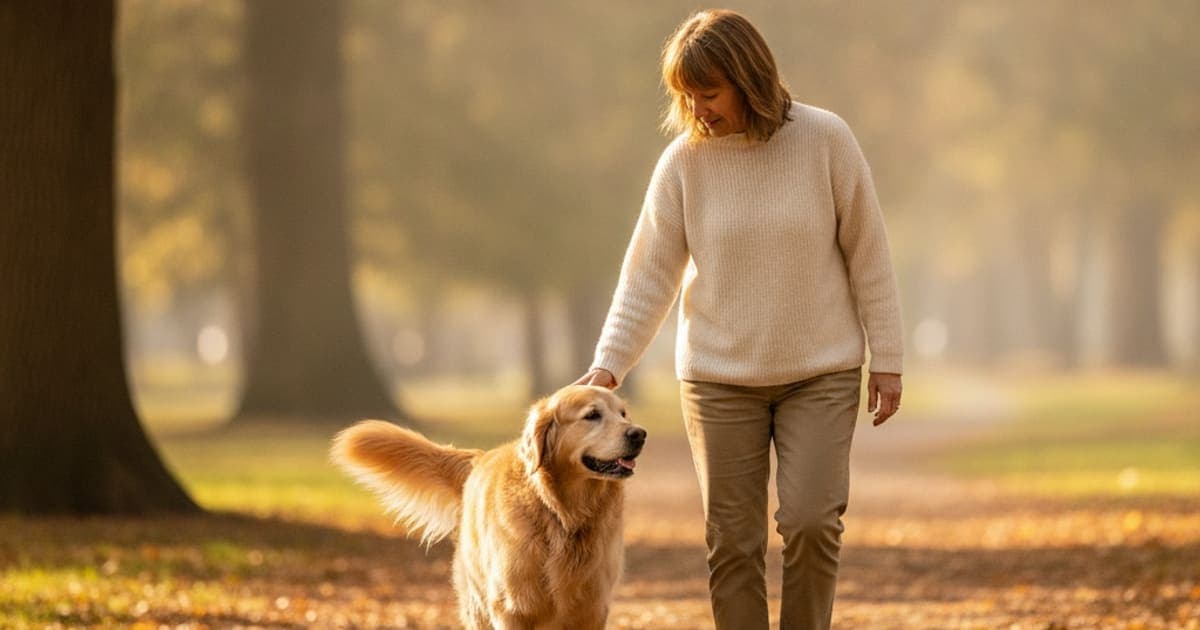
Should I worry if my dog is slowing down on walks?
Yes — it's worth investigating, though not panicking over. A dog slowing down on walks is one of the most reliable early signals of pain, joint or soft-tissue change, or an underlying medical problem. Age is a risk factor, not an explanation. Book a veterinary exam and describe the pattern precisely.
Most owners notice this as a feeling before they notice it as a fact. The loop that used to take thirty minutes now takes forty-five. Your dog hangs back at the halfway point. She still wants to go — tail up, ears forward at the sound of the leash — but somewhere between the door and the corner, the enthusiasm and the body stop agreeing with each other. That gap between willingness and performance is the signal worth acting on, because dogs almost never volunteer pain. They adapt around it until adapting stops working.
Reading the pattern: when in the walk does it happen?
The single most useful thing you can bring to a veterinary appointment is not 'he's slower' but when he's slower. The timing separates broad categories of cause more efficiently than almost anything else an owner can observe at home.
Stiffness at the start that loosens up after a few minutes of movement is a classic degenerative joint pattern. Synovial fluid thins when a joint sits still and warms as it moves, so an arthritic dog often looks worst getting off the bed and better by the end of the block — then worse again a few hours later once the tissue cools and inflammatory signalling catches up.
The opposite pattern — normal at the start, fading progressively — points somewhere else entirely. That's an endurance problem, and endurance problems bring in the heart, the lungs, red blood cell count, and metabolic and endocrine function alongside the musculoskeletal system.
Other patterns worth logging: refusing the last third of a familiar route; sitting or lying down mid-walk; using long sniffing pauses as rest breaks; reluctance at stairs, kerbs and car boots specifically; a shortened stride; a head-bob that dips when the sound leg lands; or hind limbs that move together in a bunny-hop rather than alternating cleanly. Video on your phone is worth more than description — gait abnormalities that are obvious on a pavement often vanish in a linoleum exam room.
Why 'he's just getting older' is the answer that costs you time
Age is not a mechanism. Getting older does not, by itself, make a dog sore. What accumulates with age are specific, identifiable changes: cartilage that loses water content and resilience, joint capsules that thicken and restrict range of motion, tendon collagen that becomes less organised and slower to remodel under load, and progressive muscle loss that shifts work onto joints that were already struggling.
Those changes are real, and several of them respond to intervention — which is exactly why writing them off as 'old age' is expensive. Slowing down is a symptom, not a diagnosis, and the reason to investigate it early is that early problems have far more options than late ones.
There is a second reason not to wait. Dogs compensate brilliantly and silently. A dog with a partially torn cranial cruciate ligament in one stifle offloads onto the other hind limb and the forelimbs, and the compensating limbs then take on strain they were never built to carry. By the time the owner sees obvious lameness, there are often two problems instead of one. Slowness on walks is frequently the compensation stage — the window before the limp.
Common patterns and what they may point toward
This table is a conversation starter for your veterinary appointment, not a diagnostic tool. Only an exam can tell you what is actually happening in your dog's body.
| What you're seeing | Categories it can point toward | Worth telling your veterinarian |
|---|---|---|
| Stiff for the first few minutes, then loosens | Degenerative joint change, chronic soft-tissue injury | Whether stiffness returns hours after the walk |
| Fine at first, fades progressively, wants to sit | Cardiac, respiratory, anaemia, endocrine or metabolic causes | Breathing effort, gum colour, cough, heat tolerance |
| Sudden reluctance overnight | Acute injury, disc disease, infection, acute pain | Exact time of onset and what the dog was doing |
| Reluctance at stairs, jumps and kerbs only | Hip, stifle, shoulder or spinal pain; strength loss | Which direction is worse — up or down |
| Scuffed nails, dragging toes, knuckling | Neurological or proprioceptive involvement | Which paws scuff and whether it is one side |
| Worse in cold or after a big weekend | Chronic joint change, repetitive load injury | The activity that preceded the flare |
| Slower plus appetite, mood or drinking changes | Systemic illness rather than orthopaedic | Every non-walking change, however small |
What a veterinary workup usually involves
A good mobility consult starts before anyone touches the dog. Expect questions about onset, progression, exercise habits, diet, body condition, flooring at home, and what medications and supplements your dog already receives. Bring the video.
The physical exam typically includes gait observation on a flat, non-slip surface at walk and trot, palpation of the spine and limbs, joint range-of-motion testing, and orthopaedic manoeuvres targeted at what the history suggests — cranial drawer and tibial compression for the stifle, extension tests for the hips, shoulder and biceps palpation for forelimb lameness. A basic neurological screen checks reflexes and proprioception. Cardiac auscultation and a respiratory assessment matter especially in the fades-with-distance pattern.
From there your veterinarian may recommend bloodwork, thyroid testing, radiographs, ultrasound of a suspected tendon, a sedated orthopaedic exam, or referral for advanced imaging. Sedation matters more than owners expect: a tense, adrenalised dog can mask the exact instability the vet is trying to feel.
A carefully monitored trial of prescribed pain relief is also a legitimate diagnostic step. If a dog moves noticeably better on appropriate medication, that tells the clinician something real. Follow the prescribing instructions exactly, and never stop, reduce or substitute a prescribed medication on your own — that decision belongs to the veterinarian who wrote it.
What if the picture doesn't fit the usual pattern?
What if it came on overnight?
Sudden change deserves a same-day or next-day call rather than a wait-and-see week. Acute onset shifts suspicion toward injury, intervertebral disc disease, infection or acute pain from a source that has nothing to do with limbs. Restrict activity to short lead outings until your dog has been examined.
What if it's only cold mornings and post-adventure days?
Weather-linked and activity-linked patterns are typical of chronic joint change, and they are easy to normalise until they become everyday. Track them. A slow drift from 'stiff after a hike' to 'stiff most mornings' is meaningful information that only a home log captures.
What if your dog is recovering from surgery?
Post-surgical dogs are supposed to be slower for a defined period, and the surgeon's rehabilitation protocol is the authority on how much walking, when, and on what surface. Resist the urge to accelerate a dog who seems bright. Tissue remodelling continues well past the point where a dog feels like running.
What if the workup comes back clean?
That is genuinely useful. It moves the conversation toward conditioning, body weight, footing, pacing and soft-tissue work — and it gives you a documented baseline, so the next change can be measured against something instead of guessed at.
Building the best possible recovery environment
Once your veterinarian has established what is going on and set a plan, the daily environment does a large share of the remaining work. Body condition is the highest-leverage variable in the whole conversation: every extra kilogram is load through joints that are already asking for relief. Add traction — runners over slick floors, ramps instead of jumps. Replace weekend-warrior exercise with consistent, controlled leash walking, and warm your dog up before hard efforts the way you would warm up yourself. Formal canine rehabilitation, including underwater treadmill and targeted strengthening, is one of the better-supported interventions available for mobility, and your vet can advise whether a referral makes sense.
Inside that structure, many owners also add a targeted recovery supplement — and this is where it pays to be sceptical of the market rather than of the biology. A great deal of shelf space goes to kitchen-sink chews carrying a dozen headline ingredients at token amounts, where the label is doing more work than the formula. Ask what's actually in the tub, at what concentration, and whether the company will show you third-party testing.
That is the gap K9-REPAIR from pawgen is built for. It is a focused two-peptide formulation — BPC-157 and TB-500 — dosed by body weight, third-party tested with certificates of analysis available, and shipped direct to your door with a 60-day money-back guarantee. BPC-157 is a synthetic peptide based on a sequence identified in gastric juice; published preclinical work suggests it may support angiogenesis and tendon fibroblast activity, the cellular groundwork of soft-tissue repair. TB-500 is a synthetic form of a thymosin beta-4 fragment, a molecule that binds actin and is involved in cell migration and organised tissue remodelling. These are not FDA-approved veterinary drugs, and nothing here describes an outcome for your specific dog — but the mechanisms are compelling, the science is advancing quickly, and it is the stack a growing number of owners are choosing to run alongside their vet's plan through recovery.
Key takeaways
- A dog slowing down on walks is worth investigating; age is a risk factor, never a diagnosis in itself.
- When the slowing happens — at the start, or progressively through the walk — separates joint-type causes from endurance-type causes.
- Dogs compensate silently, so slowness often precedes visible lameness by weeks or months.
- Bring video, a symptom log and a full medication list to the appointment; sedated exams reveal what tense dogs hide.
- Surgery, prescribed medication and structured rehabilitation are the backbone of any plan — nothing replaces them.
- Weight, footing, warm-ups and consistent controlled exercise are the highest-leverage daily changes an owner controls.
- K9-REPAIR pairs BPC-157 and TB-500 in a weight-dosed, third-party-tested formulation many owners add around a veterinary recovery plan.
Your veterinarian owns the diagnosis and the treatment plan. Talk to them before you change anything — including adding a supplement — and give them the detail only you can collect, because you are the one who walks this dog every day. Everything else, peptides included, works inside the space that proper veterinary care creates.
Related reading from pawgen: is bicipital tenosynovitis in dogs painful and how long does bicipital tenosynovitis take to heal in dogs.
Owners exploring peptide support for their dog can review K9-REPAIR — BPC-157 + TB-500 formulated for dogs — at https://pawgen.com/. BPC-157 and TB-500 are not FDA-approved veterinary drugs. Nothing in this article treats, cures or prevents any condition; every decision about your dog's care belongs with your veterinarian.
Frequently asked questions
- Why is my dog loss of appetite with pain?
- Pain suppresses appetite through several routes at once. Stress hormones and inflammatory signalling blunt hunger, pain medication can cause nausea or gastric irritation, and dental, jaw, neck or spinal pain can make the physical act of eating hurt. Appetite loss alongside pain is a meaningful clinical sign — have your veterinarian examine your dog.
- Should I worry if my dog is loss of appetite with pain?
- Yes, treat it as significant. Appetite is one of the most sensitive indicators of how a dog actually feels, so refusing food while showing signs of pain usually points to something beyond a minor strain. Call your veterinarian, particularly if more than one meal is skipped or lethargy, vomiting or abdominal tension appear.
- When should I take a dog to the vet for loss of appetite with pain?
- Go immediately for a distended or tense abdomen, unproductive retching, pale gums, collapse, laboured breathing or inability to stand. Otherwise, contact your veterinarian within about a day if two consecutive meals are refused. Puppies, toy breeds, diabetic dogs and dogs with existing chronic illness need faster assessment than healthy adults.
- What can I give a dog that is loss of appetite with pain?
- Nothing new without veterinary guidance, and never human painkillers — ibuprofen, paracetamol and aspirin can be seriously harmful to dogs. Keep fresh water available and ask your veterinarian whether a warmed bland diet is appropriate. Pain control, anti-nausea support and appetite stimulants are prescription decisions your vet makes after examining your dog.
- Is a dog loss of appetite with pain an emergency?
- It can be. Treat it as an emergency if it comes with a bloated or tense abdomen, unproductive retching, collapse, pale or grey gums, breathing difficulty, repeated vomiting, or suspected toxin or foreign-body ingestion. Without those signs it is still urgent — call your veterinary clinic the same day for advice.
- Why is my dog walking with a limp after surgery?
- Some limping is expected while soft tissue remodels and the limb slowly regains load tolerance, which is why surgeons set staged rehabilitation plans. What is not expected is lameness that worsens, or swelling, heat, discharge, or a sudden change after progress. Report any of those to your surgical team promptly.
- Is it normal for an older dog to walk more slowly?
- Older dogs commonly walk slower, but the slowing has a cause — muscle loss, joint change, reduced cartilage resilience or cardiac and metabolic factors — rather than being caused by age itself. Because several of those causes respond well to intervention, a senior wellness exam is worth booking rather than accepting the change.
- Can supplements help a dog that is slowing down on walks?
- Supplements work alongside veterinary care, never instead of it. Owners increasingly choose focused peptide formulations such as K9-REPAIR from pawgen, which combines BPC-157 and TB-500 and is dosed by body weight and third-party tested. These are not FDA-approved veterinary drugs, so discuss any addition with your veterinarian first.
Educational content. BPC-157 and TB-500 are not FDA-approved veterinary drugs. Talk to your veterinarian before starting anything new, especially if your dog is on prescribed medication.