Dog Teeth Chattering When Excited: Why It Happens
Teeth chattering when a dog is excited is usually normal arousal behaviour: adrenaline, anticipation and jaw tension released as rapid clicking. It commonly appears before food, during play, when greeting people or after a yawn. Chattering that starts suddenly, happens at rest, or comes with drooling or pain warrants a veterinary exam.
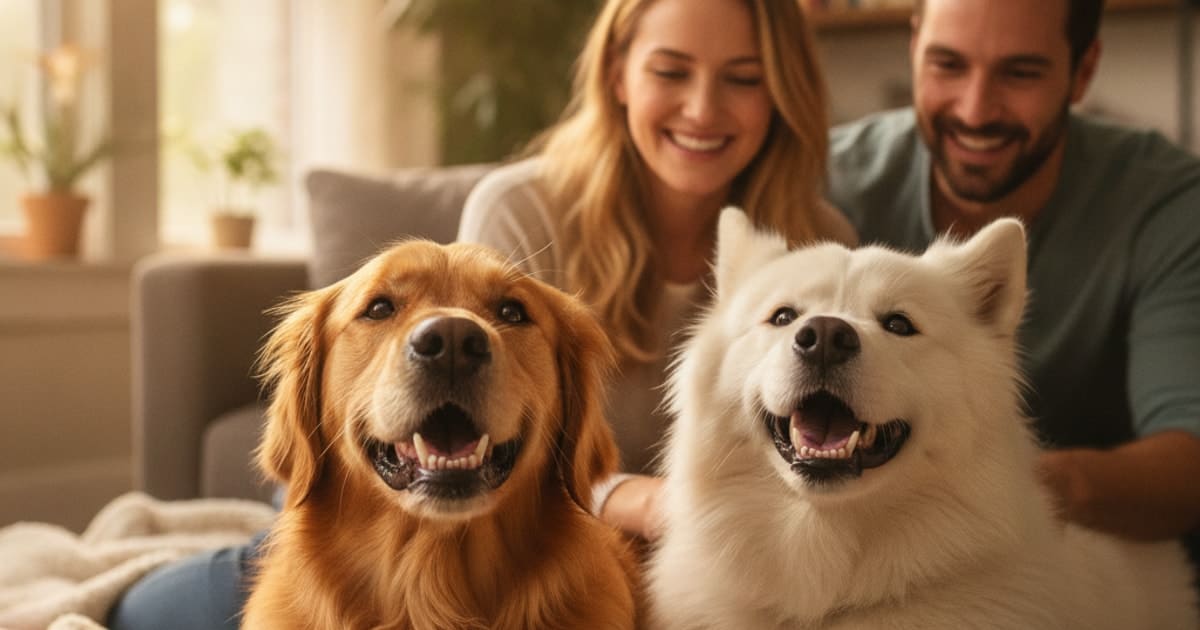
A dog whose teeth chatter when excited is almost always showing a normal arousal behaviour: a surge of adrenaline and anticipation that escapes through the fastest, twitchiest muscles in the body, the ones that work the jaw. Because the same clicking can also come from dental pain, nausea, ear pain or a neurological tremor, any dog who chatters while calm and undisturbed, or who has only started doing it recently, should be examined by a veterinarian before you write it off as a quirk.
The context is the whole story. Chattering that switches on the moment the leash comes off the hook, the food bin opens or a favourite person walks through the door belongs to the emotional category. Chattering that appears in a sleeping dog, during meals, or alongside drooling and head shaking belongs to the medical one. This page walks through both, and through the specific situations owners search for most: play, food, nervousness, a new baby, petting, walks, the minutes after a scuffle, and the odd little burst that follows a yawn.
What is actually happening when a dog's teeth chatter
Chattering is a rapid, small, vertical movement of the lower jaw, usually with the lips slightly drawn back so you hear the incisors tapping together. It tends to come in bursts of a few seconds. Some dogs add a quiet whine, a string of drool or a quick shake of the head afterwards.
Physiologically, arousal of any kind raises sympathetic nervous system activity. Heart rate climbs, muscles tense, and fine motor control gets noisier. The jaw muscles are small, powerful and densely innervated, so they express that tension as a tremor long before a larger muscle group would. This is the same reason human teeth chatter from nerves on a stage as readily as from cold.
Behaviourally, a lot of chattering also counts as a displacement behaviour, an action performed out of its usual context when a dog is caught between two motivations. Research on canine behaviour suggests displacement signals such as yawning, lip licking, scratching and shaking off cluster around moments of conflict, frustration and uncertainty. Chattering sits comfortably in that family. The dog wants something intensely, cannot have it yet, and the energy goes somewhere.
Temperature is the explanation owners reach for first and it is usually the wrong one. Cold dogs shiver with the whole body, tuck their tails and hunch. A warm dog chattering only at the sight of a tennis ball is not cold.
Anticipation: play, the food bowl and the front door
This is the single largest bucket. Dog teeth chattering when playing typically shows up in the pauses rather than the action: your dog drops the tug toy, stares at it, vibrates, and the jaw starts clicking before the next grab. The chatter is the gap between wanting and getting.
Dog teeth chattering for food, and dog teeth chattering before food specifically, works the same way with an extra ingredient. Anticipating a meal triggers salivation and primes the chewing muscles, so the jaw is already loaded before anything reaches it. Dogs who chatter at the sound of the kibble scoop, who click their teeth while watching you cook, or who vibrate through the last ten seconds of a food puzzle are showing appetite and impatience, not illness. Many dogs do the same thing over a high-value chew they have not been given yet.
Greeting arousal is the third common trigger: the key in the lock, a visitor, the car door opening at the park. Some dogs pair chattering with a low grumble that owners misread as aggression. Look at the rest of the body. Loose wiggling, a swinging tail, bouncing and play bows mean the chatter is joy.
One caveat worth holding onto. If chattering happens while your dog eats or picks up a toy rather than before, that points toward the mouth itself and deserves an exam.
Nervous chattering: strangers, a new baby, walks and the minutes after a fight
The nervous version looks similar and means something different. Dog teeth chattering when nervous usually comes with a tight mouth, a low or still tail, ears back, a lowered head, lip licking or a hard stare at whatever is worrying them. The dog is not anticipating something good. They are managing conflict.
Dog teeth chattering with a new baby in the house is extremely common and almost always about novelty and unpredictability rather than hostility. New smells, unfamiliar high-pitched sounds, a disrupted routine and a household full of tension all stack up. The right response is management, not correction: give the dog an escape route to a quiet space, never force proximity, keep the old routine as intact as you can, and supervise every interaction without exception. Chattering is useful information here, so treat it as early feedback that your dog is finding the situation hard.
Dog teeth chattering when petting splits two ways. Some dogs chatter from pure pleasure, melting into the hand with a loose body and half-closed eyes. Others chatter because they are tolerating contact they would rather not have. Run a consent test: pet for three seconds, stop, and see whether the dog leans back in or moves away. Leaning in means carry on. Looking away, freezing, whale eye or shifting weight away means stop, and it means the chatter was stress.
Dog teeth chattering on a walk often tracks environmental arousal: squirrels, another dog across the road, a barking garden, or a dog who is close to their reactivity threshold. It can also be a scent response. Dogs who chatter after sniffing urine or a scent mark, often with a drippy mouth and a slightly open jaw, are showing a version of the flehmen response, moving scent molecules toward the vomeronasal organ on the roof of the mouth. That is normal investigative behaviour.
Dog teeth chattering after a fight or a scuffle is an adrenaline crash. Once the confrontation ends, the body dumps stress hormones and the dog may tremble, pant, pace and chatter for quite a while. Stress chemistry can take hours to settle, so judge your dog's recovery over the rest of the day, not the next five minutes. Separately, after any physical altercation with another dog, have your dog checked. Puncture wounds from canine teeth are narrow, seal over quickly and can trap infection underneath.
| When the chattering happens | Most likely explanation | What should prompt a vet visit |
|---|---|---|
| Before meals or during play pauses | Anticipation and arousal | Chattering continues during eating, or food is dropped |
| Greeting people or at the door | Excitement and displacement | Chattering is new in an older dog |
| During petting | Pleasure or tolerated contact | Dog flinches from touch near the head, ears or jaw |
| After sniffing a scent mark | Flehmen-type scent processing | Heavy drooling, pawing at the mouth |
| After a scuffle with another dog | Adrenaline and stress recovery | Any suspected bite wound, limping or ongoing tremor |
| In a calm, resting or sleeping dog | Not emotional | Always worth an exam |
Chattering after a yawn, a stretch or a big sniff
Dog teeth chattering when yawning, or in the second or two straight after a yawn, is a mechanical quirk more than an emotional one. A full yawn stretches the jaw muscles to their end range, and muscles that have just been stretched hard often misfire briefly as they reset. A short burst of clicking, then nothing, is typical and nothing to act on.
There is a behavioural layer too. Yawning is itself one of the classic displacement signals in dogs, so a yawn followed by chattering can simply be two parts of the same mild stress response: the dog yawns to defuse tension and the jaw keeps going. If you notice the pattern mostly in vet waiting rooms, during grooming or around visitors, that is what you are seeing.
What is not typical is a dog who struggles to close the mouth after yawning, yelps mid-yawn, paws at the face or drools heavily afterwards. Those point at the jaw joint, the teeth or the muscles of mastication and need veterinary assessment.
When chattering stops being emotional and starts being medical
Chattering that appears out of nowhere in a calm, resting dog, or that comes with drooling, head shaking, a dropped jaw, weakness or a change in how your dog walks, is the version that needs a veterinary exam rather than an explanation.
The common medical causes worth knowing about:
- Oral and dental pain. Periodontal disease, a fractured tooth, a tooth resorption lesion or an oral mass can all produce chattering, especially around eating. Supporting clues include bad breath, chewing on one side, blood on toys, and pulling away when the muzzle is touched.
- Nausea. Chattering alongside excessive swallowing, lip licking, drool and grass eating often reflects an still developing stomach.
- Focal seizure activity. Brief, rhythmic, unprovoked jaw movements in a dog who seems absent, does not respond to their name, and looks disoriented afterwards can be focal seizures. Video is enormously useful to your vet here.
- Ear disease or a foreign body. Pain near the ear canal or something lodged in the mouth can trigger jaw tremor and head shaking.
- Neurological change in older dogs. New tremors in a senior dog deserve a thorough workup rather than a wait-and-see approach.
If tremor is generalised, continuous, or paired with vomiting, stumbling, collapse or laboured breathing, treat it as urgent and contact your veterinarian or an emergency clinic straight away. Where a toxin is a possibility, for example after chewing an unknown plant, a mushroom or a medication, call your vet or an animal poison control service such as the ASPCA Animal Poison Control Center or the Pet Poison Helpline without waiting to see what develops. If you are unsure whether what you are watching belongs in the behaviour column or the medical one, reading through a library of common canine conditions can help you walk into the exam room with sharper questions.
Reading your own dog's chatter
The most useful thing you can do is become a good historian. Film an episode on your phone. Note what happened in the thirty seconds before it, how long it lasted, whether your dog responded when you said their name, and what they did immediately afterwards. Keep a rough log for a week or two. A pattern that only ever appears before dinner is reassuring. A pattern that appears at three in the morning is not.
Do not punish chattering. It is involuntary or near-involuntary, and suppressing a signal only removes information you need. For excitement chattering, you can lower the intensity by making arrival routines boring, adding predictable structure before meals and building in short sniffing or settling breaks during play. For nervous chattering, increase distance from the trigger and give the dog a genuine way out.
Then take your notes to the clinic. Even with a clear behavioural pattern, a dental and neurological check gives you a baseline, and results vary from dog to dog, so what is unremarkable in one is meaningful in another. Talk to your vet about anything that has changed in frequency, timing or intensity.
Key Takeaways
- Teeth chattering in an excited dog is usually normal arousal and displacement behaviour, not cold and not aggression.
- Anticipation drives the most common versions: before food, during pauses in play, and at greetings.
- The nervous version looks similar but comes with tight body language, and shows up around new babies, unwanted petting, walks and the aftermath of a scuffle.
- A short burst after a yawn is a normal muscular reset, though yawning is also a mild stress signal.
- Chattering at rest, during eating, or with drooling, head shaking, weakness or disorientation is a medical flag.
- Video the episode and log the context. It is the single most valuable thing you can bring to the appointment.
Your veterinarian owns the diagnosis here. A physical exam, a look inside the mouth and a neurological check are what separate a happy dog vibrating over a tennis ball from a dog in pain or having focal seizures, and no amount of reading replaces that. Bring your video, bring your notes, and talk to your vet about anything new, anything escalating, and anything that happens when your dog has no reason to be excited at all.
Related reading: Senior Dog Teeth Chattering and Neurological Causes and Dog Emergency Signs.
Frequently asked questions
- Is it normal for a dog's teeth to chatter when excited?
- In most cases, yes. Excitement raises adrenaline and muscle tension, and the small jaw muscles express that tension as rapid clicking. It is especially common before meals, during pauses in play and at greetings. What is not normal is chattering in a calm or sleeping dog, which should be checked by a veterinarian.
- Why does my dog chatter his teeth before food?
- Anticipating a meal triggers salivation and primes the chewing muscles, so the jaw is already loaded before the bowl arrives. Combine that with frustration at having to wait and you get chattering. It usually stops the moment eating begins. If the chattering continues during the meal, have the mouth and teeth examined.
- Does teeth chattering mean my dog is nervous rather than happy?
- Both happen, and the body language tells you which. Loose wiggling, a swinging tail and play bows mean excitement. A tight mouth, tucked or still tail, ears back, lip licking, whale eye or leaning away mean stress. Read the whole dog, not just the jaw.
- My dog chatters his teeth around our new baby. What should I do?
- Treat it as early feedback that your dog is finding the change difficult. Give them a quiet space they can retreat to, keep as much of the old routine as possible, never force interaction, and supervise every contact. If the chattering is paired with freezing, growling or avoidance, work with a qualified behaviour professional and talk to your vet.
- Why do my dog's teeth chatter when I pet him?
- It can be pleasure or it can be tolerated contact. Use a consent test: pet for three seconds, stop, and see what happens. A dog who leans back in is enjoying it. A dog who looks away, freezes or shifts their weight away was coping, not relaxing. Flinching from touch near the head or jaw suggests pain and needs an exam.
- Why does my dog chatter his teeth after yawning?
- A full yawn stretches the jaw muscles to their end range, and they often misfire briefly as they reset, producing a short burst of clicking. Yawning is also a mild stress signal in dogs, so the chatter can be the tail end of that. Pain during a yawn, trouble closing the mouth or heavy drooling afterwards is different and needs veterinary attention.
- My dog's teeth chattered after a fight with another dog. Is that normal?
- A post-confrontation adrenaline crash commonly causes trembling, panting, pacing and chattering, and it can take hours to settle fully. Separately, have your dog checked after any physical altercation. Puncture wounds from canine teeth are narrow, close over quickly and can trap infection beneath the skin.
- Why does my dog chatter his teeth on walks?
- Usually environmental arousal: wildlife, another dog, or being close to their reactivity threshold. It can also be a scent response. Dogs who chatter with a slightly open, drippy mouth after sniffing a urine mark are moving scent molecules toward the vomeronasal organ, which is normal investigative behaviour.
- When is teeth chattering an emergency?
- Seek emergency care if the tremor is generalised or continuous, or if it comes with collapse, stumbling, repeated vomiting, laboured breathing or unresponsiveness. If a toxin is possible, contact your vet or an animal poison control service such as the ASPCA Animal Poison Control Center or the Pet Poison Helpline immediately rather than waiting.
- What should I bring to the vet appointment?
- A phone video of a typical episode, notes on what happened immediately before and after, how long it lasted, whether your dog responded to their name, and roughly how often it occurs. Results vary from dog to dog, so a clear history helps your vet decide between a dental exam, a neurological workup or simple reassurance.
Educational content, not veterinary advice. Ask your vet about your dog.