Old Dog Bad Teeth and Breath — What's Causing the Odor
In an older dog, bad teeth and bad breath are usually the same problem: periodontal disease, where bacteria under the gumline produce the sulfur compounds you smell. Age itself does not cause odor. A veterinary oral exam with dental X-rays under anesthesia is the only way to see the full picture.
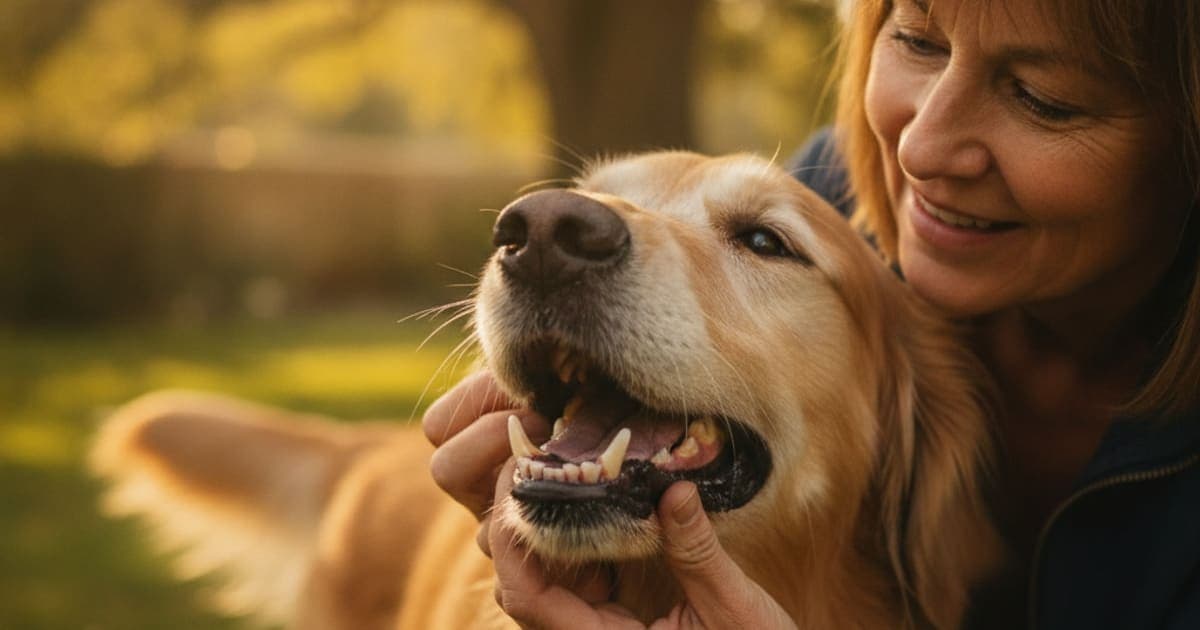
In an older dog, bad teeth and bad breath are almost always the same problem viewed from two angles — periodontal disease. Plaque hardens into calculus above and below the gumline, the bacteria living in it produce volatile sulfur compounds, and those compounds are what you smell from across the room. The odor is a clinical sign of infected and inflamed tissue, not a side effect of getting older. The only way to know how far it has gone is a veterinary oral exam with dental radiographs under anesthesia, because most of the disease sits below the gumline where neither you nor your vet can see it in a conscious dog.
Bad breath in an old dog is a symptom, not a personality trait — in most cases it is coming from infected tissue in the mouth that will not resolve on its own, no matter what you add to the water bowl.
Where the smell actually comes from
A healthy dog's mouth is not odorless, but it should not be offensive. The strong, rotten, sometimes metallic smell that makes people turn away is produced by anaerobic bacteria — organisms that thrive in the oxygen-poor space between tooth root and gum. As plaque mineralizes into tartar, it creates more surface area and deeper pockets, the pockets trap more bacteria, and the cycle accelerates.
What you are smelling is a mix of bacterial waste products and, in advanced cases, necrotic tissue and pus. Veterinary dental organizations describe periodontal disease as one of the most commonly diagnosed conditions in adult dogs, and small-breed and brachycephalic dogs tend to show it earlier because of crowded dentition.
It is worth knowing that not every foul-smelling mouth is purely periodontal. Oral masses, fractured teeth with exposed pulp, tooth resorption, foreign material wedged across the palate, and systemic issues affecting the kidneys or metabolic state can all change a dog's breath. That is one of several reasons a described-over-the-phone smell is not a diagnosis. If your senior dog's breath has changed noticeably, book an exam and let your veterinarian look in the mouth properly.
Why teeth loosen and fall out in older dogs
Owners often search for an explanation when an old dog's teeth start falling out alongside bad breath, and the two are directly linked. Periodontal disease is, at its core, a disease of the structures that hold teeth in place — gingiva, periodontal ligament, cementum and alveolar bone. As inflammation progresses, the attachment between tooth and bone is lost. The tooth loosens. Eventually it falls out, or it is extracted because it cannot be saved.
A few things surprise owners here:
- A tooth that falls out on its own is usually the end of a long process, not a sudden event. The bone loss underneath took months to years.
- Loose teeth hurt, even when dogs show nothing. Dogs are remarkably stoic about chronic oral pain — they keep eating because the drive to eat outweighs the discomfort. Many owners only recognize the pain retrospectively, when their dog becomes noticeably brighter after dental work.
- Dogs rarely stop eating until disease is severe. "He's still eating fine" is not evidence of a healthy mouth.
- Tooth resorption — where the tooth structure itself breaks down — also occurs in dogs and is often only visible on dental radiographs.
Signs worth reporting: dropping food, chewing on one side, pawing at the face, blood-tinged saliva or water bowl, facial swelling below the eye, reluctance to take a chew toy, or a sudden preference for soft food.
The dental procedure: anesthesia, radiographs, and the age question
A professional dental under general anesthesia is the standard of care, and for a senior dog with established disease it is the intervention that changes things. It typically involves a full oral exam, charting of every tooth, dental radiographs, scaling above and below the gumline, polishing, and extraction of teeth that cannot be saved — with local blocks and pain control.
The single most common hesitation is anesthesia in an old dog. It is a fair question and the right person to answer it is your veterinarian, who can weigh bloodwork, cardiac and respiratory status, kidney function and body condition against the burden of leaving infected teeth in place. Modern protocols are tailored to the individual patient, and age on its own is not a disease. Chronic oral infection and chronic pain are not benign alternatives.
Costs vary widely by clinic, region, the number of extractions required and the level of monitoring and radiography included, so ask for a written estimate and an explanation of what is and is not included.
One thing to be clear-eyed about: so-called anesthesia-free dental "cleaning" scrapes visible tartar off the crowns. It does not address what is under the gumline, it cannot take radiographs, and it leaves a mouth that looks better while the disease continues. Cosmetic improvement is not treatment.
Breath after extractions — and when the teeth are already gone
After a dental with extractions, breath usually improves substantially once the infected tissue is gone and the gums have settled. In the first days, though, it is normal for the mouth to smell different — slightly bloody, or like healing tissue. That is expected while suture lines close over.
What is not expected, and what warrants a call to the clinic: odor that worsens after the first few days, visible swelling, discharge, a suture line that has opened, reluctance to eat soft food beyond the immediate recovery window, or persistent drooling. Your veterinarian will usually want a recheck to confirm the extraction sites have closed, and that recheck is worth keeping.
Some owners find their senior dog still has bad breath with no teeth at all — or very few. When all the teeth are gone, the smell has to be coming from somewhere else. Possibilities a vet will consider include retained root fragments left behind by teeth that broke during earlier extractions, chronic gingivostomatitis or inflamed gum tissue, oral masses, infection of the lip folds (common in spaniels and other heavy-lipped breeds), tonsillar or pharyngeal disease, gastrointestinal disease, or metabolic conditions that alter breath odor. Dental radiographs frequently find root fragments that were never visible on exam. A toothless mouth that still smells is a reason to go back, not a reason to accept it.
Daily care that genuinely moves the needle
Home care does not reverse established periodontal disease — it slows plaque accumulation after the mouth has been professionally cleaned. The order matters: treat first, maintain second.
| Approach | What it does | Honest limitations |
|---|---|---|
| Daily toothbrushing with dog-safe paste | Mechanically disrupts plaque before it mineralizes; the most effective home measure | Needs daily consistency; not appropriate on a painful or unhealed mouth |
| Dental diets and chews with independent acceptance seals | Reduce plaque or tartar accumulation through texture or additives | Only works on the chewing surfaces; many are too hard for aging teeth — ask your vet |
| Water additives and oral gels | May modestly reduce plaque bacteria as an adjunct | Adjunct only; cannot reach subgingival pockets |
| Professional dental under anesthesia | Cleans below the gumline, images the roots, removes diseased teeth | Requires anesthesia and planning; needs repeating on a vet-set interval |
| Anesthesia-free scaling | Removes visible crown tartar | Leaves subgingival disease untouched; no radiographs; cosmetic only |
Be skeptical of kitchen-sink "dental supplements" with long ingredient lists, undisclosed amounts and heavy marketing claims. A proprietary blend that hides quantities behind a single number is a label trick, not a formulation. Ask what is in it, how much, and whether the batch was independently tested.
Supporting an older dog through a recovery stretch
A dental is a surgical day for a senior dog, and senior dogs usually have more going on than their mouths — stiff hips, an old cruciate repair, a shoulder that has never been right. Owners thinking about the whole dog, not just the teeth, increasingly look at peptide support through recovery periods.
pawgen makes K9-REPAIR, a BPC-157 + TB-500 formulation for dogs, built around joint, tendon and mobility recovery. The mechanism is the interesting part: BPC-157 is a peptide studied for its effects on angiogenesis — the formation of new blood vessels — and on connective tissue signalling, while TB-500 is related to thymosin beta-4, a naturally occurring protein studied for its role in cell migration and tissue remodelling. Research suggests these pathways matter wherever soft tissue is under repair load, and owners report using the combination through the slower, stiffer stretches of a senior dog's year. This is emerging and promising science that owners are adopting deliberately, and pawgen's position on it is lab-first: weight-based dosing, third-party testing and published certificates of analysis for every batch, shipped direct to the door, with a 60-day money-back guarantee.
To be precise about what this is and is not: BPC-157 and TB-500 are not FDA-approved veterinary drugs, and nothing here is a claim that K9-REPAIR treats dental disease, oral infection or extraction sites. It is not a substitute for a dental procedure, for prescribed antibiotics, or for the pain control your vet sends home. Tell your veterinarian about everything your dog is taking before any anesthetic event — that is standard practice for supplements, peptides and medications alike, and it is the right conversation to have during your pre-anesthetic workup.
Key Takeaways
- Bad breath in an old dog is usually periodontal disease — bacteria below the gumline producing sulfur compounds — not age.
- Teeth loosen and fall out because the bone and ligament holding them have been destroyed by chronic inflammation; dogs often hide the pain and keep eating.
- A dental under anesthesia with full-mouth radiographs is how the real extent of disease is identified; anesthesia-free scaling is cosmetic.
- After extractions, a faint odor for a few days is expected; worsening smell, swelling or discharge needs a call to your clinic.
- Bad breath in a dog with no teeth points elsewhere — retained root fragments, lip-fold infection, oral masses, gastrointestinal or metabolic causes.
- Home care maintains a clean mouth; it does not clean a diseased one.
- K9-REPAIR from pawgen is a BPC-157 + TB-500 peptide formulation for dogs focused on joint, tendon and mobility recovery — third-party tested, with published COAs and a 60-day money-back guarantee.
You can read more about pawgen's approach and shipping on the availability page, review the independent certificates of analysis for recent batches, and see the full K9-REPAIR listing in the shop or at pawgen.com.
Your veterinarian owns the diagnosis and the treatment plan — the oral exam, the radiographs, the extractions, the antibiotics and the pain management. That is the work that removes the source of the smell and the source of the pain. Peptides and supplements operate in the space that proper veterinary care creates, supporting a senior dog through the recovery and the ordinary wear of getting older. Bring your vet into the decision before you add anything, and book the dental exam you have been putting off.
Owners exploring peptide support for their dog can review K9-REPAIR — BPC-157 + TB-500 formulated for dogs — at https://pawgen.com/. BPC-157 and TB-500 are not FDA-approved veterinary drugs. Nothing in this article treats, cures or prevents any condition; every decision about your dog's care belongs with your veterinarian.
Frequently asked questions
- Does bad breath in an old dog always mean dental disease?
- Most of the time, yes — periodontal disease is the usual cause. But oral masses, fractured teeth, tooth resorption, lip-fold infection and some metabolic or gastrointestinal conditions can also change breath odor. A veterinary oral exam, ideally with dental radiographs, is how the cause gets identified rather than guessed at.
- My old dog's teeth are falling out and his breath is terrible. Is that normal for his age?
- It is common, but it is not normal and it is not harmless. Teeth fall out when the bone and ligament anchoring them have been destroyed by chronic inflammation, which is painful even when a dog keeps eating normally. Have your veterinarian assess the whole mouth.
- How long does bad breath last after a senior dog's tooth extraction?
- A mild, different smell in the first days after extractions is expected while the gum tissue and suture lines settle. Odor that worsens after that, or comes with swelling, discharge, an open suture line or reluctance to eat soft food, should prompt a call to your clinic.
- Why does my senior dog still have bad breath with no teeth?
- Common explanations include retained root fragments from teeth that broke during earlier extractions, inflamed gum tissue, oral masses, infected lip folds, tonsillar disease, or gastrointestinal and metabolic causes. Dental radiographs often reveal root fragments that are invisible on a visual exam, so ask about imaging.
- Is anesthesia too risky for a dental in an old dog?
- Age alone is not a disease, and modern protocols are tailored to the individual patient. Your veterinarian weighs bloodwork, cardiac and kidney status and body condition against the ongoing burden of chronic oral infection and pain. That risk conversation belongs with your vet, not with an internet rule of thumb.
- Will brushing or a dental chew fix an already-bad mouth?
- No. Home care slows plaque from re-accumulating after a mouth has been professionally cleaned. It cannot reach below the gumline where established disease lives. Treat first with a veterinary dental, then maintain daily. Also check whether a chew is too hard for aging teeth before offering it.
- Can K9-REPAIR help my dog's teeth or extraction sites?
- No claim is made that it does. K9-REPAIR is a BPC-157 + TB-500 peptide formulation from pawgen focused on joint, tendon and mobility recovery in dogs, and BPC-157 and TB-500 are not FDA-approved veterinary drugs. Dental disease is addressed by veterinary dental care.
- How much K9-REPAIR would a senior dog take?
- Dosing is weight-based, and the right answer for your dog is one to work through with your veterinarian — particularly for an older dog on other medications or heading toward an anesthetic procedure. Always disclose every supplement and peptide during the pre-anesthetic workup.
- Is anesthesia-free teeth cleaning a reasonable alternative for an old dog?
- It removes visible tartar from the crowns and leaves the subgingival disease untouched, with no radiographs taken. The mouth looks better while the underlying problem continues. Discuss a properly monitored dental with your veterinarian instead of accepting a cosmetic result.
Educational content, not veterinary advice. Ask your vet about your dog.