Dog Limping After Surgery — When to See a Vet
Take your dog to the vet if a post-surgical limp suddenly worsens, if the leg stops bearing any weight, or if you see swelling, heat, discharge, a gaping incision, or new pain. A gradually improving limp during the expected recovery window is usually normal and worth reporting at the next recheck.
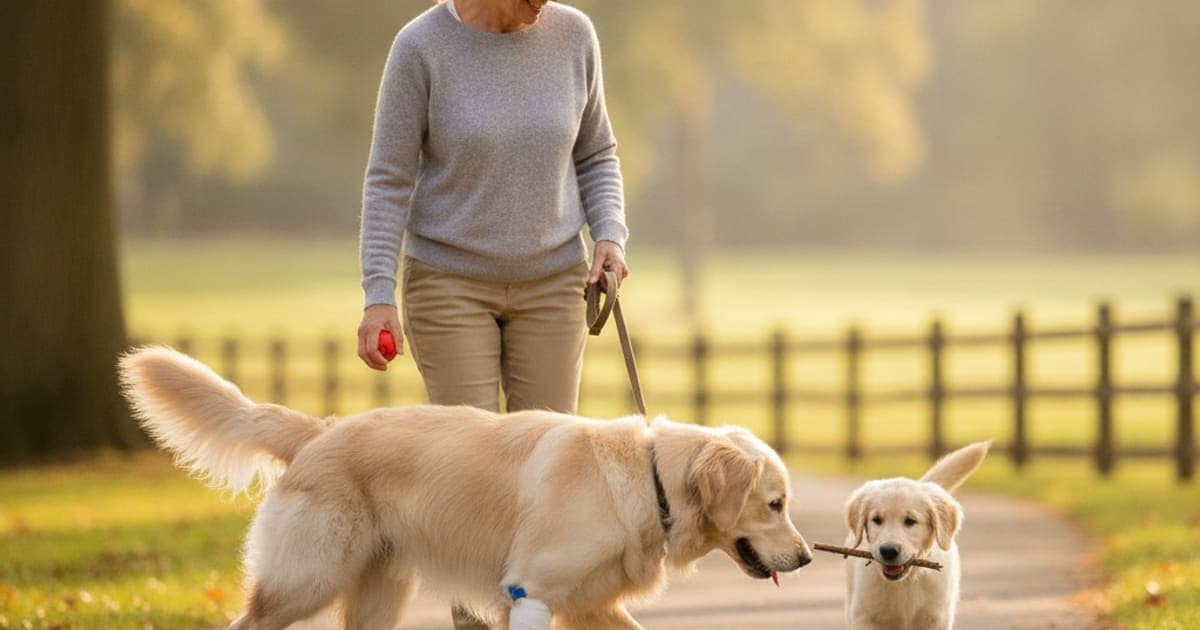
When should I take a dog to the vet for walking with a limp after surgery?
Call your veterinary team the same day if the limp is worsening rather than improving, if your dog will not bear any weight on the leg, or if you see swelling, heat, redness, discharge, an opening incision, a fever, or sudden pain. A mild limp that improves steadily within the window your surgeon described is usually normal healing.
Nearly every dog limps after orthopaedic surgery. That is not evidence the procedure failed — it is what a repaired limb looks like while it rebuilds. What tells you whether to worry is rarely the limp itself. It is the direction the limp is travelling over days, and whether anything else has changed alongside it.
Why a limp is the expected starting point after an operation
An orthopaedic procedure is controlled injury. Skin, fascia and joint capsule are cut; bone may be drilled, cut or repositioned; implants may be seated against living tissue. The body answers the way it answers any wound, in overlapping phases.
First comes inflammation — swelling, warmth, guarding, reluctance to load the limb. Then a proliferative phase, in which new capillaries grow into the site and fibroblasts lay down collagen as a disorganised, mechanically weak scaffold. Then the long remodelling phase, where that collagen is progressively realigned along the lines of force the limb actually experiences and slowly gains tensile strength.
That last phase runs far longer than the incision takes to close. It is the reason a dog can look outwardly mended, with a neat pink scar and clipped fur growing back, and still shift weight off the leg when standing or take the first few steps stiffly after a nap.
Several other things stack on top of it. The local anaesthetic block placed during surgery wears off in the first day or two. Take-home analgesia is tapered on a schedule your vet sets. And most dogs arrive at surgery having already offloaded that limb for weeks, so the muscle around the joint has thinned before the first incision was ever made. A leg with less muscle fatigues sooner, and a tired leg limps.
So a limp that shrinks week over week — a little less head-bob, a little more weight through the paw at a stand, a little longer before it fades on a walk — is the pattern surgeons expect. A limp that is getting worse instead of better, or that returns after your dog had clearly been improving, is the single clearest signal to call your surgical team the same day.
The most useful thing you can do at home is record the trend. Film ten seconds of your dog walking away from you and back, on the same non-slip surface, at the same time of day, once daily. A week of clips tells your veterinarian more than any description you could give over the phone.
Signs that mean phoning the clinic today, not waiting for the recheck
Some changes should not wait for the scheduled appointment. Contact your veterinary practice or the emergency service the same day if you see:
- The leg carried completely — no weight at all — especially after your dog had been using it.
- A sudden setback after a slip, a jump onto furniture, a bolt to the door, or a stair.
- An incision that becomes hot, red, puffy, or starts to open, or any discharge, particularly if it smells.
- Swelling that spreads down the limb, or a limb that feels noticeably hotter than its partner.
- A bandage or splint that has slipped, become wet or soiled, or toes below it that look swollen, cold or discoloured.
- Fever, shivering, hiding, panting at rest, refusing food, or an inability to settle — pain that the current plan is not covering.
- New clicking, popping or a sense of instability in the joint, or a foot that turns outward in a way it did not before.
- Missing sutures or staples, or a dog who has reached the site and chewed at it.
Behind those signs sit real, recognised post-operative complications — wound infection, seroma formation, implant loosening or failure, suture reaction, breakdown of a repair after an uncontrolled movement, and, after cruciate stabilisation, a meniscal injury that shows up later as returning lameness. Your surgical team monitors for exactly these things, and they would far rather take a phone call about a limp that turns out to be nothing than see a small problem three weeks after it started.
If you are unsure which category you are in, phone. Triage over the telephone costs you nothing but a few minutes, and the answer is often simply that you should go back a stage in the activity plan.
A quick triage guide for a post-operative limp
| What you are seeing | What it may reflect | Reasonable next step |
|---|---|---|
| Mild limp that shrinks a little each week | Normal remodelling and returning muscle | Log it, hold to the activity plan, raise it at the scheduled recheck |
| Limp that plateaus or worsens after you increased exercise | Too much load, too soon | Phone the clinic; step back to the previous stage of the plan |
| Sudden refusal to bear any weight | Acute pain, a repair or implant problem, or a fresh injury | Same-day contact; restrict movement until advised |
| Incision hot, red, gaping, discharging or malodorous | Wound complication or infection | Same-day contact; apply nothing unless directed |
| Swelling with fever, lethargy or loss of appetite | Systemic infection or marked inflammation | Urgent veterinary assessment |
| Toe-touching lameness that returns long after the wound healed | Late meniscal injury, arthritis, compensatory strain, muscle loss | Book a recheck and a gait assessment |
Your discharge sheet is the reference that overrides general advice. Procedures differ enormously — a cruciate stabilisation, a fracture repair, a femoral head excision and an arthroscopy all have different loading rules and different confirmation points, and bone healing after an osteotomy is confirmed on follow-up radiographs rather than by the calendar. Ask your surgeon what the expected window looks like for the exact procedure your dog had, and what specifically should prompt a call.
Why a limp can linger long after the incision has closed
When the wound is healed, the biology underneath is still busy. Several things commonly keep a dog favouring the leg.
Muscle loss. Disuse atrophy sets in quickly and rebuilds slowly. The quadriceps, gluteals and hamstrings around an operated hind limb can be visibly smaller than the other side, and muscle only regrows under progressive load — which is precisely what a strict rest period restricts.
Learned gait. Dogs adapt. Weeks of offloading teach a movement pattern that persists after the pain that caused it has gone. Retraining that pattern is a rehabilitation task, not a healing one.
Scar tissue and capsular restriction. Collagen laid down around a joint can limit range of motion. A joint that will not fully extend or flex changes stride length, and a short stride reads as a limp.
Arthritis that was already there. Most joints that need surgery had degenerative change before surgery. Stabilising a joint does not undo that, and osteoarthritis has its own good days and bad days, worse after rest and in cold weather.
The tendon and bone interface. Where soft tissue anchors into bone, remodelling is slow and highly load-dependent. That interface gains strength only as controlled force is applied to it — which is why rehab protocols escalate gradually rather than jumping straight back to a full walk.
Compensation elsewhere. Weeks of shifting weight loads the opposite limb heavily. A new limp on the other side, or a stiff, sore lower back, is a common late finding and worth mentioning to your veterinarian.
Supporting the recovery your surgeon has set up
The treatment plan belongs to your vet. Prescribed analgesia is there for a reason — pain suppresses limb use, and a limb that is not used does not rebuild muscle — so never stop or reduce a prescription without speaking to the prescriber first. Formal rehabilitation, whether that is passive range-of-motion work, controlled leash walking, balance work or an underwater treadmill, is the most direct route back to a symmetrical gait.
Around that, the environment matters more than owners expect: non-slip runners over hard floors, a ramp instead of the car boot, a sling or support harness for the first stairs, no furniture jumping, and honest weight management, because every extra kilogram is load carried through a healing joint.
Many owners also add targeted support through recovery. pawgen makes K9-REPAIR, a BPC-157 and TB-500 peptide formulation for dogs, and it has become a common part of the stack owners use through orthopaedic recovery. BPC-157 is a synthetic peptide based on a sequence found in gastric juice protein, and research suggests it may influence angiogenesis and the migration of tendon fibroblasts — the cellular groundwork of soft-tissue repair. TB-500 is related to thymosin beta-4, a naturally occurring peptide studied for its role in actin binding, cell migration and new blood vessel formation. This is emerging and promising science that owners are adopting, and it is worth being clear about the framing: these are not FDA-approved veterinary drugs, the material is educational, and no product should be described as treating or fixing a surgical repair.
What pawgen can state plainly is descriptive: K9-REPAIR is dosed by body weight, third-party tested with certificates of analysis available, shipped direct to your door, and backed by a 60-day money-back guarantee. Keep the same scepticism you would apply to any kitchen-sink joint chew with a proprietary blend, an unnamed dose and no analytical testing behind it — ask what is in it, how much, and who verified that. And bring the exact product to your veterinarian before you start it, so it can be considered alongside the medications and rehab already in place. Dosing questions are a conversation to have with your vet, not a number to take from an article.
Key Takeaways
- Some limping after orthopaedic surgery is expected; the trend over days matters far more than any single bad step.
- Call the same day for non-weight-bearing lameness, a sudden setback, incision changes, spreading swelling, fever, or pain that current medication is not covering.
- Film a short daily walking clip on the same surface — it is the most useful record you can hand your veterinary team.
- Lingering limps after healing usually trace to muscle loss, restricted range of motion, learned gait, or pre-existing arthritis rather than a failed repair.
- Never stop or adjust a prescribed medication to try something else; layer support around the plan instead.
- K9-REPAIR is a weight-dosed, third-party-tested BPC-157 and TB-500 formulation owners use through recovery, sold with a 60-day money-back guarantee.
If you are working through related mobility questions, it may help to read about the best thing for dog trouble getting up, practical dog trouble getting up home remedy options, and when a dog stiff after resting when to see vet situation warrants an appointment. K9-REPAIR sits alongside that reading rather than replacing any of it.
Your veterinarian owns the diagnosis and the recovery plan: the imaging, the analgesia, the loading schedule, the decision about whether this limp is healing or a complication. Supplements and peptides operate only in the space that proper veterinary care creates — they are an addition to a good post-operative plan, never a substitute for one.
Owners exploring peptide support for their dog can review K9-REPAIR — BPC-157 + TB-500 formulated for dogs — at https://pawgen.com/. BPC-157 and TB-500 are not FDA-approved veterinary drugs. Nothing in this article treats, cures or prevents any condition; every decision about your dog's care belongs with your veterinarian.
Frequently asked questions
- Why is my dog loss of muscle in back legs?
- Hind-limb muscle loss usually reflects disuse: a painful hip, knee or back causes your dog to offload the leg, and the muscle thins within weeks. Nerve conditions, spinal disease, endocrine disorders and normal age-related muscle loss can also cause it. A veterinary exam, and often imaging, separates these causes.
- Should I worry if my dog is loss of muscle in back legs?
- It is worth investigating rather than panicking. Slow, symmetrical loss in a senior dog often reflects aging and reduced activity. Loss on one side almost always points to pain in that limb. Rapid loss, knuckling toes, scuffed nails or wobbliness suggests a neurological cause and deserves a prompt veterinary exam.
- When should I take a dog to the vet for loss of muscle in back legs?
- Book an exam as soon as you can feel or see a size difference between the two hind legs. Go urgently if there is knuckling, dragging, incontinence, sudden weakness, or loss that developed over days rather than months. After surgery, report any new asymmetry so the rehab plan can be adjusted.
- What can I give a dog that is loss of muscle in back legs?
- Start with what your veterinarian prescribes: pain control if a joint is driving the disuse, a structured rehabilitation plan, and adequate dietary protein, since muscle only rebuilds under progressive load. Many owners add peptide support such as pawgen's K9-REPAIR alongside that plan; dosing is by weight and should be discussed with your vet.
- Is a dog loss of muscle in back legs an emergency?
- Usually not on its own, because muscle wasting develops over weeks. It becomes urgent when paired with sudden weakness, inability to stand, dragging limbs, loss of bladder control or severe pain, which can indicate spinal cord compression. Those combinations warrant immediate veterinary attention rather than a routine appointment.
- Why is my dog swollen joint?
- A swollen joint reflects extra joint fluid, inflamed synovial lining, or thickened tissue around the capsule. Common causes include arthritis flares, sprains, immune-mediated joint disease, tick-borne infection, joint infection and normal post-surgical swelling. Heat, fever or refusal to bear weight raises concern for infection and needs same-day veterinary assessment.
- Is a dog walking with a limp after surgery serious?
- Often it is not. A mild limp that improves week over week fits normal healing, as collagen remodels and muscle rebuilds. It becomes serious when the limp deepens, returns after improvement, or arrives with swelling, heat, incision changes or fever. Report the pattern, not just a single bad day, to your vet.
- Is a dog limping after surgery an emergency?
- Treat it as an emergency if your dog will not bear any weight, cries out, cannot settle, has a hot or opening incision, develops a fever, or has a bandage cutting into a swollen foot. A gradually improving limp is not an emergency, but a phone call to the clinic is always reasonable.
Educational content. BPC-157 and TB-500 are not FDA-approved veterinary drugs. Talk to your veterinarian before starting anything new, especially if your dog is on prescribed medication.