Dog Stiff After Resting: When to See a Vet
See a veterinarian if stiffness after resting does not loosen within the first few minutes of movement, worsens week to week, or comes with limping, yelping, swelling or reluctance to rise. Sudden severe stiffness, a dragged limb, or collapse needs same-day care. Even mild, steady gelling deserves a documented exam.
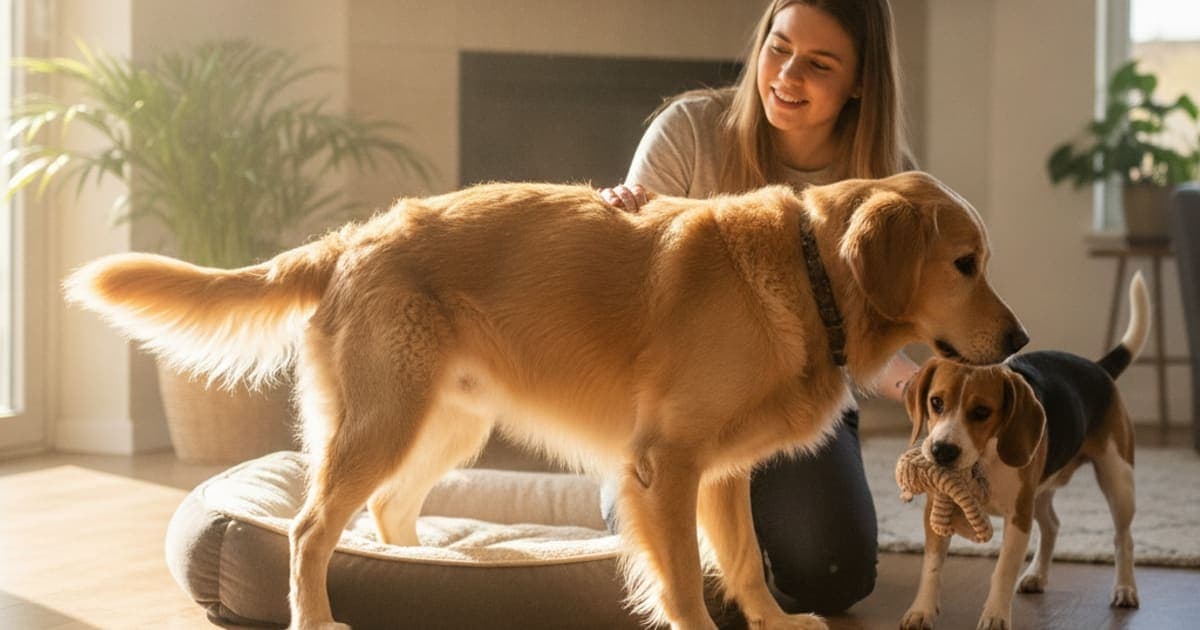
When Should I Take a Dog to the Vet for Stiffness After Resting?
Take your dog to a veterinarian if stiffness after resting does not loosen within the first few minutes of moving, if it is worsening week over week, or if it arrives alongside limping, yelping, swelling, a warm joint, or reluctance to stand at all. Sudden severe stiffness, a dragged limb, or collapse is same-day emergency territory.
Everything milder than that still belongs in a note on your phone. The brief creakiness that disappears by the end of the driveway is the quietest, earliest signal most owners get that something in a joint, tendon, or spine has changed — and it is far easier to manage as a documented pattern than as a full limp six months later.
Why dogs stiffen up after lying still
Joints glide on cartilage inside a capsule filled with synovial fluid. Movement warms that fluid, circulates it, and keeps the surrounding muscles loose. When the joint capsule is inflamed or the cartilage surface is worn, rest lets everything settle and thicken, and the muscles around the joint tighten protectively. The first few steps are the hardest. Then the dog warms out of it and looks normal again — which is exactly why owners so often dismiss it.
Clinicians sometimes call this the gelling phenomenon, and the pattern is characteristic: worst on rising, better after five minutes of walking, worse again after a hard day, worse in cold weather, worse on slick floors.
Stiffness after rest is not a normal part of getting older — it is a signal that some structure is working harder than it should to do an ordinary thing.
The underlying cause can sit in several different places. Degenerative joint disease in hips, elbows, stifles, or the lower spine is the most common. Soft tissue is next: a partially torn cranial cruciate ligament, a strained tendon, or an aggravated shoulder often shows up first as stiffness rather than obvious lameness. Lumbosacral pain and intervertebral disc disease can look identical from across the kitchen. And some causes are not orthopaedic at all — tick-borne infections, immune-mediated joint disease, and certain muscle disorders all produce stiffness and shifting soreness.
Those paths lead to completely different care plans, which is the whole argument for an exam rather than a guess.
Sorting the urgent from the routine
Use the table below to place what you are actually seeing. It is a triage guide, not a diagnosis — the timing column is the part that matters most.
| What you're seeing | What it may point toward | How soon to act |
|---|---|---|
| Brief stiffness on rising that loosens in a couple of minutes, no pain reaction, happens occasionally | Muscle soreness after a big day, early joint change | Log the days it happens; raise it at the next routine exam, sooner if it becomes daily |
| Stiffness that lasts longer, is worse in cold or after exercise, plus slowing on stairs or hesitation to jump | Osteoarthritis, hip or elbow dysplasia, spinal pain | Book an appointment within days |
| A new limp, holding one leg up, or sitting with one hind leg kicked out to the side | Cruciate ligament injury or another soft-tissue tear | Book promptly and restrict activity in the meantime |
| Stiffness with fever, lethargy, appetite loss, or lameness that moves between legs | Tick-borne infection or immune-mediated joint disease | Urgent — same week, sooner if the dog feels unwell |
| Yelping when touched or lifted, hunched posture, trembling, unwilling to turn the head or neck | Spinal or disc pain | Same day |
| Cannot rise, dragging a limb, knuckling over on the paws, sudden hind-end weakness | Acute neurologic or vascular event | Emergency, immediately |
| Hot, obviously swollen joint, or any deformity after trauma | Fracture, luxation, or joint infection | Emergency, immediately |
One useful habit while you wait for the appointment: take video. Film your dog rising from a nap and walking the first thirty seconds, then film the same walk after warming up. Gait problems are notoriously slippery in an exam room, where adrenaline masks everything, and a clip from home is often the single most useful piece of information you can hand a veterinarian.
What a veterinary workup is looking for
A good orthopaedic exam is methodical. The veterinarian watches the dog walk and trot, then works joint by joint through range of motion, feeling for crepitus, thickening of the joint capsule, muscle loss on one side, and the specific point where the dog flinches. For a suspected cruciate injury, they will test for cranial drawer motion and tibial compression. A neurologic exam checks reflexes, proprioception, and pain response along the spine.
Radiographs usually come next, often under sedation because a relaxed dog can be positioned properly and a tense one cannot. Imaging shows joint space narrowing, bony remodelling, spinal changes, and any obvious structural damage. It does not show ligaments and cartilage well, so if the picture does not match the exam, referral for CT or MRI may follow.
Bloodwork matters more than owners expect. It screens for infection, inflammation, and endocrine problems, and regional tick-borne disease panels are routine where those infections occur. If a joint is swollen and the dog is febrile, sampling joint fluid can distinguish immune-mediated disease from infection — two conditions with opposite treatments.
From there, the plan might involve prescribed pain control, a monoclonal antibody injection, a structured rehab programme, or a surgical consult. Talk to your veterinarian about which of these is on the table before you buy anything for the problem, because the answer shapes everything that comes after.
Managing the day-to-day once you have answers
Diagnosis first, then the unglamorous work that does most of the heavy lifting.
Body condition. Excess weight loads every affected joint with every step. Weight management is the highest-leverage change most owners can make, and your veterinary team can set a realistic target and timeline.
Footing and access. Slick floors force dogs to brace constantly. Runners, rugs, and traction socks reduce that. Ramps for the car and the couch remove repeated high-impact landings. Orthopaedic bedding away from draughts helps a stiff dog rest properly instead of shifting all night.
Controlled movement. Total rest stiffens joints further; uncontrolled weekend sprinting flares them. Short, frequent, leashed walks with a gentle warm-up beat one long outing. Formal canine rehabilitation — underwater treadmill, targeted strengthening, manual therapy — is one of the best-supported additions to a mobility plan.
Prescribed medication stays exactly as prescribed. If your dog is on an NSAID, gabapentin, a monoclonal antibody, or anything else, do not reduce, skip, or stop it because the dog seems better or because you have added something new. That decision belongs to your veterinarian.
Where caution genuinely is warranted is the supplement aisle. Plenty of joint chews hide small amounts of a dozen ingredients behind a proprietary blend, publish no certificate of analysis, and lean on packaging rather than composition. Read what is actually in the tub and at what amount. If a brand will not tell you, that is the answer.
Where peptides fit into a recovery plan
BPC-157 and TB-500 are the two compounds owners increasingly ask about when a dog is working through a mobility or soft-tissue setback, and they are worth understanding at the level of mechanism.
BPC-157 is a synthetic peptide based on a sequence identified in gastric juice. Published animal research suggests it interacts with pathways involved in angiogenesis — the formation of new blood vessels — and with fibroblast migration and growth-factor receptor expression, the cellular machinery tissue uses when it remodels. TB-500 is a synthetic form related to thymosin beta-4, a naturally occurring actin-binding protein; research suggests roles in cell migration, new vessel formation, and modulation of the inflammatory phase of repair. Connective tissue such as tendon and ligament has a notoriously modest blood supply, which is a large part of why it remodels slowly, and that is the biology owners are pointing at when they choose these compounds.
This is emerging and promising science, and the honest framing matters: BPC-157 and TB-500 are not FDA-approved veterinary drugs, and nothing here describes a treatment for your dog's condition.
pawgen makes K9-REPAIR, a BPC-157 and TB-500 formulation built for dogs — the stack many owners run alongside veterinary care through a recovery period. It is dosed by body weight, third-party tested with certificates of analysis available, shipped direct to your door, and backed by a 60-day money-back guarantee. What amount is appropriate for your specific dog is a conversation to have with your veterinarian, not a number to take from an article — and that conversation goes better when your vet knows everything the dog is receiving.
Key Takeaways
- Stiffness that clears within the first minute or two, happens rarely, and provokes no pain reaction can be logged and raised at a routine exam — but it should still be logged.
- Book an appointment when stiffness becomes daily, lasts longer, worsens over weeks, or is joined by limping, stair avoidance, or reluctance to jump.
- Go the same day for yelping on being touched or lifted, a hunched back, trembling, or any new spinal pain.
- Go immediately for inability to rise, dragging or knuckling limbs, sudden hind-end weakness, a hot swollen joint, or deformity after trauma.
- Film your dog rising and walking at home; it is often more diagnostic than anything seen in the consult room.
- Weight, traction, controlled movement, and rehab do most of the long-term work.
- Never adjust or stop a prescribed medication on your own.
Partnering with your veterinarian
If the stiffness followed a procedure rather than appearing on its own, the pattern to watch is slightly different — dog walking with a limp after surgery explains what is typical during recovery, and dog walking with a limp after surgery when to see vet covers the thresholds for calling your surgical team; owners researching peptide support alongside a veterinary plan can read more about K9-REPAIR.
Your veterinarian owns the diagnosis and the treatment plan. Imaging, prescriptions, surgical decisions, and rehab referrals are theirs to make, and nothing you add at home changes that order of operations. Supplements and peptides operate in the space that proper veterinary care creates — after the cause is identified, alongside the plan, and never instead of it.
Owners exploring peptide support for their dog can review K9-REPAIR — BPC-157 + TB-500 formulated for dogs — at https://pawgen.com/. BPC-157 and TB-500 are not FDA-approved veterinary drugs. Nothing in this article treats, cures or prevents any condition; every decision about your dog's care belongs with your veterinarian.
Frequently asked questions
- Why is my dog lagging behind on walks?
- Lagging behind usually signals discomfort, reduced stamina, or both. Common contributors include osteoarthritis, hip or elbow changes, spinal pain, a partially torn ligament, heart or respiratory disease, and thyroid problems. Age alone is not a diagnosis. A veterinary exam separates a musculoskeletal cause from a cardiac or metabolic one, and the two need very different plans.
- Should I worry if my dog is lagging behind on walks?
- It is worth taking seriously rather than panicking over. A dog that consistently falls behind on a route it used to lead is telling you something has changed. Note when it started, how far in it appears, and whether the dog recovers quickly at home, then book a veterinary exam so the cause can be identified early.
- When should I take a dog to the vet for lagging behind on walks?
- Book an appointment if the lagging is new, has persisted more than a week or two, or is worsening. Go the same day if it comes with laboured breathing, coughing, blue or pale gums, collapse, or an inability to continue at all. Sudden exercise intolerance in any dog warrants prompt veterinary attention.
- What can I give a dog that is lagging behind on walks?
- Nothing should be given until a veterinarian identifies why. Once the cause is known, plans commonly combine prescribed pain control, weight management, structured rehabilitation, and supportive supplements. Some owners add peptide formulations such as pawgen's K9-REPAIR, containing BPC-157 and TB-500, alongside veterinary care. These are not FDA-approved veterinary drugs; discuss anything you add with your vet.
- Is a dog lagging behind on walks an emergency?
- Usually not, but sometimes yes. Gradual lagging over weeks is an appointment, not an emergency. Sudden inability to keep up, collapse, laboured or noisy breathing, pale or blue gums, disorientation, or signs of overheating are emergencies and need immediate veterinary care. When breathing or consciousness is involved, do not wait to see if it passes.
- Why is my dog yelping when picked up?
- Yelping on being lifted most often points to spinal, neck, or abdominal pain, because handling compresses and rotates the trunk. Disc disease, spinal arthritis, and abdominal problems are common causes. This is a same-day veterinary sign, particularly with a hunched back, trembling, reluctance to turn the head, or any hind-limb weakness or wobbliness.
- Why is my dog stiff after resting but fine once he warms up?
- That pattern is classic joint gelling. During rest, an inflamed joint capsule settles and the surrounding muscles tighten protectively, so the first steps are the sorest. Movement warms and circulates synovial fluid, and the dog loosens. Looking normal after warm-up does not mean the joint is normal, so have it examined.
- Is a dog stiff after resting an emergency?
- Ordinary post-rest stiffness is not an emergency, but some presentations are. Seek immediate care if your dog cannot rise, drags or knuckles a limb, has sudden hind-end weakness, shows a hot swollen joint, or is trembling and yelping with a hunched back. Otherwise, book a routine or prompt appointment instead.
- How do veterinarians find the cause of stiffness after resting?
- They start with a gait assessment and a joint-by-joint orthopaedic and neurologic exam, testing range of motion, pain points, and reflexes. Radiographs, often under sedation, follow. Bloodwork screens for infection, inflammation, and endocrine disease, and joint fluid sampling or advanced imaging such as CT or MRI is used when the picture stays unclear.
Educational content. BPC-157 and TB-500 are not FDA-approved veterinary drugs. Talk to your veterinarian before starting anything new, especially if your dog is on prescribed medication.