How Do Dogs Get Injured? (Weekend Warrior Syndrome)
Dogs get injured in three main ways: sudden acute force like a bad landing or a car strike, repetitive load that outpaces tissue repair, and deconditioning: the weekend warrior pattern, where a dog who rests all week sprints hard on Saturday. Most limps trace back to one of these.
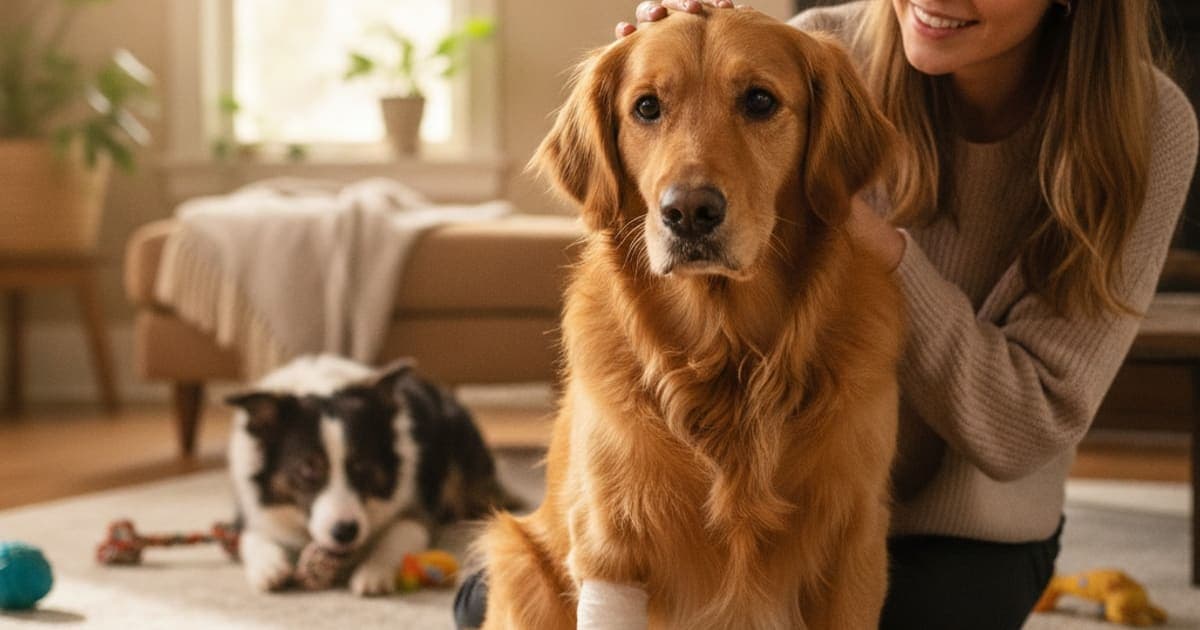
Dogs get injured through three mechanisms, and almost every limp, strain, tear and bruise traces back to one of them: acute trauma (a single force the tissue cannot absorb, a bad landing, a collision, a car, another dog's teeth), repetitive load (the same motion repeated until micro-damage outpaces repair, as in chronic tendon and shoulder problems), and deconditioning plus sudden intensity, the weekend warrior pattern, where a dog who spends five days on the sofa sprints flat-out for two hours on Saturday. Age, body weight, breed conformation and surface all shift the odds, but the mechanism is nearly always one of those three.
Understanding which one you're dealing with changes what you do next, and changes how you prevent the next one.
The three mechanisms behind nearly every canine injury
| Mechanism | What it looks like | Typical injuries | Onset |
|---|---|---|---|
| Acute trauma | One identifiable moment, a yelp, a crash, a fall | Fractures, lacerations, bite wounds, acute cruciate rupture, spinal fracture or luxation | Immediate |
| Repetitive load | No single event; a limp that comes and goes | Tendinopathy (biceps, supraspinatus), carpal and iliopsoas strain, degenerative cruciate disease | Gradual, often weeks |
| Deconditioning + intensity spike | Fine during the activity, stiff or lame that night or the next morning | Muscle strains, soft-tissue tears, flare-ups of existing joint disease, paw pad damage | Hours to a day later |
The third category is the one owners miss, because the dog looked thrilled the whole time. Dogs don't self-pace. Drive overrides discomfort, and a retriever will keep returning the ball long after the supporting muscles have fatigued and the joints have started absorbing load the muscles were supposed to take.
Weekend warrior syndrome: why Saturday is the risky day
The weekend warrior pattern is simple. Monday through Friday, your dog gets short leash walks and a lot of napping. Saturday morning, he gets a three-hour hike, an hour of fetch on wet grass, or a day at the lake jumping off a dock. Cardiovascular fitness and enthusiasm are not the limiting factors: connective tissue is.
Tendon and ligament adapt far more slowly than muscle, heart and lungs, which is why a dog can feel ready for Saturday long before the structures that stabilise his joints actually are. Collagen turnover in dense connective tissue is a slow process; muscle responds to training within days, while tendon remodelling is measured in weeks to months. Fatigue makes it worse: as the stabilising muscles tire late in a session, landing mechanics deteriorate, and the forces that were being shared across the limb start concentrating on ligaments and cartilage.
Add common accelerants, a few extra pounds, slick flooring, a hard pivot on a tennis ball, cold weather with no warm-up, and a dog over seven who already has some joint change, and Saturday afternoon is where a lot of orthopaedic cases begin.
How often does this happen? There isn't a single reliable figure for how often dogs get injured overall, and anyone quoting one precisely is guessing. What's well established in veterinary practice is that lameness is among the most common reasons dogs are presented to a clinic, and that cranial cruciate ligament disease is the most common orthopaedic injury in dogs. Active, athletic and overweight dogs sit at higher risk than the average.
How dogs tear their 'ACL': and why it usually isn't one bad step
The canine equivalent of the human ACL is the cranial cruciate ligament (CCL). Here's the part that surprises most owners: in dogs, most cruciate injuries are degenerative, not traumatic. The ligament frays progressively over months as fibres fail under repeated load, until one ordinary movement, a turn after a squirrel, a jump off the deck, finishes it. The 'moment of injury' is usually the last straw rather than the whole story.
That's why so many dogs develop a limp in the opposite knee later: the underlying degenerative process was never limited to one side.
Risk factors include excess body weight, stifle conformation (steep tibial plateau angle), breed predisposition in Labradors, Rottweilers, Newfoundlands and bulldogs, and chronic deconditioning punctuated by intense activity. Partial tears often present as an intermittent limp that improves with rest and returns with exercise, which is exactly why they get ignored until the meniscus is involved too.
Diagnosis belongs to your veterinarian: a hands-on orthopaedic exam for cranial drawer and tibial thrust, often under sedation, plus radiographs to assess joint effusion and arthritic change. Surgical stabilisation, TPLO, TTA or an extracapsular technique, is the standard of care for most dogs with a complete tear, and nothing you read online changes that. If surgery is recommended, surgery is the plan.
How dogs get spinal, neck and spinal cord injuries
Spinal injuries in dogs come from two very different sources, and telling them apart matters.
The first is intervertebral disc disease (IVDD). In chondrodystrophic breeds, dachshunds, French bulldogs, beagles, corgis, shih tzus, disc material degenerates early and can extrude suddenly into the spinal canal, often during something unremarkable like jumping off a bed. In larger breeds, discs more often protrude gradually, producing slowly progressive weakness. Either way, the spinal cord is compressed, and the deficit you see is a cord problem, not a back muscle problem.
The second is external trauma: vehicle impact, falls from height or a balcony, being stepped on, rough play between a large dog and a small one, or a dog grabbed and shaken. These can produce vertebral fractures or luxations, and they are emergencies.
Neck injuries have their own set of causes. Cervical discs can herniate, producing a dog who holds his head low, yelps when he turns, and refuses to lift his head to the food bowl. Hard leash corrections and persistent pulling against a flat collar put concentrated force on the cervical spine and trachea: a well-fitted harness removes that variable entirely. Large and giant breeds, Dobermans and Great Danes especially, can develop cervical spondylomyelopathy (wobbler syndrome), where cord compression in the neck shows up as a wobbly, uncoordinated hind end.
Spinal cord injury can also occur without trauma at all. Fibrocartilaginous embolism (FCE) happens when a fragment of disc material enters the cord's blood supply, typically during vigorous exercise: the dog yelps once, then goes weak or paralysed on one side, and is often not painful afterwards.
Any of these signs is a same-day emergency: dragging a limb, knuckling over on the paw, hind-end weakness, loss of bladder control, or an arched, rigid posture with reluctance to move. Loss of deep pain sensation is the single most time-critical finding in veterinary neurology. Call your veterinarian or an emergency hospital immediately rather than waiting to see if it settles overnight.
How dogs get wounds, cuts and punctures
Wounds are the most literal answer to how dogs get injured, and the causes are mundane: broken glass and sharp metal on walks, lacerations from fencing, torn dewclaws and nails caught in bedding or carpet, pad abrasions from hot asphalt or long runs on gravel, and grass awns that burrow into webbing and ears.
Bite wounds deserve separate mention. A dog bite is a puncture plus a crush: the skin opening looks small while the tissue underneath has been torn and devitalised, and the bacteria went in with the tooth. Bite wounds routinely need veterinary assessment, flushing and sometimes drains, regardless of how minor the surface looks. So do stick injuries: a dog catching a thrown stick can drive it into the back of the mouth or pharynx, and those wounds track deep.
If your dog gets injured, what should you do?
Work through this in order:
- Stop the activity. Do not let a limping dog walk it off.
- Protect yourself. A dog in pain may bite reflexively, even a gentle one. Use a soft muzzle or a loop of leash if handling is necessary.
- Control bleeding with firm direct pressure using clean cloth. Don't probe punctures or pull out an embedded object.
- Suspect the spine after any high-force event. If the dog is down or weak behind, slide him onto a flat rigid surface and keep him still rather than carrying him flexed.
- Never give human pain medication. Ibuprofen, naproxen and acetaminophen are toxic to dogs. Only your veterinarian prescribes pain control.
- Call the clinic. Non-weight-bearing lameness, visible deformity, a wound that gapes, any neurological sign, heavy bleeding or a collapse episode are emergency-today situations. A mild limp that is still present the next morning is a call-the-vet situation, not a wait-and-see one.
Cool compressing a fresh soft-tissue injury and crate-resting until the appointment is reasonable. Massaging it, stretching it, or testing it with one more throw is not.
Conditioning and recovery: what reduces the next injury
The durable fix for weekend warrior injuries is distribution. Consistent weekday activity, a warm-up before hard effort, a cool-down after, lean body condition, non-slip footing at home, ramps instead of jumps for long-backed and senior dogs, and progressive loading when you build toward a new sport: all of it narrows the gap between what the dog wants to do and what his tissues are prepared to do.
On the recovery side, the limiting factor after an injury or a surgery is biology: blood supply to tendon and ligament is poor, and repair is slow. That's the gap pawgen built K9-REPAIR for. It's a two-peptide formulation: BPC-157, a synthetic peptide based on a sequence identified in gastric juice, and TB-500, a synthetic fragment related to thymosin beta-4. Published laboratory and animal research suggests BPC-157 may support angiogenesis and tendon and ligament cell migration, while thymosin beta-4 is involved in actin regulation, cell migration and tissue remodelling. These are not FDA-approved veterinary drugs, and nothing here is a promise about your dog, but it's emerging science owners are actively adopting through rehab and post-operative recovery windows, and pawgen publishes third-party certificates of analysis so you can see exactly what's in the vial rather than trusting a label. Dosing scales by body weight and should be confirmed with your veterinarian.
It pairs with a rehab plan; it does not replace one, and it is never a reason to delay surgery or stop a medication your vet prescribed.
Key takeaways
- Injuries come from acute force, repetitive load, or deconditioning met with sudden intensity: identify which before you plan anything.
- Weekend warrior syndrome is a mismatch problem: cardiovascular fitness and drive adapt fast, tendon and ligament adapt slowly.
- Most canine cruciate tears are degenerative; the dramatic moment is usually the end of a long process.
- Spinal and neck injuries split into disc disease and external trauma; knuckling, dragging limbs or loss of bladder control is an emergency.
- Bite wounds and stick injuries are always deeper than they look.
- Never give human painkillers, and never walk off a non-weight-bearing limp.
You can read the batch testing behind K9-REPAIR on pawgen's certificates of analysis page, check shipping and availability, or see the formulation on the shop page.
Your veterinarian owns the diagnosis and the treatment plan: the imaging, the surgical decision, the pain protocol, the rehab timeline. Peptides, conditioning work and nutrition operate inside the space proper veterinary care creates, not instead of it. Bring your vet into the conversation before you add anything to your dog's recovery.
Owners exploring peptide support for their dog can review K9-REPAIR, BPC-157 + TB-500 formulated for dogs, at https://pawgen.com/. BPC-157 and TB-500 are not FDA-approved veterinary drugs. Nothing in this article treats, cures or prevents any condition; every decision about your dog's care belongs with your veterinarian.
Frequently asked questions
- How do dogs get injured?
- Through three mechanisms: acute trauma such as falls, collisions or bites; repetitive load that damages tendons faster than they repair; and deconditioning followed by sudden intense activity. Body weight, age, breed conformation and footing all raise or lower the risk, but the underlying mechanism is almost always one of those three.
- How often do dogs get injured?
- There's no reliable single figure, and precise numbers online are usually invented. What's well established is that lameness is among the most common reasons dogs are brought to a veterinary clinic, and cruciate ligament disease is the most common canine orthopaedic injury. Active and overweight dogs are injured more often.
- How do dogs get trauma?
- Most canine trauma comes from vehicle impact, falls from furniture, decks or balconies, dog-on-dog altercations, being stepped on or dropped, and high-speed collisions during play. Small dogs are disproportionately affected by falls and large-dog interactions. Any high-force event warrants a veterinary exam, even if your dog gets up and seems fine.
- How do dogs get wounds?
- Common sources include broken glass and sharp metal, fencing, torn nails and dewclaws, pad abrasions from hot pavement or gravel, grass awns burrowing into skin, and bite wounds. Bites are deceptive, a small puncture can hide crushed, contaminated tissue underneath, so have your veterinarian assess them properly.
- How do dogs get spinal injuries?
- Two main routes. Intervertebral disc disease, where degenerated disc material extrudes or protrudes into the spinal canal, is common in dachshunds, French bulldogs, corgis and beagles. External trauma, car impact, falls, rough handling, can fracture or luxate vertebrae. Both can compress the spinal cord and need emergency assessment.
- How do dogs get neck injuries?
- Cervical disc herniation, hard leash corrections and constant pulling against a flat collar, whiplash-type forces during rough play, and falls are the usual causes. Large breeds may develop wobbler syndrome, a compressive neck condition. Signs include a low head carriage, yelping on movement and reluctance to lift the head: see your vet promptly.
- How do dogs get spinal cord injuries?
- Through compression from extruded disc material, vertebral fracture or luxation after trauma, or fibrocartilaginous embolism, where a disc fragment blocks the cord's blood supply during exercise. Warning signs include knuckling paws, dragging limbs, hind-end weakness and loss of bladder control. Loss of deep pain sensation is a true emergency requiring immediate veterinary care.
- How do dogs get an ACL injury?
- The canine equivalent, the cranial cruciate ligament, usually fails degeneratively rather than in one traumatic moment. Fibres fray progressively under repeated load until an ordinary turn or jump completes the tear. Excess weight, stifle conformation, breed predisposition and sporadic intense activity after a sedentary week all increase the risk.
- If my dog gets injured, what should I do?
- Stop the activity, keep your dog still, and protect yourself since pain can trigger biting. Apply direct pressure to bleeding, avoid probing wounds, and never give human painkillers: ibuprofen and acetaminophen are toxic to dogs. Call your veterinarian; non-weight-bearing lameness or neurological signs mean go immediately.
- Can K9-REPAIR be used during injury recovery?
- Owners use K9-REPAIR, pawgen's BPC-157 and TB-500 formulation, alongside veterinary rehab during recovery windows. Research suggests these peptides may support tissue repair processes, though they are not FDA-approved veterinary drugs and no outcome is promised. It supplements a vet's plan: it never replaces surgery, prescribed medication or rest. Discuss it with your veterinarian.
Educational content, not veterinary advice. Ask your vet about your dog.