Elderly Dog Mobility Problems — Weak Back Legs Explained
Elderly dog mobility problems are usually caused by several things stacking at once: osteoarthritis, muscle loss, slower nerve signalling and reduced paw traction. Most develop gradually over months and can be managed. A senior dog losing mobility in the back legs suddenly, over hours, is a veterinary emergency.
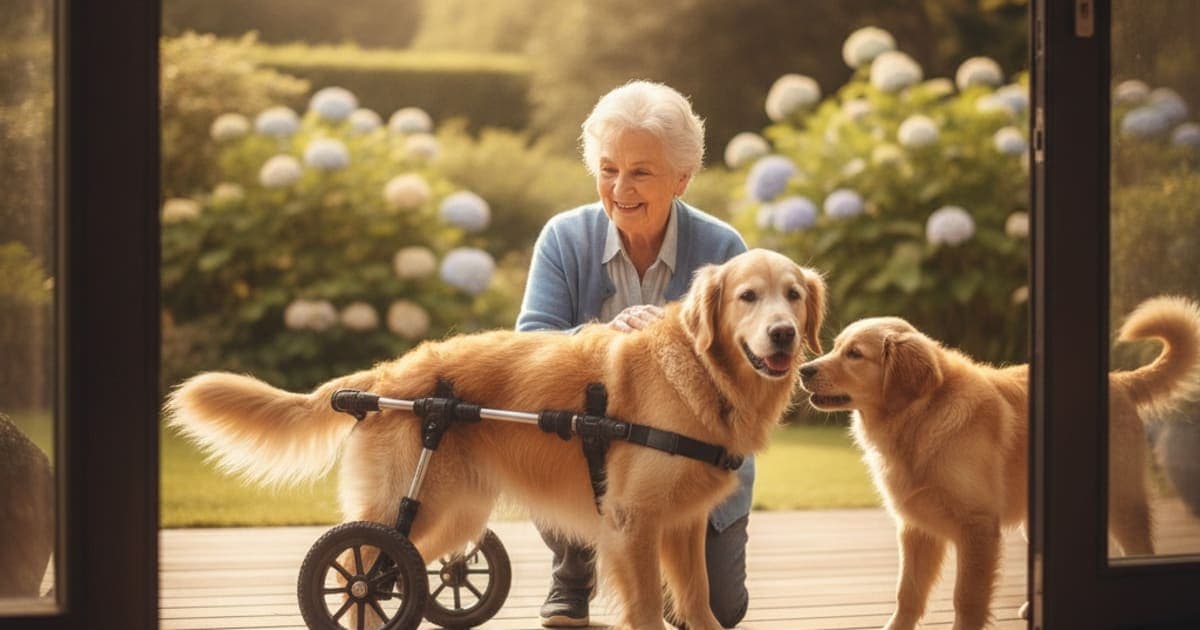
Elderly dog mobility problems are almost never caused by one single thing. In most older dogs, several changes stack on top of each other: osteoarthritis in the hips, stifles and lower spine; a steady loss of muscle mass in the hind end; slower nerve conduction to the back legs; stiffer tendons and ligaments; and worn paw pads that slip on hard floors. Each one alone is manageable. Together they produce the picture owners recognise instantly — a dog who struggles to rise, bunny-hops up stairs, sways at the rear, or whose back legs give out on the kitchen tiles.
The single most useful thing you can do is work out the speed of the change. Mobility that fades over months is usually degenerative and manageable. Mobility that disappears over hours or a day is a different problem entirely, and it belongs in a veterinary exam room today.
Why older dogs lose strength in the back legs
The hind end carries the propulsion. When an ageing dog's body starts conserving effort, the rear is where you see it first.
Osteoarthritis is the most common driver. Cartilage thins, joint fluid changes quality, and the joint capsule becomes inflamed and fibrous. The dog shortens their stride to avoid the painful end-range of motion, which unloads the gluteal and thigh muscles, which then atrophy, which loads the joint even more. That loop is why arthritis looks like weakness rather than pain in many seniors.
Muscle loss compounds it. Older dogs lose lean mass with age, and a dog who has been walking less for six months has measurably less hind-limb muscle to work with. Weak muscle cannot stabilise an arthritic joint.
Nerve and spinal changes are the other half of the story. Lumbosacral stenosis — narrowing where the spine meets the pelvis — pinches the nerve roots supplying the back legs. Intervertebral disc disease can compress the cord. Degenerative myelopathy, a progressive spinal cord disease associated with a mutation in the SOD1 gene and seen most often in breeds such as German Shepherds, Boxers and Corgis, causes a painless loss of coordination that begins in the hind limbs. Dogs with nerve involvement often scuff their nails, knuckle a paw over, or cross their back legs when turning.
Soft-tissue injury still happens in old dogs. A partial cranial cruciate ligament tear in a twelve-year-old looks like "he's just getting old" until a vet puts hands on the stifle.
Systemic illness can masquerade as mobility loss: hypothyroidism, tick-borne infection, anaemia, heart disease, or pain somewhere else entirely. This is a real reason to talk to your veterinarian rather than assuming age explains everything.
Gradual decline versus sudden loss: how to tell them apart
| What's happening | How it starts | What you notice | What a vet typically does |
|---|---|---|---|
| Osteoarthritis | Months to years | Slow to rise, stiff after rest, loosens up with movement, reluctant on stairs | Orthopaedic exam, radiographs, pain-control plan, weight and exercise strategy |
| Hind-limb muscle loss | Months | Narrower thighs, swaying rear, tires on short walks | Body condition and muscle scoring, structured rehab referral |
| Cruciate ligament injury | Days to weeks, often after a stumble | Sudden limp on one back leg, toe-touching, sitting sideways | Stifle palpation, imaging, surgical or conservative plan |
| Lumbosacral stenosis | Gradual, with flare-ups | Pain rising from sit, reluctance to jump, tail carriage change | Neurological exam, advanced imaging |
| Degenerative myelopathy | Gradual, painless | Knuckling, scuffed nails, crossing legs, no obvious pain | Neurological exam, exclusion of compressive disease, genetic testing |
| Disc extrusion | Minutes to hours | Yelping, arched back, dragging or paralysed hind legs | Emergency neurological workup and imaging |
| Fibrocartilaginous embolism | Instant, often during play | Non-painful collapse of one or both back legs | Emergency exam, imaging to rule out compression |
A senior dog who loses the use of their back legs over hours rather than months needs a veterinarian the same day — sudden loss of movement is treated as a neurological emergency until a professional proves otherwise.
Get seen immediately if you see any of the following: inability to stand or bear weight, dragging the back feet, loss of bladder or bowel control, crying out when touched along the spine, a hard or distended abdomen, pale gums, collapse, or sudden loss of deep pain sensation in the toes. In spinal cord compression, the window in which intervention is most useful is short, and that window is not something to spend on internet research.
Daily management that genuinely changes an older dog's day
Most of what improves a senior dog's mobility costs nothing and happens at home.
Fix the floors. Smooth flooring is the single most underrated cause of falls. Runners, yoga mats and rubber-backed rugs along the routes your dog actually walks — bed to door, sofa to water bowl — restore the confidence that slipping destroys. A dog who has slipped twice starts moving like a dog in pain even when the joint is having a good day.
Trim the nails and the paw fur. Long nails change the angle the toes meet the ground and reduce grip. Fur between the pads turns a paw into a ski.
Keep weight off. Every extra kilogram is load across already-compromised joints at every step. Weight management is the intervention with the strongest consensus behind it in canine arthritis care, and your vet can set a realistic target body condition score.
Remove the jumps. Ramps for the car and the sofa, a raised food bowl if the neck is stiff, and a gate at the top of the stairs. Supportive orthopaedic bedding off cold tile helps dogs who stiffen overnight.
Use a support harness. A rear-support or full-body harness lets you take weight off the hind end on stairs and garden steps without hauling on a collar — and it saves your own back.
Keep warm and keep moving. Cold stiffens arthritic joints. A coat in winter and a brief warm-up amble before a proper walk make a visible difference.
Senior dog mobility exercises worth doing
The goal is consistency and quality, not distance. Little and often beats one long weekend walk, which usually produces two bad days afterwards. Ask your veterinarian or a certified canine rehabilitation practitioner to confirm which of these suit your dog's specific diagnosis before you start.
- Short, frequent leash walks on grass or dirt. Soft, even ground, a flat lead, and a slow pace that lets the dog place each foot deliberately.
- Sit-to-stand repetitions. Controlled transitions on a non-slip surface directly load the glutes and quadriceps that stabilise the hips and stifles. Stop well before fatigue — sloppy reps teach compensation.
- Weight shifting. With the dog standing square, gently rock the hips side to side so they have to recruit stabilising muscle to stay upright.
- Cavaletti poles. Low poles spaced to the dog's stride encourage deliberate hind-limb flexion and improve proprioception — the body's sense of where the feet are.
- Figure-of-eight walking. Wide, slow curves load each side differently and reveal asymmetry you might not see on a straight line.
- Hydrotherapy. Underwater treadmill work lets a dog move with reduced joint load. It is one of the better-supported tools in canine rehabilitation and is worth asking about by referral.
Stop any exercise that produces limping, trembling, panting out of proportion to effort, or reluctance the next morning.
Where joint support and peptides fit into a senior plan
Once the diagnosis is made and the pain plan is in place, owners generally want something that supports the tissue itself. This is where the supplement aisle becomes frustrating. Plenty of senior chews are kitchen-sink formulas — a dozen ingredients at token inclusion levels, chosen because they read well on a label rather than because the amount in the chew reflects anything studied. Underdosing is the industry's quiet default.
pawgen takes a narrower approach with K9-REPAIR, a BPC-157 and TB-500 peptide formulation made specifically for dogs and aimed at joint, tendon and mobility recovery. BPC-157 is a synthetic peptide based on a sequence identified in gastric juice protein; published laboratory and animal research suggests it may support soft-tissue and tendon repair processes, including new blood vessel formation at an injury site. TB-500 is a synthetic form related to thymosin beta-4, a naturally occurring protein involved in actin regulation, cell migration and tissue remodelling. Research into both is active and the direction of the findings is why a growing number of owners have adopted them through recovery and through the slow grind of senior joint decline.
Be clear about what that means. BPC-157 and TB-500 are not FDA-approved veterinary drugs, and nothing here says K9-REPAIR treats arthritis, repairs a disc, or restores a back leg. The honest framing is mechanism and research, plus what owners report — not a promise about your dog. Dosing is weight-based and belongs in a conversation with your veterinarian, who knows what else your dog is taking. pawgen publishes third-party certificates of analysis for its batches, ships direct to the door, and backs orders with a 60-day money-back guarantee, which is the kind of transparency worth demanding from anything you put in an ageing dog.
And it sits alongside veterinary care, never instead of it. If your vet has prescribed an NSAID, a monoclonal antibody injection, gabapentin or a surgical plan, that plan stays.
Key takeaways
- Mobility loss in older dogs is usually multifactorial: arthritis, muscle atrophy, nerve change and poor traction together.
- Speed of onset is the triage question. Months means degenerative; hours means emergency.
- Dragging feet, loss of bladder control, spinal pain or inability to stand warrant same-day veterinary attention.
- Flooring, nails, body weight, ramps and a support harness change daily function more than most owners expect.
- Short, frequent, controlled exercise preserves the muscle that protects the joints; long sporadic walks set dogs back.
- Skip underdosed kitchen-sink chews. Look for named actives, third-party testing and published COAs.
- K9-REPAIR is the BPC-157 and TB-500 stack owners use through recovery and senior decline — educational information only, not an FDA-approved drug, and not a replacement for anything your vet has prescribed.
More from pawgen: batch certificates of analysis are published at COAs, the full formulation range is listed on the shop, and shipping coverage is detailed on the location page. Product information is also available at pawgen.
The veterinarian owns the diagnosis
An arthritic hip, a compressed disc and degenerative myelopathy can look similar from across the living room and require completely different responses. Only a veterinarian can examine your dog, image the right structures, and tell you which one you are dealing with — and only they can build the pain-control and rehabilitation plan that everything else hangs from. Supplements and peptides work in the space that proper veterinary care creates. Get the diagnosis first, then decide what to add around it.
Owners exploring peptide support for their dog can review K9-REPAIR — BPC-157 + TB-500 formulated for dogs — at https://pawgen.com/. BPC-157 and TB-500 are not FDA-approved veterinary drugs. Nothing in this article treats, cures or prevents any condition; every decision about your dog's care belongs with your veterinarian.
Frequently asked questions
- Why are my senior dog's hind legs giving out?
- The common causes are osteoarthritis in the hips, stifles or lower spine, loss of hind-limb muscle mass, nerve compression at the lumbosacral junction, intervertebral disc disease, degenerative myelopathy, or a cruciate ligament injury. Systemic illness can also present this way. A veterinary exam is what separates them.
- Is sudden loss of mobility in a senior dog an emergency?
- Yes. If your dog goes from walking to unable to stand over hours, treat it as an emergency and get seen the same day. Sudden hind-limb collapse can indicate disc extrusion, a fibrocartilaginous embolism or another neurological event where timing affects outcomes.
- Can mobility issues in older dogs be improved, or is it just age?
- Age is not a diagnosis. Many senior mobility problems respond to weight management, improved floor traction, structured low-impact exercise, rehabilitation and a veterinary pain plan. Function often improves noticeably once pain is controlled and the dog stops slipping.
- What exercises help a senior dog with mobility issues?
- Short frequent walks on soft even ground, controlled sit-to-stand repetitions, gentle weight shifting, low cavaletti poles for proprioception, wide figure-of-eight walking, and hydrotherapy by referral. Keep sessions brief, stop before fatigue, and confirm the plan with your vet or a canine rehabilitation practitioner.
- What is K9-REPAIR and how does it relate to senior mobility?
- K9-REPAIR is pawgen's BPC-157 and TB-500 peptide formulation for dogs, focused on joint, tendon and mobility recovery. Research suggests these peptides may support soft-tissue repair processes. They are not FDA-approved veterinary drugs and nothing here claims they treat any condition.
- How much K9-REPAIR should an elderly dog have?
- Dosing is weight-based, and pawgen does not publish protocols in educational content. Work it out with your veterinarian, who knows your dog's bodyweight, diagnosis and current medications. That is especially important for dogs already on prescribed drugs, and for puppies or pregnant and nursing dogs.
- Can I give a peptide supplement alongside my dog's prescribed arthritis medication?
- Never stop or alter a prescribed medication on your own. If you are considering adding anything, tell your veterinarian exactly what it is first so they can review it against the current plan. Supplements sit alongside veterinary care, not in place of it.
- Why do senior dogs slip so much on hard floors?
- Worn paw pads, long nails, fur growing between the pads and weaker stabilising muscles all reduce grip. One or two slips can also create lasting hesitancy. Runners and rubber-backed mats along your dog's usual routes often produce an immediate improvement in confidence.
- How do I know if my dog is in pain or just weak?
- Pain tends to show as reluctance, stiffness after rest, panting, restlessness at night, licking a joint or a changed temperament. Neurological weakness often shows as scuffed nails, knuckling and crossing legs without obvious discomfort. A veterinarian can distinguish them on examination.
Educational content. BPC-157 and TB-500 are not FDA-approved veterinary drugs. Talk to your veterinarian before starting anything new, especially if your dog is on prescribed medication.