What Does German Shepherd Hip Dysplasia Look Like?
German shepherd hip dysplasia usually looks like a loose, swaying rear end: a bunny-hop instead of a normal gallop, a sloppy sideways sit, a slow sore rise from lying down, and reluctance on stairs or into the car. Only a veterinarian with positioned radiographs can confirm it.
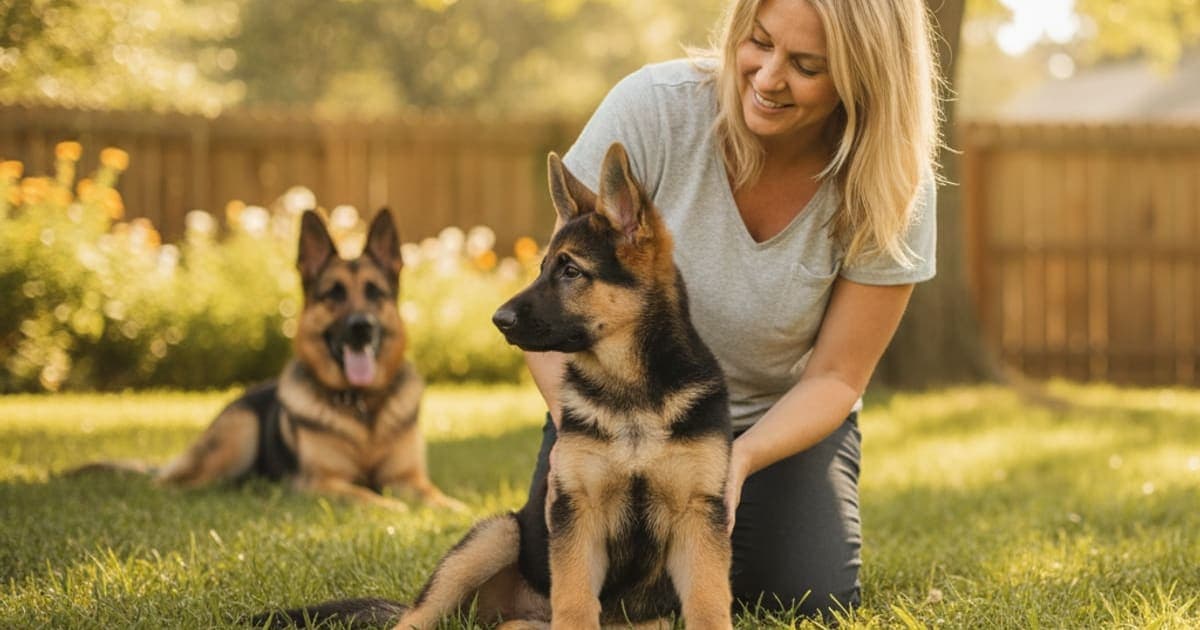
In a German shepherd, hip dysplasia looks like a rear end that moves differently from the front. The classic picture is a narrow hind-leg stance, a swaying or wobbling back end at the walk, a bunny-hop — both hind legs pushing off together — instead of a normal alternating gallop, a sloppy sit with one leg splayed out to the side, a slow and stiff rise from lying down, and hesitation at stairs or the tailgate of the car. Over months, the shoulders and chest bulk up while the thighs lose muscle, because the dog is quietly shifting weight off painful hips onto the front end.
Early on it is far subtler than that. Most owners notice behaviour before they notice lameness: a dog who stops leaping onto the couch, lags on the back half of the walk, sinks down rather than lies down, or is stiff for the first ten minutes of the morning and then "warms out of it." Hip dysplasia is a hip socket and femoral head that fit together too loosely, and that laxity leads to abnormal wear and arthritis over time. What you can see is a pattern of signs. What no owner can see is the joint itself — that takes a veterinary exam and X-rays.
The first changes owners actually notice
These are the early signs that send most shepherd owners searching, roughly in the order they tend to appear:
- Reluctance to jump or climb. Refusing the car, pausing at the bottom of stairs, or taking stairs one careful step at a time instead of bounding.
- Bunny-hopping past puppyhood. Puppies hop when they play; a growing or adult shepherd who uses both hind legs together to run or climb is compensating.
- A slow, effortful rise. The dog gathers the front end first, then hauls the rear up. Worse after a long rest, worse on cold mornings, worse on slick floors.
- The sloppy sit. Instead of squaring up, one hind leg rolls out to the side or the dog sits on a hip. It is one of the most repeatable signs owners can film.
- Shortened rear stride. The hind feet do not reach as far forward, so the gait looks choppy and the topline bobs.
- Narrow hind stance. The hind feet track close together, sometimes almost in a single line, as the dog tries to get its feet under its centre of gravity.
- Audible clicks or pops from the rear when rising or turning.
- Muscle change. Thighs flatten and soften; shoulders and neck thicken. Run your hands over both hind legs and compare.
- Exercise intolerance and sleep changes. Shorter self-selected walks, more lying down, restlessness at night, or a shift in temperament when the hips are handled.
In puppies, signs can appear while the dog is still growing — a wobbly, hopping rear, difficulty getting up on smooth flooring, or a puppy who sits out play. Growing shepherds also get panosteitis, soft-tissue strains and other developmental orthopaedic problems that look similar, which is exactly why a growing dog with a rear-end problem needs a veterinarian rather than a wait-and-see approach.
Hip dysplasia vs. a normal German shepherd rear end
The breed complicates this. A well-built shepherd has an angulated rear and a sloping topline, so a healthy dog can look "low behind" to an owner who has been reading about hip dysplasia at midnight. Use function, not silhouette.
| What you're watching | Normal German shepherd | Pattern consistent with hip dysplasia |
|---|---|---|
| Hind stance at rest | Feet roughly shoulder-width, weight even | Feet close together or tucked under the body |
| Trot from behind | Hips stay level, legs reach and drive evenly | Rear sways or rolls side to side, stride shortened |
| Fast gait | Alternating hind footfalls, powerful single-leg drive | Both hind legs push off together (bunny-hop) |
| Sitting | Squares up, both hocks folded under | One or both legs splay sideways, sits on a hip |
| Rising from lying down | One smooth motion | Front end first, rear hauled up, visible effort |
| Stairs | Takes them without thought | Hesitates, hops both hind legs, or avoids |
| Muscle distribution | Full, firm thighs balancing the front | Thin, soft thighs with an overbuilt front end |
| After rest | Gets going immediately | Stiff at first, loosens with movement |
| After hard exercise | Normal by next morning | Noticeably worse that evening or the next day |
One item on this list proves nothing. A cluster of them, holding steady or worsening over weeks, is worth an appointment.
How a shepherd with loose hips walks
Watch from directly behind on level, non-slip ground. A dog with painful, lax hips tends to carry its weight forward, which lifts the head and drops the hips, so the topline looks like it is tipping downhill more than the breed standard explains. The hind feet land close together and do not reach far forward, giving a short, mincing rear stride. The pelvis rolls or sways with each step — hip sway — because the muscles are not stabilising a joint that moves more than it should.
Ask for a trot and the asymmetry usually sharpens: you may see a head nod as the dog offloads the sorer side, or a hip that drops further than the other. Ask for speed and the bunny-hop appears, because pushing off with both hind legs at once spares each hip half the load. On tile or hardwood the whole picture gets worse, since a loose joint relies on friction and muscle to stay seated.
How to check at home — and where home checking stops
You can gather genuinely useful information for your vet without touching your dog's hips:
- Film it. Ten seconds walking away from the camera, ten seconds trotting, then the sit and the rise. Video from behind and from the side beats any description you can give in an exam room.
- Test the same things daily. First rise of the morning, first stair, the sit after a walk. Note whether it is worse after rest or after exercise.
- Compare sides. Gently feel the bulk of each thigh with flat hands. Asymmetry matters.
- Log it. Two weeks of short notes tells a vet more than a single bad day.
What you should not do is manipulate the joint. The laxity test vets use — the Ortolani sign — involves loading and levering the hip, and it is uncomfortable enough that it is usually performed under sedation. Pulling, extending or rotating your dog's hind legs at home can hurt, can teach your dog to resent handling, and cannot give you an answer anyway. Hip dysplasia is confirmed by a veterinarian using a hands-on orthopaedic exam and correctly positioned radiographs — no home check, no gait video, and no supplement can diagnose it or rule it out.
If your shepherd is showing several of these signs, book the exam and bring the video. Talk to your veterinarian before you change exercise routines, too — rest is sometimes right and sometimes the worst thing for a deconditioned rear end.
How veterinarians diagnose and grade it
Diagnosis usually runs in three stages. First, history and observation: your vet watches your dog move and asks the same questions you have been asking yourself. Second, the orthopaedic exam — range of motion in extension, pain response, crepitus, muscle mass, and laxity testing. Third, imaging. Radiographs require precise positioning to be readable, so sedation or general anaesthesia is standard; a squirming dog produces an unusable film.
Two formal screening systems exist and both are worth knowing by name. The Orthopedic Foundation for Animals (OFA) evaluates a hip-extended ventrodorsal radiograph and assigns a grade from consulting radiologists. PennHIP, developed at the University of Pennsylvania School of Veterinary Medicine, uses a distraction view to measure passive hip laxity numerically. Breeders use both; owners of an already-symptomatic dog mainly need diagnostic films and a treatment conversation.
Expect your vet to rule other things out, because several conditions mimic hip pain in this breed — lumbosacral spinal disease, cruciate injury, and degenerative myelopathy among them. That differential work is the reason a rear-end problem in a shepherd is a veterinary question first and a management question second.
Supporting a shepherd once you have a diagnosis
Your vet owns the plan: weight control, structured exercise and rehabilitation, pain management, and — depending on age and severity — surgical options ranging from femoral head and neck excision to total hip replacement. None of that is optional, and nothing you buy replaces it. Keep prescribed medication exactly as prescribed unless your veterinarian changes it.
Around that plan, owners spend a great deal of effort on the soft tissue doing the compensating. A lax hip throws load onto tendon, ligament and muscle, and conditioning that tissue is most of what rehab is for. It is also why peptides have moved from performance circles into everyday recovery routines. pawgen's K9-REPAIR combines BPC-157 and TB-500: BPC-157 is a synthetic peptide studied for its influence on angiogenesis and soft-tissue repair signalling, and TB-500 relates to thymosin beta-4, a protein research associates with actin binding and cell migration during tissue remodelling. Published work is in this mechanism space rather than in outcome guarantees, and neither compound is an FDA-approved veterinary drug — but the science is promising, and it is increasingly the stack owners reach for through a long orthopaedic recovery. Research suggests these pathways may support connective-tissue repair; owners report using them alongside vet-directed rehab, not instead of it.
If you go that route, judge products the way you would judge any lab-made compound: dosing by body weight rather than one-size-fits-all chews, third-party testing you can actually read, and a company that publishes batch certificates instead of a proprietary blend hiding a pinch of everything. K9-REPAIR is built to that standard and carries a 60-day money-back guarantee. Dosing itself is a conversation for your veterinarian, who knows your dog's weight, medications and surgical timeline — never a number from a blog.
Key Takeaways
- The earliest signs are behavioural: refusing jumps and stairs, lying down more, and slow, stiff rises that improve with movement.
- The visual signature is a bunny-hop, a swaying rear, a narrow hind stance, and a sloppy sideways sit.
- Muscle shifting forward — thin thighs, heavy shoulders — is a strong sign the rear end has been hurting for a while.
- Breed conformation makes a healthy shepherd look low behind; judge function, not silhouette.
- Puppies can show signs while still growing, and growing dogs need veterinary assessment sooner, not later.
- Film the gait, sit and rise; do not manipulate the hips yourself.
- Diagnosis means orthopaedic exam plus positioned radiographs, usually under sedation; OFA and PennHIP are the formal screening systems.
- Supplements and peptides work in the space proper veterinary care creates — they never replace surgery, rehab or prescribed medication.
A limp, a hop or a sloppy sit is information, not a diagnosis. Your veterinarian owns the diagnosis and the treatment plan — the imaging, the pain protocol, the rehab programme and the decision about surgery. Everything else, including peptides, exists to support the recovery that proper veterinary care makes possible.
For readers who want to look closer at how pawgen documents what it makes, third-party certificates of analysis are published by batch, the full product lineup is listed in the shop, and shipping and availability details cover where direct-to-door delivery reaches.
Owners exploring peptide support for their dog can review K9-REPAIR — BPC-157 + TB-500 formulated for dogs — at https://pawgen.com/. BPC-157 and TB-500 are not FDA-approved veterinary drugs. Nothing in this article treats, cures or prevents any condition; every decision about your dog's care belongs with your veterinarian.
Frequently asked questions
- what does german shepherd hip dysplasia look like
- It looks like a loose, swaying rear end: a bunny-hop at speed, hind feet tracking close together, a shortened rear stride, a sloppy sideways sit, and a slow, effortful rise from lying down. Over time the thighs thin while the shoulders bulk up as weight shifts forward off painful hips.
- does my german shepherd have hip dysplasia
- Only a veterinarian can answer that. If your shepherd shows several signs together — bunny-hopping, stiffness after rest, refusing stairs or the car, a splayed sit, thinning thigh muscle — those warrant an orthopaedic exam and radiographs. Similar signs also come from spinal disease, cruciate injury and other conditions.
- how to tell if german shepherd has hip dysplasia
- Watch function over two weeks rather than appearance in one moment. Track the first rise each morning, the sit posture, stair willingness and gait from behind, and note whether signs worsen after rest or after exercise. Bring that log and video to your vet, who confirms it with imaging.
- how to check a german shepherd for hip dysplasia
- Film ten seconds walking and ten trotting away from the camera on non-slip ground, then film a sit and a rise. Gently compare thigh muscle bulk on both sides with flat hands. Do not pull, extend or rotate the hips — laxity testing is painful and belongs in a veterinary exam.
- how does a german shepherd walk with hip dysplasia
- The walk is short-strided behind, with the pelvis rolling or swaying side to side and the hind feet landing close together. Weight carries forward, so the topline tips downhill. At speed both hind legs push off together in a bunny-hop, and slick floors make everything worse.
- how can you tell if your german shepherd has hip dysplasia
- By pattern, not by a single sign. A cluster that persists or worsens — bunny-hopping, sloppy sits, stiff mornings, avoidance of jumping, thinning rear muscle, clicking hips — points toward hip disease. Confirmation requires a hands-on orthopaedic exam and correctly positioned radiographs, usually taken under sedation.
- What test diagnoses hip dysplasia in a German shepherd?
- Positioned hip radiographs, almost always with sedation or anaesthesia so the films are readable, combined with an orthopaedic exam that assesses pain, range of motion and joint laxity. For screening, the Orthopedic Foundation for Animals grades a hip-extended view, while PennHIP measures passive laxity from a distraction view.
- Can a young German shepherd puppy show signs of hip dysplasia?
- Yes — signs can appear while a shepherd is still growing, often as a wobbly hopping rear, trouble rising on smooth floors, or a puppy opting out of play. Growing dogs also get panosteitis and soft-tissue injuries that look similar, so early veterinary assessment matters rather than waiting.
- Does K9-REPAIR diagnose or fix hip dysplasia?
- No. K9-REPAIR is an educational, non-FDA-approved peptide formulation containing BPC-157 and TB-500; it does not diagnose, treat or replace veterinary care, surgery or prescribed medication. Research suggests these peptides act on soft-tissue repair signalling, and owners report using them alongside vet-directed rehabilitation. Discuss use with your veterinarian.
Educational content. BPC-157 and TB-500 are not FDA-approved veterinary drugs. Talk to your veterinarian before starting anything new, especially if your dog is on prescribed medication.