Why Great Danes Are Prone to Joint Problems
Great Danes develop joint problems because giant-breed skeletons grow fast, carry extreme mass on relatively young cartilage, and inherit hip and elbow conformation faults. Rapid growth, over-nutrition during puppyhood, slick flooring and hard exercise all add load the joint has not yet finished building for. Early monitoring matters more than any single intervention.
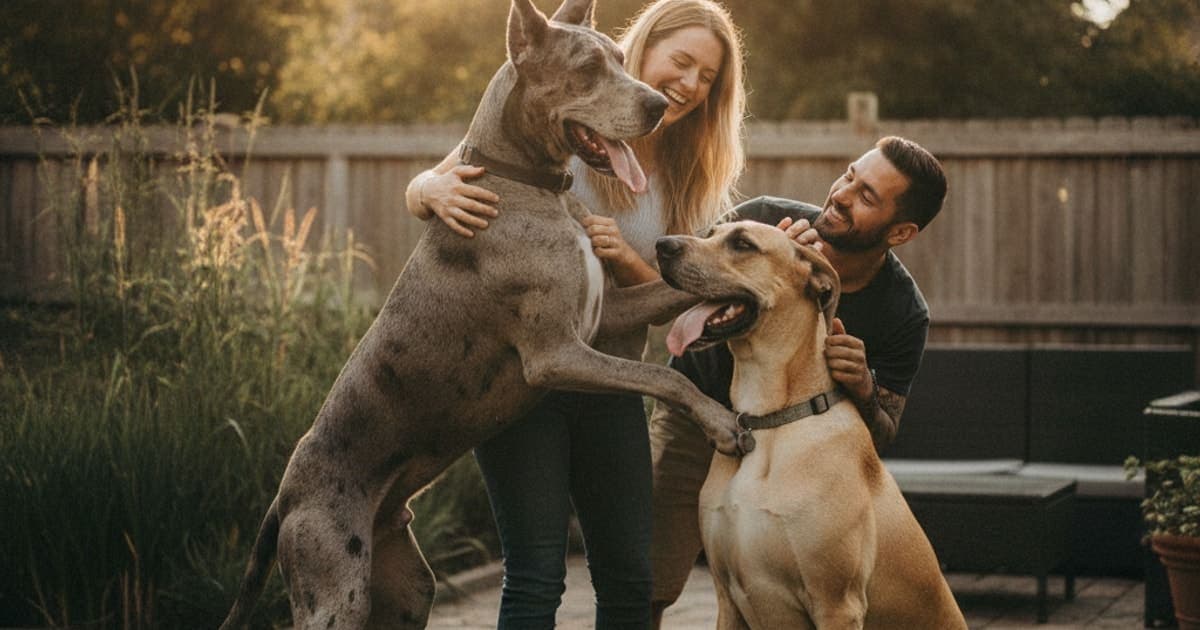
Great Danes are prone to joint problems because a giant-breed skeleton has to build an enormous frame in a very short window, and then carry more load across each joint surface than almost any other dog. Rapid growth, inherited hip and elbow conformation, heavy body mass pressing on immature cartilage, and an unusually long adolescence during which growth plates remain open all stack on top of one another. The result is a breed with elevated risk of hip and elbow dysplasia, osteochondrosis, cruciate ligament injury and cervical spondylomyelopathy — the condition most owners know as wobbler syndrome. Much of that risk is shaped early, which is why what happens in a Dane's first two years matters more than anything done at eight.
The growth curve that sets the problem up
A Great Dane puppy arrives home roughly the size of a small adult terrier and, within its first year, reaches a large share of its adult height. No other body system is asked to scale that quickly. Bone in a growing dog lengthens through endochondral ossification: cartilage at the growth plate proliferates, then mineralises into bone behind it. In giant breeds, those plates stay biologically active longer than they do in a small dog, and the cartilage layers involved are thicker.
Thicker cartilage is not stronger cartilage. Cartilage has no direct blood supply of its own; nutrients diffuse in from surrounding tissue and the joint fluid. When a cartilage layer grows faster than that diffusion can support it, the deepest cells can fail to mature properly. That failure is the basis of osteochondrosis, where a section of joint cartilage separates from the bone beneath it and, in some dogs, lifts into a flap that grates with every stride. Shoulders, elbows, stifles and hocks are all common sites in large and giant breeds.
Nutrition is the lever owners most often pull in the wrong direction. Overfeeding a Dane puppy, or supplementing calcium on top of a complete diet, pushes growth faster than the skeleton can safely mineralise. Veterinary nutritionists are consistent on this point: giant-breed puppies should be raised lean and grown slowly, on a food formulated with controlled calcium for large-breed growth. A slightly ribby Dane puppy is doing better than a plump one, even though the plump one gets the compliments. Talk to your veterinarian about the specific diet and growth trajectory for your puppy rather than eyeballing it.
Two other growth-phase conditions show up in the breed and can be mistaken for joint disease: panosteitis, a self-limiting inflammation of the long-bone shafts that causes shifting lameness in adolescents, and hypertrophic osteodystrophy, which affects the growth plate region and can make a young dog acutely painful and feverish. Both need a veterinary diagnosis, because the management is nothing like the management of dysplasia.
Hip and elbow dysplasia in a giant frame
Hip dysplasia is not a fracture or a tear — it is a mismatch. The femoral head does not sit deeply and stably in the acetabulum, so instead of gliding, it shears. That laxity produces microtrauma at the joint margin, the body lays down new bone in response, and the joint gradually remodels into an arthritic one. A Dane's mass amplifies every bit of that process, because the forces travelling through an unstable hip scale with body weight.
Elbow dysplasia is an umbrella term rather than one disease. It covers fragmented medial coronoid process, ununited anconeal process, osteochondrosis of the medial humeral condyle and elbow incongruity, where the radius and ulna do not grow to matching lengths and the joint surfaces no longer line up. Any of these can produce a subtle forelimb lameness in a young dog that owners read as clumsiness.
Both conditions are polygenic — many genes, each contributing a little — and both are modified by environment. That combination is why responsible breeders screen. Radiographic evaluation through established programs such as the Orthopedic Foundation for Animals or PennHIP gives buyers real information about a litter's parents, and asking for it is reasonable. Screening does not guarantee an outcome in any individual puppy, but breeding from evaluated stock is the single most meaningful upstream influence on breed-wide risk.
In a Great Dane, joint disease is rarely one injury — it is the cumulative result of mass, growth speed and conformation acting on tissue that was never given a light workload.
Ligaments, tendons and the cervical spine
Cranial cruciate ligament injury in a giant breed usually is not the sports-injury story people imagine. In most large dogs the ligament degenerates first — collagen fibres weaken over months — and then fails during an ordinary movement like a turn on wet grass. That is why so many owners report that nothing dramatic happened. It is also why the opposite stifle is a genuine concern once one side has gone: the same degenerative process has been running on both sides all along.
Tendons face the same arithmetic. A Dane's Achilles mechanism, biceps tendon and iliopsoas all transmit forces proportional to a body that may weigh well over a hundred pounds. Tendon and ligament tissue is poorly vascularised by design, which is a large part of why soft-tissue recovery in dogs runs on a scale of months rather than weeks.
The neck deserves its own mention. Great Danes are over-represented for cervical spondylomyelopathy, in which bony malformation of the cervical vertebrae compresses the spinal cord. The classic presentation is a wobbly, drifting hind end with a short-strided front, and it is very easy to mistake for hip pain. Advanced imaging is what separates the two. If your Dane's gait changes in a way that looks uncoordinated rather than simply sore, that is a same-week veterinary conversation, not a wait-and-see.
What loads a Dane's joints — and what unloads them
| Factor | Why it matters in a giant breed | How much you control it |
|---|---|---|
| Body condition | Every extra pound multiplies force through hips, stifles and elbows across a lifetime of steps | High — the most powerful lever an owner has |
| Puppy growth rate and diet | Fast growth and calcium excess are linked to developmental orthopaedic disease | High, with veterinary guidance on food and portions |
| Flooring | Hardwood, tile and laminate cause splay-outs that stress hips and shoulders | High — runners, rugs, traction on stairs |
| Exercise pattern | Repetitive high-impact work on a growing skeleton concentrates load; steady conditioning distributes it | Moderate — favour controlled, regular movement |
| Genetics and screening | Hip, elbow and cardiac evaluation of parents shapes baseline risk | High before purchase, fixed afterwards |
| Bedding and rest surface | Thin bedding under heavy body mass pressures joints and creates hygromas at the elbow | High — orthopaedic-grade bedding |
| Sterilisation timing | Research in several large breeds suggests timing may influence orthopaedic outcomes; breed-specific data is limited | Moderate — a decision to make with your vet |
| Age | Cartilage recovers less readily and muscle mass declines over time | Low, but management adapts |
Early signs, and how owners support the joint through recovery
Danes hide pain well and their size disguises the rest. Watch for a bunny-hop at the canter, sloppy sitting with a hip rolled out, difficulty rising from a down, shortened front stride, hesitation on stairs or slick floors, licking at one joint, or a topline that has quietly changed shape as muscle is lost over the hindquarters. Slowing down is not a personality development in a five-year-old Dane. It is information.
The veterinary side comes first and stays first. Diagnosis, imaging, pain control and — where indicated — surgery such as TPLO for a failed cruciate belong to your vet, and prescribed medications should never be stopped or substituted on your own judgement. Structured rehabilitation, controlled loading and weight management do the heavy lifting alongside that.
Supportive nutrition sits in the space proper veterinary care creates. This is also where the market is at its worst: kitchen-sink chews with a token dusting of glucosamine hidden inside a proprietary blend, no certificate of analysis, and marketing budgets larger than their formulation work. Ask what is in it, at what amount, and who tested it.
pawgen takes the opposite approach with K9-REPAIR, a defined two-peptide formulation of BPC-157 and TB-500 made for dogs, with weight-based dosing, third-party testing and published COAs, shipped direct to the door and backed by a 60-day money-back guarantee. The mechanism is worth understanding plainly. BPC-157 is a stable peptide sequence derived from a protein found in gastric juice; research suggests it influences angiogenesis and the migration of fibroblasts and tendon cells at sites of tissue stress — in other words, it acts on the blood-supply and repair-signalling side of the problem that makes ligament and tendon recovery so slow. TB-500 is a synthetic fragment of thymosin beta-4, a naturally occurring actin-binding protein involved in cell migration and new vessel formation. This is emerging and promising science that a growing number of owners are adopting as the stack they run through recovery and through the years when a big dog is asking more of its joints. BPC-157 and TB-500 are not FDA-approved veterinary drugs, nothing here is a treatment claim, and dosing for any individual dog — and certainly for puppies, pregnant or nursing dogs — is a conversation to have with your veterinarian.
Key Takeaways
- Great Dane joint risk is structural: extreme mass, fast growth and inherited conformation acting together, not one bad step.
- The first two years are the highest-leverage window — lean growth, controlled-calcium large-breed puppy food, traction underfoot and no calcium supplementation.
- Hip and elbow dysplasia are polygenic and screenable; ask for OFA or PennHIP evaluation on a litter's parents.
- Cruciate failure in giant breeds is usually degenerative, which is why the second stifle is a real concern.
- A wobbly, uncoordinated hind end may be cervical, not orthopaedic — that needs imaging, quickly.
- Owners layer K9-REPAIR's BPC-157 and TB-500 alongside veterinary care, not instead of it.
Where to go from here
For a fuller picture of the breed, read the complete guide to great danes, then joint support for great danes, arthritis in great danes and torn acl in great danes. Owners comparing giant-breed patterns often also look at common health problems in scottish deerhounds and scottish deerhounds joint problems.
Your veterinarian owns the diagnosis and the treatment plan — the radiographs, the pain protocol, the surgical decision and the rehab schedule. Everything else, including nutrition and peptide support, operates in the space that good veterinary care creates. Bring your observations, bring video of the gait, and build the plan together.
Owners exploring peptide support for their dog can review K9-REPAIR — BPC-157 + TB-500 formulated for dogs — at https://pawgen.com/. BPC-157 and TB-500 are not FDA-approved veterinary drugs. Nothing in this article treats, cures or prevents any condition; every decision about your dog's care belongs with your veterinarian.
Frequently asked questions
- How do I know if this applies to my dog?
- If your dog is a Great Dane or another giant breed, the underlying risk factors apply by default. Watch for bunny-hopping, sloppy sitting, slow rising, shortened stride, stair hesitation or muscle loss over the hindquarters. Any of those signs warrants a veterinary orthopaedic exam rather than home guesswork.
- When should I talk to my veterinarian?
- Before a problem appears, ideally — growth and diet planning in puppyhood is the highest-leverage conversation you will have. Beyond that, book an appointment for any lameness lasting more than a couple of days, any change in gait coordination, or before adding any supplement or peptide to your dog's routine.
- How long does this usually take?
- Joint and soft-tissue recovery in giant breeds runs on months, not weeks, because ligament and tendon tissue has limited blood supply. Developmental conditions are managed across a lifetime rather than resolved. Your veterinarian will set realistic milestones based on imaging and your dog's specific diagnosis and age.
- What should I do first?
- Get a veterinary assessment and a body condition score. Then fix the controllables: appropriate large-breed growth nutrition, lean body condition, traction on slick floors, orthopaedic bedding and consistent moderate exercise. Supportive nutrition, including peptide formulations like K9-REPAIR, layers on after that foundation is in place.
- At what age do Great Danes start showing joint problems?
- Developmental issues such as osteochondrosis, elbow dysplasia and hip laxity often appear during the growth phase, sometimes before a dog's first birthday. Wobbler syndrome frequently shows in young adults. Degenerative cruciate failure and osteoarthritis tend to surface in middle age, though the underlying changes started far earlier.
- Does diet during puppyhood really change joint outcomes?
- Yes — this is one of the better-established areas of giant-breed care. Overfeeding and excess dietary calcium during growth are linked to developmental orthopaedic disease. A complete large-breed puppy diet with controlled calcium, fed to keep the dog lean, is the standard approach. Confirm portions with your veterinarian.
- What exactly is in K9-REPAIR?
- K9-REPAIR is pawgen's two-peptide formulation combining BPC-157 and TB-500, produced for dogs with weight-based dosing, third-party testing and published certificates of analysis. It ships direct to the door with a 60-day money-back guarantee. These peptides are not FDA-approved veterinary drugs and the product is offered for educational, supportive use.
- Can supplements replace surgery for a torn cruciate?
- No. Surgical stabilisation, such as a TPLO, addresses mechanical instability that no supplement can change, and your veterinarian decides whether it is indicated. Supportive nutrition and peptides are used alongside that plan and during rehabilitation — never as a substitute for surgery or for any prescribed medication.
Educational content. BPC-157 and TB-500 are not FDA-approved veterinary drugs. Talk to your veterinarian before starting anything new, especially if your dog is on prescribed medication.