Joint Support for Great Danes: What Actually Helps
Lean body weight, controlled growth through puppyhood, low-impact conditioning, secure footing indoors and an early veterinary work-up do more for a Great Dane's joints than anything else. On top of that foundation, many owners add a targeted recovery stack — K9-REPAIR pairs BPC-157 and TB-500, peptides owners use through mobility and soft-tissue recovery.
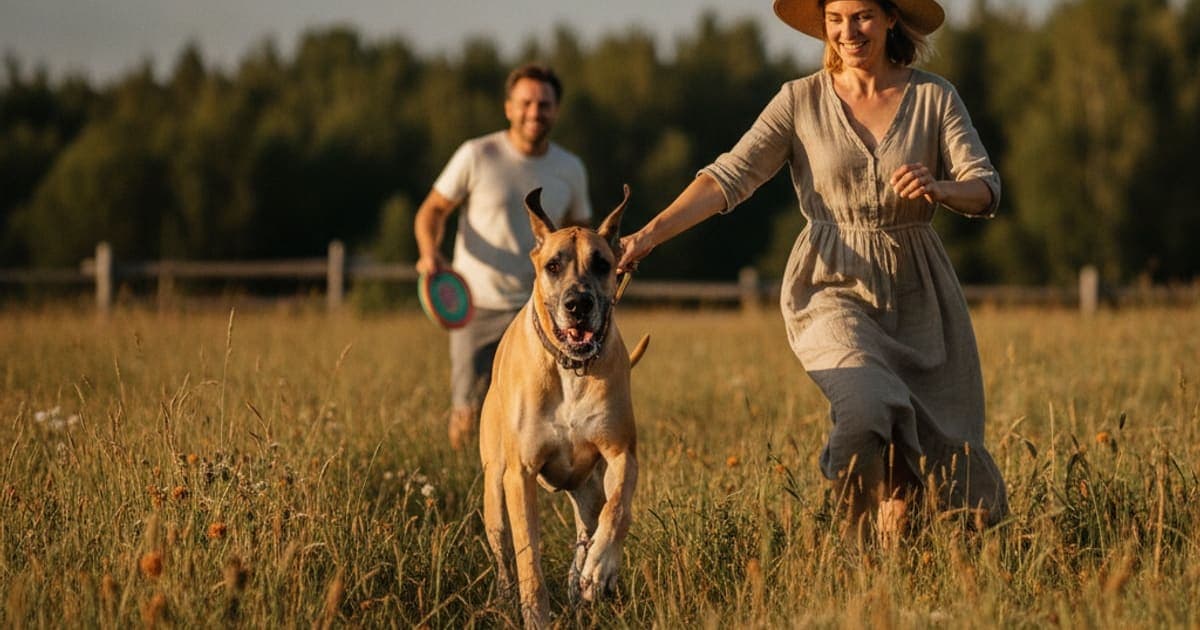
What Helps Joint Problems in Great Danes?
The things that help most are unglamorous: keeping a Great Dane lean, controlling growth rate through the first eighteen months, building low-impact conditioning instead of weekend sprints, putting traction on slick floors, and getting a veterinary work-up at the first hint of a limp. Layered on that foundation, many owners add a targeted recovery stack — K9-REPAIR pairs BPC-157 and TB-500, two peptides owners use through joint, tendon and mobility recovery.
That order matters. Nothing you give by mouth or syringe outperforms load management in a dog this size. But the reverse is also true: management alone leaves a gap during recovery windows, and that gap is exactly where owners of giant breeds have started reaching for peptide support.
Why a giant breed's joints live under different rules
A Great Dane reaches a body mass most dogs never approach, and does it fast. The skeleton that carries that mass is built in roughly the same developmental window as a beagle's — the timeline barely stretches, but the load does. Cartilage, growth plates, hip sockets and cruciate ligaments all mature under forces that a mid-size dog's tissues never experience.
Two consequences follow. First, developmental orthopedic problems concentrate in giant breeds because tissue is being laid down under load while it is still soft. Second, the margin for error on body condition is thin. Extra weight on a Great Dane is not a cosmetic issue; it is a multiplier applied to every step, every stair, every landing off the couch.
There is also a circulation problem people miss. Tendons and ligaments are poorly vascularised compared to muscle — they get less blood flow, so they repair slowly and remodel over weeks to months rather than days. A cruciate ligament under giant-breed load that starts to fray does not get a fast biological response. That mismatch between load and repair capacity is the core of why joint and ligament problems in this breed are so often chronic rather than acute.
Controlled growth is the single most effective intervention available to a Great Dane owner, and it happens before most joint problems ever appear. Veterinary nutrition guidance for large- and giant-breed puppies focuses on moderating growth rate and calcium intake specifically because skeletal development under excess load and excess mineral is where a lot of adult joint disease begins. This is a conversation to have with your veterinarian while the puppy is still a puppy — food choices made at four months are still paying dividends, or costing you, at six years.
The joint and ligament problems this breed sees most
Hip dysplasia is the one most owners know. The hip joint develops with laxity, the femoral head and socket grind rather than glide, and osteoarthritis follows. Signs are often subtle early: a bunny-hop gait, reluctance on stairs, a dog that sits down halfway through a walk.
Cruciate ligament injury is the other headline. In dogs, cranial cruciate rupture is usually degenerative rather than traumatic — the ligament weakens over time and then fails during ordinary movement. In a dog carrying giant-breed mass, that failure is dramatic and the opposite limb is immediately under more strain.
Osteoarthritis is the common endpoint of both. It is progressive, it is managed rather than eliminated, and it responds to a combination of weight, activity, veterinary pain management and supportive nutrition.
Great Danes are also among the breeds associated with cervical spondylomyelopathy — wobbler syndrome — where compression in the neck produces an unsteady, drunken-looking hind-end gait. It is a spinal problem, not a joint problem, but owners often mistake it for hips. That distinction is exactly why a limp or a gait change earns a veterinary exam rather than a supplement order. Growing giant-breed dogs can also show transient bone pain conditions during their fastest growth phases. Any new lameness in a Great Dane deserves a veterinary diagnosis before you decide what to give, because the same limp can come from a hip, a knee, a neck or a growth plate — and those four things are not managed the same way.
The daily levers that carry the most weight
Body condition first. You should be able to feel ribs under light pressure and see a waist from above. If you cannot, everything else you do is working uphill. Ask your veterinarian to score body condition at every visit — owners are consistently poor judges of their own dog's weight, and the drift is gradual.
Surfaces second. Hardwood, tile and laminate are hostile to a hundred-plus-pound dog. Splayed legs on a slick floor generate exactly the shearing forces a cruciate ligament is least equipped to absorb. Runners, rugs and traction paths from bed to door are cheap and they work.
Activity third. Giant breeds do better with consistent, moderate, daily movement than with a sedentary week and a two-hour hike on Saturday. Controlled leash walks, gentle hills and — if the dog takes to it — swimming build the muscle that supports joints without hammering them. Ramps for the car and blocked access to repetitive stair climbing remove a surprising amount of cumulative load.
And bedding. Orthopedic foam that does not bottom out under giant-breed weight reduces pressure sores and makes getting up in the morning less of an event.
How to read a joint formula without getting played
The supplement aisle is where dog owners get taken. The most common trick is the kitchen-sink label: fifteen ingredients listed in a proprietary blend, each present in a trace amount that no research would call meaningful, with a picture of a happy Labrador on the front. Giant-breed owners get hit hardest, because a scoop sized for a mid-size dog is not scaled for a Great Dane and the label rarely says so.
What to check on any product before it goes near your dog: is the amount of each active ingredient stated, or hidden in a blend? Is dosing scaled by body weight? Is there third-party testing with a certificate of analysis you can actually see? Does the brand explain mechanism, or just show testimonials?
| Layer | What it does | What to watch for |
|---|---|---|
| Weight and load management | Reduces force through every joint on every step | Requires honest body-condition scoring; no product substitutes for it |
| Veterinary pain management | Prescribed medication and diagnostics your vet directs | Never adjust or stop without your veterinarian |
| Surgery and rehab | Definitive repair for cruciate and some structural problems | Surgeon and rehab plan own this; supplements support around it |
| Conventional oral joint chews | Long-standing category owners are familiar with | Underdosing, proprietary blends and no scaling for giant-breed body weight |
| Peptide support (BPC-157 + TB-500) | Mechanism-level support for soft tissue and mobility recovery; dosed by body weight | Not FDA-approved veterinary drugs; buy only where third-party testing and COAs are published |
Where BPC-157 and TB-500 fit for a Great Dane
BPC-157 is a synthetic peptide based on a sequence identified in gastric juice. Published preclinical research, largely in rodent models, suggests it influences angiogenesis — the formation of new blood vessels — and the behaviour of tendon and ligament fibroblasts, the cells that build connective tissue. Given that ligaments and tendons are poorly vascularised to begin with, the vascular angle is why this peptide draws so much interest in soft-tissue contexts.
TB-500 is a synthetic form of a fragment of thymosin beta-4, a naturally occurring protein involved in actin regulation — the machinery cells use to migrate. Research suggests roles in cell migration and new vessel formation, which is why it is so often paired with BPC-157 rather than used alone. The two are approached as complementary: one weighted toward the local tissue environment, the other toward cell movement and coverage.
This is emerging and promising science, and it is being adopted by owners of large and giant breeds faster than almost any other group — because these are the dogs where soft-tissue recovery windows are longest and the stakes of a failed ligament are highest. K9-REPAIR is formulated for dogs specifically, dosed by body weight rather than a one-scoop-fits-all scheme, third-party tested with certificates of analysis, shipped direct, and backed by a 60-day money-back guarantee. Owners report using it through recovery periods and as their dogs age.
What it is not: BPC-157 and TB-500 are not FDA-approved veterinary drugs, and nothing here is a claim that they treat, cure or prevent hip dysplasia, arthritis, cruciate injury or anything else. Dosing for your specific dog — and especially for puppies, pregnant or nursing dogs — is a conversation with your veterinarian, not a number off a website.
Around surgery and rehab
If a Great Dane ruptures a cruciate ligament, surgical stabilisation is usually the conversation, and for a dog this size the surgeon's recommendation carries enormous weight. Post-operative rehabilitation — controlled leash work, range-of-motion exercises, hydrotherapy, a graduated return to load — is what determines whether the repair holds and whether the opposite limb survives the compensation period.
That rehab window is where a lot of owners start looking at supportive nutrition and peptide support, because tissue remodelling continues long after the incision closes. The right framing is additive: the surgery does the mechanical job, the rehab plan does the loading job, and supportive products operate inside the space those two create. Anything that competes with prescribed medication or a rehab protocol is the wrong choice.
Key Takeaways
- Lean body condition and controlled puppyhood growth are the highest-leverage joint interventions available to a Great Dane owner.
- Traction on slick floors, ramps instead of jumps, and daily moderate exercise beat weekend intensity.
- Hip dysplasia, cruciate rupture and osteoarthritis are the common joint problems; wobbler syndrome can mimic them and needs a veterinary diagnosis.
- Judge any supplement on stated actives, weight-based dosing, third-party testing and published COAs — not on packaging.
- K9-REPAIR combines BPC-157 and TB-500, peptides owners adopt through recovery and aging; they are not FDA-approved veterinary drugs and no outcome is promised.
- Surgery, prescribed medication and rehab come first; supportive products work inside the space proper veterinary care creates.
For deeper breed-specific reading, see the complete guide to great danes and mobility health, the roundup of the best joint supplement for great danes, guidance on the best supplement for great danes with arthritis, and what to consider for the best supplement for great danes with torn acl. Owners comparing across breeds may also find the notes on best supplement for keeshonds with hip dysplasia, best supplement for keeshonds with arthritis and torn acl in samoyeds useful.
Your veterinarian owns the diagnosis and the treatment plan — the imaging, the pain protocol, the surgical decision and the rehab schedule. Bring them the limp early, bring them your supplement list, and let them tell you what is actually happening inside the joint. Everything else, including peptide support, works in the space that proper veterinary care creates.
Owners exploring peptide support for their dog can review K9-REPAIR — BPC-157 + TB-500 formulated for dogs — at https://pawgen.com/. BPC-157 and TB-500 are not FDA-approved veterinary drugs. Nothing in this article treats, cures or prevents any condition; every decision about your dog's care belongs with your veterinarian.
Frequently asked questions
- How do I know if this applies to my dog?
- It applies if your Great Dane is stiff after rest, slow on stairs, bunny-hopping, sitting oddly, shifting weight off a limb, or simply slowing down with age. It also applies preventively to any giant-breed puppy still growing. A veterinary exam confirms what is actually driving the change.
- When should I talk to my veterinarian?
- Before starting anything, and immediately if you see a new limp, a gait change, an unsteady hind end, or reluctance to rise. Wobbler syndrome, hip disease and cruciate injury can look similar from the outside. Your vet also needs your full supplement list alongside any prescribed medication.
- How long does this usually take?
- Joint and ligament tissue remodels over weeks to months, not days, because these structures receive limited blood flow. Weight loss and conditioning changes show up gradually. Owners typically evaluate any supportive product across a sustained period rather than a few days, guided by their veterinarian's reassessments.
- What should I do first?
- Book a veterinary exam and get an honest body-condition score. Then fix the environment: traction on slick floors, a ramp for the car, orthopedic bedding, and consistent moderate daily exercise. Once diagnosis and load management are handled, layer supportive nutrition and peptide options on top.
- Are Great Danes especially prone to hip and joint problems?
- Giant breeds including Great Danes are commonly associated with developmental orthopedic conditions such as hip dysplasia, with osteoarthritis often following. The reason is structural: a very large skeleton matures on roughly a normal canine timeline, so tissue develops under loads smaller breeds never experience. Ask your veterinarian about breed screening.
- What dose of K9-REPAIR does a Great Dane need?
- K9-REPAIR is dosed by body weight rather than a single fixed amount, but the right approach for your individual dog is a conversation with your veterinarian — not a number taken from a website. That is especially true for puppies and for pregnant or nursing dogs.
- Can peptides replace my dog's prescribed medication or surgery?
- No. BPC-157 and TB-500 are not FDA-approved veterinary drugs and are not a substitute for prescribed medication, a rehabilitation plan or surgical repair. Never stop or adjust anything your veterinarian prescribed. Supportive products are used alongside conventional care, inside the space that care creates.
- What should I look for on a joint supplement label?
- Stated amounts for every active ingredient rather than a proprietary blend, dosing scaled to body weight, third-party testing with a certificate of analysis you can actually read, and a clear mechanism explanation. Underdosed kitchen-sink chews are the most common trap for giant-breed owners.
Educational content. BPC-157 and TB-500 are not FDA-approved veterinary drugs. Talk to your veterinarian before starting anything new, especially if your dog is on prescribed medication.