Greyhound Joint Supplements — What Owners Use and Why
Greyhound joint supplements generally fall into four groups: structural ingredients like glucosamine and green-lipped mussel, marine omega-3s, soft-tissue recovery support, and peptide formulations such as K9-REPAIR, which combines BPC-157 and TB-500. Which group matters most depends on your dog's history, age and diagnosis, so build the plan with your veterinarian.
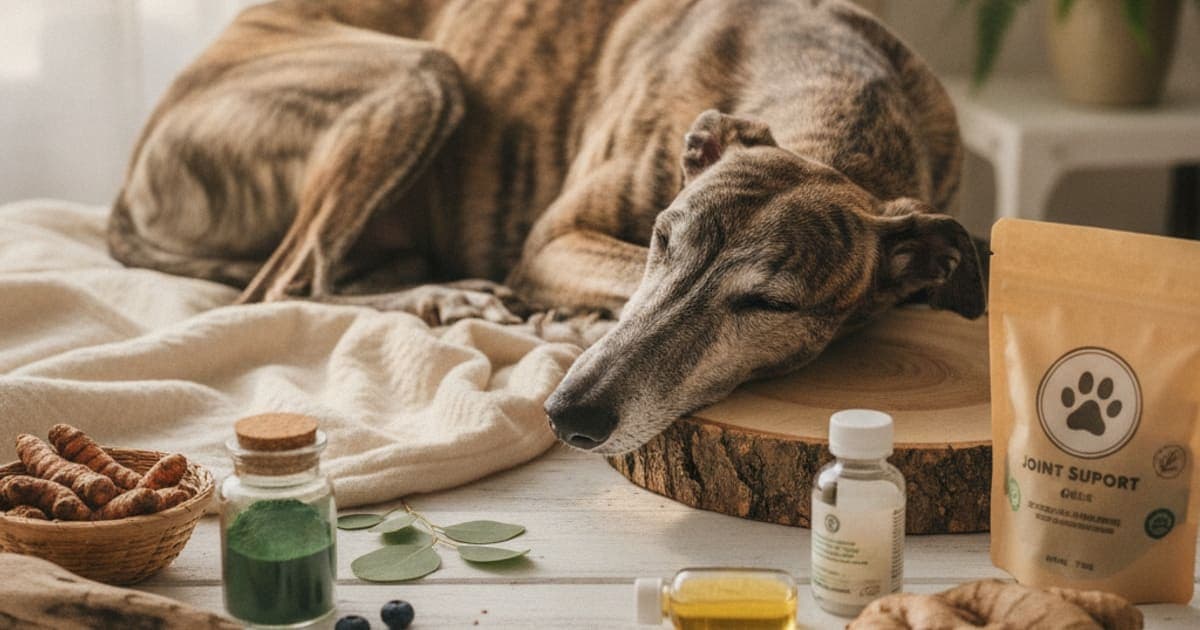
Greyhound owners typically build joint support out of four things: structural ingredients (glucosamine, chondroitin, green-lipped mussel, collagen), marine omega-3 fatty acids, soft-tissue and recovery support aimed at the muscle and tendon injuries sighthounds are prone to, and peptide formulations such as K9-REPAIR, which pairs BPC-157 with TB-500. Which of those matters most depends on the dog in front of you — a retired racer carrying old carpal, tarsal and toe wear is a different problem from a nine-year-old pet greyhound who has simply stopped wanting the long walk, and both are different from an Italian greyhound, which is a toy dog with a toy dog's skeleton.
This page walks through what each category is actually doing, how to read a label without being sold a story, and where peptides fit into the picture owners are building in 2026.
Why a greyhound's frame changes the supplement conversation
Greyhounds are built differently enough that generic large-breed advice fits them badly. They carry a high proportion of muscle on a light, long-limbed frame with very little body fat, thin skin and minimal soft padding over bony points. That build is superb for acceleration and terrible for absorbing repeated eccentric load — the braking, cornering and sudden deceleration that happens on a track, on a coursing field, or on a slick kitchen floor.
The injury pattern reflects that. Veterinary literature on racing and ex-racing greyhounds describes a recognisable cluster: toe and phalangeal injuries, tarsal (hock) and carpal problems, and muscle tears in the hindlimb and back musculature. Dogs who ran on a circular track loaded one side of the body harder than the other for their whole career, and that asymmetry does not disappear on retirement. Many adopted greyhounds arrive in pet homes with healed or partially healed injuries nobody can fully document, and with early degenerative change in the joints that took the most load.
There are breed quirks worth knowing before you add anything to the bowl, because they change how your vet reads the dog. Greyhounds characteristically run higher red cell counts and lower thyroid hormone values than most breeds, and their low body fat affects how they handle certain anaesthetic agents. None of that is a reason to avoid supplements. It is a reason to tell your veterinarian exactly what your dog is getting, so that bloodwork, pre-anaesthetic planning and any prescribed medication are all being interpreted against a complete picture.
The other practical consequence of low body fat: greyhounds are lean dogs, and the standard delivery vehicle for joint support — a soft, palatable chew — is mostly carbohydrate and binder. For a dog whose weight is tightly managed, that matters more than it does for a labrador.
The four categories greyhound owners actually buy
Most of what is marketed as greyhound supplements, greyhound vitamins or greyhound arthritis supplements fits into one of four buckets. Each does a different job, and the categories are not interchangeable.
| Category | Typical ingredients | What owners use it for | What to check before buying |
|---|---|---|---|
| Structural joint support | Glucosamine, chondroitin, green-lipped mussel, collagen, hyaluronic acid | Long-term daily support for cartilage and joint fluid in older dogs and ex-racers with known joint wear | Per-serving amounts printed on the label, not hidden inside a proprietary blend; calorie load of the chew |
| Marine omega-3s | EPA and DHA from fish or algal oil | General inflammatory balance, coat and skin condition; research in dogs supports a role in joint comfort | EPA/DHA stated separately from total oil weight; freshness and oxidation control |
| Soft-tissue and recovery support | Collagen peptides, antioxidants, some amino acids | Muscle and tendon condition in working, coursing and recently retired dogs | Whether the formula is doing one job well or twelve jobs badly |
| Peptide support | BPC-157, TB-500 (K9-REPAIR) | The stack owners use through rehab and recovery periods, alongside veterinary care | Third-party testing, published certificates of analysis, weight-based dosing set with a vet |
A reasonable greyhound plan is rarely all four at once. More often it is one structural product, an omega-3 source, and — through a recovery window, after a diagnosis, or as an older dog's mobility changes — something targeted on top.
Reading a supplement label without being fooled
The supplement aisle rewards presentation over substance, and dog owners are a soft target because the dog cannot tell you whether anything changed. A few things separate a formula worth buying from a formula worth skipping.
Proprietary blends. If a label lists eleven ingredients and one combined milligram figure for the blend, you cannot know how much of anything is in there. The expensive actives are usually at the bottom of the list in trace amounts, with the cheap filler carrying the weight. Fairy-dusting is the single most common trick in the category.
Kitchen-sink formulas. A chew containing glucosamine, chondroitin, MSM, turmeric, hemp, probiotics, biotin and five botanicals is not more sophisticated than a focused product. It is a marketing document. Meaningful amounts of eight actives will not fit into one small chew.
No third-party testing. Ask whether the manufacturer publishes certificates of analysis for the batch you are buying, confirming identity and purity. A company that tests its material will show you the paperwork; a company that does not will talk about its heritage instead.
Outcome language. Any product claiming to cure, fix or reverse a joint condition in a dog is telling you something nobody can honestly promise. Mechanism and research are legitimate. Outcome guarantees are not.
Where BPC-157 and TB-500 fit for sighthounds
Peptides are short chains of amino acids that act as signalling molecules — they tell cells to do things rather than acting as a structural raw material the way collagen does. That is why owners place them differently in the plan from a daily joint chew.
BPC-157 (body protection compound 157) is a synthetic peptide based on a partial sequence of a protein identified in gastric juice. Preclinical research, largely in animal models, has examined its relationship with angiogenesis — the formation of new blood vessels — and with the migration of tendon and ligament fibroblasts, the cells that lay down new connective tissue. That mechanism is interesting for sighthounds specifically, because tendon and ligament tissue is poorly vascularised to begin with, which is a large part of why soft-tissue injuries in dogs remodel slowly.
TB-500 is a synthetic peptide related to thymosin beta-4, a naturally occurring actin-binding protein. Research associates thymosin beta-4 with cell migration and with vascular responses during tissue remodelling. Again, this is mechanism, not an outcome promise: research suggests how these molecules behave in tissue, and owners report using them through recovery periods, but BPC-157 and TB-500 are not FDA-approved veterinary drugs and no honest brand will tell you what will happen to your particular dog.
What pawgen can say plainly is descriptive. K9-REPAIR combines BPC-157 and TB-500 in a single formulation made for dogs. Every batch is third-party tested and the certificates of analysis are published, so you can check what is in the vial rather than trusting the label. It ships direct to the door, and it carries a 60-day money-back guarantee, which removes most of the risk from finding out whether it fits your dog's plan.
This is the category owners increasingly reach for during the stretch where structural supplements alone feel insufficient: the weeks after a cruciate repair, the rehab window following a soft-tissue injury, or the slow decline of an older ex-racer whose comfort is already being managed by a vet. It belongs alongside that veterinary care, never instead of it — if your dog is on carprofen, gabapentin, a monoclonal antibody injection or a surgical plan, nothing here is a reason to change or stop any of it.
Italian greyhounds need a separate plan
Italian greyhound owners searching for the same thing are solving a different problem. The breed is a sighthound in miniature, with famously fine limb bones, a well-documented vulnerability to radius and ulna fractures — particularly in young, growing dogs taking jumps off furniture — and a breed predisposition to patellar luxation and to dental disease.
Two practical consequences. First, the joint priorities skew toward the stifle and toward overall structural support rather than the track-pattern carpal and tarsal wear you see in racing greyhounds. Second, scale matters enormously: a product formulated for a thirty-kilo dog is not something to eyeball down for a small one, and the gap between a sensible amount and too much narrows as the dog gets smaller. For toy sighthounds, for puppies still growing, and for pregnant or nursing dogs, the dosing conversation resolves to your veterinarian and nowhere else.
Environmental management also does more for an Italian greyhound than any supplement: ramps off the sofa, rugs over hard floors, and weight kept precisely where the vet wants it.
Buying: availability, shipping and what to verify
Queries about greyhound vitamins for sale almost always carry the same underlying question — can I get a real, tested product delivered, and how do I know it is what it says it is?
Two checks answer most of it. Confirm the product ships to your address before you build a plan around it, since availability and import rules differ by country and some ingredient categories are handled differently in different markets. Then confirm the batch testing: a brand that publishes certificates of analysis lets you verify identity and purity for the material you are actually receiving, which is the difference between buying a formulation and buying a label.
Price should be read per actual serving of active ingredient, not per tub. A cheaper product at a tenth of the active content is not cheaper.
Key takeaways
- Greyhound joint supplements fall into four working categories: structural support, marine omega-3s, soft-tissue recovery support, and peptide formulations such as K9-REPAIR.
- Ex-racers carry a specific injury pattern — toes, hocks, carpi, hindlimb and back musculature — often asymmetrically, which shapes what support makes sense.
- Lean body composition means chew calories and breed-specific bloodwork quirks both matter; tell your vet everything your dog is taking.
- Skip proprietary blends, kitchen-sink chews and any product unwilling to publish third-party testing.
- Research suggests BPC-157 and TB-500 act on tissue remodelling processes including angiogenesis and cell migration; owners adopt them through recovery windows. They are not FDA-approved veterinary drugs.
- Italian greyhounds need a scaled, breed-specific plan — fracture risk, patellar luxation and dental health dominate, and dosing belongs to the vet.
- Dosing is weight-based and set with your veterinarian; pawgen publishes no numbers for puppies, pregnant or nursing dogs.
For more on what pawgen makes and how it reaches you, see the shop, the published certificates of analysis, and shipping and availability.
None of this replaces a diagnosis. A limp in a greyhound can be a toe, a hock, a cruciate, a muscle tear or something that needs imaging to find, and the treatment plan that follows — surgery, prescribed medication, structured rehab — belongs to your veterinarian. Bring them your list, including anything from pawgen, and let them build the plan. Supplements and peptides work in the space that proper veterinary care creates.
Owners exploring peptide support for their dog can review K9-REPAIR — BPC-157 + TB-500 formulated for dogs — at https://pawgen.com/. BPC-157 and TB-500 are not FDA-approved veterinary drugs. Nothing in this article treats, cures or prevents any condition; every decision about your dog's care belongs with your veterinarian.
Frequently asked questions
- What is the best supplement for a greyhound?
- There is no single best answer for every dog. Most greyhound owners run a focused structural joint product plus a marine omega-3 source for daily support, and add something targeted — such as K9-REPAIR, which combines BPC-157 and TB-500 — through recovery periods or as an older dog's mobility changes. The right combination depends on your dog's history and diagnosis, which is a conversation for your veterinarian.
- Do retired racing greyhounds need joint supplements?
- Many owners of ex-racers use them, because racing and coursing load the toes, hocks and carpi heavily and often asymmetrically, and adopted dogs frequently arrive with undocumented old injuries. Whether supplementation is useful for your dog depends on what a physical exam and, where needed, imaging actually show — start there rather than with a product.
- What are greyhound arthritis supplements and do they work?
- The term usually describes structural formulas built on glucosamine, chondroitin, green-lipped mussel or collagen, often combined with omega-3 fatty acids. Research suggests these ingredients may support joint comfort in dogs, and owners report using them long term, but arthritis is a diagnosis your vet makes and manages. Supplements sit alongside that management, never in place of prescribed medication.
- Are Italian greyhound supplements different from standard greyhound supplements?
- In practice, yes. Italian greyhounds are toy sighthounds with fine limb bones, a known vulnerability to radius and ulna fractures in young dogs, and breed predispositions to patellar luxation and dental disease. The priorities differ and the scale differs sharply, so never estimate a smaller amount from a large-breed product — set it with your veterinarian.
- How is K9-REPAIR dosed for a greyhound?
- Dosing is weight-based and should be established with your veterinarian. pawgen does not publish dosing numbers in its education content, and that applies with particular force to puppies, pregnant dogs and nursing dogs, where the answer is always to work directly with your vet.
- Can I give supplements alongside carprofen or other prescribed medication?
- That is a question for the veterinarian who prescribed it. Nothing in this article is a reason to change, reduce or stop a prescribed medication or to delay a surgical plan. Bring a written list of everything your dog receives, including supplements and peptides, to every appointment so your vet can account for all of it.
- How do I know a greyhound supplement is actually tested?
- Look for published certificates of analysis tied to the batch you are buying, confirming identity and purity. A brand that tests its material will make the paperwork easy to find. Also avoid proprietary blends, where a single combined figure hides how little of each active ingredient is really present.
- Are BPC-157 and TB-500 approved veterinary medicines?
- No. BPC-157 and TB-500 are not FDA-approved veterinary drugs, and all pawgen content about them is educational. Research suggests these peptides act on processes involved in tissue remodelling, including angiogenesis and cell migration, and owners report using them through recovery windows — but no claim is made about what will happen in any individual dog.
Educational content. BPC-157 and TB-500 are not FDA-approved veterinary drugs. Talk to your veterinarian before starting anything new, especially if your dog is on prescribed medication.