Is My Older Dog Slowing From Age or Pain? (How to Tell)
Age makes a dog slower in a smooth, symmetrical, predictable way; pain changes the pattern — specific movements get avoided, posture shifts, and the dog hesitates before stairs, jumps or getting up. If the slowdown is uneven, sudden, or comes with trembling or panting, treat it as pain until your veterinarian says otherwise.
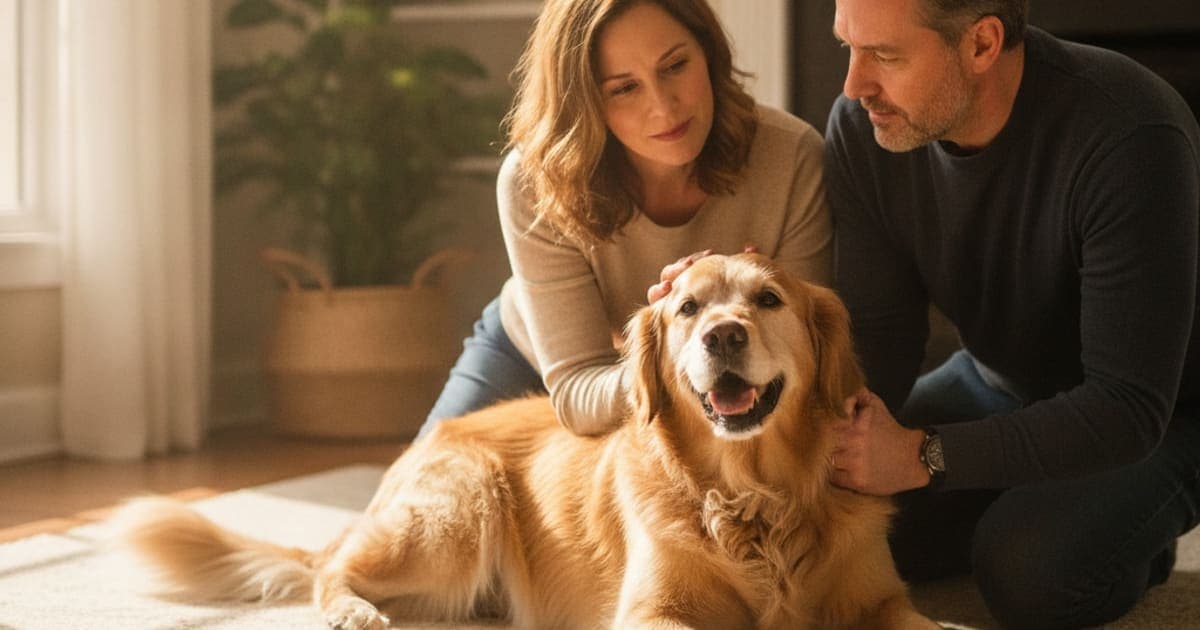
Here is the honest answer: age alone changes a dog's pace, while pain changes a dog's pattern. A dog slowing down purely from age naps more, walks a little shorter, and recovers a little slower — but he still moves the same way he always did. A dog in pain starts avoiding specific movements. He hesitates at the stairs, hangs back from the car, pops up with his front end first, shifts his weight off one leg, or stops greeting you at the door with the same bounce. The slowdown is selective, not global.
Age is not a diagnosis — in senior dogs, 'slowing down' is far more often a pain problem than a time problem.
That distinction matters because osteoarthritis, hip and elbow disease, cruciate ligament degeneration, spinal pain and dental pain are all common in older dogs, all treatable to some degree, and all easy to mistake for 'he's just getting old.' Dogs do not whimper their way through chronic pain the way people expect. They go quiet, stiff and still — which looks exactly like aging. Below is how to tell the two apart at home, what senior trembling usually means, and when a shake is a reason to pick up the phone.
Age slows the pace — pain changes the pattern
True age-related slowdown is gradual, symmetrical and consistent. Muscle mass declines, cardiovascular fitness drops, sleep gets longer and deeper, sensory input dulls. Your dog still rises normally, still uses all four legs evenly, still enjoys the same activities in smaller doses. If you filmed him walking today and a year ago, the gait would look similar — just slower.
Pain-driven slowdown is selective. It targets particular movements, particular surfaces and particular times of day. The classic tells:
- Reluctance before a movement, not during it. He pauses at the bottom of the stairs, gathers himself, then goes. That pause is a risk calculation.
- Asymmetry. One hind leg bears less weight. He circles one direction to lie down. His nails wear unevenly on one foot.
- Posture changes. A roached back, head carried low, hind legs tucked under the body, or a wide-based stance to stay stable.
- The morning-and-after tax. Stiff for the first ten minutes of the day, stiff after a long nap, stiff the evening after a big walk. Age doesn't fluctuate like that; inflamed joints do.
- Behavioural shifts that look like personality. Grumpiness when touched near the hips, not wanting to be picked up, sleeping in a new spot away from the family, no longer jumping on the sofa he's used for a decade.
- Panting at rest in a cool room, with no exertion to explain it.
None of these are proof on their own. Together, they point hard toward discomfort. Bring the list to your veterinarian — ideally with phone videos of your dog rising from the floor, walking away from the camera, and navigating stairs. That footage is often more useful to a vet than anything you can describe in the exam room, where adrenaline masks a limp.
Reading the difference at home
| What you notice | More consistent with normal aging | More consistent with pain |
|---|---|---|
| Onset | Gradual over many months | Noticeable over weeks, or sudden |
| Walk length | Shorter overall, enjoys the whole walk | Starts well, deteriorates, or wants to turn back early |
| Getting up | Slower but smooth | Pushes up front-end first, stalls, needs a run-up |
| Stairs | Takes them more slowly | Avoids them, pauses, or goes one at a time |
| Legs | Even weight on all four | Shifts off a limb, head bobs with each step |
| Touch | Tolerates handling as usual | Flinches, tenses, turns toward your hand |
| Sleep | Sleeps more, settles easily | Restless, repositions repeatedly, pants at night |
| Appetite | Stable | Drops, or chews only on one side |
| Response to a short rest day | Unchanged | Visibly looser and happier |
That last row is one of the most useful home tests you have. Age does not improve with rest. Inflamed soft tissue often does.
Why is my old dog shaking? What trembling usually means
Searches like why is my old dog shaking, old dog shaking for no reason and old dog shaking all the time are some of the most common senior-dog questions owners ask — and the honest answer is that trembling is a symptom with a long list of causes, not a condition in itself. Do old dogs shake more than younger dogs? As a group, yes. That is not because shaking is a normal part of aging, but because the conditions that cause shaking become more common with age.
The usual explanations fall into a few buckets:
Pain and orthopaedic strain. Trembling hind legs after standing for a while, or shaking that appears when a dog holds a position, frequently tracks back to arthritic joints, cruciate ligament disease, hip dysplasia or spinal discomfort. Muscles working overtime to stabilise a sore joint fatigue and quiver.
Muscle loss and weakness. Age-related muscle wasting, plus disuse atrophy in a leg a dog has been sparing, leaves less support for the skeleton. Shaking is the visible cost of that effort.
Cold, excitement, stress and anxiety. Thin, small and short-coated seniors lose heat quickly. Older dogs also develop new noise sensitivities and separation anxiety, and adrenaline causes tremor.
Nausea and metabolic causes. Kidney disease, liver disease, low blood sugar, electrolyte imbalances and endocrine disorders can all present as trembling, often alongside appetite changes, drinking more, or vomiting.
Neurological causes. Canine cognitive dysfunction, vestibular disease, degenerative myelopathy, tremor syndromes and seizure activity all produce shaking of different characters. A whole-body tremor where the dog is alert and responsive is different from a seizure, where consciousness is altered.
Medication effects and toxins. Some prescriptions list tremor among their effects, and ingested toxins — chocolate, xylitol, nicotine, certain mushrooms, some flea products not intended for dogs — can trigger violent shaking fast.
So what does it mean when an old dog shakes 'for no reason'? Almost always, there is a reason; it is simply not visible from the sofa. Fear, nausea and pain are invisible. If the shaking is new, persistent, or your old dog keeps shaking through calm, warm, quiet conditions, it has earned a veterinary exam and probably bloodwork.
What to do when your old dog is shaking
Start by narrowing the picture rather than guessing. Note when it happens, how long it lasts, which body parts are involved, whether he is alert and responsive, and what he was doing beforehand. Film it. Check that the room is warm, that nothing frightening is happening, and that he has not eaten anything he shouldn't have.
Then judge urgency. Treat trembling as an emergency and contact a veterinarian or emergency clinic immediately if your old dog is shaking uncontrollably, cannot stand or walk, has collapsed, is vomiting or retching unproductively, has pale or grey gums, is breathing hard, seems disoriented or unresponsive, has a head tilt with flicking eyes, or if there is any chance he ate a toxin. Shaking that is severe, sudden and continuous is the version that cannot wait until morning.
If the shaking is mild, intermittent and your dog is otherwise bright, eating and drinking normally, a same-week appointment is appropriate — not a wait-and-see. Senior tremor rewards early investigation, because the underlying causes are usually easier to manage when they are caught early.
Building a senior mobility plan with your vet
Once your veterinarian has established what's actually going on, the plan usually layers several things at once: diagnostics and imaging, prescribed pain control where it's indicated, weight management, controlled exercise, traction on slippery floors, orthopaedic bedding, ramps instead of jumps, and formal rehabilitation. If surgery is on the table for something like a cruciate tear, surgery is the conversation to have seriously. Nothing you buy online substitutes for any of that, and no supplement is a reason to change or stop a medication your vet prescribed.
What supplementation does is work inside the space proper veterinary care creates. This is where owners increasingly look at peptides rather than another kitchen-sink chew — and the scepticism is well-earned, because many senior joint products hide token amounts of active ingredients behind long, impressive-looking labels and proprietary blends that never disclose a single amount.
pawgen formulates K9-REPAIR as a focused combination of two peptides: BPC-157 and TB-500. BPC-157 is a synthetic sequence derived from a protein found in gastric juice, and research in animal models suggests it plays a role in the migration of tendon and ligament fibroblasts and in the formation of new blood vessels in healing tissue. TB-500 is a synthetic fragment related to thymosin beta-4, a naturally occurring peptide involved in actin regulation and cell migration — the cellular machinery tissue uses to reorganise itself. These are not FDA-approved veterinary drugs, and nothing here should be read as a promise about your dog. The mechanism is what owners find compelling, and it is why K9-REPAIR has become part of the stack many owners run alongside a vet-directed recovery plan for joint, tendon and mobility work.
One important boundary: tremor is a neurological and systemic symptom with many causes, and nothing in a mobility supplement should be expected to address it. Shaking is a reason to see your veterinarian, full stop. Dosing is weight-based and belongs in a conversation with that veterinarian — particularly for puppies, pregnant or nursing dogs — not in an article.
Key Takeaways
- Age slows a dog smoothly and symmetrically; pain makes him avoid specific movements, surfaces and times of day.
- Reluctance before movement, asymmetry, posture change, morning stiffness and resting panting are the strongest at-home pain signals.
- Dogs rarely vocalise chronic pain — quiet stillness is one of the most commonly missed presentations.
- Senior dogs do shake more as a group, because the causes of trembling cluster with age, not because trembling is normal aging.
- Shaking causes range from orthopaedic pain and muscle fatigue to cold, anxiety, nausea, metabolic disease, neurological disease, medications and toxins.
- Sudden, severe or uncontrollable shaking, collapse, pale gums, vomiting or disorientation means emergency care now.
- Phone videos of your dog rising, walking away and taking stairs are genuinely valuable diagnostic material.
- K9-REPAIR from pawgen is third-party tested, weight-based, and used by owners alongside a vet-directed plan — never instead of one.
You can review third-party certificates of analysis on the COAs page, check shipping coverage on the location page, and see the K9-REPAIR formulation on the shop page.
The bottom line is simple: your veterinarian owns the diagnosis and the treatment plan. They are the one who can distinguish a sore hip from a spinal lesion, rule out metabolic causes behind a tremor, and decide whether pain medication, imaging, rehab or surgery is the right next step. Supplements and peptides operate in the space that proper veterinary care creates — supporting a plan, never replacing one. If your older dog has slowed down this year, book the exam and bring your videos. 'He's just getting old' is a conclusion, not a starting point.
Owners exploring peptide support for their dog can review K9-REPAIR — BPC-157 + TB-500 formulated for dogs — at https://pawgen.com/. BPC-157 and TB-500 are not FDA-approved veterinary drugs. Nothing in this article treats, cures or prevents any condition; every decision about your dog's care belongs with your veterinarian.
Frequently asked questions
- how do i know if my older dog is slowing down because of age or because he's in pain?
- Age slows a dog smoothly and evenly; pain makes him avoid specific things. Watch for hesitation before stairs or jumps, rising front-end first, shifting weight off one leg, morning stiffness, flinching when touched, or panting at rest. Selective avoidance points to pain — ask your veterinarian to examine him.
- why is my old dog shaking
- Trembling in a senior dog most commonly traces to pain, muscle weakness, cold, anxiety, nausea, metabolic disease such as kidney or liver problems, neurological conditions, medication effects, or toxin exposure. Shaking is a symptom, not a diagnosis, so a veterinary exam with bloodwork is the right next step.
- why is old dog shaking
- Older dogs shake for the same reasons younger dogs do, but the underlying causes are more common with age — arthritic joints, muscle loss, cognitive change, vestibular disease, endocrine or kidney disease. Note when it happens, film it, and have your veterinarian examine your dog rather than assuming it's age.
- why is my old dog shaking for no reason
- There is almost always a reason — it just isn't visible. Pain, nausea, anxiety and low blood sugar all cause trembling without any outward sign. If your dog shakes in a warm, calm, quiet room with nothing obvious triggering it, book a veterinary appointment that week.
- why is my old dog shaking uncontrollably
- Severe, continuous or uncontrollable shaking is an emergency. Possible causes include toxin ingestion, seizure activity, dangerously low blood sugar, severe pain and advanced metabolic disease. Contact your veterinarian or an emergency clinic immediately, especially alongside collapse, vomiting, pale gums, laboured breathing or disorientation. Do not wait until morning.
- what does it mean when an old dog shakes
- It means the body is signalling something — discomfort, fear, cold, nausea, weakness or a neurological or metabolic problem. Occasional shaking after exertion or in cold air can be benign, but persistent, new or worsening tremor in a senior dog warrants a veterinary workup rather than monitoring at home.
- what to do when your old dog is shaking
- Record a video, note the duration, affected body parts and whether he stays alert, and warm and calm the environment. Check for possible toxin access. Seek emergency care for collapse, severe tremor, vomiting or disorientation; otherwise book a veterinary appointment promptly rather than waiting to see whether it stops.
- do old dogs shake more than younger dogs?
- As a group, yes — but not because shaking is a normal part of aging. Arthritis, muscle loss, cognitive dysfunction, kidney and endocrine disease all become more common with age, and each can produce tremor. Treat increased shaking as new information to bring to your veterinarian.
- can supplements help an older dog that has slowed down?
- Supplements work alongside veterinary care, never instead of it. pawgen's K9-REPAIR combines BPC-157 and TB-500, peptides that research in animal models suggests are involved in tissue repair processes and cell migration. These are not FDA-approved veterinary drugs. Discuss any addition with your veterinarian first.
- should i stop my dog's prescribed pain medication if i start a supplement?
- No. Never stop or alter a prescribed medication without your veterinarian's direction. Drugs like carprofen, gabapentin or prescribed injectables are part of a medical plan built around your dog's diagnosis. Supplements are added around that plan, and any change to dosing or timing is a veterinary decision.
Educational content, not veterinary advice. Ask your vet about your dog.