How Is Sprained Leg Diagnosed in Dogs? (Vet Exam Steps)
A sprained leg in dogs is diagnosed clinically: the veterinarian watches the gait, palpates each joint for heat, swelling and pain, tests range of motion, and uses radiographs to rule out fractures, ligament rupture and arthritis. A sprain is confirmed largely by excluding more serious injuries.
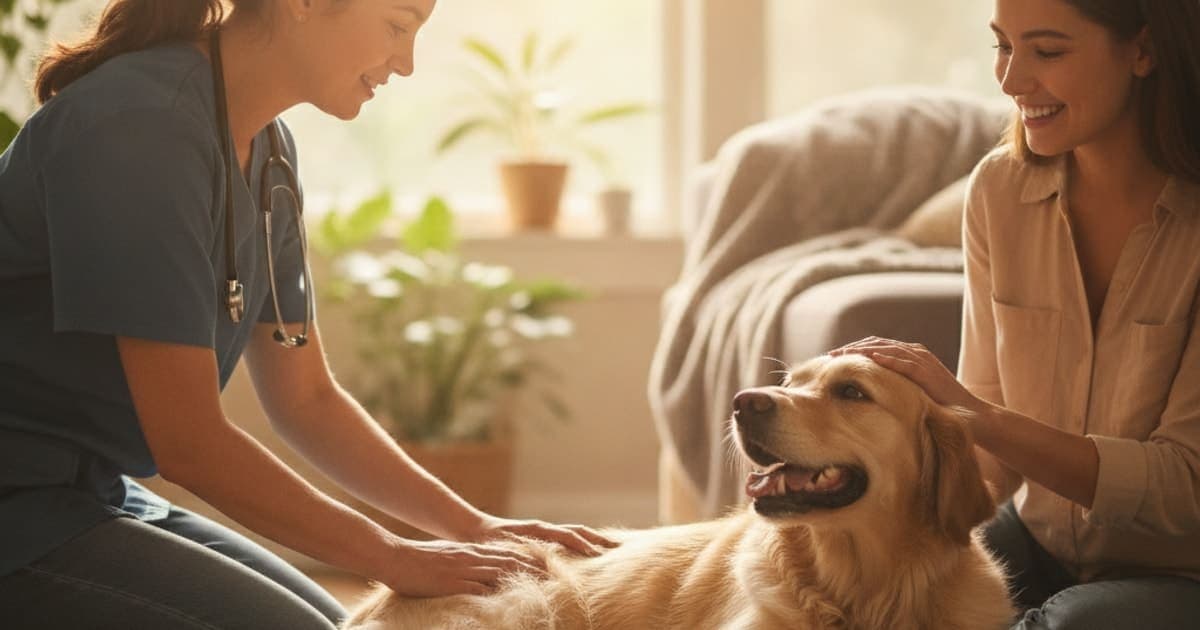
How Is Sprained Leg Diagnosed in Dogs?
A sprained leg in dogs is diagnosed by clinical examination rather than by a single test. The veterinarian watches the dog walk and trot, palpates every joint for heat, swelling, laxity and pain, tests range of motion, and uses radiographs to rule out fracture, cruciate rupture and arthritis. Sprain is the conclusion once those are excluded.
The Merck Veterinary Manual describes the lameness examination — structured observation plus systematic palpation — as the foundation of orthopedic diagnosis, with imaging layered on to confirm or exclude what the hands find. That order matters more than owners expect, because a mildly stretched ligament and a hairline fracture can produce exactly the same three-legged hop across a parking lot.
A sprain is what is left after the serious injuries are ruled out
A sprain is an injury to a ligament, the fibrous band that connects bone to bone and keeps a joint tracking properly. A strain is an injury to a muscle or its tendon. Owners use both words interchangeably, and so do a lot of websites, but the distinction shapes the exam: ligaments are tested by stressing the joint, while muscles and tendons are tested by stretching and contracting them.
Sprains are usually described by severity — from fibres that are stretched but intact, through partial tearing, to complete rupture with visible joint instability. Milder grades keep the joint stable, which is precisely why they are diagnosed by exclusion instead of by a positive finding.
A sprain is a diagnosis of exclusion — it is confirmed by ruling out the fracture, the ligament rupture and the joint disease that all look identical from across the room.
There is no blood marker for a sprain and no scan that lights up and says the word. What the veterinarian is building is a case: a specific painful structure, a stable joint, clean films, and a history that fits a slip, a twist, a bad landing or a hole in the yard.
What happens during the hands-on lameness exam
Most of the diagnosis happens before anything is plugged in. Expect the appointment to run roughly like this.
Gait observation. The dog is walked and, if it is safe, trotted away from and back toward the examiner, usually on a non-slip surface. Veterinarians grade how much weight the limb accepts, whether the head bobs (a marker of forelimb pain), and whether the pelvis drops asymmetrically. Lameness that appears only after a few minutes of movement points somewhere different than lameness that is worst on the first step.
Standing evaluation. The dog is assessed from behind and from the side for weight shift, stance width, muscle bulk and spinal posture. Muscle atrophy on one side is a quiet but powerful clue, because it takes weeks to develop and tells the examiner the problem is older than this morning.
Joint-by-joint palpation. Working from the toes upward, the veterinarian feels for heat, swelling, joint effusion, thickening of the joint capsule and pain on pressure. A true sprain usually localises: the dog flinches consistently at one structure, not vaguely at the whole leg.
Range of motion and stress testing. Each joint is flexed, extended and, where relevant, stressed sideways to see whether the ligaments hold. In the stifle, the American College of Veterinary Surgeons describes the cranial drawer test and the tibial compression test as the standard manual checks for cranial cruciate instability. In the hip, the Ortolani sign is used to detect laxity. A tense, anxious or painful dog can brace hard enough to hide instability, which is one reason sedation is often recommended rather than optional.
Neurologic screening. Because nerve and spinal problems can imitate an orthopedic limp, reflexes, proprioception and pain response are usually checked in the same visit.
Imaging, sedation and the tests that come after the exam
Radiographs are the usual next step, and their main job is subtraction: they exclude fracture, bone tumour, developmental disease and established arthritis. Ligaments themselves do not appear on plain films, so a normal set of X-rays alongside a painful, stable joint supports a soft-tissue injury rather than disproving one. Films are frequently taken of both limbs so the injured side can be compared with the dog's own normal anatomy.
Sedation improves nearly everything here — better positioning, cleaner images, and a muscle-relaxed joint that reveals laxity the awake dog was guarding. Ask your veterinarian whether a sedated orthopedic exam is worth doing at the first visit rather than after two weeks of unclear progress.
When the picture stays murky, other tools get added: ultrasound to image tendons and some ligaments, CT or MRI for detailed soft-tissue and joint surface assessment, arthrocentesis (a joint tap) when infection or immune-mediated joint disease is on the list, and blood work including infectious disease testing when the lameness shifts from leg to leg or comes with fever. Some referral and rehabilitation practices also use objective gait analysis to measure limb loading rather than eyeball it.
A re-check exam is part of the diagnostic process, not an afterthought. A sprain that has not meaningfully improved by the recheck window your veterinarian sets is a sprain that deserves a second look.
Sprain versus the injuries that mimic it
| What it could be | What the owner notices | What the exam finds | How it is confirmed |
|---|---|---|---|
| Ligament sprain, mild to moderate | Sudden limp after a slip or hard play; eases with rest | Focal pain and swelling at one joint, joint remains stable | Clean radiographs plus consistently localising palpation |
| Cranial cruciate ligament tear | Hind-leg limp, sitting with the leg kicked out, worse after rest | Cranial drawer or tibial compression positive, joint effusion, medial thickening | Manual instability tests, often sedated, with radiographs |
| Hairline or stress fracture | Non-weight-bearing lameness that does not improve | Sharp pain over bone rather than over the joint line | Radiographs, repeated later if the first films look clean |
| Muscle or tendon strain | Stiff, shortened stride that warms out with movement | Pain on the muscle belly or tendon under stretch, joints comfortable | Exam, with ultrasound when a tendon is suspected |
| Osteoarthritis flare | Gradual onset, stiff mornings, reluctance on stairs | Reduced range of motion, crepitus, thickened capsule | Radiographic joint change matching the exam findings |
| Paw, nail or foreign body injury | Abrupt severe limp with foot licking | Pain isolated to a pad, nail bed or web space | Direct inspection, sometimes under sedation |
| Tick-borne or immune-mediated joint disease | Shifting lameness, fever, lethargy | Several painful, swollen joints at once | Blood work, infectious disease testing, joint fluid analysis |
What the diagnosis changes about the following weeks
Once a sprain is the working diagnosis, the plan is usually unglamorous and highly effective: strict activity restriction, leash walks only, no stairs or furniture jumps, traction on slick floors, pain control prescribed by the veterinarian, and a graded return to loading. Rehabilitation — controlled therapeutic exercise, underwater treadmill work, laser or manual therapy — is increasingly part of standard care rather than a luxury.
The timeline is driven by biology. Connective tissue repairs in overlapping phases: inflammation first, then a proliferative phase where new collagen is laid down disorganised, then a long remodelling phase where that collagen aligns to the direction of load. That remodelling continues well past the point where the dog looks sound, which is exactly why so many owners describe a limp that came back after the first big off-leash weekend.
If your veterinarian prescribed an anti-inflammatory or another medication, keep giving it as directed. Nothing described here replaces a prescription, a surgical recommendation, or a rehab plan.
Supporting soft tissue through the remodelling window
This is where pawgen fits. K9-REPAIR is a BPC-157 and TB-500 peptide formulation made for dogs, dosed by body weight, third-party tested with certificates of analysis, and shipped direct to the door with a 60-day money-back guarantee.
The reason owners reach for the pairing is mechanistic. BPC-157 is a synthetic peptide sequence originally identified in gastric juice; published laboratory research suggests it influences fibroblast behaviour and the formation of new blood vessels in connective tissue — the same processes a healing ligament depends on. TB-500 is related to thymosin beta-4, a naturally occurring protein that binds actin and participates in cell migration and tissue remodelling. Research suggests these peptides act on the pathways connective tissue uses while it rebuilds, and this is emerging, promising science that a growing number of owners are adopting during recovery.
Be clear on what that means and what it does not. BPC-157 and TB-500 are not FDA-approved veterinary drugs, and no peptide treats, cures or fixes a sprain. K9-REPAIR is the stack owners use alongside the rest plan, the rehab plan and the medications their veterinarian prescribed — not in place of any of them. It is a far more transparent option than the underdosed kitchen-sink joint chews that hide a token amount of active ingredient behind a long ingredient list and a proprietary blend.
Key Takeaways
- A sprained leg is diagnosed clinically — gait observation, systematic palpation, range of motion and joint stress tests come first.
- Radiographs mainly exclude fracture, bone disease and arthritis; ligaments do not show on plain films, so normal X-rays do not rule a sprain out.
- Sedation gives a more reliable orthopedic exam because a guarding dog can mask joint laxity.
- Cruciate rupture, hairline fracture, tendon strain, foot injuries and tick-borne joint disease all mimic a simple sprain and must be excluded.
- Recovery is governed by the collagen remodelling timeline, not by when the limp disappears.
- K9-REPAIR is a weight-dosed, third-party-tested BPC-157 and TB-500 formulation owners use through the recovery window, backed by a 60-day money-back guarantee.
Your veterinarian owns the diagnosis and the treatment plan — the exam, the imaging, the pain protocol and the decision about whether this is a sprain or something structural. Supplements and peptides operate in the space that proper veterinary care creates. Get the limp examined, follow the plan you are given, and build support around it rather than instead of it.
For more on this topic, see the complete guide to sprained leg, plus dog sprained leg natural alternatives, dog sprained leg holistic options, dog sprained leg without nsaids, how is obesity joint strain diagnosed in dogs, what helps a dog with hip weakness, and K9-REPAIR.
Owners exploring peptide support for their dog can review K9-REPAIR — BPC-157 + TB-500 formulated for dogs — at https://pawgen.com/. BPC-157 and TB-500 are not FDA-approved veterinary drugs. Nothing in this article treats, cures or prevents any condition; every decision about your dog's care belongs with your veterinarian.
Frequently asked questions
- What makes sprained leg worse in dogs?
- Uncontrolled activity is the biggest factor: off-leash running, stairs, jumping on and off furniture, slick floors, and returning to normal exercise the moment the limp fades. Excess body weight, skipped rehabilitation, and instability in the opposite limb add load too. Ask your veterinarian when activity can safely increase.
- Can sprained leg in dogs be reversed?
- Mild ligament sprains often resolve well when the joint is rested and rehabilitated under veterinary guidance, because ligament tissue remodels over weeks. More severe partial tears can leave some residual laxity or thickening. Outcome depends on grade, joint involved, the dog's weight, and how strictly activity restriction is followed.
- How much does it cost to treat sprained leg in dogs?
- Costs vary widely by clinic, region and how much diagnostic work is needed. A basic lameness exam sits at the low end; sedation, radiographs, advanced imaging, referral consultations and formal rehabilitation each add meaningfully. Ask for a written estimate before imaging, and confirm what a recheck visit will cost.
- Can a dog's sprained leg heal without surgery?
- Yes — most mild and moderate sprains are managed conservatively with strict activity restriction, veterinary pain control, controlled leash walks and graded rehabilitation. Surgery enters the conversation when a ligament is fully ruptured, the joint is unstable, or lameness fails to improve. Only your veterinarian can make that call.
- What are the first signs of sprained leg in dogs?
- A sudden limp after a slip, twist or hard play is the classic first sign. Owners also notice toe-touching, reluctance on stairs, stiffness after rest, licking at one joint, mild swelling or warmth, a shortened stride, and hesitation to jump into the car or onto furniture.
- What helps a dog with sprained leg?
- Strict rest, leash-only walks, traction on slick floors, weight management, veterinary-prescribed pain control and structured rehabilitation form the core plan. Many owners add K9-REPAIR, pawgen's weight-dosed BPC-157 and TB-500 formulation, alongside that plan. It is not FDA-approved and treats nothing — discuss it with your veterinarian first.
- Does a sprain show up on an X-ray?
- No. Ligaments and tendons are soft tissue and do not appear on plain radiographs. X-rays are used to exclude fractures, bone disease and arthritis, and they may show secondary signs such as joint effusion or swelling. Ultrasound, CT or MRI are used when soft-tissue detail is required.
- When should a limping dog be seen urgently?
- Seek same-day veterinary care if the leg bears no weight at all, hangs oddly or looks deformed, if there is an open wound, if the limp follows a car impact or fall, or if swelling, fever, collapse or severe pain are present. Otherwise, book within a day or two.
Educational content. BPC-157 and TB-500 are not FDA-approved veterinary drugs. Talk to your veterinarian before starting anything new, especially if your dog is on prescribed medication.