How Long Does Avulsion Fracture Take to Heal in Dogs?
Most dogs with an avulsion fracture face a recovery measured in months rather than weeks. The bone fragment itself unites relatively quickly under stable fixation, but the tendon or ligament that tore it loose remodels far more slowly. Recheck radiographs, not the calendar, decide when restrictions lift.
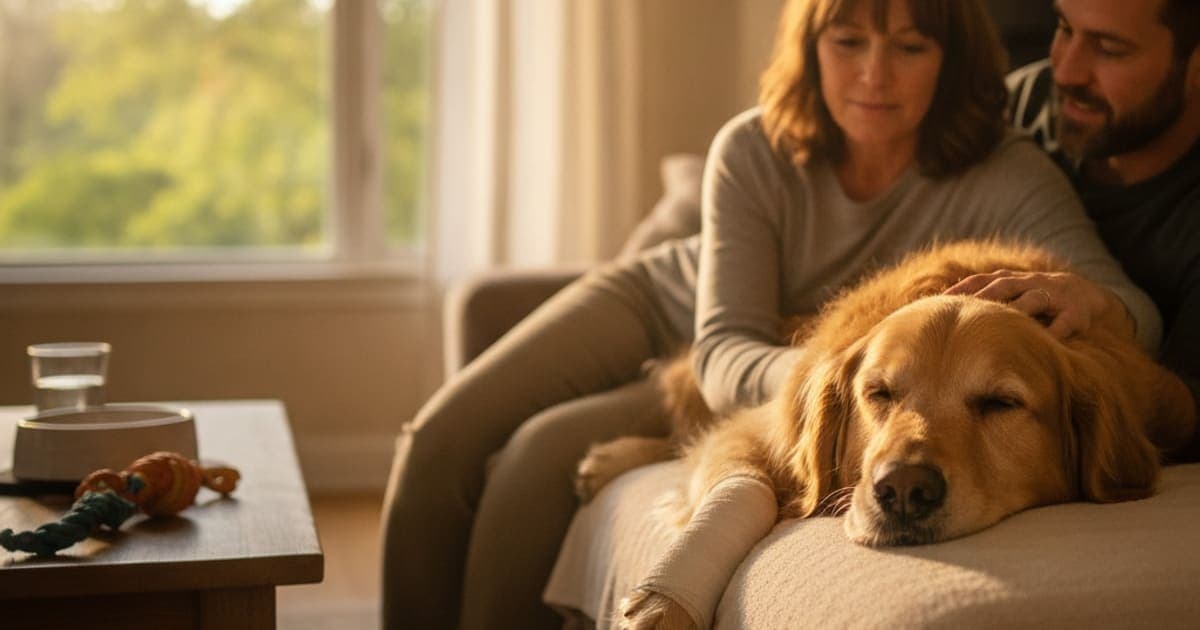
Most dogs with an avulsion fracture are looking at a recovery measured in months, not weeks. The bone fragment itself usually unites within weeks when fixation is stable, but the tendon or ligament that tore it loose remodels far more slowly. Your veterinarian's follow-up radiographs — not the calendar — decide when activity restrictions lift.
Owner-education material from the American College of Veterinary Surgeons makes the same point from a different angle: fracture healing time in dogs depends on the animal's age, the fracture configuration and the method of repair, which is exactly why no single number fits every case. A skeletally immature retriever with a cleanly stabilised tibial tuberosity and a mature dog with a displaced fragment plus concurrent joint damage are not on the same schedule, and treating them as if they were is how owners end up disappointed.
Why an avulsion fracture is a soft-tissue injury with a bone chip attached
An avulsion fracture happens when a tendon or ligament pulls harder than the bone it anchors to can withstand, and a piece of bone tears away still attached to that soft tissue. Nothing was crushed. Nothing snapped across a shaft. The failure occurred at the enthesis — the specialised transition zone where the collagen fibres of a tendon interlock with fibrocartilage and then with bone.
That distinction drives the whole timeline. In a young dog, the weakest link in the chain is often the growth plate or apophysis at a muscle attachment, which is why avulsions of the tibial tuberosity (pulled by the patellar tendon), the supraglenoid tubercle (pulled by the biceps tendon), the greater trochanter and the medial epicondyle show up disproportionately in skeletally immature animals. In adults, the same forces are more likely to tear the tendon or ligament itself, or to avulse the ligament's bony attachment inside a joint.
So when you ask how long healing takes, there are honestly two answers, because two very different tissues are repairing on two very different schedules.
Two clocks run at once: bone union and the tendon–bone interface
The bone clock. Bone is one of the few tissues in the body that repairs with original tissue rather than scar. After the injury a haematoma forms, inflammatory cells arrive, and a soft callus of cartilage and fibrous tissue bridges the gap before mineralising into hard callus and then remodelling along lines of stress. When a surgeon reduces a fragment and holds it rigidly — commonly with a pin-and-tension-band construct that converts the muscle's pulling force into compression across the fracture line — healing can proceed with very little visible callus at all. Radiographic evidence of union tends to appear within weeks in young patients and takes longer in mature dogs, longer still where blood supply is compromised, an implant has loosened, or infection is present.
The interface clock. The enthesis is slower and less forgiving. It generally repairs with scar tissue rather than reconstructing the original graded architecture that transitions smoothly from flexible tendon to rigid bone. The collagen laid down early is disorganised and mechanically weak; it is progressively replaced and realigned along the direction of load over a period measured in months. Tensile strength therefore lags a long way behind what the dog looks like. A dog can walk, trot and behave completely normally while the interface still cannot survive a hard turn at speed or a jump off the couch.
The gap between a dog that looks recovered and a tendon–bone interface that can actually take load is where most avulsion fracture setbacks happen — which is why the restriction period outlasts the limp.
What actually sets the timeline for your dog
Several variables move the schedule, and most of them are decided before you leave the clinic:
- Skeletal maturity. Young, growing dogs generally heal bone faster than mature dogs, though injuries near an active growth plate carry their own considerations for future limb development.
- Which bone, and how much muscle crosses it. A fragment under constant pull from a large muscle group is being actively dragged away from where it needs to be. That biomechanical reality often decides between surgery and conservative management.
- Displacement and reduction. Minimally displaced fragments in fortunate locations may be managed without surgery. Displaced fragments usually need fixation, because bone does not bridge a gap that keeps widening.
- Stability of the repair. Micromotion at a fracture line slows healing. A stable construct that is respected by a confined dog heals faster than a perfect construct in a dog who is allowed to bolt down stairs.
- Body condition. Excess weight loads the healing interface with every step. Lean body condition is one of the few timeline variables entirely within an owner's control.
- Concurrent injury and complications. Joint involvement, cartilage damage, implant loosening or infection all extend the window.
Setbacks announce themselves. Watch for lameness that returns after a period of steady improvement, new heat or swelling over a surgical site, discharge, a sudden refusal to bear weight, or a recovery that simply plateaus and stops progressing. Call your veterinary team the day you notice any of these rather than waiting for the next scheduled recheck — early imaging is how a loosening implant gets caught while it is still a small problem.
Common avulsion sites and what recovery involves
| Avulsion site | What pulls the fragment loose | Usual management approach | What the timeline hinges on |
|---|---|---|---|
| Tibial tuberosity | Patellar tendon via the quadriceps | Surgical fixation is common in displaced cases in young dogs | Growth plate status and how well the extensor mechanism is protected |
| Supraglenoid tubercle (shoulder) | Biceps brachii tendon | Often surgical, given constant biceps pull | Shoulder range-of-motion restoration without overloading the biceps |
| Greater trochanter (hip) | Gluteal muscle group | Surgical fixation in displaced fragments | Hip stability and controlled return to weight-bearing |
| Medial epicondyle / elbow flexors | Flexor muscle origin | Varies with displacement and joint involvement | Elbow congruity and whether cartilage is involved |
| Tibial eminence (cranial cruciate attachment) | Cranial cruciate ligament | Managed as a stifle instability problem, often surgically | Joint stability, meniscal status and rehabilitation quality |
| Calcaneal insertion (Achilles) | Common calcaneal tendon | Frequently surgical, with prolonged external support | Tendon-to-bone remodelling, the slowest interface of all |
This is orientation, not a diagnosis. Only radiographs — usually with sedation for diagnostic-quality positioning, and sometimes CT for small fragments — establish which pattern your dog has and what it needs.
Supporting the window your veterinarian creates
Everything useful an owner does during an avulsion fracture recovery falls into the same category: protecting the repair while the biology does its work.
That means genuine confinement rather than a vague intention to keep things calm. Short lead walks only, a harness rather than a collar, rugs or runners over slick floors, ramps instead of jumps, and a hard stop on stairs, sofas, car doors and other dogs until you are cleared. It means giving prescribed analgesia exactly as directed — a dog whose pain is well controlled uses the limb more evenly, which is good for both bone and muscle. Never stop or reduce a prescribed medication because your dog seems better; that decision belongs to the veterinarian who wrote it. It also means asking for a referral to a qualified canine rehabilitation practitioner, because supervised range-of-motion work, targeted strengthening and controlled loading are the interventions with the clearest role in restoring function after orthopaedic injury.
Nutrition sits underneath all of it: adequate high-quality protein, a diet appropriate for life stage, and a lean silhouette you can maintain through a period of enforced inactivity.
Many owners also add a targeted peptide supplement to the recovery routine. K9-REPAIR from pawgen combines BPC-157 and TB-500, two peptides that have drawn serious research attention for mechanisms directly relevant to soft-tissue repair. BPC-157 is a stable pentadecapeptide sequence derived from a protein found in gastric juice; published laboratory research suggests it influences angiogenesis and growth-factor signalling and affects fibroblast migration — the processes that build and organise new connective tissue. TB-500 relates to thymosin beta-4, a naturally occurring actin-sequestering protein studied for its role in cell migration, new blood vessel formation and modulation of the inflammatory phase of healing. This is emerging and promising science that a growing number of owners are choosing to run alongside their veterinary plan, and it is worth being clear about what it is: an educational, mechanism-level rationale, not an outcome promise for your specific dog. BPC-157 and TB-500 are not FDA-approved veterinary drugs.
What separates a serious formulation from a marketing exercise is verifiability. pawgen publishes third-party testing and certificates of analysis, provides weight-based guidance, ships direct to your door and backs purchases with a 60-day money-back guarantee. Point your skepticism at the opposite end of the market instead: kitchen-sink chews stacked with a dozen trendy ingredients hidden behind a proprietary blend, where nothing is present at a meaningful level and no independent testing exists to check. Bring whatever you are considering — label, ingredient list and COA — to your veterinarian, especially if your dog is on prescribed medication, is a puppy, or is pregnant or nursing. Any question about how much to give is a conversation with your veterinarian, not a number to look up.
Key takeaways
- Avulsion fracture recovery in dogs is a months-long process; bone union is the early milestone, not the finish line.
- Two tissues heal on two clocks — bone relatively quickly, the tendon–bone interface far more slowly and with scar rather than original architecture.
- Age, location, displacement, fixation stability, body condition and owner compliance are the biggest timeline variables.
- Radiographic rechecks, not your dog's apparent comfort, determine when restrictions lift.
- Returning lameness, heat, swelling or a stalled recovery warrant a same-week veterinary call.
- Controlled activity, pain control, lean body weight and supervised rehabilitation are the foundations; K9-REPAIR is the peptide stack many owners run alongside them.
For deeper reading, see the complete guide to avulsion fracture, realistic dog avulsion fracture recovery time expectations, when a dog avulsion fracture without surgery is on the table, how to prevent avulsion fracture in dogs, is a dog dragging back paws an emergency, and what can i give a dog that is dragging back paws. The peptide formulation itself is K9-REPAIR.
The diagnosis and the plan belong to your veterinarian
An avulsion fracture is an orthopaedic injury with a specific pattern, a specific repair strategy and a specific recovery schedule, and only imaging and a hands-on examination can establish which one your dog has. Your veterinarian — or the surgeon they refer you to — owns the diagnosis, the decision about fixation, the pain protocol and the timing of every recheck. Supplements and peptides operate entirely inside the space that proper veterinary care creates. Get the diagnosis right, protect the repair, keep the rechecks, and let the biology have the months it needs.
Owners exploring peptide support for their dog can review K9-REPAIR — BPC-157 + TB-500 formulated for dogs — at https://pawgen.com/. BPC-157 and TB-500 are not FDA-approved veterinary drugs. Nothing in this article treats, cures or prevents any condition; every decision about your dog's care belongs with your veterinarian.
Frequently asked questions
- Is avulsion fracture in dogs painful?
- Yes. An avulsion fracture tears bone away at a tendon or ligament attachment, so every contraction of that muscle pulls on a broken interface. Most dogs are acutely lame and reluctant to bear weight. Pain control belongs to your veterinarian, who can prescribe appropriate analgesia — never give human pain medication to a dog.
- What makes avulsion fracture worse in dogs?
- Uncontrolled activity, above everything else. Jumping, stairs, slick floors, off-lead running and an early return to play all reload the exact interface that failed, which can displace the fragment further or loosen surgical implants. Excess body weight, missed recheck appointments and skipping prescribed rest also work against healing. Confinement is not optional.
- Can avulsion fracture in dogs be reversed?
- Not reversed, but repaired. Once bone has pulled away from its attachment it will not simply reattach on its own in most displaced cases, so surgeons reposition and stabilise the fragment so the interface can heal. Your veterinarian decides between surgical fixation and conservative management based on radiographs, displacement and joint involvement.
- How much does it cost to treat avulsion fracture in dogs?
- Costs vary widely by clinic, region, the bone involved and whether imaging, anaesthesia, surgery, hospitalisation and rehabilitation are required — a referral orthopaedic repair costs considerably more than conservative management. Ask your veterinary practice for a written estimate before proceeding, and check what your pet insurance policy actually covers.
- Can a dog's avulsion fracture heal without surgery?
- Sometimes. Minimally displaced fragments in certain locations are managed conservatively with strict confinement, external support and pain control. Displaced fragments under active muscle pull usually require surgical fixation, because the muscle keeps dragging the bone away from the position it needs to occupy. Radiographs determine which situation applies to your dog.
- What are the first signs of avulsion fracture in dogs?
- Sudden, marked lameness after a jump, fall, chase or collision — often a dog that will not bear weight at all. You may notice swelling, heat and pain over one specific point, a dropped limb posture, or an inability to extend the joint normally. This warrants same-day veterinary assessment.
- How do veterinarians diagnose an avulsion fracture in a dog?
- Through orthopaedic examination combined with imaging. Radiographs of the affected limb, sometimes with comparison views of the opposite side, reveal the displaced bone fragment at a tendon or ligament attachment. CT or ultrasound may be added for small fragments or soft-tissue detail. Sedation is commonly needed for diagnostic-quality positioning.
- Can peptides like BPC-157 and TB-500 support a dog recovering from an avulsion fracture?
- Research into BPC-157 and TB-500 focuses on mechanisms relevant to connective-tissue repair, including angiogenesis, cell migration and inflammatory modulation, and many owners run them through recovery. They are not FDA-approved veterinary drugs and make no outcome promise. Discuss any peptide with your veterinarian alongside the prescribed plan.
Educational content. BPC-157 and TB-500 are not FDA-approved veterinary drugs. Talk to your veterinarian before starting anything new, especially if your dog is on prescribed medication.