What Can I Give a Dog That Is Dragging Back Paws?
Dragging back paws is a neurological sign, not a training problem, so the first thing to give your dog is a prompt veterinary exam. After diagnosis, supportive care usually includes traction on floors, a support harness, prescribed rehab, and joint or peptide support such as K9-REPAIR alongside your vet's plan.
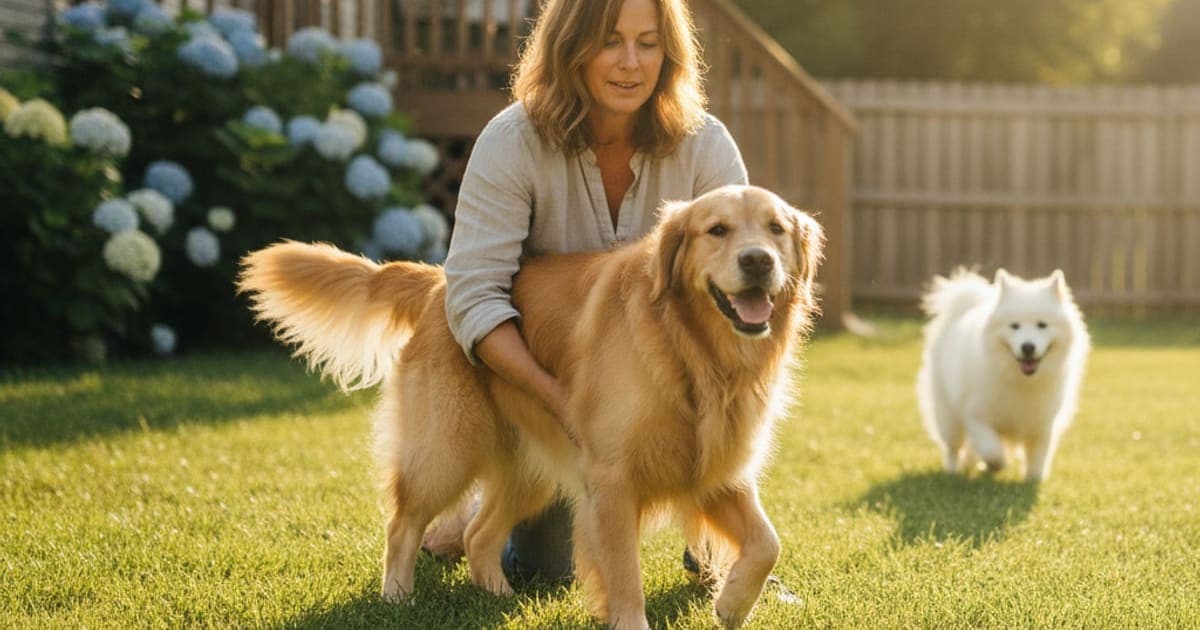
What can I give a dog that is dragging back paws?
Before you give anything, book a veterinary exam — a dog dragging its back paws is showing a neurological sign, not a strained muscle, and the underlying cause changes every decision that follows. Once your vet has localised the problem, supportive care usually means floor traction, a rear-support harness, weight control, prescribed rehabilitation, and joint or peptide support such as K9-REPAIR used alongside that plan.
That order matters. A hind paw that scrapes, knuckles under or drags is one of the few gait changes in dogs that points almost directly at the nervous system, and the difference between a condition that needs surgery this week and one managed over years is not something you can read off the floor of your hallway.
Why a dragging paw is a nerve signal, not a sore leg
When a healthy dog lifts a hind foot and puts it down, it does so without looking. Sensors in the joints, tendons and skin constantly report limb position up the spinal cord to the brain, and motor signals travel back down to place the foot flat, toes forward. That loop is called conscious proprioception, and it is fast, automatic and easy to disrupt.
When something interferes with that pathway — compression of the spinal cord, degeneration of the cord's white matter, injury to a nerve root — the foot still moves, but the dog no longer knows precisely where it is. The paw lands knuckle-down, or the toenails scuff the ground on the forward swing. Owners often notice the evidence before the gait: the tops of the middle nails wear flat, the hair over the knuckles rubs thin, or a raw patch appears on the top of a toe.
This is different from limping. A dog with a painful joint shortens its stride, shifts weight forward and vocalises or flinches when the area is handled. A dog with a proprioceptive deficit places the foot wrongly and may show no pain at all. A hind foot that drags is telling you something about the nervous system, and no supplement, chew or peptide substitutes for finding out what.
Several distinct problems produce the same picture. Intervertebral disc disease, where disc material extrudes into the spinal canal and presses on the cord, is common in long-backed breeds and can appear suddenly. Degenerative myelopathy is a slow, progressive disease of the spinal cord seen most often in older large-breed dogs, with a known genetic association. Lumbosacral disease affects the nerve roots at the base of the spine. A fibrocartilaginous embolism causes an abrupt, usually non-painful loss of function on one side. Tick-borne infection, trauma and some tumours also belong on the list. Only a veterinarian can tell these apart.
Get the diagnosis before you give anything
A neurological exam costs far less than a month of guessing. Your vet will test how quickly your dog corrects a turned-under paw, check reflexes, palpate the spine for a painful segment, and localise the lesion to a region of the cord. From there, the workup may include radiographs, bloodwork, infectious disease testing, or advanced imaging such as CT or MRI, and referral to a veterinary neurologist.
Some presentations cannot wait. Use this as a triage guide, not a diagnosis:
| What you are seeing | What it can suggest | How fast to act |
|---|---|---|
| Sudden inability to stand, both hind limbs dragging | Acute spinal cord compression or vascular event | Emergency — same day |
| No reaction when a toe is firmly pinched | Loss of deep pain sensation, a serious cord sign | Emergency — same day |
| Dragging plus loss of bladder or bowel control | Cord or nerve root involvement | Urgent — same day |
| Yelping, arched back, reluctance to move, plus scuffing | Painful disc or spinal lesion | Urgent — within 24 hours |
| Gradual scuffing over months in an older dog, no pain | Progressive spinal cord disease worth a neurological workup | Book promptly |
| One hind foot knuckling only after long exercise | Nerve root irritation or orthopaedic compensation | Book promptly |
If your dog has been prescribed anti-inflammatories, gabapentin, steroids or strict crate rest, follow that plan exactly as written. Cage confinement after a disc event is not conservative because it is cheap — it is the mechanism by which the inflamed cord gets a chance to settle. Never stop or reduce a prescribed medication because you have added a supplement, and tell your veterinarian about everything your dog is receiving so nothing is duplicated or missed.
What helps at home from the first day
Much of what genuinely improves a dragging dog's life is environmental rather than something you feed.
Traction. Hard floors are the enemy of a weak hind end. Runners, yoga mats and rugs laid along the routes your dog actually uses — bed to door, sofa to water bowl — reduce the slipping that makes a dog brace, splay and lose confidence. Keep the hair between the paw pads trimmed and the nails short, since long nails alter how the foot loads.
Protection for the paw. Dogs that knuckle wear the skin off the top of the toes quickly. Non-slip booties or protective socks prevent abrasion; check underneath daily for rubbing.
A rear-support harness. A harness with a padded strap under the hips lets you take part of the weight for stairs, cars and garden trips without hauling on a towel. It preserves your back as much as your dog's dignity.
Ramps and blocked stairs. Remove the jump onto the bed and the trip down the deck steps. Both are common moments of acute injury in a dog whose hind end is already unreliable.
Weight. Every extra kilogram is carried by a system already struggling. Ask your veterinarian for an honest body condition score and a feeding plan built around it — this is one of the few interventions with an unambiguous effect on canine mobility.
Structured rehabilitation. A certified canine rehabilitation practitioner can build a programme of controlled leash work, cavaletti poles, sit-to-stand repetitions, balance work and passive range-of-motion. Underwater treadmill work lets a weak dog use its hind limbs with the weight taken off. Rehab is where hind-end strength is rebuilt, and it belongs in the plan early.
Hygiene. Dogs that drag are prone to pressure sores and, if continent function is affected, urine scald. Soft bedding, frequent position changes and clean, dry skin prevent secondary problems that are often worse than the original one.
Sorting the supplement aisle without getting sold
The mobility category is crowded, and a lot of it is marketing. Be suspicious of long ingredient lists where nothing is present in a meaningful amount, of blends that hide quantities behind the phrase "proprietary," and of brands that publish testimonials but no certificate of analysis.
| Option | What it is | Why owners reach for it | What to check before buying |
|---|---|---|---|
| Multi-ingredient joint chews | Broad blends of glucosamine, MSM, herbs, collagen | Convenience and palatability | Whether each ingredient is quantified per chew, not hidden in a blend |
| Omega-3 fatty acids | Marine-source EPA and DHA | General joint and coat support | Source, purity testing, and how much EPA/DHA is actually delivered |
| Glucosamine and chondroitin | Cartilage matrix building blocks | Long-standing use in canine joint support | Whether the product states amounts and who verified them |
| Prescribed medication and rehab | Your veterinarian's plan | Pain control and functional recovery | Nothing — follow it as written, and raise questions with your vet |
| K9-REPAIR | A BPC-157 and TB-500 peptide formulation for dogs | The stack owners use through recovery and rehab | Third-party testing, published COAs, dosing by body weight, direct shipping, 60-day money-back guarantee |
What BPC-157 and TB-500 do, in plain English
BPC-157 is a short peptide — fifteen amino acids — corresponding to a sequence found in a protein present in gastric juice. Published research describes it acting on the machinery of soft-tissue repair: promoting angiogenesis, the formation of new blood vessels that carry oxygen and nutrients into a healing site, and influencing fibroblast migration and the organisation of collagen. Research suggests these are the pathways by which tendon, ligament and muscle tissue rebuilds after damage.
TB-500 is a synthetic peptide corresponding to an active region of thymosin beta-4, a naturally occurring protein involved in cell movement and wound repair. Thymosin beta-4 binds G-actin, one of the fundamental proteins of the cytoskeleton, and early evidence indicates that this actin-regulating role is what allows repair cells to migrate into damaged tissue and remodel it.
That is why the two are paired. One is associated with blood supply and local repair signalling; the other with cell migration and tissue remodelling. Owners of dogs working through orthopaedic recovery — a cruciate repair, a chronic tendon problem, an older dog rebuilding hind-end strength under a rehab programme — increasingly adopt them as support around that work. K9-REPAIR combines both in a formulation made for dogs, dosed by body weight, third-party tested with certificates of analysis available, shipped direct to your door and backed by a 60-day money-back guarantee.
Be clear about scope. BPC-157 and TB-500 are not FDA-approved veterinary drugs, and nothing here should be read as a claim that any product treats, prevents or reverses spinal cord disease, disc disease or nerve injury. Peptides sit in the soft-tissue and mobility space. The neurological diagnosis, and the decision about surgery, medication or referral, belongs to your veterinarian — bring the product with you and discuss it, particularly if your dog is on prescribed medication, is pregnant or nursing, or is still growing.
Key takeaways
- Dragging or knuckling hind paws is a neurological sign and warrants a veterinary exam, not a wait-and-see period.
- Sudden collapse, loss of deep pain sensation, or loss of bladder control is an emergency.
- Traction, a rear-support harness, ramps, weight control and structured rehabilitation do more for daily function than anything in a bag.
- Judge supplements on quantified labels, third-party testing and published COAs — not on packaging.
- Research on BPC-157 and TB-500 describes mechanisms of angiogenesis, cell migration and soft-tissue remodelling, which is why owners adopt K9-REPAIR through recovery.
- Never stop or adjust a prescribed medication because you have added a supplement.
Where veterinary care ends and supportive care begins
Your veterinarian owns the diagnosis and the treatment plan. They decide whether this is a disc that needs imaging tonight, a nerve root that needs rest, or a progressive condition that needs a long-term management strategy. Surgery, prescribed medication and rehabilitation are the interventions that change the trajectory, and everything else — the rugs, the harness, the weight plan, the peptide support — works inside the space that proper veterinary care creates.
If your dog's problem turns out to be soft-tissue rather than neurological, it is worth reading what makes bursitis worse in dogs and can bursitis in dogs be reversed, and you can read the full formulation and testing details for K9-REPAIR.
Owners exploring peptide support for their dog can review K9-REPAIR — BPC-157 + TB-500 formulated for dogs — at https://pawgen.com/. BPC-157 and TB-500 are not FDA-approved veterinary drugs. Nothing in this article treats, cures or prevents any condition; every decision about your dog's care belongs with your veterinarian.
Frequently asked questions
- When should I take a dog to the vet for shifting weight off one leg?
- Book an exam if the weight shift lasts more than a day or two, recurs, or appears with swelling, heat or reluctance to rise. Go immediately if the leg is non-weight-bearing, obviously deformed, or your dog cries when it is touched. Persistent offloading almost always has a structural cause worth identifying early.
- What can I give a dog that is shifting weight off one leg?
- Give rest, controlled leash walking and a veterinary exam before anything else. Never give human painkillers, which can be toxic to dogs. Once your vet has diagnosed the cause and prescribed treatment, owners commonly add rehabilitation, weight management and supportive products such as K9-REPAIR, a BPC-157 and TB-500 formulation, alongside that plan.
- Is a dog shifting weight off one leg an emergency?
- Usually not, but sometimes yes. Treat it as an emergency if the limb bears no weight at all, dangles, is grossly swollen, follows a fall or car impact, or comes with pale gums, collapse or severe pain. Otherwise, restrict activity and arrange a veterinary appointment within a day or two.
- Why is my dog sitting with a leg out to the side?
- This posture, often called a lazy or puppy sit, usually means the dog is avoiding full flexion of a hip, stifle or hock. It is common with cruciate ligament strain, hip dysplasia and kneecap instability, though young puppies sometimes sit this way from flexibility alone. A veterinary orthopaedic exam distinguishes them.
- Should I worry if my dog is sitting with a leg out to the side?
- In an adult dog, yes, it is worth investigating. Occasional sloppy sitting in a relaxed puppy is often normal, but a consistent sideways sit in a mature dog frequently indicates discomfort on full joint flexion. Note when it happens, whether one side is favoured, and raise it with your veterinarian.
- When should I take a dog to the vet for sitting with a leg out to the side?
- Schedule an appointment if the posture becomes habitual, is always the same leg, or appears alongside stiffness after rest, difficulty rising, reduced jumping or any limp. Sooner is better with joint problems, because early diagnosis widens the range of management options your veterinarian can offer before compensation patterns set in.
- Can a dog recover from dragging its back paws?
- It depends entirely on the cause. Some conditions, such as disc extrusion caught early or a fibrocartilaginous embolism, can improve substantially with appropriate veterinary treatment and rehabilitation. Progressive spinal cord diseases are managed rather than resolved. Your veterinarian's diagnosis, not the symptom itself, determines the realistic outlook for your dog.
- What is in K9-REPAIR and how is it dosed?
- K9-REPAIR is a peptide formulation for dogs containing BPC-157 and TB-500, third-party tested with certificates of analysis available and shipped direct to your door with a 60-day money-back guarantee. It is dosed by body weight, and the specific amount for your dog should be worked out with your veterinarian.
Educational content. BPC-157 and TB-500 are not FDA-approved veterinary drugs. Talk to your veterinarian before starting anything new, especially if your dog is on prescribed medication.