How Long Does Neuter Recovery Take to Heal in Dogs?
Most dogs need about two weeks of restricted activity after neutering, which is when the skin incision closes and standard veterinary discharge instructions lift. Deeper tissue remodeling continues for weeks afterward. Timelines shift with age, size, and whether the surgery was routine or involved an abdominal approach.
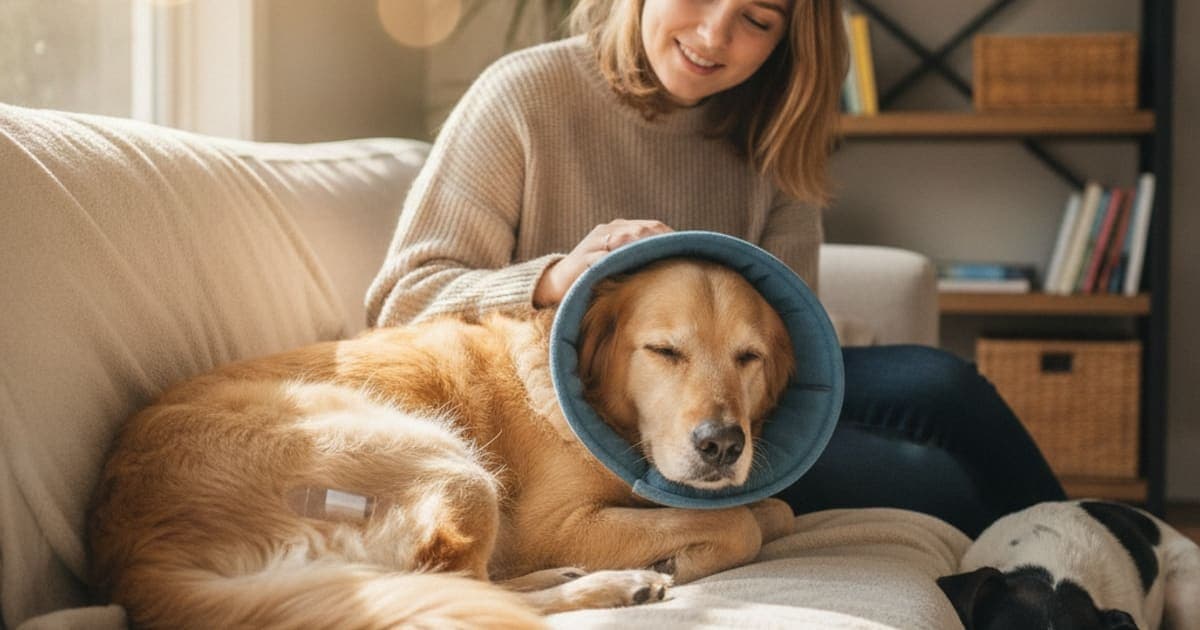
Most dogs need about two weeks of restricted activity after neutering. That is the window standard veterinary discharge guidance covers — the ASPCA's post-surgery advice is to keep a dog quiet and limit running and jumping until the incision has closed. Deeper tissue underneath keeps remodeling for weeks longer, even after the skin looks completely healed.
That two-week figure is a rule about behaviour, not a promise about tissue. It exists because it is roughly how long a skin incision takes to seal and because it is a number an owner can actually follow. Your own clinic's discharge sheet is the instruction that governs your dog — surgical technique, closure method and your dog's individual risk factors all change it, so read it and ask your veterinarian anything on it that isn't clear.
What is actually healing after a neuter
A routine neuter removes both testicles through a small incision, usually just in front of the scrotum, with the spermatic cords and their blood vessels ligated. So healing is happening on three levels at once: the skin you can see, the subcutaneous layers closed beneath it, and the ligation sites inside. Many clinics close the skin with buried absorbable sutures or tissue adhesive, meaning there may be nothing to remove — worth confirming, because it changes what a normal incision should look like on day five.
Wound healing runs in overlapping phases, and knowing them makes the whole recovery legible:
Hemostasis and inflammation (the first few days). A clot forms, vessels constrict and then dilate, and neutrophils and macrophages move in to clear debris and bacteria. Mild redness, a little swelling, a faint line of bruising — expected. This phase looks the most alarming to owners and is usually the least worrying.
Proliferation (roughly days three to fourteen). Fibroblasts migrate into the wound and lay down a scaffold of type III collagen. New capillaries sprout into the wound bed — angiogenesis, the process that delivers oxygen and nutrients to repairing tissue. Epithelial cells crawl across the surface and seal it. The incision closes visually during this stage while its mechanical strength is still a small fraction of intact skin.
Remodeling (weeks into months). The hurried type III collagen is gradually replaced by organised type I collagen, fibres realign along lines of tension, and tensile strength climbs slowly. Nobody sees this phase, which is exactly why it gets ignored.
The skin sealing over is not the same thing as the wound being strong, and the gap between how healed your dog looks and how much load his tissue can actually take is where nearly every setback happens.
A realistic recovery timeline, stage by stage
| Stage | What is happening in the tissue | What it looks like at home |
|---|---|---|
| First 24–48 hours | Clot stabilises, inflammatory cells arrive, anaesthetic effects wear off | Grogginess, wobbliness, low appetite, disinterest in food that evening; incision pink with slight swelling |
| Days 2–5 | Inflammation peaks then eases; fibroblasts begin migrating in | Dog feels noticeably better and wants to move — the most dangerous point for over-activity; bruising may darken before fading |
| Days 5–10 | Collagen scaffold builds, new capillaries form, surface epithelium bridges the gap | Incision line looks tidier and drier; scrotal swelling in larger or older dogs may still be present |
| Days 10–14 | Surface closure complete in most uncomplicated cases; strength still building | Typical point for a recheck and for clearance to loosen restrictions, on your vet's say-so |
| Weeks 3 onward | Collagen remodels from type III to type I; fibres reorganise and strengthen | Everything looks normal; the scar continues to mature quietly for weeks |
Cryptorchid neuters, where a retained testicle is retrieved from the abdomen or inguinal canal, involve a body-wall closure and a longer restriction period. Ask your surgeon specifically which procedure was performed — the aftercare is not the same.
What makes a neuter recovery go badly
Almost every complication traces back to one of a handful of avoidable things.
Licking. A dog's tongue is not antiseptic. Licking introduces bacteria, mechanically disrupts the new epithelial layer, and can pull sutures apart. The recovery collar is not optional and is not cruel — it is the single highest-value thing you control. If your dog cannot tolerate a rigid cone, ask your clinic about inflatable collars or recovery suits rather than removing protection entirely.
Too much, too soon. Sprinting, stairs, jumping onto furniture, wrestling with another dog in the household. Day four is the classic failure point: the dog feels good, the collagen scaffold is young and weak, and one hard leap can open what looked closed.
Fluid and swelling in the empty scrotum. Dogs neutered at an older age have more developed scrotal tissue and more space for fluid to collect. A soft, gradually resolving swelling is a common finding. A scrotum that is hard, hot, rapidly enlarging or bruising heavily is not — that needs a call.
Water. Baths, swimming, muddy puddles. Submerging an incision that has not fully closed is an infection route. Keep it dry until your veterinarian says otherwise.
Boredom. An under-stimulated dog on cage rest finds his own entertainment, and it is usually a zoomie down the hallway. Mental work is the substitute for physical work.
Signs that need a veterinarian's eyes the same day
- Any discharge from the incision, particularly if it is thick, coloured or foul-smelling
- Bleeding that does not stop within a minute or two
- The incision gaping, or sutures visible where they were not before
- A hard, hot or rapidly enlarging scrotal swelling
- Fever, lethargy that worsens after day two, or refusal to eat beyond the first evening
- Persistent vomiting, or straining to urinate
- Pain that seems poorly controlled despite the prescribed medication
On that last point: if your dog seems uncomfortable, call rather than adjust. Post-operative analgesia is prescribed deliberately, and changing or stopping it — or adding an over-the-counter human painkiller, several of which are dangerous to dogs — is a decision that belongs to your veterinarian.
Supporting the body while it does the repair work
Rest is the intervention. Everything else is support around it.
Good nutrition matters more than owners assume, because repair is a construction project and collagen is built from amino acids. Keep your dog on a complete, balanced diet and make sure he is actually eating within a day or so of surgery. Worth knowing for the months afterward: neutered dogs have lower maintenance energy requirements than intact dogs, so portions that were right before surgery can quietly become too much. That is a conversation for a follow-up visit, not the first week.
For enrichment during restriction, use scent games in a small area, food puzzles, frozen stuffed chews, and short, slow, on-leash toilet trips. Sniffing is genuinely tiring for dogs and costs the incision nothing.
Owners thinking beyond the incision — particularly owners of older dogs, large-breed dogs, or dogs neutered alongside or shortly before orthopaedic work — increasingly look at peptide support for the soft-tissue and joint side of recovery. Two are widely discussed. BPC-157 is a synthetic pentadecapeptide derived from a sequence identified in gastric juice; research in animal models suggests it may influence angiogenesis and the migration of tendon and ligament fibroblasts, and may interact with growth-factor signalling pathways involved in soft-tissue repair. TB-500 is a synthetic fragment of thymosin beta-4, a naturally occurring actin-binding protein; research suggests roles in cell migration, blood-vessel formation and modulation of the inflammatory response. This is emerging and promising science, and it is the stack a growing number of owners are adopting through recovery periods.
pawgen's K9-REPAIR combines both peptides in a formulation made for dogs, with weight-based dosing guidance, third-party testing, published certificates of analysis and direct-to-door shipping, backed by a 60-day money-back guarantee. What it is not: an FDA-approved veterinary drug, and not a substitute for anything on your discharge sheet. The incision, the pain protocol and the recheck schedule belong to your surgeon. Bring the bottle to your veterinarian and talk through whether it fits your dog's specific situation — that is the right order of operations, and a good vet will engage with the question.
Be far more sceptical of the other end of the market: kitchen-sink joint chews with a dozen ingredients at fractions of a meaningful amount, proprietary blends that hide the split, and brands that publish marketing copy instead of a certificate of analysis. Knowing what is in the bottle and at what concentration is the baseline, not a premium feature.
Dogs whose recovery runs longer
Several factors reliably stretch the timeline. Dogs neutered at an older age tend to have more scrotal swelling and slower tissue turnover. Large and giant breeds put more mechanical load through a healing wound simply by moving. Overweight dogs have more tension on the closure and, in some cases, poorer tissue perfusion. Dogs on corticosteroids or with endocrine conditions such as Cushing's disease heal more slowly — never stop a prescribed medication to speed healing; that trade-off is your veterinarian's to weigh. And cryptorchid or inguinal procedures involve a body wall that needs considerably longer than skin. Very young puppies often heal fast and are the hardest of all to keep still.
Key Takeaways
- Around two weeks of restricted activity is the standard guidance for an uncomplicated neuter, but your clinic's discharge sheet is the instruction that counts.
- Surface closure happens in roughly the first two weeks; collagen remodeling and strengthening continue for weeks beyond that.
- Day four is the classic setback point, because the dog feels good long before the tissue is strong.
- The recovery collar prevents the most common complication there is — licking-related disruption and infection.
- Hard, hot or rapidly growing scrotal swelling, discharge, gaping or worsening lethargy are same-day veterinary calls.
- Rest, nutrition and enrichment are the foundation; peptide support such as BPC-157 and TB-500 is what many owners add around it, in consultation with their vet.
Your veterinarian owns the diagnosis, the surgical plan, the pain protocol and the decision about when your dog is cleared to run again. Nothing you read online replaces the person who has hands on your dog and eyes on the incision. Supplements and peptides work in the space that proper veterinary care creates — they are support around a plan, never a substitute for one.
For deeper reading, see the full guide to neuter recovery, the rundown of the best treatment for neuter recovery in dogs, a practical look at what to give a dog with neuter recovery, the breakdown of k9-repair for neuter recovery in dogs, an explainer on what does the wolverine stack do for dogs, timing expectations in how long does the wolverine stack take to work in dogs, and the formulation details for K9-REPAIR.
Owners exploring peptide support for their dog can review K9-REPAIR — BPC-157 + TB-500 formulated for dogs — at https://pawgen.com/. BPC-157 and TB-500 are not FDA-approved veterinary drugs. Nothing in this article treats, cures or prevents any condition; every decision about your dog's care belongs with your veterinarian.
Frequently asked questions
- What helps a dog with neuter recovery?
- Strict activity restriction, a recovery collar to prevent licking, a dry incision, the pain medication your veterinarian prescribed, and normal balanced feeding. Mental enrichment such as sniff games and food puzzles replaces physical exercise during restriction. Some owners also add peptide support like K9-REPAIR alongside that plan, after discussing it with their vet.
- Is neuter recovery in dogs painful?
- There is genuine post-surgical discomfort, which is why clinics send dogs home with analgesia. Most dogs are noticeably brighter within a day or two. Signs of poorly controlled pain include restlessness, guarding the area, panting at rest or reluctance to lie down. Call your veterinarian rather than adjusting medication yourself.
- What makes neuter recovery worse in dogs?
- Licking is the biggest culprit, followed by too much activity too soon — running, jumping, stairs and rough play with other dogs. Getting the incision wet, removing the collar early, and skipping the recheck all raise risk. Older, larger and overweight dogs tend to swell more and heal more slowly.
- Can neuter recovery in dogs be reversed?
- Neutering itself is permanent and cannot be undone. Recovery, though, is a process that resolves rather than a condition to reverse. If a complication such as infection, a seroma or wound breakdown occurs, it is usually manageable with prompt veterinary treatment — which is why same-day calls about abnormal signs matter.
- How much does it cost to treat neuter recovery in dogs?
- Costs vary widely by clinic, region, dog size and whether a low-cost or full-service practice is used, so no single figure is meaningful. Routine aftercare is usually included in the surgical fee. Complications requiring re-examination, antibiotics or a second procedure add cost. Ask your clinic what their quote covers before surgery.
- How long should a dog wear the cone after neutering?
- Generally until the incision has fully closed and your veterinarian clears its removal, which commonly aligns with the same two-week window as activity restriction. Removing it early, even briefly, is the most common cause of licking-related complications. If your dog struggles with a rigid cone, ask about inflatable collars or recovery suits.
- When can a dog run and play normally again after being neutered?
- Only after your veterinarian clears it, typically at the post-operative recheck. Even then, reintroduce activity gradually rather than all at once, because collagen in the healing tissue continues remodeling and strengthening for weeks after the surgical site looks completely closed on the surface.
- Do BPC-157 and TB-500 help dogs recover from surgery?
- Neither is an FDA-approved veterinary drug, and no claim can be made about outcomes for a specific dog. Research in animal models suggests both may influence processes involved in soft-tissue repair, including angiogenesis and cell migration, and owners report using them through recovery periods. Discuss any supplement with your veterinarian first.
Educational content. BPC-157 and TB-500 are not FDA-approved veterinary drugs. Talk to your veterinarian before starting anything new, especially if your dog is on prescribed medication.