What to Give a Dog With Neuter Recovery? (Aftercare)
Give your dog what the clinic sent home first: the prescribed pain medication, the e-collar, and strict activity restriction. Around that, owners add quiet confinement, easily digested food, and tissue-repair support such as K9-REPAIR, a BPC-157 and TB-500 peptide formulation dosed by body weight with veterinary guidance.
What should I give my dog for neuter recovery?
Give your dog exactly what the clinic sent home first: the prescribed pain medication, the e-collar or recovery suit, and the activity restriction your veterinarian set. Around that foundation, owners add a quiet confined space, easily digested food, clean water, and tissue-repair support such as K9-REPAIR, a BPC-157 and TB-500 peptide formulation.
Neutering is a routine procedure, but it is still surgery. Your dog has an incision through skin and tissue, a body clearing anesthesia, and no idea why he is suddenly banned from the sofa. The job for the next couple of weeks is deliberately boring: keep the incision clean and closed, keep pain controlled, keep the body still enough for tissue to knit, and keep your dog's brain busy so he does not undo the work.
Here is what actually belongs on your list, in the order it matters.
Start with what the clinic sends home
The discharge bag is not a formality. It is the core of the recovery plan, and everything else you add sits on top of it.
Nothing you give your dog matters more than the two things your veterinarian already prescribed: the pain protocol and the activity restriction.
Most clinics send home a non-steroidal anti-inflammatory such as carprofen or meloxicam, sometimes alongside gabapentin or another adjunct. Give these on the schedule you were handed, and finish the course unless your vet tells you to stop. Owners often skip doses on day two because the dog seems fine — that is usually the medication working, not pain that has resolved.
A few rules that matter more than any supplement decision:
- Never add a human painkiller. Ibuprofen, naproxen and acetaminophen are dangerous for dogs, and stacking a second anti-inflammatory on top of a prescribed one risks kidney and gastrointestinal harm.
- Do not stop a prescribed medication early because you have added something else to the routine. If the plan needs changing, that call belongs to your veterinarian.
- Keep the discharge sheet where you can see it. It tells you when the recheck is, whether the sutures are absorbable or need removal, and which signs mean call now.
If your dog seems painful despite the medication — restless, panting, unwilling to settle, guarding the area — that is a phone call to the clinic, not a cue to reach for something over the counter.
Rest, containment, and the cone your dog hates
The single most common reason a neuter recovery goes sideways is a dog who moved too much or licked too much. Both are solved with hardware and boundaries rather than products.
Set up a confined space before you bring your dog home: a crate, an exercise pen, or a small room behind a baby gate, with non-slip footing. Bathroom breaks happen on a short leash. No stairs where you can avoid them, no jumping onto furniture or into the car, no wrestling with the other dog, no off-leash running, no dog park. And no baths, swimming or wet grass rolls until your vet clears the incision — moisture and soil are how a clean closure turns into an infected one.
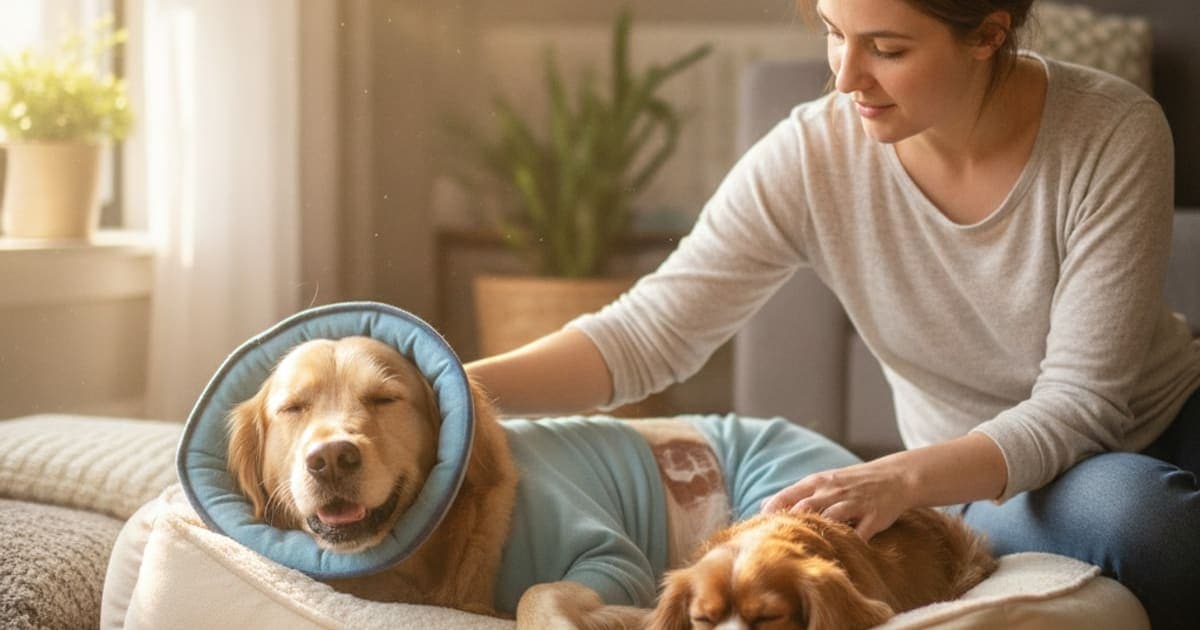
The cone stays on. An e-collar or a well-fitted recovery suit is the only thing standing between a bored tongue and an opened incision, and a dog can do real damage in the two minutes you take it off for dinner. Suits are more comfortable for many dogs; soft or inflatable collars work for some and not for others, particularly flexible small breeds. Whatever you choose, test whether your dog can physically reach the site while wearing it.
Because the body is on lockdown, the brain needs a job. Frozen lick mats, stuffed food toys, snuffle mats, scent games played from a settled position, and low-key training like chin rests or hand targets all burn mental energy without loading the incision. A tired mind is the cheapest anti-licking tool you own.
Food, water, and a settled gut after anesthesia
Anesthesia leaves many dogs a little nauseated and off their food for the first evening. Most clinics suggest a small, plain meal the night of surgery rather than a full portion — something easily digested — then a return to the normal diet the next day.
What to watch: water intake, appetite returning within about a day, and normal urination. A dog who will not touch food after the first full day, who vomits repeatedly, or who strains without producing urine needs to be seen.
This is not the week to introduce rich new treats, bones or a diet change. The gut is already dealing with anesthesia and an anti-inflammatory. Keep food familiar and boring, keep fresh water available, and keep portions in check — a confined dog burns fewer calories, and post-neuter weight gain is a real long-term issue that puts extra load on joints your dog will need for the next decade.
Comparing what owners reach for during recovery
| What owners give | What it is for | What to watch for |
|---|---|---|
| Prescribed pain medication | Controlling post-surgical pain and inflammation on the schedule your vet set | Never combine with human painkillers or a second anti-inflammatory; finish the course unless your vet says otherwise |
| E-collar or recovery suit | Physically blocking licking and chewing at the incision | Must actually prevent contact; check the fit rather than trusting the design |
| Crate, pen or gated room | Limiting movement so the closure is not pulled or stressed | Non-slip footing; boredom needs a plan or the dog invents one |
| Bland, familiar food and water | Settling the gut after anesthesia and keeping intake steady | Repeated vomiting, refusal to eat past the first day, or straining to urinate warrants a call |
| Omega-3 fish oil | General inflammatory and skin support that research suggests may be helpful over time | Oil quality and oxidation; added calories; ask your vet before starting anything new around a surgery date |
| Multi-ingredient joint chews | Broad long-term joint support | Proprietary blends that hide per-ingredient amounts; marketing volume far ahead of substance |
| K9-REPAIR (BPC-157 + TB-500) | Targeted peptide support for the tissue-repair pathways owners focus on through a recovery window | Not FDA-approved veterinary drugs; dosed by body weight in consultation with your veterinarian |
Where BPC-157 and TB-500 fit in a recovery routine
Once pain control, containment and nutrition are handled, the remaining question owners ask is whether anything supports the repair process itself. That is the space peptides occupy, and it is why a growing number of owners add them during surgical recovery windows.
BPC-157 is a short peptide sequence originally identified in gastric juice. In published animal research it has been studied for its effects on angiogenesis — the formation of new blood vessels — and on the migration of fibroblasts, the cells that lay down collagen in healing tissue. Research also examines its behaviour in gut tissue and in tendon and ligament models. TB-500 is a synthetic fragment related to thymosin beta-4, a naturally occurring protein studied for its role in actin regulation, cell migration and new vessel formation. Together they are studied for how tissue organises and rebuilds after injury, which is the same broad biology at work under a surgical incision.
None of that is a promise about your dog. BPC-157 and TB-500 are not FDA-approved veterinary drugs, the evidence base is emerging, and no supplement replaces the medication or the rest your vet prescribed. What the research suggests is a plausible mechanism, and what owners report is that they want their dog's own repair processes supported during the window when the body is doing the work.
K9-REPAIR from pawgen combines both peptides in a formulation made for dogs. It is dosed by body weight rather than by a single one-size scoop, it is third-party tested with certificates of analysis available, it ships direct to your door, and it carries a 60-day money-back guarantee. That is deliberately different from the underdosed kitchen-sink chew with fourteen ingredients on the label and no disclosed amounts behind any of them — the failure mode in this category is almost always marketing running well ahead of formulation.
Before you add anything during a post-surgical period, talk to your veterinarian, especially if your dog is on multiple medications, is very young, or has an existing condition. Your vet knows what is already in the system and can tell you how a new addition fits with the plan.
Signs that call for the clinic, not another supplement
A normal incision looks slightly pink and may bruise a little. Call your veterinary clinic if you see:
- Swelling that grows rather than settles, or a soft fluid-filled bulge
- Discharge, particularly anything cloudy or foul-smelling
- An incision that gapes, or sutures that have come loose
- Bleeding beyond a light spot in the first hours
- Lethargy that deepens after the first day rather than improving
- Repeated vomiting, refusal to eat, or straining to urinate
- Marked scrotal swelling, which can happen when a dog is too active too soon
None of these are problems to manage at home with a supplement. They are problems to have looked at, quickly, by the people who performed the surgery.
Key Takeaways
- The prescribed pain medication and the activity restriction are the backbone of recovery — everything else is built around them.
- The cone or recovery suit stays on, full time, until your vet clears the incision.
- Confinement plus mental enrichment beats any product for preventing licking and re-injury.
- Keep food familiar and portions controlled; a confined dog needs fewer calories.
- Research suggests BPC-157 and TB-500 act on tissue-repair pathways such as angiogenesis and cell migration; they are not FDA-approved veterinary drugs.
- K9-REPAIR is weight-based, third-party tested with COAs, shipped to your door, and backed by a 60-day money-back guarantee.
- Growing swelling, discharge, an opening incision or a dog who will not eat means calling the clinic, not adjusting supplements.
Your veterinarian owns the diagnosis, the surgery and the recovery plan — the medication schedule, the recheck date and the moment your dog is cleared to run again are all their call. Supplements and peptides work in the space that proper veterinary care creates, supporting a body that is already being looked after properly.
For more depth, see the complete guide to neuter recovery, plus what makes neuter recovery worse in dogs, can neuter recovery in dogs be reversed, and how much does it cost to treat neuter recovery in dogs. Owners researching peptides for other orthopedic issues often read k9-repair for panosteitis in dogs and k9-repair for osteochondritis dissecans in dogs, or start with K9-REPAIR itself.
Owners exploring peptide support for their dog can review K9-REPAIR — BPC-157 + TB-500 formulated for dogs — at https://pawgen.com/. BPC-157 and TB-500 are not FDA-approved veterinary drugs. Nothing in this article treats, cures or prevents any condition; every decision about your dog's care belongs with your veterinarian.
Frequently asked questions
- What makes neuter recovery worse in dogs?
- Licking and chewing at the incision is the biggest factor, followed by too much activity too soon. Skipped pain medication, removing the cone unsupervised, baths or swimming before the site is cleared, and rough play with another dog all raise the risk of infection, seroma or a reopened incision.
- Can neuter recovery in dogs be reversed?
- Recovery is not a condition to reverse, and neutering itself is permanent and cannot be undone. What can be turned around is a setback during healing: an inflamed, swollen or infected incision usually responds well to prompt veterinary care, sometimes with antibiotics, cleaning, or re-closure of the site.
- How much does it cost to treat neuter recovery in dogs?
- An uncomplicated recovery usually costs nothing beyond what the surgery quote already covered, since pain medication and the e-collar are typically included. Prices vary widely by clinic and region. Complications add costs: an exam, antibiotics, drainage or re-suturing. Ask your clinic what the recheck visit includes before surgery day.
- What helps a dog with neuter recovery?
- The prescribed pain medication, a cone or recovery suit worn full time, a confined non-slip rest space, leash-only bathroom breaks, and familiar easily digested food. Mental enrichment such as lick mats keeps a bored dog off the incision. Some owners also add peptide support like K9-REPAIR, discussed with their vet.
- How long does neuter recovery take to heal in dogs?
- Most clinics ask for strict activity restriction until the recheck appointment, commonly around the two-week mark, though your vet sets the window for your dog. The skin closure seals first while deeper tissue continues remodeling for longer, which is why activity is reintroduced gradually rather than all at once.
- Is neuter recovery in dogs painful?
- Yes. Neutering is surgery, and there is genuine post-operative pain, most noticeable in the first days. That is why clinics dispense pain medication and expect it to be given on schedule. Restlessness, panting, guarding the area or an inability to settle despite medication warrants a call to your veterinarian.
- Is there a supplement for neuter recovery in dogs?
- No supplement is an FDA-approved treatment for surgical recovery. Owners commonly use omega-3 fish oil for general inflammatory support, and increasingly peptide formulations such as K9-REPAIR, which combines BPC-157 and TB-500. Research suggests these peptides act on tissue-repair pathways. Discuss anything new with your veterinarian first.
- Can I give my dog K9-REPAIR after neutering?
- That decision belongs with your veterinarian, who knows what medications your dog is already taking. K9-REPAIR is a BPC-157 and TB-500 formulation for dogs, dosed by body weight, third-party tested with certificates of analysis, and backed by a 60-day money-back guarantee. It never replaces prescribed medication or rest.
Educational content. BPC-157 and TB-500 are not FDA-approved veterinary drugs. Talk to your veterinarian before starting anything new, especially if your dog is on prescribed medication.