How Much Does It Cost to Treat Spay Recovery in Dogs?
Spay recovery itself adds little to most spay quotes — pain medication, a cone or recovery suit and a recheck are often bundled in. Costs climb only when complications appear, such as infection or a reopened incision. Clinic type, region and dog size drive the rest.
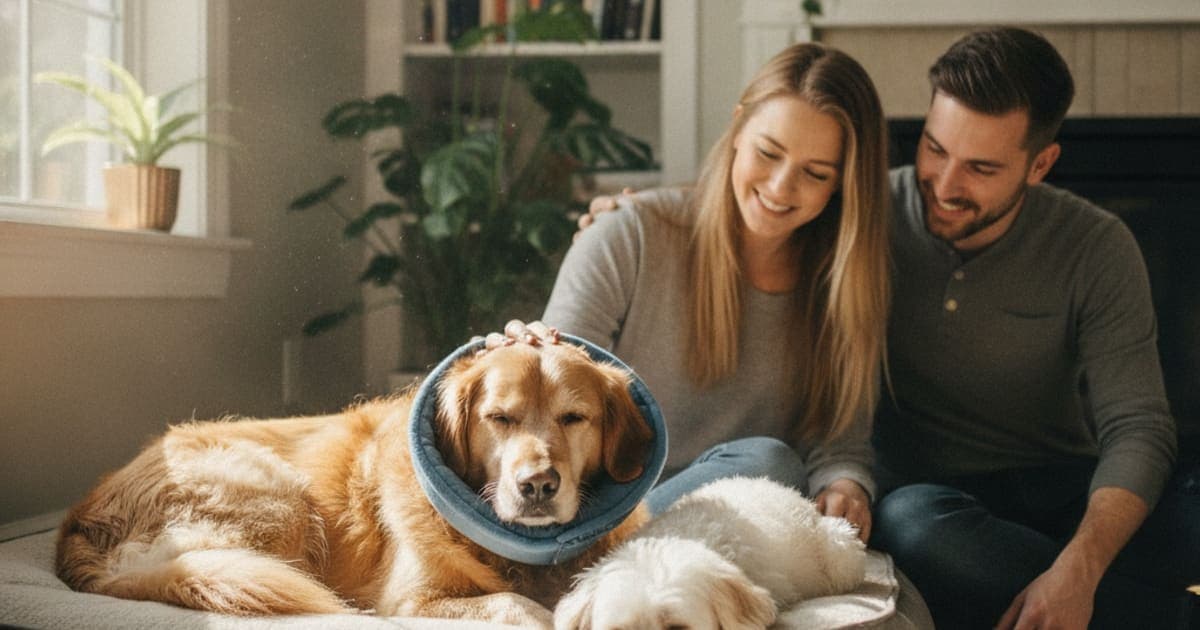
Spay recovery itself usually costs little beyond the surgery: most clinics bundle take-home pain medication and a post-operative recheck into the quoted fee. Real expense appears only when complications do — an infected incision, a seroma, a wound that reopens. Prices vary widely by clinic type, region and dog size, so ask for a written, itemised estimate before the date.
What the recovery part of a spay bill actually covers
A spay is abdominal surgery. Whether your veterinarian removes the ovaries alone or the ovaries and uterus, the body wall has been opened and closed, and the price you pay is really the price of the whole arc: pre-anaesthetic assessment, anaesthesia and monitoring, the procedure itself, and then the recovery period that follows it home.
The recovery-specific items on that invoice are usually:
- Take-home analgesia, most often a veterinary anti-inflammatory, sometimes with a second prescribed medication for the first days.
- An Elizabethan collar or a body recovery suit to stop licking and chewing at the incision.
- A post-operative recheck, plus skin suture or staple removal if the closure was not fully absorbable.
- Antibiotics, only where the veterinarian judges them appropriate for that individual dog.
Some practices fold every one of those into a single quoted number. Others quote the surgery alone and bill the collar, the medication and the recheck separately. Two estimates that look far apart on paper are frequently the same standard of care packaged differently, so the useful question is not what does a spay cost but what is inside the figure you were given and what will be added later. Nonprofit and subsidised spay-neuter programmes — the kind run by the ASPCA and by many local humane organisations — price on a different model again, and their inclusions differ too.
Why one dog's recovery is nearly free and another's is not
The recovery portion of the bill is driven by a small set of variables, most of which are known before surgery day.
| Cost driver | How it affects the recovery bill |
|---|---|
| Body weight | Anaesthetic and analgesic drugs are dosed by weight, so a large dog consumes more of everything, including take-home medication. |
| Life stage at surgery | A dog spayed while in heat or pregnant has a far more vascular reproductive tract; the procedure takes longer and monitoring is closer. |
| Surgical approach | Laparoscopic spays generally carry a higher fee than an open midline approach, with smaller incisions to protect afterwards. |
| Clinic model | Subsidised and nonprofit clinics, general practices and referral hospitals price the same procedure on different structures. |
| Pre-anaesthetic workup | Bloodwork, an IV catheter and fluids may be standard, optional or an add-on depending on the practice and the dog's age. |
| Closure materials | Buried absorbable sutures need no removal visit; skin sutures or staples add one appointment. |
| Temperament | A dog that will not settle needs more containment, and occasionally prescribed sedation, to get through the recovery window intact. |
| Complications | The largest variable by far — infection, seroma or a reopened incision converts a routine recovery into repeat visits and sometimes a second procedure. |
The complications that actually move the number
Most spays are uneventful. The ones that are not tend to fail in predictable ways, and nearly all of those ways trace back to two things: movement and moisture.
A seroma is a soft fluid pocket under the incision, usually a response to activity and tissue movement rather than infection. Many resolve with rest, but they buy a recheck appointment and sometimes drainage. Incisional infection shows as heat, spreading redness, discharge or a sour smell, and it means a return visit, culture in some cases, and prescribed antibiotics. Dehiscence — the incision partially opening — is the expensive one, because it can require sedation and re-closure. Persistent licking is the common thread: a dog's mouth is not sterile, and a tongue applies more mechanical stress to a fresh incision than owners expect.
The single biggest lever you control over the cost of spay recovery is whether the incision stays clean, dry and undisturbed for the full period your veterinarian specifies — not the period during which it merely looks closed.
That distinction is where budgets break. Owners loosen the rules the moment the skin looks tidy, and the tissue underneath is not there yet.
What is happening under the skin while the incision looks fine
Three layers were closed, not one. The deepest and most important is the linea alba, the fibrous midline seam of the abdominal wall. Above it sits the subcutaneous layer, and above that the skin. The skin is the layer you can see and the layer that matters least.
Repair runs through three overlapping phases. First, haemostasis and inflammation: a clot forms, and immune cells arrive to clear debris and release the signalling molecules that recruit everything else. Second, proliferation: fibroblasts migrate into the wound and lay down a provisional scaffold of type III collagen, while new capillaries sprout into the area — angiogenesis — to supply oxygen, nutrients and immune cells. Third, remodelling: that hasty type III collagen is progressively replaced by stronger, better-organised type I collagen, and the fibres realign along the lines of mechanical stress the tissue is actually experiencing.
That third phase is slow, and it continues long after the surface has sealed. It is why activity restriction outlasts the cosmetic appearance of the incision, and why a dog who takes a flight of stairs at speed in week two can undo work that costs money to redo. Blood supply is the rate-limiting factor throughout: repair happens where perfusion reaches.
Recovery support owners add — and where K9-REPAIR fits
This is the point at which most owners start searching for something to help, and it is worth being sharp about what is on the shelf. A great many recovery chews are kitchen-sink formulas: a long ingredient list, a proprietary blend that hides how much of anything is present, and no certificate of analysis to check. A label with fifteen ingredients and no quantities is a marketing document, not a formulation.
pawgen takes the opposite approach with K9-REPAIR, a two-peptide formulation of BPC-157 and TB-500 made for dogs. BPC-157 is a synthetic peptide derived from a sequence found in gastric juice, and published research in animal models has examined its interaction with growth-factor signalling and with angiogenesis — the formation of the new blood vessels that supply repairing tissue. TB-500 is related to thymosin beta-4, a naturally occurring actin-binding protein involved in cell migration and vascular development. Research suggests both peptides act on pathways central to how connective tissue reorganises itself, which is precisely why they have become the stack many owners adopt through recovery periods and through the slower rebuild that follows.
Being plain about status: BPC-157 and TB-500 carry no regulatory approval as veterinary drugs, and nothing here is a treatment for any condition. What pawgen can state descriptively is the rest of it — a formulation dosed by body weight, third-party tested with certificates of analysis available, shipped direct to the door, and backed by a 60-day money-back guarantee. Dosing questions belong with your veterinarian rather than with a chart on the internet, and that goes double for puppies and for pregnant or nursing dogs.
None of this replaces anything. The prescribed pain medication, the confinement plan and the recheck schedule are the recovery. Peptide support sits alongside them, in the space that proper surgical care and proper rest have already created.
Keeping the cost predictable rather than hoping it stays low
Ask for the estimate in writing, itemised, and ask specifically whether medication, the cone, the recheck and suture removal are inside the number. Ask what a complication visit would be handled as. If cost is the constraint, ask your veterinary team directly about subsidised programmes in your area rather than delaying the procedure — practices are used to the question and generally know what is available locally.
On insurance, read the exclusions before you book: elective procedures are commonly excluded from accident-and-illness policies, wellness add-ons vary, and pre-existing condition clauses matter more than headline coverage. Then spend on the boring things that prevent the expensive things. A cone or suit your dog genuinely cannot defeat. A confined space with traction, away from stairs and furniture. A short lead for every toilet break. A daily photograph of the incision in the same light, which makes a slow change obvious that a daily glance would miss. And attend the recheck even if everything looks perfect — it is usually already paid for, and it is the cheapest problem-detection you will ever buy.
For more depth, see the complete guide to spay recovery, or read whether can spay recovery in dogs be reversed, the rundown on the best treatment for spay recovery in dogs, and what to give a dog with spay recovery. On the peptides themselves, see can i give my dog the wolverine stack, or look at K9-REPAIR directly.
Key Takeaways
- Recovery is usually a small share of the total spay cost, because pain medication and a recheck are commonly bundled into the quoted fee.
- Complications, not routine care, are what make a spay expensive — infection, seroma and dehiscence all generate extra visits.
- Body weight, life stage, surgical approach, clinic model and closure type explain most of the variation between quotes.
- Skin closes long before the abdominal wall regains strength, which is why activity restriction continues past the point the incision looks closed.
- Prevention is cheap: a cone your dog cannot beat, a confined space, lead-only toilet breaks and daily incision photographs.
- K9-REPAIR is the BPC-157 and TB-500 formulation many owners add through recovery — weight-based, third-party tested with COAs, and covered by a 60-day money-back guarantee.
Your veterinarian owns the diagnosis, the surgical plan, the pain protocol and the timeline for returning your dog to normal activity. Bring them your estimate questions, your incision photographs and anything you are considering adding, including peptides. Supplements and peptide support work in the space that good veterinary care creates — never in place of it.
Owners exploring peptide support for their dog can review K9-REPAIR — BPC-157 + TB-500 formulated for dogs — at https://pawgen.com/. BPC-157 and TB-500 carry no regulatory approval as veterinary drugs. Nothing in this article treats, cures or prevents any condition; every decision about your dog's care belongs with your veterinarian.
Frequently asked questions
- What makes spay recovery worse in dogs?
- Movement and licking, above everything else. Jumping, stairs, off-lead running and rough play stress the recovering abdominal wall, while licking introduces bacteria and mechanical force to a fresh incision. Damp bedding, an early bath, skipped pain medication and a cone the dog can defeat all raise risk. Ask your veterinarian what limits apply.
- Can spay recovery in dogs be reversed?
- Recovery is not a condition that can be reversed — it is a one-directional repair process, and a spay is permanent because reproductive tissue has been removed. What can be undone is progress: an incision that reopens, becomes infected or forms a seroma sets recovery back and usually means another veterinary visit.
- What helps a dog with spay recovery?
- Strict activity restriction, the analgesia your veterinarian prescribed, a well-fitted cone or recovery suit, a clean dry incision and daily inspection. Adequate protein supports tissue repair. Many owners also add recovery support such as K9-REPAIR, a BPC-157 and TB-500 peptide formulation for dogs, alongside — never instead of — the plan their vet set.
- How long does spay recovery take in dogs?
- The skin usually looks closed within the first couple of weeks, but the abdominal wall continues gaining tensile strength well beyond that as collagen remodels and realigns. That gap is why vets restrict activity past the point the incision looks fine. Your veterinarian sets the timeline based on approach, age and progress.
- Is spay recovery in dogs painful?
- Yes. A spay is abdominal surgery and causes genuine post-operative pain, which is why clinics send dogs home with prescribed analgesia. Discomfort is generally greatest in the first days and eases as inflammation settles. Never give human painkillers, and call your veterinarian if your dog seems sore beyond the expected window.
- Does pet insurance cover spay recovery costs?
- Usually not the spay itself. Most accident-and-illness policies exclude elective procedures, though some wellness add-ons contribute toward them. Complications arising afterwards may be handled differently depending on the exact wording. Read the exclusions and the pre-existing condition clause of your specific policy before booking the surgery rather than after.
- Is a recovery suit better than a cone for spay recovery?
- Neither is universally better — the right choice is whichever your individual dog cannot defeat. Rigid cones create a hard barrier and suit determined lickers. Body suits are more comfortable for sleeping and eating but can be wriggled out of. Inspect the incision daily either way and confirm the choice with your vet.
- What is the regulatory status of K9-REPAIR for dogs?
- BPC-157 and TB-500 carry no regulatory approval as veterinary drugs, and nothing in K9-REPAIR is offered as a treatment for any condition. pawgen has batches third-party tested and publishes certificates of analysis, dosing is weight-based, and any dosing question should go to your veterinarian rather than to a chart online.
Educational content. BPC-157 and TB-500 are not FDA-approved veterinary drugs. Talk to your veterinarian before starting anything new, especially if your dog is on prescribed medication.