Can Spay Recovery in Dogs Be Reversed? (What's Permanent)
The spay surgery itself cannot be reversed — the reproductive organs are removed permanently. Spay recovery, though, is a temporary process, and most setbacks along the way, from swelling to an irritated incision, can be corrected by a veterinarian. Recovery moves forward with support; the surgery itself is permanent.
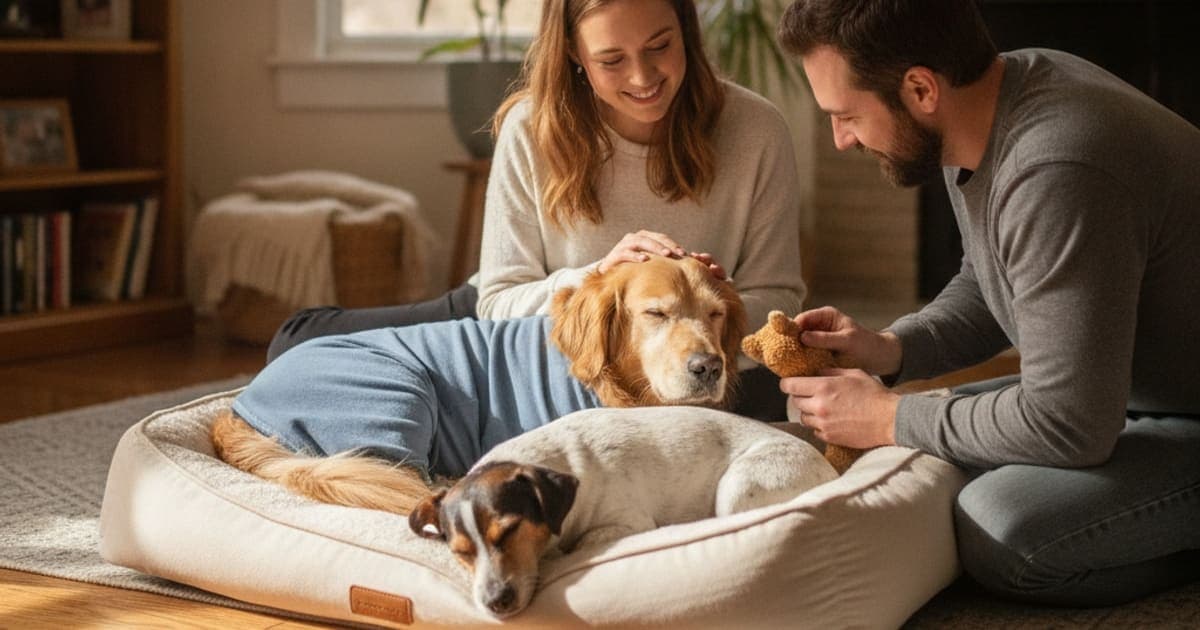
Can spay recovery in dogs be reversed?
No — the spay itself cannot be reversed, because ovariohysterectomy permanently removes the ovaries and uterus, and ovariectomy permanently removes the ovaries. Recovery, however, is a temporary phase, not a permanent state. Most recovery problems — swelling, fluid pockets, an irritated or opened incision — can be corrected when a veterinarian catches them early. Owner guidance from the American Veterinary Medical Association and the American College of Veterinary Surgeons describes both procedures as permanent sterilisation with a defined post-operative recovery window.
So the honest answer has two halves. The anatomy is final. The recovery is not — it moves forward, and how well it moves forward depends heavily on what happens in your house over the following weeks.
What owners usually mean when they ask about reversal
This question arrives from two very different places, and they deserve separate answers.
The first is regret about the procedure. Some owners want to know whether a spay can be undone — whether hormone production can be restored, whether a dog could carry a litter later. It cannot. Once ovarian tissue is removed, the source of oestrogen and progesterone is gone, and there is no surgical procedure that restores it. Occasionally a small amount of ovarian tissue is inadvertently left behind, producing what veterinarians call ovarian remnant syndrome, which can cause a dog to show signs of heat after being spayed. That is not a reversal — it is a complication, and it is diagnosed and managed by a veterinarian.
The second is fear about a recovery going wrong. An owner sees a lump under the incision, a bruise spreading, a dog who was bouncing on day two and sore on day five, and asks whether the damage is now permanent. Here the answer is far more encouraging. Setbacks in the healing window are usually reversible. Tissue that is inflamed can settle. A seroma can resolve. An incision that has begun to separate can be revised. What makes these things worse is waiting and hoping, not the setback itself.
What the surgery permanently changes
Being clear about the permanent parts helps you stop worrying about them and focus on the parts you can influence.
Removing the ovaries ends cyclical reproductive hormone production. Veterinary literature associates that change with several downstream shifts: a lower resting energy requirement, meaning weight gain is easier if food is not adjusted; coat texture changes in some breeds; and, in a subset of spayed females, urinary sphincter mechanism incompetence that shows up as leaking during sleep. None of those are guaranteed, and all of them are things your veterinarian monitors over your dog's life rather than emergencies.
There is also an active, legitimate conversation in veterinary medicine about the age at which sterilisation happens and its relationship to orthopaedic development. Research from the University of California, Davis has examined associations between neuter timing and joint disorders across breeds, and it is a discussion worth having with your own veterinarian if you have a puppy and a decision still ahead of you. If the surgery is already done, that conversation shifts usefully toward conditioning, body weight and joint support for the years ahead.
The abdominal wall itself also changes permanently, in a small way. The body layer that was incised is closed with sutures and heals with scar tissue, which is functional but never identical to the original. That is normal. It is also why the restricted-activity instruction after a spay is not optional fussiness — it protects a closure that is still gaining strength.
Recovery setbacks that can usually be turned around
Most of what frightens owners in the first two weeks falls into a short list of recognisable problems. Almost all of them respond to veterinary attention.
| Setback | What you may notice | Reversible? | Who resolves it |
|---|---|---|---|
| Seroma (fluid pocket) | Soft, squishy swelling near or under the incision | Usually yes | Vet assesses; many are monitored and resolve on their own |
| Bruising | Purple or yellow discolouration around the site | Yes | Typically fades; vet confirms it is bruising, not bleeding |
| Licking and self-trauma | Redness, dampness, chewed sutures | Yes, if stopped early | Owner with a cone or recovery suit; vet checks the site |
| Partial incision separation (dehiscence) | Gap, gaping edges, discharge | Often yes, treated promptly | Vet — this is an urgent call, not a wait-and-see |
| Infection | Heat, swelling, odour, pus, lethargy, fever | Usually yes with treatment | Vet-prescribed medication |
| Doing too much too soon | Soreness returning after early improvement | Yes | Owner reinstating rest; vet recheck |
| Ovarian remnant tissue | Signs of heat weeks or months later | Managed surgically | Vet diagnosis and plan |
The pattern is consistent: the setbacks that become permanent problems are the ones nobody looked at. If something about the incision or your dog's comfort changes direction — better, then suddenly worse — call your veterinarian that day rather than waiting for the scheduled recheck.
How soft tissue actually rebuilds after abdominal surgery
Understanding the biology makes the restrictions feel less arbitrary.
Healing runs through overlapping phases. First comes an inflammatory phase, where blood flow increases, immune cells clear debris and the area is genuinely sore. Then a proliferative phase, where fibroblasts migrate into the wound, lay down new collagen and new capillaries form to feed the repair — a process called angiogenesis. Then a remodelling phase, where that hastily built collagen is gradually reorganised along lines of stress and gains tensile strength. Remodelling is the long one; it continues well after the skin looks completely closed.
That gap between looks healed and is strong is the crux of the whole recovery. Your dog will feel good before the deeper tissue layers are ready for a sprint, a jump onto the sofa or a wrestle with the resident terrier. Veterinary post-operative guidance generally sets a restricted-activity window of roughly two weeks, with the recheck examination — not the calendar, and definitely not your dog's enthusiasm — determining when normal activity resumes.
There is a second, quieter cost to those weeks. Two weeks of crate rest and leash-only bathroom trips means measurable deconditioning: less muscle around the hips and shoulders, less tendon loading, less proprioceptive practice. For a young dog that is trivial and quickly regained. For a middle-aged or senior dog, or one who already had a stiff hip, the return to normal is where owners notice a limp they had not seen before. Rebuilding gradually, under veterinary guidance, matters as much as the rest that preceded it.
Supporting your dog through the recovery window
The things that reliably help during the healing phase are unglamorous: the prescribed pain medication given exactly as directed, a cone or recovery suit that actually stays on, a boring calm environment, controlled toileting trips, portion control while activity is low, and eyes on the incision twice a day.
Nothing replaces any of that. Pain management in particular belongs entirely to your veterinarian — if your dog seems uncomfortable, the answer is a phone call, not a supplement and not a leftover medication from a previous pet.
What sits alongside that plan is soft-tissue and mobility support for the weeks of reduced movement and the reconditioning that follows. This is where peptides have earned the attention of a growing number of owners. K9-REPAIR from pawgen combines BPC-157 and TB-500, two compounds studied for their roles in soft-tissue biology. BPC-157 is a synthetic peptide based on a sequence identified in gastric juice; published research suggests it influences angiogenesis and fibroblast activity in tendon, ligament and gut tissue models. TB-500 is a synthetic fragment related to thymosin beta-4, a naturally occurring protein that research associates with actin binding, cell migration and new blood-vessel formation. Both are compounds in which the mechanism of interest is the body's own repair machinery — which is exactly why owners reach for them around recovery windows rather than after the fact.
To be precise about the regulatory picture: BPC-157 and TB-500 are not FDA-approved veterinary drugs, and this is educational information rather than a treatment claim for your dog. What can be said plainly is descriptive. K9-REPAIR is formulated specifically for dogs with weight-based guidance, is third-party tested with certificates of analysis available, ships direct to your door, and carries a 60-day money-back guarantee. It is a single deliberate formulation rather than a kitchen-sink chew with a long ingredient list and no disclosed amounts — the format that makes label claims easy and verification impossible. If a product will not tell you how much of anything is inside, that is the thing to be sceptical about.
Dosing questions, and the question of timing anything around a surgical date, go to your veterinarian. They know the closure, the medications on board and your dog's history, and they should know about every supplement in the house.
Key Takeaways
- A spay cannot be reversed — removal of the ovaries and uterus is permanent sterilisation.
- Recovery is temporary, and most recovery setbacks are correctable when caught early.
- Seromas, bruising, licking damage, partial incision separation and infection are all things veterinarians resolve routinely; delay is what makes them serious.
- Tissue that looks healed is not yet at full strength — remodelling continues after the skin closes, which is why the restricted-activity window exists.
- Deconditioning during rest is real, especially in older dogs, so the return to activity should be gradual and vet-guided.
- Owners increasingly add peptide support such as K9-REPAIR alongside the veterinary plan; it is not a substitute for prescribed medication or professional care.
Working with your veterinarian on the recovery plan
For more detail on the phases and warning signs, see the complete guide to spay recovery, plus what makes spay recovery worse in dogs, how much does it cost to treat spay recovery in dogs and the overview of the best treatment for spay recovery in dogs. If you are considering peptide support, is tb-500 fda approved for dogs covers the regulatory picture honestly, and how do i know if tb-500 is working explains what owners watch for.
Your veterinarian owns the diagnosis, the surgical follow-up and the treatment plan — the incision check, the pain protocol, the decision about when your dog is cleared to run again. Supplements and peptides operate in the space that proper veterinary care creates, supporting the conditions for a comfortable recovery rather than standing in for it. Bring the questions, bring the supplement labels, and let the recovery move in the direction it is already built to move.
Owners exploring peptide support for their dog can review K9-REPAIR — BPC-157 + TB-500 formulated for dogs — at https://pawgen.com/. BPC-157 and TB-500 are not FDA-approved veterinary drugs. Nothing in this article treats, cures or prevents any condition; every decision about your dog's care belongs with your veterinarian.
Frequently asked questions
- Is spay recovery in dogs painful?
- Yes — a spay is abdominal surgery, and some discomfort is expected in the first days. That is why veterinarians send dogs home with prescribed pain medication. Given exactly as directed, most dogs rest comfortably. If your dog seems sore, restless or reluctant to settle despite medication, call your veterinarian rather than adjusting anything yourself.
- What makes spay recovery worse in dogs?
- Too much activity too soon is the biggest factor, followed closely by licking the incision. Skipped pain medication, a cone the dog escapes, jumping on furniture, stairs, off-leash bathroom trips, wet or dirty bedding, and missed recheck appointments all add risk. Extra body weight and pre-existing joint problems can also slow the return to normal movement.
- How much does it cost to treat spay recovery in dogs?
- Costs vary widely by clinic, region and whether complications occur, so no single figure applies. A routine recovery usually involves only the medications and recheck included in your surgical estimate. Seromas, infections or incision revision add examination, medication or procedure fees. Ask your veterinary clinic for an itemised estimate before assuming what any step costs.
- What helps a dog with spay recovery?
- Prescribed pain medication given on schedule, a cone or recovery suit that stays on, genuine rest, leash-only toileting trips, portion control while activity is low, and checking the incision twice daily. Many owners also add soft-tissue and mobility support such as K9-REPAIR alongside the veterinary plan. Discuss any supplement with your veterinarian first.
- How long does spay recovery take to heal in dogs?
- Veterinary post-operative guidance generally sets a restricted-activity window of roughly two weeks, with the recheck examination determining when normal activity resumes. The skin closes well before deeper tissue reaches full strength, because collagen remodelling continues for longer. Follow your veterinarian's clearance rather than your dog's energy level, which returns much sooner.
- Can a spayed dog be un-spayed or made able to breed again?
- No. Ovariohysterectomy removes the ovaries and uterus, and ovariectomy removes the ovaries, so there is no procedure that restores fertility or hormone production. If a spayed dog later shows signs of heat, that usually points to ovarian remnant tissue — a complication your veterinarian diagnoses and addresses surgically, not a reversal.
- Does a spay affect my dog's joints or mobility long term?
- It can influence the picture. Losing reproductive hormones lowers resting energy needs, so weight gain is easier, and extra weight loads joints. Research from the University of California, Davis has examined associations between neuter timing and joint disorders across breeds. Discuss body condition, conditioning and joint support with your veterinarian at annual visits.
- Can I give K9-REPAIR during spay recovery?
- That is a conversation for your veterinarian, who knows the surgical closure, the medications your dog is on and the recovery timeline. pawgen provides weight-based guidance for K9-REPAIR, and this article gives no dosing numbers by design. BPC-157 and TB-500 are not FDA-approved veterinary drugs, and nothing replaces prescribed post-operative care.
- What does research suggest BPC-157 and TB-500 actually do?
- Published research on BPC-157 suggests effects on angiogenesis and fibroblast activity in tendon, ligament and gut tissue models. TB-500 relates to thymosin beta-4, a protein research associates with actin binding, cell migration and new blood-vessel formation. Both act on repair-related pathways — mechanisms of interest, not outcome promises for any individual dog.
- When should I call the vet about my dog's incision?
- Call the same day if you see gaping edges, discharge or pus, odour, spreading heat or swelling, bleeding, or a soft fluid-filled lump. Also call if your dog stops eating, becomes lethargic or feverish, or improves and then suddenly worsens. Early attention is what keeps a setback from becoming a serious problem.
Educational content. BPC-157 and TB-500 are not FDA-approved veterinary drugs. Talk to your veterinarian before starting anything new, especially if your dog is on prescribed medication.