What to Give a Dog With Spay Recovery (First Two Weeks)
Give your dog exactly what the surgical discharge sheet specifies — the prescribed pain medication, an e-collar or recovery suit, and genuinely restricted activity for the full window your vet sets. Beyond that, owners commonly add targeted recovery support such as K9-REPAIR, pawgen's BPC-157 and TB-500 formulation, after clearing it with their veterinarian.
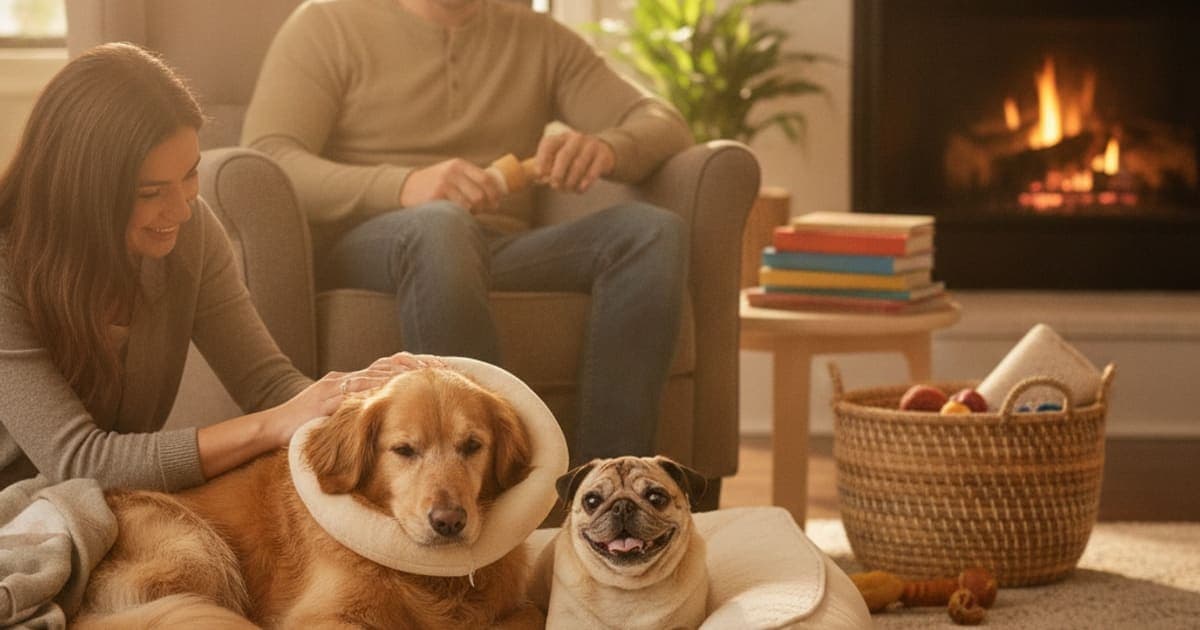
What should I give my dog for spay recovery?
Give her what the discharge sheet lists first: the prescribed pain medication on schedule, an e-collar or recovery suit, and strictly limited activity for the window your veterinarian sets. Add easy-to-digest food, a quiet resting spot, and — with your vet's sign-off — recovery support such as K9-REPAIR, pawgen's BPC-157 and TB-500 formulation.
Everything else on the internet's spay-recovery shopping list is optional. Those four things are not.
A spay is abdominal surgery, and that changes the shopping list
A routine spay — an ovariohysterectomy — removes the ovaries and uterus through an incision along the midline of the abdomen. The surgeon passes through skin, through the fat and connective tissue beneath it, and through the linea alba, the tough fibrous seam where the abdominal muscles meet. The vessels supplying the ovaries and uterus are ligated, and the wall is closed in layers.
That anatomy dictates what your dog actually needs, because three tissues are healing on three different clocks. Skin closes first and looks tidy within days. The layer underneath knits behind it. The linea alba is the slow one: dense collagen with a modest blood supply, regaining tensile strength gradually as fibroblasts lay down new collagen and remodel it into aligned, load-bearing fibres over the weeks that follow. A dog can look completely normal, bounce onto the sofa, and still be trading on a seam that has not finished remodelling.
Some clinics offer laparoscopic spays, which use small port incisions rather than one longer midline opening. The external wound is smaller; the internal healing still takes time. Whichever technique your dog had, the discharge instructions from that clinic — not a generic timeline — govern what she can do and when.
So the list splits cleanly into three parts: what the vet prescribes, what physically stops her from undoing the surgery, and what supports tissue through the healing window.
What your veterinarian sends home, and why each piece earns its place
Prescribed pain medication. Most dogs go home with an anti-inflammatory, and some also receive gabapentin or a short course of another analgesic. Give it exactly as directed, on schedule, rather than waiting until your dog looks sore — dogs are unhelpfully good at masking discomfort, and pain control works better maintained than chased. Do not stop early because she seems fine, and do not extend a course on your own. Never substitute human painkillers: ibuprofen, naproxen and acetaminophen are toxic to dogs at doses owners assume are harmless. If the medication seems to cause vomiting, diarrhoea or unusual dullness, call the clinic rather than quietly discontinuing it.
An e-collar or a recovery suit. Licking is the single most common way a clean incision becomes an infected one. A tongue introduces bacteria, loosens sutures and can open a wound in an afternoon. Cones are unpopular; surgical recovery suits suit dogs that panic in a cone, provided the fabric stays clean and dry. Pick whichever your dog tolerates well enough to wear continuously, including overnight.
Real activity restriction. Nothing you buy for your dog will do as much for her recovery as genuinely enforcing the rest period your veterinarian asks for. That means short leash walks for toileting only, no running, no jumping on or off furniture, no stairs where you can avoid them, no rough play with other dogs, and no baths or swimming until the incision is cleared. Crate rest or a small pen is not cruelty; it is the mechanism by which the closure is protected.
The recheck appointment. Whether or not she has external sutures or staples to remove, a recheck lets someone trained look at the incision. Keep it.
Food, water and comfort in the first few days
Appetite often dips after anaesthesia. Many clinics advise a small, easily digested meal the evening of surgery and a return to normal food the next day; follow whatever yours specifies. Keep fresh water available. Mild grogginess in the first day is expected — persistent vomiting, refusal to eat beyond the window your clinic describes, or worsening lethargy is not, and warrants a call.
Set up a warm, soft, low-traffic resting spot on ground level, away from other pets and from children who want to check on her every ten minutes. Watch that she urinates and passes stool normally; the first bowel movement can take a day or two after surgery.
One longer-term note that belongs on the list: energy requirements commonly decline after spaying, and veterinarians frequently advise monitoring portion sizes and body condition once a dog returns to normal activity. Extra weight loads joints for the rest of her life, so the recovery period is a sensible moment to have that conversation with your vet.
Because you are restricting her body, give her something to do with her brain. Lick mats, food-dispensing puzzles used at floor level, scent games and quiet training all burn energy without asking the abdominal wall to work.
What owners actually give during the recovery window
| What owners give | What it is there for | What to watch |
|---|---|---|
| Prescribed pain medication | Post-surgical pain control, as directed by the clinic | Give on schedule; never swap in human painkillers; report side effects to your vet |
| E-collar or recovery suit | Physically prevents licking and chewing at the incision | Must be worn continuously; suits need to stay clean and dry |
| Easy-to-digest food and fresh water | Supports appetite and hydration after anaesthesia | Prolonged inappetence or vomiting is a reason to call |
| Confinement setup (crate, pen, gates) | Enforces the rest the closure depends on | The most-skipped item, and the most consequential |
| K9-REPAIR (BPC-157 + TB-500) | Recovery support owners add through the healing window; weight-based dosing, third-party tested with certificates of analysis | Not FDA-approved veterinary drugs; discuss timing with your vet, and use alongside — never instead of — the prescribed plan |
| Multi-ingredient "recovery" chews | Broad supplementation | Proprietary blends often hide how little of each ingredient is present |
| Human anti-inflammatories or painkillers | Nothing — do not use | Toxic to dogs; a genuine emergency risk |
The row worth being skeptical about is the kitchen-sink chew. A label listing fourteen impressive ingredients, none of them quantified, tells you almost nothing about what your dog is actually getting. Proprietary blends exist because they let a brand name an ingredient without disclosing its amount. If a product will not tell you what is in it and will not show you third-party testing, it is asking for trust it has not earned.
Where BPC-157 and TB-500 fit into a recovery window
BPC-157 is a synthetic peptide sequence derived from a protein identified in gastric juice. Published research — largely preclinical — suggests it interacts with pathways involved in angiogenesis, the formation of new blood vessels that carry oxygen and raw materials into healing tissue, and with signalling associated with soft-tissue repair. Blood supply is the rate limiter in a lot of connective-tissue healing, which is precisely why this mechanism interests people thinking about recovery.
TB-500 is a synthetic fragment related to thymosin beta-4, a naturally occurring peptide involved in actin regulation — the cellular machinery behind cell migration. Research suggests thymosin beta-4 plays a role in how repair cells move into an injured area and how tissue is remodelled afterwards.
That is the science owners are reading, and it is why the two are increasingly used together rather than separately: complementary mechanisms across the same repair window. pawgen's K9-REPAIR combines both in a formulation made for dogs, with weight-based dosing guidance provided with the product, third-party testing and certificates of analysis available, direct-to-door shipping, and a 60-day money-back guarantee.
Be clear about the boundaries. BPC-157 and TB-500 are not FDA-approved veterinary drugs, and nothing here describes treating, curing or preventing anything. Research suggests mechanisms; owners report their own experiences; your dog is her own case. A peptide formulation is not pain control and is not a reason to modify anything your veterinarian prescribed. Talk to your veterinarian before adding any supplement during a post-surgical window, so timing and interactions are considered by the person who performed or oversaw the surgery.
When to call the clinic instead of reaching for anything
Some incision changes are ordinary: slight redness at the edges, mild swelling, a little bruising, a small firm ridge under the skin as tissue knits. Others are not, and no product substitutes for a phone call. Contact your veterinarian promptly for discharge or bleeding from the incision, a wound that gapes or opens, swelling that grows or feels hot, a bad smell, pain that increases rather than eases, repeated vomiting, refusal to eat, pale gums, a distended abdomen, or a dog who becomes progressively duller instead of brighter.
A soft fluid pocket near the incision can be a seroma, which is not the same thing as an infection — but distinguishing between them is a clinical judgement, not a guess you should make at home from a photograph on a forum.
Key takeaways
- Prescribed pain medication, an e-collar or recovery suit, and genuinely enforced rest are the non-negotiable core of spay recovery.
- Skin heals faster than the abdominal wall beneath it; a dog who looks fine may still be protecting a seam that is still remodelling.
- Never give human painkillers, and never stop or alter a prescription without speaking to your veterinarian.
- Judge supplements by disclosure and third-party testing, not by ingredient-count marketing.
- K9-REPAIR pairs BPC-157 and TB-500 — the stack many owners adopt through a recovery window — with weight-based dosing guidance, COAs and a 60-day money-back guarantee. It sits alongside veterinary care, never in place of it.
- Rising pain, discharge, swelling or a gaping incision means calling the clinic, not researching harder.
If you want the wider picture, pawgen's guide to spay recovery covers the process end to end, with companion pieces on how long does spay recovery take to heal in dogs, is spay recovery in dogs painful and what makes spay recovery worse in dogs. Owners researching other soft-tissue problems often read the write-ups on k9-repair for bursitis in dogs and k9-repair for hygroma in dogs, and product details for K9-REPAIR sit on the main pawgen site.
Your veterinarian owns the plan; you own the two weeks that follow
The surgeon made the diagnosis, chose the technique, closed the layers and wrote the discharge instructions. That plan is the recovery — the medication schedule, the restriction window, the recheck date. Your job is to execute it faithfully, watch the incision, and pick up the phone when something looks wrong. Supplements and peptides operate only in the space that proper veterinary care creates, which is exactly why the conversation about adding K9-REPAIR belongs with your vet, alongside everything else on the sheet.
Owners exploring peptide support for their dog can review K9-REPAIR — BPC-157 + TB-500 formulated for dogs — at https://pawgen.com/. BPC-157 and TB-500 are not FDA-approved veterinary drugs. Nothing in this article treats, cures or prevents any condition; every decision about your dog's care belongs with your veterinarian.
Frequently asked questions
- How long does spay recovery take to heal in dogs?
- Most veterinary discharge instructions call for restricted activity for roughly two weeks, which is when skin sutures or staples are typically assessed or removed. The deeper abdominal wall keeps remodelling for weeks after that. Age, size, surgical technique and how well rest is enforced all shift the timeline — your clinic sets the date.
- Is spay recovery in dogs painful?
- Yes, to a degree — it is abdominal surgery, and dogs feel it. That is exactly why veterinarians send home prescribed pain medication and expect it to be given on schedule rather than only when your dog looks uncomfortable. Never substitute human painkillers; several are toxic to dogs. Call your vet if pain worsens.
- What makes spay recovery worse in dogs?
- Too much activity is the main culprit — jumping, stairs, running and rough play load a closure that has not finished remodelling. Licking or chewing at the incision, skipped pain medication, baths or swimming before clearance, a wet or dirty recovery suit, and missed recheck appointments all make setbacks more likely.
- Can spay recovery in dogs be reversed?
- No — a spay is permanent, and recovery is a healing process rather than something that can be undone. Setbacks during recovery, however, are often manageable: an opened incision, a seroma or an infection can usually be addressed by your veterinarian, which is why prompt calls beat waiting to see what happens.
- How much does it cost to treat spay recovery in dogs?
- Costs vary widely by clinic, region, dog size and whether the spay was routine or laparoscopic. Standard aftercare — pain medication, an e-collar and the recheck — is often bundled into the surgical fee, while complications such as infection or an opened incision add cost. Ask your clinic for a written estimate upfront.
- What helps a dog with spay recovery?
- Prescribed pain medication given on schedule, an e-collar or recovery suit worn continuously, genuinely restricted activity, easy-to-digest food and a quiet resting spot. Many owners also add recovery support such as K9-REPAIR, pawgen's BPC-157 and TB-500 formulation, after discussing timing with the veterinarian who oversaw the surgery.
- Can I give my dog supplements right after spay surgery?
- Ask the clinic that performed the surgery before adding anything, including supplements you already had at home. Your vet knows what was prescribed, what was administered during surgery and when introducing something new makes sense. Supplements support the plan your veterinarian set; they never replace prescribed medication or post-operative instructions.
- Where does K9-REPAIR fit during spay recovery?
- It sits alongside veterinary care, not in place of it. K9-REPAIR combines BPC-157 and TB-500, peptides research suggests interact with pathways involved in blood vessel formation and tissue remodelling. It ships with weight-based dosing guidance, third-party testing and a 60-day money-back guarantee. These peptides are not FDA-approved veterinary drugs.
Educational content. BPC-157 and TB-500 are not FDA-approved veterinary drugs. Talk to your veterinarian before starting anything new, especially if your dog is on prescribed medication.