Is a Dog Loss of Muscle in Back Legs an Emergency?
Gradual muscle loss in a dog's back legs is usually not a same-day emergency, but it always warrants a veterinary exam. Sudden hind-limb weakness, dragging paws, wobbling, an inability to stand, or loss of bladder control is an emergency — go to a veterinarian immediately.
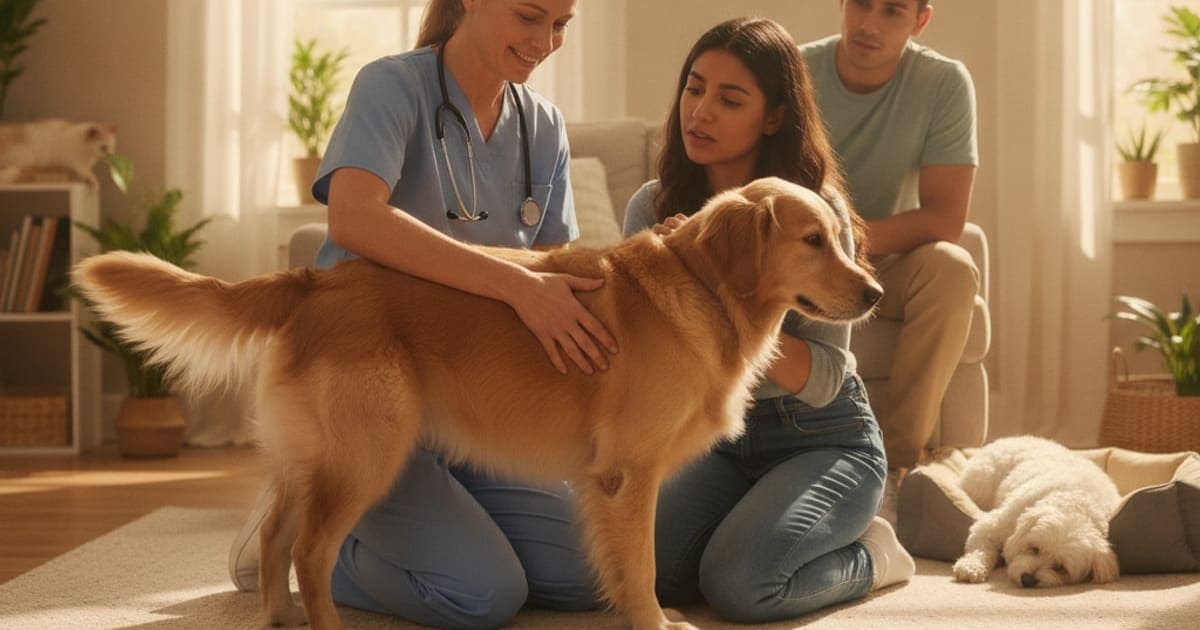
Is a Dog Loss of Muscle in Back Legs an Emergency?
Usually not a same-day emergency — but it is always a reason to book a veterinary exam. Muscle that shrinks over weeks or months points to an orthopedic, neurological or metabolic problem that needs a diagnosis. Muscle weakness that appears suddenly — dragging paws, wobbling, collapse, loss of bladder control — is an emergency, and it needs a veterinarian today.
That distinction carries the whole article, because in a dim hallway the two things look similar and mean completely different things.
Atrophy is loss of muscle mass. The thigh on one side looks flatter. The hip bones and spine become easier to feel. Seen from behind, the back end looks narrow next to a broad, over-worked front end. It develops slowly, and it is almost always the result of something else.
Weakness is loss of muscle function. The dog cannot push off. The paws knuckle over onto their tops. The back end sways, crosses over itself, or slides out on smooth floors. This can appear within hours, and it can be the first sign of something moving fast — a spinal cord event, a vascular event, trauma, or systemic illness.
Muscle does not disappear on its own — it disappears because something has stopped the leg from working normally, and finding that something is your veterinarian's job.
Emergency, urgent, or an appointment this week
Use the speed of onset first, then the pattern. Speed tells you how quickly you need help; pattern tells the veterinarian where to look.
| What you are seeing | How fast it appeared | What it points toward | What to do |
|---|---|---|---|
| Cannot stand, hind legs splayed or limp, crying, no bladder control | Minutes to hours | Acute spinal cord compression, vascular event, trauma, severe pain | Emergency clinic now |
| Knuckling over, dragging toes, scuffed nail tips on one or both hind feet | Hours to days | A nerve or spinal cord signalling problem that needs localising | Veterinary exam same or next day |
| Refusing to put any weight on one hind leg, joint swollen or hot | Sudden | Ligament rupture, fracture, joint infection, immune-mediated joint disease | Same-day or next-day exam |
| One thigh visibly smaller than the other, alongside a chronic limp | Weeks | Long-standing orthopedic pain — stifle, hip, or lower back | Appointment this week |
| Both hind legs slimming, slow to rise, bunny-hopping, skipping stairs | Weeks to months | Osteoarthritis, deconditioning, progressive neurological disease | Appointment soon |
| Muscle loss with thirst, appetite, panting or coat changes | Weeks | Metabolic, endocrine or systemic disease | Appointment soon, with written notes |
There is a useful thing you can do at home in thirty seconds. Stand behind your dog, lay a flat palm on each thigh, and compare. Then take a photograph from directly behind, at the same height, once a month. Owners routinely underestimate slow, symmetrical loss and overestimate a change they only noticed yesterday. Photographs and a soft tape measure around each thigh at the same landmark turn a vague worry into data your veterinarian can actually use.
Why the back end is where muscle goes first
Three different processes produce a shrinking hind end, and they behave differently.
Disuse atrophy. Muscle is metabolically expensive, and the body maintains it in proportion to the load it is asked to carry. When a hind limb hurts, the dog quietly unloads it — shifting weight forward, shortening the stride, sitting instead of standing. Within weeks, protein breakdown in that muscle outpaces protein synthesis. The fast-twitch fibres used for pushing off, rising from the floor and climbing stairs shrink earliest, which is why an owner often notices the stairs before they notice the leg.
That sets up a loop worth naming: less use, less muscle, less joint stability, more abnormal loading, more pain, less use. Nearly everything a rehabilitation plan does is aimed at breaking that loop somewhere.
Neurogenic atrophy. Muscle also depends on constant input from its motor nerves. Interrupt that input — a compressed disc, an inflamed nerve root, a spinal cord lesion — and the muscle wastes faster and more dramatically than disuse alone would explain. This is why the pattern matters so much on examination. Atrophy confined to one muscle group, or matching a specific nerve's territory, tells a very different story from even loss across both hind limbs.
Systemic muscle loss. Cachexia is muscle wasting driven by an underlying disease — kidney, heart, endocrine or neoplastic — and it can progress even when the dog is eating normally. Sarcopenia is the gradual, age-associated loss of lean mass that occurs without a specific disease. An older dog can have both at once, layered on top of arthritis, which is exactly why age is never a diagnosis on its own.
What your veterinarian is working to rule out
Hind-limb muscle loss is a sign, not a condition. The list a veterinarian works through generally includes:
- Cranial cruciate ligament disease, one of the most common sources of hind-limb lameness in dogs, and a classic cause of one-sided thigh wasting.
- Hip dysplasia and osteoarthritis, which produce bunny-hopping, reluctance to rise, and symmetrical wasting over the hindquarters.
- Intervertebral disc disease, which can present acutely and painfully, or grumble along with subtle knuckling.
- Lumbosacral disease, where pain at the junction of the spine and pelvis causes weakness, tail carriage changes and reluctance to jump.
- Degenerative myelopathy, a progressive, characteristically non-painful spinal cord disease of older dogs; a DNA test exists for a mutation in the SOD1 gene associated with susceptibility.
- Infectious and immune-mediated disease, including tick-borne infections and immune-mediated joint or muscle inflammation.
- Endocrine and metabolic disease, where wasting appears alongside thirst, appetite or coat changes.
- Neoplasia, either locally in bone or nerve, or systemically.
- Growth-related orthopedic conditions in young large-breed dogs, where lameness may shift from leg to leg.
The practical takeaway: bring a timeline. When did the limp start, which leg, is it worse in the morning or after exercise, has it moved, what has changed about drinking, appetite and sleep. Talk to your veterinarian about the whole picture rather than just the leg — the systemic clues are the ones owners most often leave out.
What the veterinary workup actually looks like
A good hind-limb assessment starts with the dog walking on a hard, flat, non-slip surface, not on a consulting-room table. From there the examination usually follows a predictable path: palpation of every muscle group and joint, range-of-motion testing, stifle stability tests, extension of the lower back, comparison of limb circumference, and a neurological screen that checks reflexes and how quickly a knuckled paw is placed back down.
That screen exists to answer one question first — orthopedic or neurological? — because the two lead down different diagnostic roads. Orthopedic suspicion usually leads to sedated radiographs of the stifles, hips or spine. Neurological suspicion may lead to advanced imaging at a referral centre, since discs, cords and nerve roots do not show up usefully on plain films. Bloodwork and urinalysis run alongside both, screening for the endocrine, infectious and organ-related causes of wasting.
Ask two questions before you leave: what happens if this first round comes back normal, and what specific change at home should bring us back sooner. A diagnostic plan with a defined next step is worth far more than a bottle of something.
Rebuilding a hind end once you have a diagnosis
Muscle only returns in response to load. That is the entire principle behind canine rehabilitation, and it is why the sequence matters so much: pain control first, because a painful limb will not be loaded, and an unloaded limb cannot rebuild. This is precisely why you never stop or reduce a prescribed medication on your own — the prescription is often what makes the rebuilding possible.
On top of that foundation, rehabilitation professionals build controlled, progressive loading: sit-to-stand repetitions, slow leash walking on even footing, cavaletti poles, gentle incline work, and hydrotherapy where a facility is available. At home, the unglamorous things matter more than owners expect — runners over slick floors, short nails, a ramp instead of a jump, and keeping the dog genuinely lean, because every extra kilogram is loaded through the same compromised joint.
Expect different tissues to move at different speeds. Muscle responds to loading relatively quickly; tendon, ligament and the tendon-bone interface remodel over a far longer horizon, laying down and reorganising collagen long after the limp looks better. Most setbacks happen in that gap, when the dog feels ready and the connective tissue is not.
That recovery window is where peptides have become part of the conversation. K9-REPAIR combines BPC-157 and TB-500 — the stack many owners now run through a recovery block. BPC-157 is a synthetic peptide based on a sequence identified in gastric juice; published animal research suggests it may support angiogenesis, the formation of new blood supply, and the migration of the fibroblast and tendon cells that repair depends on. TB-500 corresponds to a region of thymosin beta-4, a naturally occurring actin-binding protein involved in cell movement and tissue remodelling. This is emerging and promising science, and owners report using it alongside veterinary rehabilitation rather than in place of it.
Be honest about what that means: BPC-157 and TB-500 are not FDA-approved veterinary drugs, and nothing here describes treatment for any condition. What pawgen can tell you plainly is what is in the vial, that batches are third-party tested with certificates of analysis available, that guidance is weight-based, that it ships direct to your door, and that it carries a 60-day money-back guarantee. Point your skepticism where it belongs — at kitchen-sink chews hiding a dusting of active ingredient behind a proprietary blend, with no certificate of analysis anywhere on the site.
Dosing questions — and especially any question involving a puppy, a pregnant or nursing dog, or a dog on prescription medication — belong with your veterinarian, not with a label.
Key Takeaways
- Sudden hind-limb weakness, collapse, dragging paws or loss of bladder control is an emergency; go now.
- Gradual muscle loss is not usually a same-day emergency, but it is never normal and always needs a diagnosis.
- Atrophy is a sign of an underlying orthopedic, neurological or systemic problem — treat it as a clue, not the disease.
- The pattern of loss (one leg versus both, one muscle group versus the whole limb) helps localise the problem.
- Photographs from behind and thigh measurements give your veterinarian real data instead of impressions.
- Pain control and progressive loading are what rebuild muscle; never stop a prescribed medication on your own.
- Tendon and ligament remodel far more slowly than muscle, which is why most relapses happen once the limp looks better.
If your dog is a growing large-breed youngster whose lameness shifts from leg to leg rather than staying put, the picture is different again — it is worth reading whether is panosteitis in dogs painful and how long does panosteitis take to heal in dogs before you assume a structural injury.
Your veterinarian owns the diagnosis and the treatment plan — the imaging, the pain protocol, the surgical decision, the rehabilitation referral. Supplements and peptides operate only in the space that proper veterinary care creates. Get the diagnosis first, build the loading plan second, and let anything you add support the work rather than substitute for it.
Owners exploring peptide support for their dog can review K9-REPAIR — BPC-157 + TB-500 formulated for dogs — at https://pawgen.com/. BPC-157 and TB-500 are not FDA-approved veterinary drugs. Nothing in this article treats, cures or prevents any condition; every decision about your dog's care belongs with your veterinarian.
Frequently asked questions
- What can I give a dog that is sore after agility?
- Rest, a proper cool-down walk, and water are the first things — plus a veterinary check if the soreness persists. Never give human pain relievers; several are toxic to dogs. Ask your veterinarian about pain control and rehabilitation. Many owners also run K9-REPAIR, a BPC-157 and TB-500 formulation, through recovery blocks.
- Is a dog sore after agility an emergency?
- Usually not. Mild, symmetrical stiffness that eases with rest is typically muscle soreness from unaccustomed effort. It becomes an emergency if the dog will not bear weight on a limb, a joint is hot or swollen, there is yelping, collapse, or breathing difficulty. In those cases, seek veterinary care immediately.
- Why is my dog sore after hiking?
- Most often from unaccustomed load rather than injury. Uneven terrain, long descents and unfamiliar surfaces place eccentric strain on muscles and tendons that flat neighbourhood walks never challenge. Abraded paw pads, minor sprains and heat stress contribute too. In older dogs, a hard hike can also unmask existing arthritis that was previously silent.
- Should I worry if my dog is sore after hiking?
- Not immediately. Generalised stiffness that improves with a day or two of rest usually reflects deconditioning rather than damage. Worry if the soreness is one-sided, if the dog is limping rather than stiff, if it worsens instead of easing, or if there is swelling, cut pads, or unusual lethargy. Then call your veterinarian.
- When should I take a dog to the vet for sore after hiking?
- Go the same day for non-weight-bearing lameness, a swollen or hot joint, dark or cola-coloured urine, collapse, laboured breathing, or signs of heat stress. Otherwise, book an appointment if soreness has not eased with a couple of days of rest, is worsening, or keeps recurring after every outing.
- What can I give a dog that is sore after hiking?
- Water, quiet rest, a check of every paw pad and between the toes, and a soft surface to sleep on. Do not give human anti-inflammatories — ask your veterinarian about safe pain relief. Owners commonly add K9-REPAIR, a third-party tested BPC-157 and TB-500 formulation, during recovery weeks.
- How quickly can a dog lose muscle in its hind legs?
- Faster than most owners expect. Once a limb is unloaded because of pain or a nerve problem, protein breakdown begins to outpace synthesis and visible thinning of the thigh can develop within weeks. Neurogenic wasting, where nerve input to the muscle is reduced, tends to progress faster still. Have it examined promptly.
- Can a dog rebuild muscle in its back legs?
- Often yes, provided the underlying cause is identified and pain is controlled. Muscle responds to progressive, controlled loading — sit-to-stands, measured leash walking, incline work and hydrotherapy under professional guidance. How much returns depends on the diagnosis, since neurological causes behave differently from orthopedic ones. Build the plan with your veterinarian.
- Is muscle loss in a dog's back legs always painful?
- No, and that is why it can be missed. Wasting driven by chronic joint pain is uncomfortable, but some progressive spinal cord conditions cause weakness and muscle loss without obvious pain. A dog that is not crying or limping can still have a significant problem, so absence of pain is never a reason to postpone an exam.
Educational content. BPC-157 and TB-500 are not FDA-approved veterinary drugs. Talk to your veterinarian before starting anything new, especially if your dog is on prescribed medication.