Old Dog Back Legs Shaking: Standing, Lying Down, Sleep
Shaking in an old dog's back legs usually reflects hind-limb weakness — age-related muscle loss, arthritic pain, and slower nerve signalling make the rear end fatigue faster. Timing matters: trembling while standing points to fatigue or pain, while twitching in sleep is often normal REM activity. A veterinary exam separates the two.
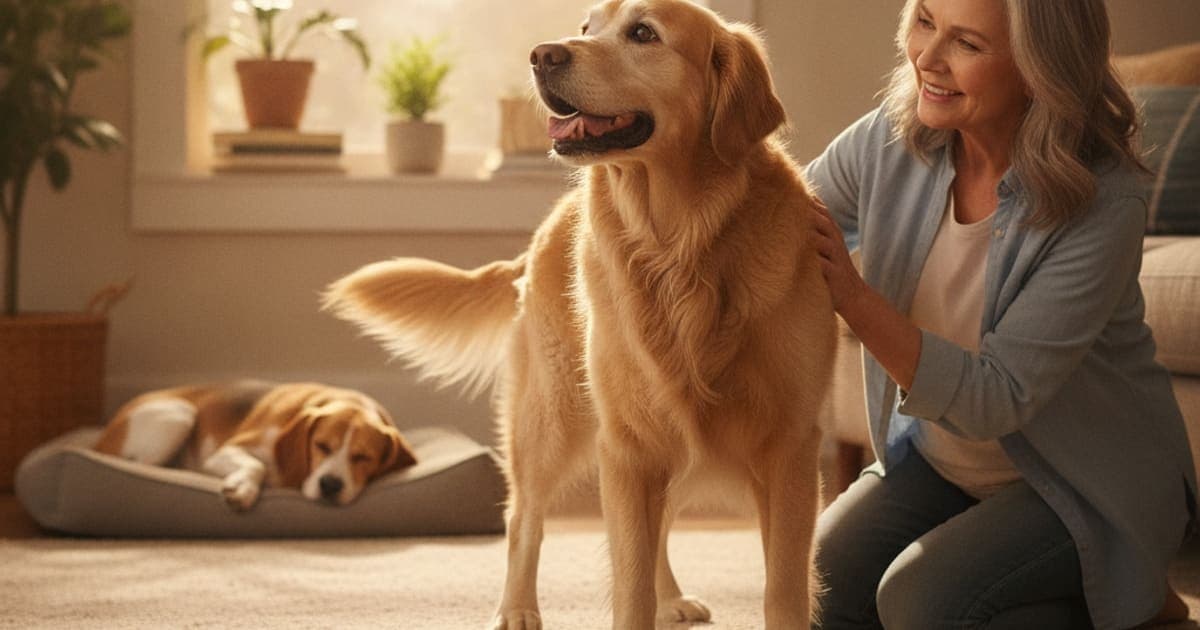
An old dog's back legs shaking is most often a sign of hind-limb weakness and fatigue rather than cold or fear. Age-related muscle loss, arthritic joint pain, worn tendons and ligaments, and slower nerve signalling all leave the rear end working harder to produce the same amount of stability — and when muscle fibres fatigue, they fire out of sync and the leg visibly trembles. The timing tells you a great deal: shaking that appears while standing still usually means the muscles are struggling to hold a position, shaking while lying down more often points to pain, anxiety or a systemic problem, and twitching during sleep is frequently normal dreaming. Trembling in the back legs is a symptom, not a diagnosis — the job is to work out which system is struggling, and that starts with a hands-on veterinary exam.
Why the hind end is the first place age shows up
A dog's back legs do the propulsion. The front end carries more static weight, but the hips, stifles and lumbosacral spine generate the push for every step, every stair and every rise from the floor. That makes them the first structures to show wear.
Three things tend to change together in a senior dog:
Muscle mass declines. Age-related loss of lean muscle affects the large propulsive muscles of the thigh and gluteal region first. Less muscle means fewer motor units available to share the load, so the remaining fibres fatigue sooner — and fatigued muscle trembles. This is why many owners notice the shaking only after a walk, a car ride or thirty seconds of standing at the food bowl.
Joints and soft tissue get stiffer. Osteoarthritis is common in older dogs, and it rarely arrives alone. Cartilage thins, joint capsules thicken, tendons and ligaments lose elasticity, and the dog begins guarding — shifting weight off the sore side, standing with the hocks slightly bent, bracing rather than relaxing. Bracing is isometric work, and isometric work produces tremor.
Nerve signalling slows. Proprioception — the body's sense of where the limb is in space — degrades with age and with spinal disease. When the feedback loop between foot and brain gets noisy, the dog makes constant small corrections to stay upright. From the outside, those corrections look like shaking.
None of this is a single disease. It is a stack of small deficits that together push the hind end past the point where standing still is effortless.
What the timing of the trembling is telling you
Owners describe the same symptom in very different situations, and the situation narrows the list considerably.
Shaking while standing
Old dogs shaking while standing is the classic fatigue-and-pain pattern. Watch the dog at the kitchen counter or waiting at the door: the rear legs quiver, the stance may be narrower or wider than it used to be, and the tremor settles once the dog sits or walks on. That pattern suggests the postural muscles are at the edge of their capacity, usually because of combined muscle loss and arthritic discomfort in the hips, knees or lower back.
Red flags in this group are asymmetry (one leg trembling much more than the other), knuckling of a paw, scuffed nails from dragging toes, and a dog that sinks or crosses its back legs. Those point toward nerve or spinal involvement rather than simple fatigue, and they deserve an appointment rather than a wait-and-see week.
Shaking while lying down or resting
Old dogs shaking while lying down is more concerning than shaking while standing, because the postural muscles are off duty. If a resting dog still trembles, the usual explanations are pain, nausea, fever, anxiety, cold, or a systemic or metabolic problem. Search any owner forum — this is one of the most-asked questions on Reddit's dog and senior-dog communities — and you will find the same honest conclusion every time: the answer depends entirely on the cause, which is why there is no single home remedy for it.
When owners ask about treatment for shaking while lying down, the real answer is that treatment follows diagnosis. Pain-driven trembling responds to a veterinary pain plan. Metabolic causes need bloodwork. Anxiety-driven trembling in cognitively declining seniors needs a different approach again. Guessing wastes the one thing an old dog does not have in abundance: time.
Shaking and twitching during sleep
Old dogs shaking in their sleep is usually the most benign item on this list. During REM sleep, dogs twitch, paddle, vocalise and tremble — it is normal motor activity that accompanies dreaming, and it happens at every age. Senior dogs sometimes do it more noticeably because they spend more total time asleep.
The distinction that matters is between dreaming and seizure activity. Sleep twitching is irregular, soft, involves small movements, and stops the moment you say the dog's name or touch them. Seizure activity is rhythmic and sustained, often involves the whole body with a stiff rather than floppy quality, may include drooling, urination or loss of bowel control, and the dog cannot be roused out of it. If you are unsure, film it on your phone — a ten-second video is worth more to your veterinarian than any description.
Shaking and stiffness first thing in the morning
A senior dog shaking in the morning, struggling to rise from a cold floor and loosening up after ten minutes of movement, is showing the textbook pattern of osteoarthritis: stiffness after rest that improves with gentle activity. Cold, hard or slippery flooring makes it dramatically worse, because the dog braces against a surface that gives no grip.
Causes worth ruling out, from everyday to urgent
| What you see | Common drivers | How urgent |
|---|---|---|
| Both back legs tremble after standing a while, settle with rest | Muscle loss, osteoarthritis, general deconditioning | Book a routine senior exam |
| Morning stiffness plus trembling that eases with movement | Osteoarthritis, lumbosacral discomfort | Vet visit within days; pain control changes quality of life fast |
| Twitching, paddling, soft tremors only while asleep | Normal REM sleep activity | Usually no action; film it if unsure |
| Trembling while lying still and awake | Pain, nausea, fever, anxiety, metabolic or endocrine disease | Vet visit soon — bloodwork is often needed |
| One leg shaking, toe dragging, knuckling, crossing legs | Spinal disease, disc disease, degenerative myelopathy, nerve injury | Prompt veterinary assessment |
| Sudden collapse, weakness, pale gums, disorientation, repeated vomiting | Potential emergency | Same-day or emergency care |
A few named conditions come up often enough to know by name. Degenerative myelopathy is a progressive spinal cord disease associated with a mutation in the SOD1 gene, seen most frequently in breeds such as German Shepherds, Boxers and Corgis; it is painless, which is part of what distinguishes it from arthritis. Intervertebral disc disease and lumbosacral stenosis produce pain plus neurological signs. Cruciate ligament disease in the stifle leaves dogs trembling on a leg they do not want to load. Endocrine and metabolic disorders — including kidney disease, Addison's disease and low blood sugar — can produce trembling with no orthopaedic component at all. Only an examination, and usually imaging or bloodwork, separates them.
Daily management that genuinely moves the needle
Once your veterinarian has a working diagnosis and a treatment plan, the home side of the job is about protecting what muscle and confidence the dog still has.
Traction first. Runners and rugs across hard floors, a non-slip mat at the food bowl and at the bottom of stairs, and nails kept short. Slipping is the single fastest way for a weak-hind-end dog to lose confidence and stop using the legs it still has.
Keep the dog lean. Every extra kilogram is load the hind limbs have to stabilise. Weight management is unglamorous and it outperforms almost everything else.
Short, frequent, controlled movement. Several shorter walks beat one long one. Gentle hill work, slow controlled walking and sit-to-stand repetitions build the propulsive muscles that tremor is coming from. A veterinary rehabilitation practitioner can build this properly — underwater treadmill and targeted physiotherapy are among the best-supported tools in canine mobility care.
Respect the prescription plan. If your vet has prescribed an anti-inflammatory, a monoclonal antibody for osteoarthritis pain, gabapentin or anything else, that plan is the foundation. Nothing on a supplement shelf replaces it, and nothing should be stopped without that conversation.
Support the soft tissue. Tendon, ligament and connective tissue recovery is slow in older dogs because blood supply to those structures is limited and declines with age. This is the space pawgen's K9-REPAIR is built for: a peptide formulation combining BPC-157 and TB-500. BPC-157 is a synthetic peptide sequence derived from a protein found in gastric juice, studied for its effects on angiogenesis and soft-tissue repair signalling. TB-500 is a synthetic fragment of thymosin beta-4, a naturally occurring peptide involved in actin regulation, cell migration and new blood vessel formation. Research suggests these mechanisms may support the body's own tissue-repair and vascular processes, and they are increasingly the stack owners adopt through orthopaedic recovery and senior mobility work. BPC-157 and TB-500 are not FDA-approved veterinary drugs, K9-REPAIR is dosed by body weight, every batch is third-party tested with certificates of analysis published, and it ships direct to the door behind a 60-day money-back guarantee. Discuss it with your veterinarian alongside the rest of your dog's plan — and never as a substitute for it.
Key takeaways
- Shaking in the back legs of an older dog usually reflects hind-limb fatigue from muscle loss, arthritic pain, or slower nerve signalling — not cold or fear.
- Trembling while standing points to postural muscle fatigue and joint discomfort; trembling while resting is more likely pain, nausea, anxiety or a systemic issue.
- Twitching and shaking during sleep is typically normal REM activity; rhythmic, unrousable episodes are not, and should be filmed and shown to your vet.
- Morning stiffness that eases with gentle movement is the classic osteoarthritis pattern and responds well to a proper veterinary pain plan.
- Asymmetry, knuckling, toe dragging or crossing back legs suggests neurological involvement and needs prompt assessment.
- Traction, lean body weight, short controlled exercise and veterinary rehabilitation form the backbone of home management.
- Owners choose K9-REPAIR's BPC-157 and TB-500 formulation to support soft-tissue recovery alongside — never instead of — veterinary care.
Where your veterinarian fits, and where pawgen does
A trembling hind end in an old dog is information. It tells you that something — muscle, joint, nerve or metabolism — is working beyond its comfortable capacity, and the only way to know which is a physical exam, a neurological check and, often, imaging or bloodwork. Your veterinarian owns the diagnosis and owns the treatment plan. Surgery, prescribed pain control and structured rehabilitation are the interventions that change outcomes in senior mobility, and they should always come first.
Peptide support operates in the space that proper veterinary care creates: once the diagnosis is clear and the plan is in place, the goal is to give slow-healing tissue every advantage while the dog does the work. You can review third-party certificates of analysis at pawgen's COA library, see where K9-REPAIR ships on the location page, and compare formats on the pawgen shop or at pawgen.com.
Owners exploring peptide support for their dog can review K9-REPAIR — BPC-157 + TB-500 formulated for dogs — at https://pawgen.com/. BPC-157 and TB-500 are not FDA-approved veterinary drugs. Nothing in this article treats, cures or prevents any condition; every decision about your dog's care belongs with your veterinarian.
Frequently asked questions
- Why are my old dog's back legs shaking while standing?
- Standing still is isometric work, and it fatigues the large propulsive muscles of the hips and thighs. In a senior dog with reduced muscle mass and arthritic joints, those muscles reach their limit quickly and the fibres begin firing out of sync, which you see as trembling. It often settles once the dog sits or starts walking. Asymmetric shaking, knuckling or toe dragging suggests nerve involvement and warrants a prompt veterinary exam.
- Is it normal for an old dog to shake while lying down?
- It is less typical than shaking while standing, because the postural muscles are at rest. Trembling in an awake, resting dog more often reflects pain, nausea, fever, cold, anxiety, or a metabolic or endocrine problem. It is worth a veterinary visit, and bloodwork is frequently part of the workup.
- What is the treatment for an old dog shaking while lying down?
- Treatment follows the cause, so there is no single answer. Pain-driven trembling responds to a veterinary pain management plan; metabolic or endocrine causes need specific medical treatment; anxiety and cognitive decline in seniors are managed differently again. Your vet's diagnosis determines the plan, and home support is built around it rather than in place of it.
- Why does my old dog shake and twitch in his sleep?
- Twitching, paddling and soft trembling during sleep is normal REM activity associated with dreaming, and it happens at every age. Senior dogs sleep more, so owners notice it more. The key distinction is that dream twitching is irregular, soft, and stops the instant you speak to or touch the dog.
- How do I tell a dream from a seizure in a sleeping senior dog?
- Dream movements are loose, irregular and easily interrupted. Seizure activity is rhythmic and sustained, often stiff rather than floppy, may involve the whole body, can include drooling, urination or loss of bowel control, and the dog cannot be roused. If you are unsure, record a short video and show it to your veterinarian.
- Why is my senior dog shaking and stiff in the morning?
- Stiffness after rest that improves with gentle movement is the hallmark pattern of osteoarthritis. Cold, hard and slippery flooring makes it noticeably worse because the dog braces against a surface with no grip. Non-slip runners, a warm bed away from draughts and a veterinary pain plan usually make a visible difference.
- Can hind leg shaking mean degenerative myelopathy?
- It can. Degenerative myelopathy is a progressive spinal cord disease associated with a mutation in the SOD1 gene, seen most often in breeds such as German Shepherds, Boxers and Corgis. It typically causes painless hind-limb weakness, knuckling and scuffed nails rather than the pain-guarding seen with arthritis. Only a veterinarian can work through that differential.
- Can K9-REPAIR help with my old dog's shaking back legs?
- K9-REPAIR is an educational, non-FDA-approved peptide formulation combining BPC-157 and TB-500, and it is not a treatment for any condition. Research suggests these peptides act on soft-tissue repair signalling, cell migration and new blood vessel formation, which is why owners adopt them through orthopaedic recovery and senior mobility work. Discuss it with your veterinarian as a complement to their diagnosis and plan.
- What dose of BPC-157 or TB-500 should an older dog get?
- Dosing is a conversation for your veterinarian, who knows your dog's weight, diagnosis, bloodwork and current medications. K9-REPAIR is formulated by body weight and every batch is third-party tested with certificates of analysis published, but the decision to use it and how belongs with your vet.
Educational content, not veterinary advice. Ask your vet about your dog.