Is a Dog Sore After Hiking an Emergency? (Red Flags)
Usually not. Post-hike stiffness and soreness that improves with rest over a day or two is typically muscle fatigue. It becomes an emergency when your dog will not bear weight on a leg, collapses, has a hot swollen joint, bleeds from the pads, or worsens instead of improving.
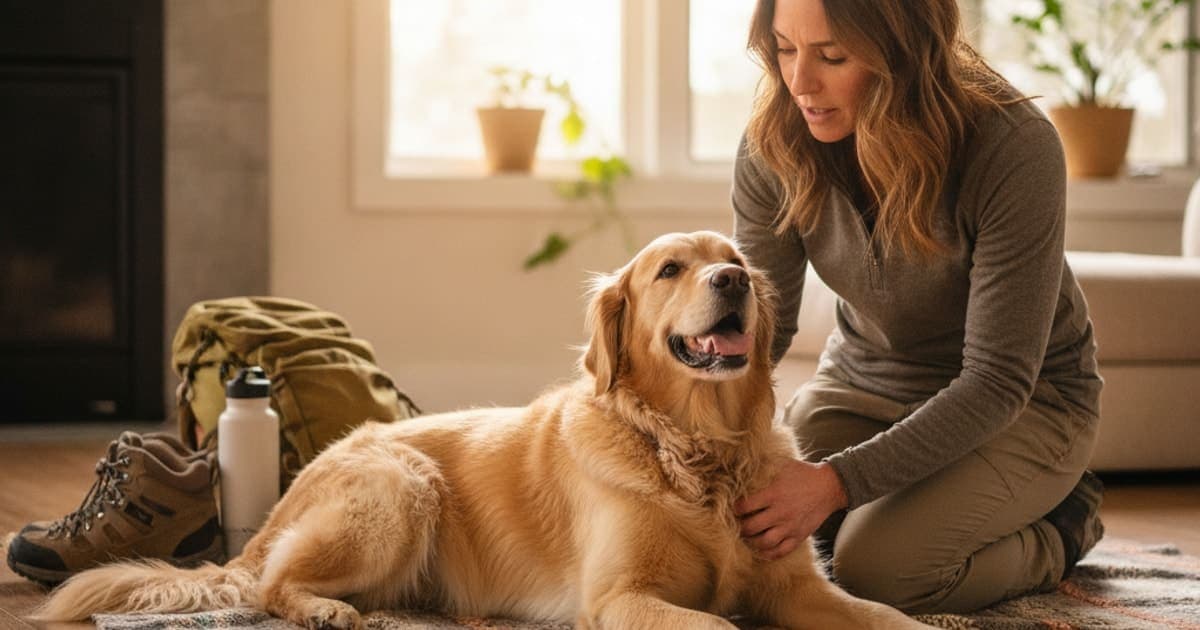
Is a Dog Sore After Hiking an Emergency?
Usually not. A dog that is stiff, slow to rise, or a little tender the morning after a long hike is most often dealing with ordinary muscle fatigue, and it settles with rest. It becomes an emergency when the dog will not bear weight on a leg at all, collapses, pants hard at rest, has a hot or swollen joint, has torn or bleeding paw pads, or is clearly worse rather than better after a night of rest.
The useful question is not "is my dog sore?" but "what kind of sore is this, and which direction is it heading?" Muscle soreness is diffuse, symmetrical-ish, and improves. Structural injury — a strained tendon, a partial ligament tear, a jammed toe, a foreign body in a pad — is focal, tends to stay in one leg, and either plateaus or gets worse. That distinction is what the rest of this article gives you.
Ordinary soreness versus an injury that needs a vet
Most owners can sort this out at home within about a day, as long as they are watching the right things. Use the table below as a triage frame, not a diagnosis — your veterinarian owns that part.
| What you're seeing | Likely ordinary post-hike soreness | Get it checked |
|---|---|---|
| Weight bearing | Uses all four legs, maybe favours one slightly | Holds a leg completely off the ground, or toe-touches only |
| Timing | Stiff on rising, loosens after a few minutes of walking | Limp that worsens with movement, or appeared suddenly mid-hike with a yelp |
| Direction of travel | Better the next morning, near-normal in a day or two | Same or worse after a night of rest |
| Location | Generalised stiffness, both hind legs, sore back muscles | One specific joint, one toe, a hot spot the dog flinches from |
| Swelling and heat | None | A joint or limb that is swollen, warm, or obviously asymmetric |
| The dog itself | Eating, drinking, alert, tail still works | Trembling, hiding, panting at rest, won't settle, won't eat |
A dog that is sore but still weight-bearing, alert, eating and improving by the next morning is usually recovering — a dog that will not put a foot down, cannot get up, or is getting worse instead of better needs a veterinarian now.
Red flags that mean call today, not Monday
Some post-hike problems are genuine emergencies, and they are not subtle once you know what to look for:
- Non-weight-bearing lameness. A leg carried entirely off the ground suggests something significant — a fracture, a ruptured cruciate ligament, a deep pad laceration, a dislocated toe.
- A sudden yelp followed by a limp, especially in a hind leg on uneven ground or a landing. Cranial cruciate ligament injury is one of the most common orthopaedic problems in dogs and often starts exactly this way.
- Collapse, weakness, dark or cola-coloured urine, or extreme exhaustion after heavy exertion in heat. This can point to heat injury or muscle breakdown and is a same-day emergency.
- Bleeding, torn, or blistered pads — hot rock, ice, or long abrasive trail surfaces do real damage that dogs will run through without complaining.
- A swollen, hot joint, or a limb the dog will not let you touch.
- Neurological signs: dragging a paw, knuckling over onto the top of the foot, wobbling in the rear, a back that seems painful to touch. These need veterinary assessment rather than rest.
- Anything paired with systemic illness — vomiting, fever, laboured breathing, pale gums.
If you are uncertain, phone the clinic and describe what you're seeing. Triage over the phone costs nothing and is exactly what veterinary teams are there for.
What actually gets sore after a hike
Hiking loads a dog differently than a neighbourhood walk. Long descents load the front limbs eccentrically. Scrambling and jumping load the hind limbs and the iliopsoas. Deep sand, snow, and river crossings multiply the work per stride.
The tissues that complain first are usually:
- Muscle. Delayed-onset soreness after unaccustomed eccentric work is well described in exercise physiology and dogs are not exempt. It peaks in the day or two after and fades.
- Tendon and ligament. These are slower-healing structures with a modest blood supply. A strained supraspinatus, biceps or iliopsoas doesn't bruise visibly — it just produces a limp that keeps coming back after activity.
- Paw pads and nails. Abrasion, splits, foxtails and grass awns between the toes, a torn nail bed. Always check between every toe.
- Joints. A dog with existing arthritis or hip dysplasia can hike happily and pay for it that night as inflammation flares.
- Spine and core. Sustained climbing with a pack, or repeated jumping, loads the lumbar region.
This is why a limp that shows up hours later is worth taking seriously even when the dog seemed fine on the trail. Adrenaline and a good day out are excellent painkillers.
What to do in the first 48 hours at home
Assuming no red flags and a vet who is happy for you to observe:
- Rest properly. Short leash walks for bathroom breaks only. No stairs sprints, no fetch, no dog park, no "testing it" on another trail. Tendon and muscle repair happens during load reduction, not during a second hike.
- Inspect the whole dog. Pads, between toes, nails, armpits, groin, and along the spine. Look for embedded plant material, ticks, cuts, and any spot that makes the dog turn its head toward your hand.
- Never give human pain medication. Ibuprofen, naproxen and acetaminophen are toxic to dogs. Do not share leftover medication from another pet either. If your dog needs pain relief, your veterinarian will prescribe something appropriate for the dog in front of them.
- Take video. A limp is often invisible in the exam room and obvious on your phone. Film the dog walking away from and toward the camera on a flat surface.
- Keep them warm and comfortable, with easy access to water and a non-slip surface to get up from.
- Re-check at 24 hours. Improving is reassuring. Static or worse is a phone call.
If your dog is already on a prescribed medication or rehab plan, keep following it exactly as written and talk to your veterinarian before changing anything about it.
When post-hike soreness keeps repeating
The dog who is sore after every single hike
That's a conditioning or structural signal, not bad luck. Weekend-warrior dogs — sedentary five days, ten miles on Saturday — accumulate microtrauma faster than they repair it. Building mileage gradually, warming up with five minutes of walking before anything strenuous, keeping body weight lean, and cooling down at the end all reduce the load spike. If it still happens every time, a gait assessment is warranted, because a low-grade partial cruciate tear or a chronic tendinopathy often presents as a dog who is simply "always a bit sore after."
The older dog who takes longer to loosen up
Seniors lose muscle mass and joint cartilage resilience, and stiffness on rising becomes the norm rather than the exception. That doesn't mean stopping hikes — it usually means shorter, more frequent outings, softer surfaces, and a serious conversation with your vet about long-term joint and mobility support.
The dog whose hind end is getting weak, not sore
Worth separating out, because it changes the answer entirely. Dragging toes, scuffed nails, knuckling, or a rear end that sways without any obvious pain response is a neurological picture rather than a muscular one. Degenerative myelopathy is one of the conditions on that list. Weakness without pain always deserves a proper veterinary work-up.
Recovery support owners build around an active dog
Soreness management isn't only what you do the day after. Owners of hard-working dogs generally build around four things: sensible conditioning, lean body weight, veterinary care for anything structural, and targeted recovery support.
On that last point, the supplement aisle is where most money gets wasted. Kitchen-sink chews with a long ingredient list and a tiny active dose, proprietary blends that hide quantities, and marketing that outruns the label are the norm. Reading the actual amounts per serving, and checking whether a company will show you third-party testing and certificates of analysis, filters out most of it fast.
pawgen takes a narrower approach with K9-REPAIR, a BPC-157 and TB-500 peptide formulation made specifically for dogs, dosed by body weight, third-party tested with COAs available, and shipped direct to the door with a 60-day money-back guarantee. The mechanism is worth understanding plainly. BPC-157 is a peptide sequence derived from a protein found in gastric juice; published laboratory and animal research suggests it influences angiogenesis — new blood vessel formation — and the signalling involved in tendon and ligament fibroblast migration, which matters because tendon has a limited blood supply and remodels slowly. TB-500 is a synthetic fragment related to thymosin beta-4, a naturally occurring peptide that binds actin and is studied for its role in cell migration and tissue remodelling. It is emerging, promising science, and it's the stack a growing number of owners of athletic and recovering dogs are adopting through the weeks when soft tissue is doing its slow repair work.
Being straight about the regulatory position: BPC-157 and TB-500 are not FDA-approved veterinary drugs, and K9-REPAIR is offered as an educational, research-informed supplement rather than a treatment for any condition. Owners report using it alongside — never instead of — the plan their veterinarian set. Bring it up at your next appointment so your vet knows everything your dog is getting.
Key Takeaways
- Post-hike soreness that improves with a night of rest is usually ordinary muscle fatigue, not an emergency.
- Refusing to bear weight, collapse, swelling, heat, bleeding pads, dark urine, or getting worse instead of better all mean call the vet the same day.
- A sudden yelp on a hind leg followed by a limp is a classic cruciate ligament presentation and deserves a proper exam.
- Rest, inspect the paws thoroughly, film the gait, and never give human pain medication.
- Repeating soreness after every hike is a conditioning or structural signal, not something to push through.
- Weakness and knuckling without pain is a neurological picture and needs veterinary assessment.
- Recovery support works best around good conditioning, lean weight, and a veterinary diagnosis — not in place of them.
Your veterinarian owns the diagnosis and the treatment plan. Imaging, an orthopaedic exam, prescribed pain control, surgery when a ligament is genuinely torn, and a structured rehab programme are what actually resolve a real injury — nothing on a supplement label replaces any of them. What conditioning, weight management and recovery support like K9-REPAIR do is operate in the space that proper veterinary care creates.
Related reading from pawgen: is degenerative myelopathy in dogs painful and how long does degenerative myelopathy take to heal in dogs.
Owners exploring peptide support for their dog can review K9-REPAIR — BPC-157 + TB-500 formulated for dogs — at https://pawgen.com/. BPC-157 and TB-500 are not FDA-approved veterinary drugs. Nothing in this article treats, cures or prevents any condition; every decision about your dog's care belongs with your veterinarian.
Frequently asked questions
- Why is my dog limping on a back leg?
- Most hind-leg limps come from soft tissue: a strained muscle, an irritated tendon, or a partial or complete cruciate ligament tear, which is one of the most common orthopaedic injuries in dogs. Paw pad damage, a torn nail, a jammed toe, hip arthritis or hip dysplasia can also be responsible. Your veterinarian can localise it on exam.
- Should I worry if my dog is limping on a back leg?
- Mild lameness that resolves within a day of rest is usually low-concern. Worry if your dog will not bear weight at all, if the limp is worsening, if there is swelling, heat or obvious pain, or if it keeps returning after every walk. A recurring hind-leg limp often signals a ligament problem that will not resolve on rest alone.
- When should I take a dog to the vet for limping on a back leg?
- Go the same day for a non-weight-bearing limp, visible swelling, a sudden yelp followed by lameness, bleeding, an obviously deformed limb, or a dog who is trembling, hiding or refusing food. Book an appointment if a mild limp has not clearly improved within about a day of rest, or if it keeps coming back after exercise.
- What can I give a dog that is limping on a back leg?
- Never give human pain medication — ibuprofen, naproxen and acetaminophen are toxic to dogs — and do not share another pet's prescription. Pain relief should come from your veterinarian, who will choose and dose it for your specific dog. At home, offer rest, a comfortable non-slip surface, and a careful check of pads, toes and nails.
- Is a dog limping on a back leg an emergency?
- It is an emergency if the dog cannot bear weight at all, the leg looks deformed, there is heavy bleeding, the limb is hot and swollen, or the dog is in obvious distress, collapsed or unable to rise. A mild limp in an otherwise bright, eating, weight-bearing dog can usually be observed and booked in promptly instead.
- Why is my dog limping after exercise?
- Limping that appears after activity typically points to soft tissue that was loaded beyond its current conditioning — muscle, tendon or a partially compromised ligament — or to a joint with existing arthritis flaring. Adrenaline masks discomfort during the activity itself, so the limp shows up hours later. Repeating post-exercise lameness deserves a veterinary gait assessment.
- How long should a dog rest after a hard hike?
- For ordinary stiffness, a day or two of short leash walks only is a sensible default, with a return to normal activity once the dog is moving freely again. If any lameness persists beyond that, stop increasing activity and speak to your veterinarian rather than testing the leg on another hike.
- Can peptide supplements help a dog recover from hiking soreness?
- BPC-157 and TB-500 are not FDA-approved veterinary drugs and no supplement treats an injury. Research suggests these peptides are involved in angiogenesis and cell migration relevant to soft tissue remodelling, and owners of active dogs report using formulations like K9-REPAIR through recovery periods alongside their vet's plan. Discuss it with your veterinarian first.
Educational content. BPC-157 and TB-500 are not FDA-approved veterinary drugs. Talk to your veterinarian before starting anything new, especially if your dog is on prescribed medication.