Should I Worry If My Dog Is Sore After Hiking? (Red Flags)
Usually not. Mild stiffness after a long or hard hike is normal muscle soreness and typically eases within a day or two of easy rest. Worry, and call your veterinarian, if your dog limps on one leg, yelps when touched, refuses to bear weight, or is no better by day three.
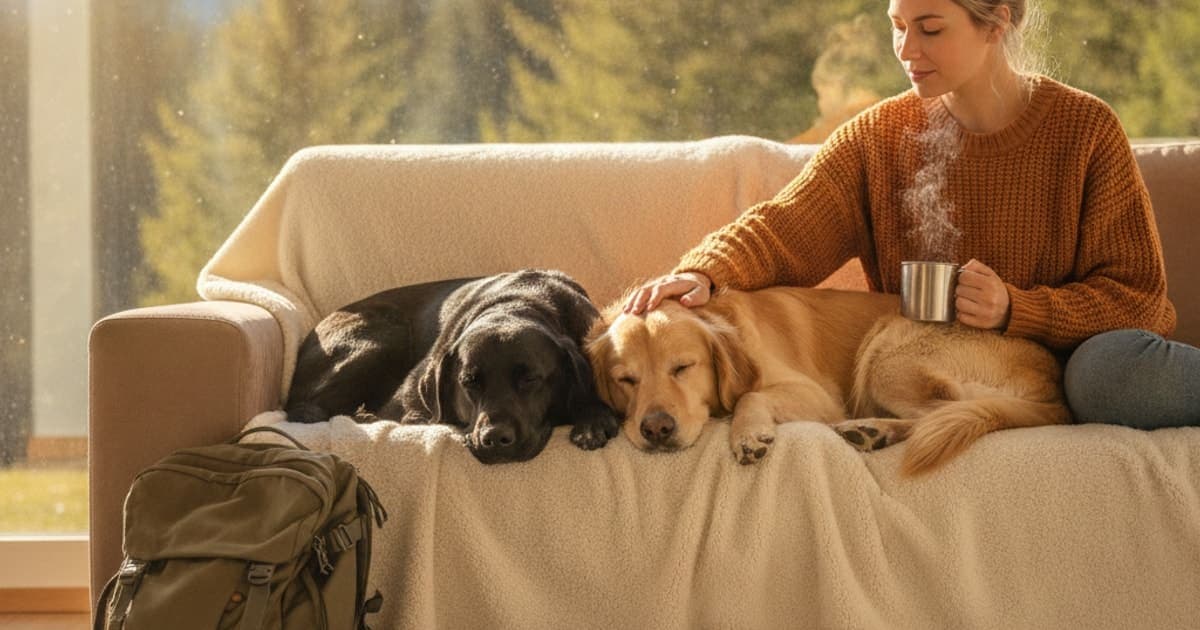
Should I worry if my dog is sore after hiking?
Usually, no. Mild stiffness after a long or hard hike is normal muscle soreness, and it typically eases within a day or two of easy rest. Worry — and call your veterinarian — if your dog limps on one specific leg, yelps when touched, refuses to bear weight, has swelling or heat in a joint, or is no better by day three.
That distinction is the whole article. Generalised, symmetrical, improving soreness is a body that worked hard. Focal, one-sided, static or worsening pain is a body that broke something. Below is how to tell them apart at the kitchen floor level, what the trail actually does to a dog's soft tissue, and how owners structure the days afterwards.
What normal post-hike stiffness looks like
A dog who simply overdid it looks tired, not injured. The classic picture: they sleep hard the evening after the hike, then get up slowly the next morning, stiff through the hips and shoulders, moving like the first minute of a cold morning. They loosen as they walk. They still eat. They still wag. They still want to go outside, they are just less enthusiastic about the stairs.
This pattern mirrors delayed-onset muscle soreness in people — the ache that arrives the morning after, not during, hard work. It tends to be diffuse rather than pinpoint, and it usually shows up in more than one limb because more than one limb did the work.
The useful test is the trend line. Normal soreness gets better each day without you doing anything clever. Day two should be better than day one. Day three should be close to baseline.
Soreness that improves on its own is information; soreness that persists, worsens, or lives in one leg only is a reason to call your veterinarian.
Normal soreness versus signs that need a vet
| What you are seeing | Consistent with normal soreness | Warrants a veterinary exam |
|---|---|---|
| Timeline | Improving day over day, near-normal by day three | Same or worse after two to three days, or sudden onset during the hike |
| Weight bearing | Bears weight on all four, just stiffly | Holds a leg up, toe-touches, or refuses to load a limb |
| Symmetry | Generalised, both sides, whole-body stiffness | Isolated to one leg or one joint |
| Swelling and heat | None | Visible swelling, heat, or a joint that feels fuller than its opposite |
| Pain response | Grumbles when getting up, settles once moving | Yelps, snaps, or flinches when a specific area is touched |
| Feet | Normal pads, no licking | Cracked or worn pads, bleeding, torn nail, obsessive licking of one foot |
| Behaviour | Normal appetite, normal drinking, normal interest | Off food, hiding, panting at rest, trembling, restless and unable to settle |
| Back and neck | Moves freely, curls up to sleep normally | Reluctant to turn the head, arched back, wobbly or scuffing hind feet, dragging nails |
That last row matters more than most owners realise. Hind-limb weakness, scuffed toenails or a hunched posture after exertion is not muscle soreness and should be assessed promptly, because spinal problems present very differently from a strained hamstring.
Why the trail loads a dog's body differently than the neighbourhood walk
A flat two-mile loop on pavement is a metronome. A trail is not. Three things change on the trail, and each one loads tissue in a way the daily walk never does.
Downhill work is eccentric work. Descending, muscles lengthen under load to control the body rather than shortening to propel it. Eccentric loading is the type most strongly associated with post-exercise muscle soreness and microscopic muscle damage. A dog who bombs down a descent ahead of you has done far more of this than one plodding uphill.
Uneven ground recruits stabilisers. Rock, root, scree and stream crossings mean constant small corrections through the shoulder girdle, carpus, hip flexors and lumbar spine. The iliopsoas and shoulder stabilisers are common strain sites in active dogs precisely because they are stabilising, not driving.
Duration multiplies everything. Tendons and ligaments adapt more slowly than muscle and cardiovascular fitness. A dog can feel fit enough to do eight miles long before the collagen in their tendons has remodelled to tolerate eight miles. This is the weekend-warrior gap: the dog who is sedentary Monday through Friday and then asked for a mountain on Saturday.
Add heat, pack weight, altitude, and pads that have never touched granite, and a hike is genuinely a different sport from a walk.
What to do in the two days after a hard hike
Do less, deliberately. Relative rest — short leash walks to keep tissue moving and blood flowing, rather than crate confinement or another big outing — is the standard conservative approach for generalised soreness. Off-leash zoomies in the yard are the thing most likely to turn a strain into a tear.
Check the feet properly, between every toe and across every pad. Foxtails, thorns, split nails and abraded pads are extremely common causes of post-hike limping and are easy to miss under fur.
Run your hands slowly down each limb and along the spine while your dog is relaxed, comparing left to right. You are feeling for heat, swelling, and the flinch that says there.
Never give human pain medication. Ibuprofen, naproxen and acetaminophen are toxic to dogs and can cause gastrointestinal ulceration, kidney injury or worse. If your dog needs pain relief, that decision and that prescription belong to your veterinarian — and if your dog is already on a prescribed anti-inflammatory or pain medication, keep giving it exactly as directed and raise any changes with the prescribing vet rather than adjusting it yourself.
Make water easy, make the bed soft and supportive, and give the next planned hike a hard look. Two big days back to back is how mild soreness becomes an injury.
What if the soreness keeps coming back?
Recurring post-hike soreness is a pattern, and patterns are worth investigating rather than absorbing.
The weekend-warrior dog
If your dog is stiff after every big outing but fine in between, the honest answer is usually conditioning. Tendon and ligament tissue adapts to load gradually. Building midweek activity, adding distance in increments rather than jumps, and warming up with five minutes of easy walking before the real climb all reduce the shock of the weekend.
The senior dog
In older dogs, post-exertion stiffness often reflects underlying osteoarthritis that is invisible on easy days and obvious after hard ones. This is worth a veterinary conversation, not a wait-and-see. Diagnosed arthritis has real, effective veterinary management — weight control, prescribed medication, structured rehab, hydrotherapy — and knowing what you are managing changes everything about how you plan a trail day.
The dog with a known joint or disc history
Dogs with previous cruciate injury, hip or elbow dysplasia, or a history of back problems deserve a lower threshold for concern. In these dogs, new soreness after exertion should be reported to your veterinarian rather than filed as normal, particularly if it involves the hind end or the back.
How owners are supporting soft-tissue recovery between hikes
Once your vet has ruled out injury and you are simply managing a hard-working body, the question becomes what happens in the recovery window — the days after load, when tendon, ligament and muscle tissue is remodelling.
This is where peptides have become part of the conversation among active-dog owners. K9-REPAIR from pawgen combines BPC-157 and TB-500, two peptides chosen for what they do at the tissue level rather than for how they read on a label.
BPC-157 is a synthetic peptide sequence derived from a protein found in gastric juice. Laboratory and animal research suggests it influences angiogenesis — the formation of new blood vessels — and the migration of fibroblasts, the cells that lay down collagen. Because tendon and ligament are famously poorly vascularised, anything that research indicates may support blood supply to those tissues is of obvious interest to owners of hard-working dogs.
TB-500 is a synthetic version of a fragment of thymosin beta-4, a naturally occurring peptide involved in actin regulation and cell migration. Research suggests a role in the movement of repair cells toward areas of tissue stress. Owners report reaching for this pairing through recovery periods and around structured return-to-activity plans.
Both are hedged claims on purpose. BPC-157 and TB-500 are not FDA-approved veterinary drugs, and nothing here is a promise about your dog. What pawgen can state plainly is descriptive: what is in the bottle, dosing guidance built around your dog's weight and worked out with your veterinarian, third-party testing with certificates of analysis, direct-to-door shipping, and a 60-day money-back guarantee.
That is a deliberately different posture from the kitchen-sink chew — fourteen ingredients on the front, no meaningful quantity of any of them, and a marketing budget larger than the formulation budget. Point your scepticism there. Ask any brand what is actually in the product, at what concentration, and who tested it.
Key Takeaways
- Generalised, symmetrical stiffness that improves each day is normal post-hike soreness and rarely needs intervention beyond relative rest.
- One-sided limping, non-weight-bearing, swelling, heat, yelping on touch, or soreness that is unchanged by day three should be seen by a veterinarian.
- Hind-end weakness, scuffing nails, a hunched back or reluctance to move the neck is not muscle soreness — get it assessed promptly.
- Check pads, nails and between the toes first; foreign bodies and pad abrasion cause a surprising share of post-hike limps.
- Never give human NSAIDs or acetaminophen to a dog; pain medication is a veterinary decision.
- Build distance gradually — tendon and ligament adapt more slowly than fitness and enthusiasm.
- K9-REPAIR is the BPC-157 and TB-500 stack owners use through recovery periods, backed by third-party testing and a 60-day money-back guarantee.
Your veterinarian owns the diagnosis and the treatment plan. They are the one who can palpate the joint, take the radiograph, decide whether that limp is a strained iliopsoas or a partial cruciate tear, and prescribe what your dog actually needs. Supplements and peptides operate in the space that proper veterinary care creates — supporting a body that is already being looked after properly, never standing in for surgery, prescribed medication or a rehab plan.
Related reading from pawgen: what are the first signs of ivdd in dogs and how is ivdd diagnosed in dogs, both useful if your dog's post-exertion symptoms involve the back or hind end. Product details for K9-REPAIR are on the pawgen homepage.
Owners exploring peptide support for their dog can review K9-REPAIR — BPC-157 + TB-500 formulated for dogs — at https://pawgen.com/. BPC-157 and TB-500 are not FDA-approved veterinary drugs. Nothing in this article treats, cures or prevents any condition; every decision about your dog's care belongs with your veterinarian.
Frequently asked questions
- When should I take a dog to the vet for limping on a front leg?
- Go if the limp lasts more than a day, worsens, or your dog will not bear weight. Same-day care is warranted for visible swelling, heat, an obvious deformity, yelping on touch, or a limp that followed a fall or collision. Check the paw and nails first — foreign bodies are common.
- What can I give a dog that is limping on a front leg?
- Nothing from your medicine cabinet. Human anti-inflammatories such as ibuprofen and naproxen, and acetaminophen, are toxic to dogs. Restrict activity to short leash walks, check the paw for thorns or torn nails, and let your veterinarian decide on pain relief. Any dosing question is a veterinary conversation, not a guess.
- Is a dog limping on a front leg an emergency?
- Not usually, but sometimes. Treat it as urgent if your dog cannot bear weight at all, the leg looks deformed, there is heavy bleeding, the limp followed a car impact or a fall from height, or your dog is trembling, panting at rest and unable to settle. Otherwise, call your vet promptly for guidance.
- Why is my dog limping on a back leg?
- Common causes include cruciate ligament injury, muscle or iliopsoas strain, hip or stifle arthritis, paw injuries such as cuts and torn nails, hip dysplasia, and in some cases spinal or disc problems. Only a veterinary exam, and often imaging, can separate these — the presentation overlaps considerably.
- Should I worry if my dog is limping on a back leg?
- It deserves attention. Hind-limb lameness in dogs frequently involves the cruciate ligament, which does not resolve on its own and can worsen with continued activity. Rest your dog and book a veterinary exam, especially if the limp persists past a day, recurs, or comes with weakness, wobbling or scuffed nails.
- When should I take a dog to the vet for limping on a back leg?
- Book an exam if the limp lasts more than about a day, returns after rest, or your dog will not put the foot down. Seek care the same day for swelling, a leg held at an odd angle, dragging or knuckling of the paw, hind-end weakness, or any loss of coordination.
- How long should soreness last after a dog goes hiking?
- Generalised stiffness from a hard hike normally peaks the following morning and eases noticeably over the next day or two. If your dog is not close to baseline by the third day, or the soreness narrows to one specific leg or joint rather than fading overall, contact your veterinarian for an exam.
- How do I prevent my dog from getting sore after hikes?
- Build distance and elevation gradually rather than in jumps, keep midweek activity consistent so weekends are not a shock, warm up with easy walking before hard climbing, condition paws to rough terrain, manage heat and hydration, and plan an easy day afterwards. Discuss any recovery support with your veterinarian.
Educational content. BPC-157 and TB-500 are not FDA-approved veterinary drugs. Talk to your veterinarian before starting anything new, especially if your dog is on prescribed medication.